Stacking the Shelves: 26 August 2025

Stacking the Shelves is hosted by Marlene at Reading Reality and the details are on her blog, as well as a huge amount of book reviews. Why not visit her blog if you haven’t already found it? The gorgeous graphic is also used courtesy of the site.

The idea is to share the books you are adding to your shelves, may they be physical or virtual. This means you can include books you buy in physical stores or online, books you borrow from friends or the library, review books, gifts and of course e-books!

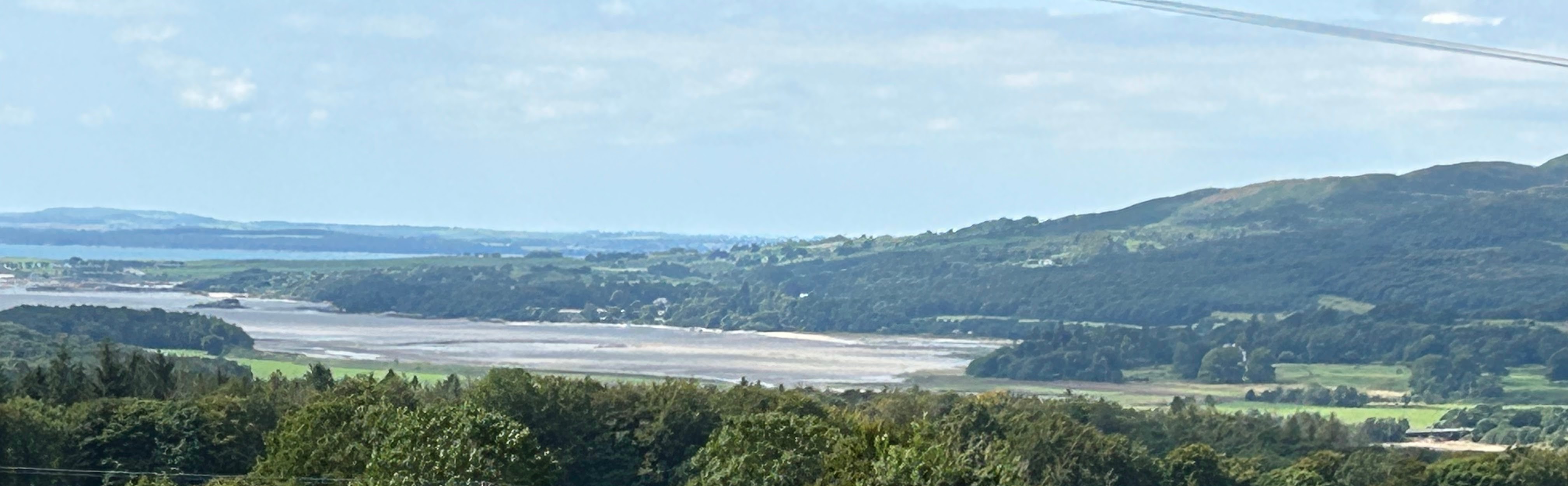
I’ve been away on holiday near Gatehouse of Fleet in Dumfries and Galloway, Scotland. We had a brilliant time in a lodge overlooking Fleet Bay, part of the Solway Firth.

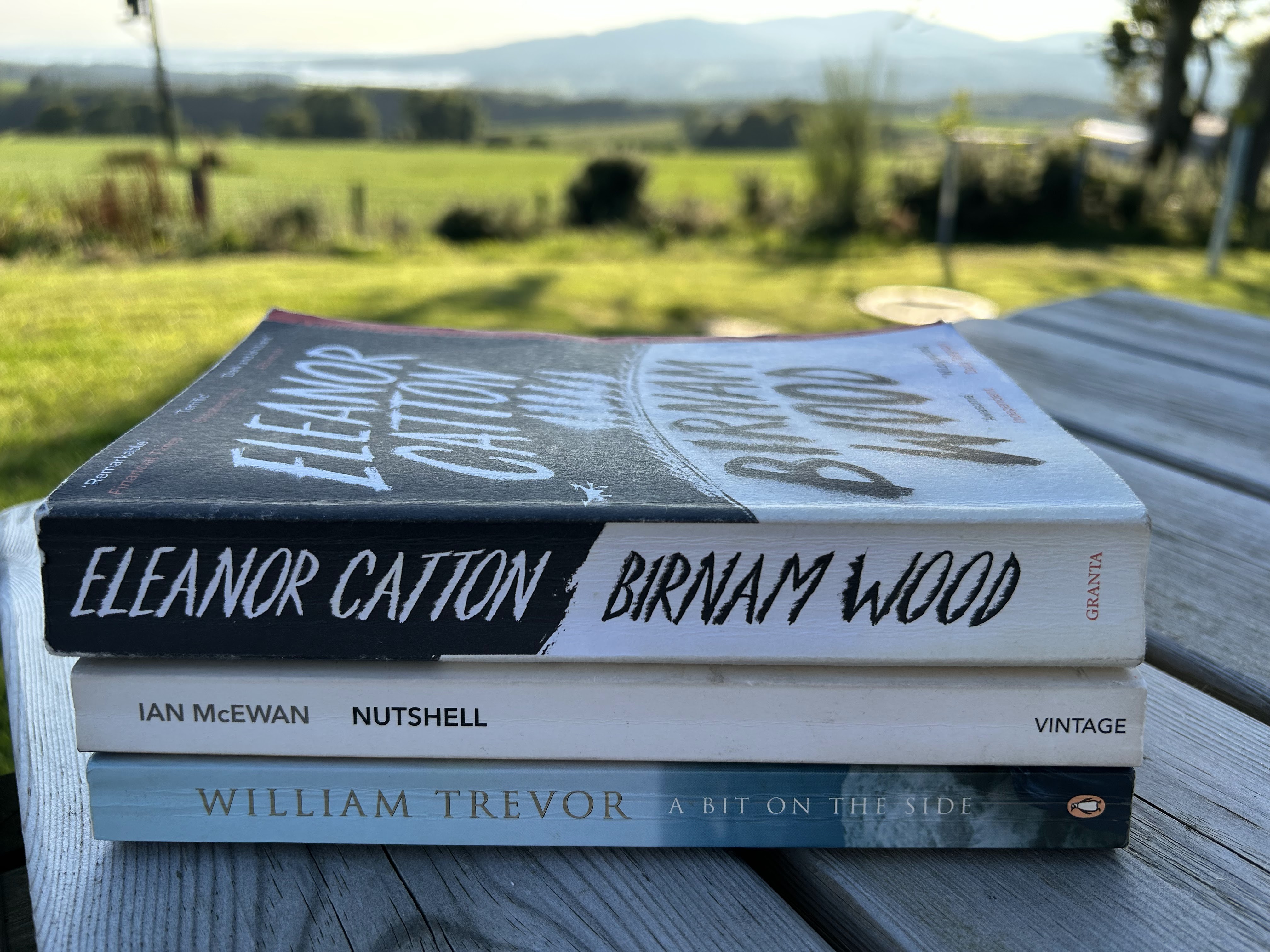
I bought these three paperbacks from a charity shop in Gatehouse of Fleet:

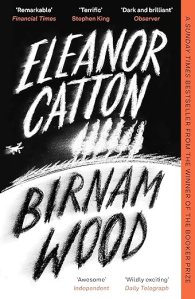
Birnam Wood by Eleanor Catton – Like her previous novel The Luminaries, which I loved, this book is set in a fictionalised New Zealand, primarily in and around a national park in the South Canterbury region. The title is taken from a line in Macbeth. It follows members of a guerilla gardening collective, Birnam Wood as, with the help of a charismatic tech billionaire, they undertake a new project on abandoned farmland.

Nutshell by Ian McEwan, a version of Hamlet. Trudy has betrayed her husband, John. She’s still in the marital home – a dilapidated, priceless London townhouse – but not with John. Instead, she’s with his brother, the profoundly banal Claude, and the two of them have a plan. But there is a witness to their plot: the inquisitive, nine-month-old resident of Trudy’s womb. I’ve enjoyed some of McEwan’s books, but this one looks rather different and, having read a few pages, I’m not sure about it.

A Bit on the Side by William Trevor, a collection of twelve short stories. I don’t think I’ve read any of Trevor’s books, but I thought this one looks interesting, with stories about adultery, secret passions and domestic infidelities. ‘A treat … each meditate[s] on the subject of love – adulterous, unspoken, clandestine, sometimes cruel. Whether set in rural Ireland or London, their pages whisper of relished secrets and dreams foolishly clung to’ Mail on Sunday.

These are e-books I’ve either bought for 99p or acquired for free this month:

The Testaments – Margaret Atwood’s sequel picks up the story more than fifteen years after Offred stepped into the unknown, with the explosive testaments of three female narrators from Gilead. The Republic of Gilead is beginning to rot from within. At this crucial moment, two girls with radically different experiences of the regime come face to face with the legendary, ruthless Aunt Lydia. But how far will each go for what she believes?

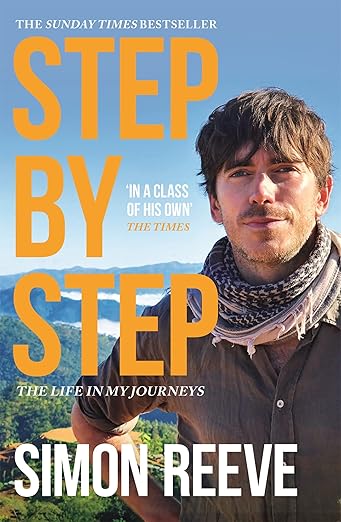
Step by Step: The Life In My Journeys by Simon Reeve. I love his TV travel programmes, so this was a 99p must for me. It’s his autobiography describing how he has journeyed across epic landscapes, dodged bullets on frontlines, walked through minefields and been detained for spying by the KGB. His travels have taken him across jungles, deserts, mountains and oceans, and to some of the most beautiful, dangerous and remote regions of the world. He gives the full story behind some of his favourite expeditions, and traces his own inspiring personal journey back to leaving school without qualifications, teetering on a bridge, and then overcoming his challenges by climbing to a ‘Lost Valley’ and changing his life … step by step.

The First Witch of Boston by Andrea Catalano, her debut novel. This was free from Amazon Prime this month. It is based on the true story of Margaret Jones, the first woman to be found guilty of witchcraft in Massachusetts Bay Colony, 1646. When Thomas and Margaret Jones arrive from England to build a life in the New World Margaret’s skill with healing herbs rouses suspicion of black magic. Personal tragedies, religious hysteria, and wariness of the unknown turn most against her, and even the devotion Margaret and her husband share is at risk.

I enjoy historical fiction and Mist Over Pendle by Robert Neill, (American title, The Elegant Witch) is one of my favourite novels. It tells the tale of witchcraft set in a wild inaccessible corner of Lancashire leading up to the trials of the famous Pendle witches in 1612. So, I thought it would be interesting to compare the two books.

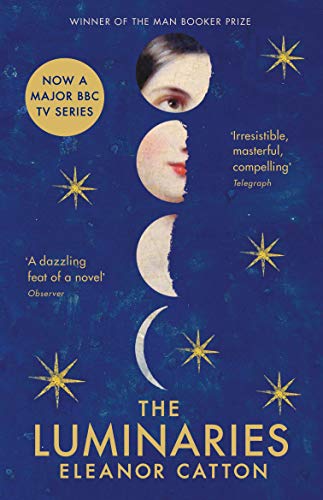
The Luminaries by Eleanor Catton

Sometimes I read books and have no desire to write about them, not because I didn’t enjoy them but because I just want to get on and read the next book. And this summer has been one of those times, so that now I’m finding difficult to remember all the details of the books I’ve read because I didn’t write about them soon after I finished reading. It’s been a strange time during this pandemic and it’s not been easy to concentrate. But I do want to keep a record of my reading and the only way now to catch up is to write some brief notes about each book, beginning with The Luminaries by Eleanor Catton, the winner of the 2013 Booker Prize,

Rating: 4 out of 5.

I downloaded The Luminaries by Eleanor Catton 3 years ago. I read it in July. It is a long and detailed book, written with such intricate plotting and numerous characters that it bewildered me at times. It’s historical fiction set in New Zealand in the 1860s, during its gold rush and it has everything – gold fever, murder, mystery and a ghost story too.

Blurb from Goodreads:

It is 1866, and young Walter Moody has come to make his fortune upon the New Zealand goldfields. On the stormy night of his arrival, he stumbles across a tense gathering of twelve local men who have met in secret to discuss a series of unexplained events: A wealthy man has vanished, a prostitute has tried to end her life, and an enormous fortune has been discovered in the home of a luckless drunk. Moody is soon drawn into the mystery: a network of fates and fortunes that is as complex and exquisitely ornate as the night sky. Richly evoking a mid-nineteenth-century world of shipping, banking, and gold rush boom and bust, The Luminaries is a brilliantly constructed, fiendishly clever ghost story and a gripping page-turner. 

I found the structure a bit of a stumbling block at first as the chapters halve in length from the very long opening chapter to the very short final chapter – so that from feeling overwhelmed by the length and detail of the opening chapters, by the time that I neared the ending I felt distinctly dissatisfied with the brevity of the concluding chapters – the early chapters are too long and the final ones are too short. And the significance of the astronomical headings completely bypassed me.

But if this sounds as though I didn’t enjoy this novel, that is wrong, because I did for the major part of the book. I loved the pictures it builds up of the setting in New Zealand, the frontier town and its residents from the prospectors to the prostitutes, and the obsessive nature of gold mining. And I did become fully absorbed in the story during the week it took me to read. it

These are the other books I read in July and August and have not yet reviewed:

  • Thin Air by Michelle Paver
  • The Birdwatcher by William Shaw
  • Still Life by Val McDermid
  • Dead Man’s Footsteps by Peter James

My Friday Post: The Luminaries by Eleanor Catton

Every Friday Book Beginnings on Friday is hosted by Gillion at Rose City Reader where you can share the first sentence (or so) of the book you are reading, along with your initial thoughts about the sentence, impressions of the book, or anything else the opener inspires.

My choice this week is The Luminaries by Eleanor Catton, one of my TBRs. I’ve had this book for 3 years and decided to read it now after watching (recorded) the first episode of the TV series.

It begins:

MERCURY IN SAGITTARIUS

In which a stranger arrives in Hokitika; a secret council is disturbed; Walter Moody conceals his most recent memory; and Thomas Balfour begins to tell a story.

I am confused this is not like the start of the TV adaptation at all.

Also every Friday there is The Friday 56, hosted by Freda at Freda’s Voice.

30879-friday2b56

These are the rules:

  1. Grab a book, any book.
  2. Turn to page 56, or 56% on your eReader. If you have to improvise, that is okay.
  3. Find any sentence (or a few, just don’t spoil it) that grabs you.
  4. Post it.
  5. Add the URL to your post in the link on Freda’s most recent Friday 56 post.

Page 56:

Over the past fortnight Balfour had kept his silence on the subject of Lauderback’s encounter with the dead man, Crosbie Wells, though the circumstances of the hermit’s death held a considerable amount of curiosity for him; he had not discussed Anna Wetherall, the whore on the road, at all

I am now read on past this passage and am on page 65 and even more confused – some of the characters are the same in book and TV, but I no longer know who is who!

I resorted to Google and discovered an article in the Radio Times that explained it to me – MAJOR CHANGES HAVE BEEN MADE – Eleanor Catton has adapted her own novel for the screen – and she’s reframed the story from a new perspective:

For one thing, there’s the total absence of Walter Moody from the first four episodes. That’s in stark contrast to the book, which memorably begins with the arrival of Scottish lawyer Mr Moody in the smoking room of the Crown Hotel in Hokitika.

So, now I have a dilemma – shall I carry on reading the book or watching the TV series?

The book blurb:

It is 1866, and Walter Moody has come to make his fortune upon the New Zealand goldfields. On arrival, he stumbles across a tense gathering of twelve local men, who have met in secret to discuss a series of unsolved crimes. A wealthy man has vanished, a whore has tried to end her life, and an enormous fortune has been discovered in the home of a luckless drunk. Moody is soon drawn into the mystery: a network of fates and fortunes that is as complex and exquisitely patterned as the night sky.

The Luminaries is an extraordinary piece of fiction. It is full of narrative, linguistic and psychological pleasures, and has a fiendishly clever and original structuring device. Written in pitch-perfect historical register, richly evoking a mid-19th century world of shipping and banking and goldrush boom and bust, it is also a ghost story, and a gripping mystery. It is a thrilling achievement and will confirm for critics and readers that Catton is one of the brightest stars in the international writing firmament.