Top 5 Tuesday was created by Shanah at Bionic Book Worm, and it is now being hosted by Meeghan at Meeghan Reads. You can see the Top 5 Tuesday topics for the whole of 2025 here.
Today the topic is top 5 books with sizes in the titles.
These are all books I’ve read with links to my posts on them:
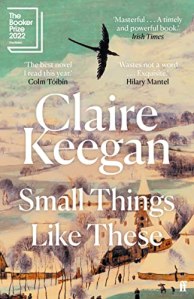
Small Things Like These by Claire Keegan. This won the 2022 Orwell Prize for Political Fiction, an award for outstanding novels and collections of short stories, first published in the UK or Ireland, that illuminate major social and political themes, present or past, through the art of narrative. It also won the Kerry Group Irish Novel of the Year 2022.
It is 1985 in a small Irish town. During the weeks leading up to Christmas, Bill Furlong, a coal merchant and family man faces into his busiest season. Early one morning, while delivering an order to the local convent, Bill makes a discovery which forces him to confront both his past and the complicit silences of a town controlled by the church.
Claire Keegan’s style of writing is a refreshing change from so many of the long and complicated books I so often read. It is precise, focused, and beautifully written bringing her characters to life – these are real, ordinary people, living ordinary lives in 1980s Ireland. And the detail is there too in all the particulars of everyday life – it packs a lot into its pages.
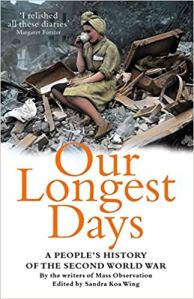
Our Longest Days: A People’s History of the Second World War by the writers of Mass Observation. For six years the people of Britain endured bombs and the threat of invasion, and more than 140,000 civilians were killed or seriously wounded. Men and women were called to serve in the armed forces in record numbers, and everyone experienced air raids and rationing. In these terrible times, volunteers of almost every age, class and occupation wrote diaries for the “Mass Observation” project, which was set up in the 1930s to collect the voices of ordinary men and women.
Using many diaries that have never been published before, this book tells the story of the war – the military conflict, and, mainly, life on the home front – through these voices. Through it all, people carry on living their lives, falling in love, longing for a good meal, complaining about office colleagues or mourning allotment potatoes destroyed by a bomb.
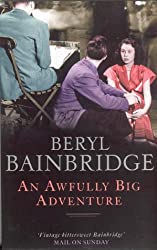
An Awfully Big Adventure by Beryl Bainbridge. First published in 1989 and shortlisted for the Booker Prize, this is set in 1950, as a Liverpool repertory theatre company are rehearsing its Christmas production of Peter Pan. The story centres around Stella, a teenager and an aspiring actress who has been taken on as the assistant stage manager.
It’s semi-autobiographical based on Beryl Bainbridge’s own experience as an assistant stage manager in a Liverpool theatre. On the face of it this is a straight forward story of the theatre company but underneath it’s packed with emotion, pathos and drama. And it’s firmly grounded in a grim post-war 1950s England, food rationing still in operation and bombed buildings still in ruins overgrown with weeds.
The title is taken from Peter Pan, the play about the boy who never grew up, whose attitude to death was ‘To die will be an awfully big adventure.’ Bainbridge’s use of Peter Pan emphasises the themes of reality versus imagination, the loss of childhood innocence, and the quest for love.
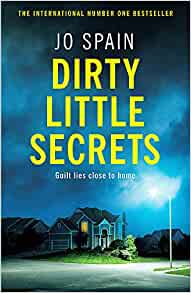
Dirty Little Secrets by Jo Spain, a psychological thriller, set in Withered Vale, a small, gated community of just seven houses, outside the small village of Marwood in Wicklow in Ireland. On the surface it is a perfect place where the wealthy live their privileged lives and keep themselves to themselves – until a cloud of bluebottles stream out of the chimney of number 4 and Olive Collins’ dead and disintegrating body is discovered inside. She had been dead for three months and none of the neighbours had bothered to find out why she hadn’t been seen all that time. But someone must have known what had happened to her – the question being who?
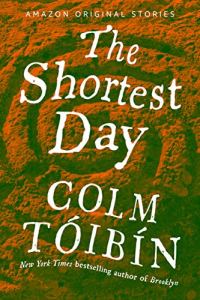
The Shortest Day by Colm Toibin, a short story about the mythical past, about the strange carvings found on certain stones, about archaeology, and about the unknown customs and rituals of our ancient past. It’s storytelling at its best – a tale of wonder and mystery.
Professor O’Kelly is writing notes about Newgrange, also called Bru na Boinne, a circular mound with a retaining wall that had a narrow passageway leading into a vaulted central chamber. There are spirals and diamond shaped designs cut into some of the stones both inside the chamber itself and outside the entrance to the passageway. It’s a burial chamber, a prehistoric monument in County Meath in Ireland, that was built around 3200 BC – older than Stonehenge and the Egyptian pyramids. It’s ringed by a stone circle, stones brought from the Mournes and Wicklow Mountains.
Meanwhile deep within the chamber there were whispers among the dead that the professor was coming again. They are concerned that he would discover the secret of the light penetrating the chamber on the winter solstice – the shortest day of the year. Some of the local inhabitants know of the secret but they never talk about it, except in whispers between themselves. When he arrives they put up a number of obstacles to prevent him from entering the chamber.

 BooksPlease