Asking for the Moon by Reginald Hill

Asking for the Moon is described on the cover as a Dalziel and Pascoe novel, but it is actually a collection of four novellas. According to Wikipedia the collection was first published in 1996 in hardback by HarperCollins.

The first story is The Last National Service Man which tells how Dalziel and Pascoe first met. Neither of them are impressed by the other. Dalziel thinks Pascoe is everything he dislikes – a graduate, well spoken, and a Southerner from south of Sheffield. Pascoe thinks Dalziel is an archetypical bruiser who got results by kicking down doors and beating out questions in Morse code on a suspect’s head. When Dalziel and Pascoe are kidnapped by a madman with a serious and justifiable grudge against the Superintendent they need to get over their differences and work together to escape their jailer.

The next two stories both feature ‘ghosts’ – Pascoe’s Ghost and then Dalziel’s Ghost (both first published in 1979 in another collection of short stories). In Pascoe’s Ghost a man whose wife has been missing for a year gets some strange phone calls—as well as a visit from Detective Inspector Pascoe—in a novella that pays homage to Edgar Allan Poe, with each chapter headed with a quotation from Poe’s poetical works. This is the longest story and reminded me of Agatha Christie’s Golden Age Mysteries as Pascoe interviews the suspects in the library.

Dalziel’s Ghost is a brief and rather odd story in which the two detectives keep a nightly vigil in Sandstone Rigg farmhouse, an isolated house that had been renovated, apparently disturbing a ghost. In Dalziel’s experience there are three main causes of ghosts – ‘One: bad cooking. Two: bad ventilation and Three – bad conscience.’ Things aren’t what they seem and Dalziel is once again his devious self. But I think this one is the least convincing of the four stories.

One Small Step, was originally published in 1990 by Collins Crime Club.The story is set in 2010, when a French astronaut, one of an international space team from the Federated States of Europe, became the first man to be murdered on the moon. Retired Detective-Superintendent Andrew Dalziel, suffering from gout and Peter Pascoe, now Commissioner of Eurofed Justice are called upon to investigate – on board the space ship. In his Foreword I gather that Hill wrote this to celebrate the twenty years he’d been writing the Dalziel and Pascoe novels.

I think the best story in the book is the first one, The Last National Service Man.

If you haven’t read any of the Dalziel and Pascoe novels, don’t start with this one. It’s not the best, but still an enjoyable 3* book for me.

Underworld by Reginald Hill

Rating: 5 out of 5.

Deadheads is the 10th Dalziel and Pascoe novel first published in 1988, set in the small mining town of Burrthorpe (a fictional town) in Yorkshire. The setting is excellent and Hill paints a compelling account of the mining community and gives a convincing insight into the period a few years after the Miners’ Strike of 1984. The majority of the book is about the miners, their families, their hatred of the bosses, and their distrust and dislike of the police.

There are two mysteries facing Dalziel and Pascoe. One is current and the other is a case that had appeared to have been resolved several years earlier, when Tracy Pedley, a young girl disappeared. Her body was never discovered and some of the residents believed that Billy Farr, who was the last person to see her alive, was responsible for her death. But then Donald Pickford committed suicide leaving a letter confessing to killing several young girls in the area and although he hadn’t mentioned Tracy by name, she was counted as a probable victim. Even so, some people still thought Billy was guilty and their suspicions were confirmed when later on it appeared that he committed suicide when he fell to his death in an abandoned mineshaft.

Matters are brought to boiling point when the local newspaper serialises the memoirs of ex-Deputy Chief Constable Neville Whatmough, who had been in charge of the Pickford case. This incenses Colin Farr, Billy’s son. And then another man is found dead in the mine …

Dalziel has just a minor role as Pascoe leads the investigation. Ellie, Pascoe’s wife, also plays a major role. Her involvement comes about when she tutors some of the miners as part of the union-sponsored day release courses and meets Colin Farr, Billy’s son. He is an angry young man and Ellie is attracted both to his intelligence and his physical masculinity, despite the strength of her feminist views. She really is an irritating character, an angry young woman and for most of the book it looked as though the Pascoes’ marriage was about to come to an end. It’s left to Dalziel to bring a touch of humour to the book and his down to earth approach to the miners gets more results than Pascoe’s middle class attempts to understand them.

I thoroughly enjoyed Underworld.

Note:

The title appears as ‘Under World‘ in some editions and as ‘Underworld‘ on others. On the front cover of the paperback I read it is ‘Under World‘ but on the title page it is one word -‘Underworld‘. The Underworld or Hades in ancient Greek and Roman Mythology was where the souls of the dead resided. Hill divides Underworld into three parts and begins each part with verses from Dante’s The Divine Comedy, thus equating the mine with hell.

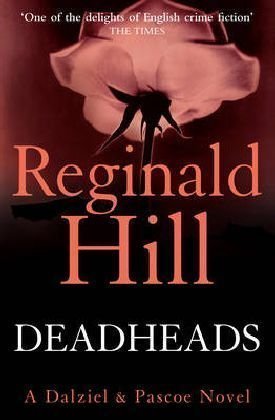
Deadheads by Reginald Hill

5 Stars

Deadheads is the 7th Dalziel and Pascoe novel first published in 1983 and by then Reginald Hill was really getting into his stride and showing his versatility as this book is not a bit like his earlier books. There are deaths, of course, but are they murders? Each one could just as easily be from natural causes or accidents. You think you know from the first chapter who the culprit could be, but I wasn’t really sure – and even by the end I was still wondering if I was right. The police investigation is run mainly by Pascoe and to a certain extent by his wife, Ellie, whilst Dalziel is occupied with other matters, only involved as the mystery draws towards its end.

Blurb

Patrick Aldermann inherits the splendid Rosemount House and gardens on the death of his aunt, and there he is able to indulge his horticultural passions without restraint.

When his boss, Dick Elgood, suggests that Aldermann is a murderer, then retracts the accusation, Peter Pascoe’s detecting instincts are aroused. How did an underachieving accountant make his way to the top of the company so quickly? And why do so many of his colleagues keep dropping dead?

Meanwhile, when not fielding politically incorrect insults from Superintendent Dalziel, Police Cadet Singh—Mid-Yorkshire’s first Asian copper—has dug up some very interesting information about Aldermann’s beautiful wife, Daphne, who’s now firm friends with one Ellie Pascoe…

It’s important to read the first chapter of Deadheads by Reginald Hill very carefully. At first I didn’t, but as I read on I began to think I’d misread it, so I went back to it – and then I understood its significance. It’s a short chapter that sets the theme for the book. Each chapter is named after a particular rose followed by a description of that rose and the first one is called Mischief, a hybrid tea, in which old Mrs Florence Aldermann instructs her great nephew, eleven year old Patrick, how to deadhead roses and explains why it is necessary.

The blurb outlines the plot and to write much more would, I think, mean I’d be giving away too many spoilers. I found the whole book fascinating, written with humour and social commentary on the issues of racism, homosexualty, feminism and marital infidelity. The plot is well executed and Hill’s descriptive writing is, as usual superb, both in terms of the setting and the development of the characters. And I especially liked the ambiguity of the plot and the circularity of the book – ending as it began with Patrick in his rose garden, pruning roses.

A Killing Kindness by Reginald Hill

A killing kindness

HarperCollins | 2013 | 372 pages | Paperback | my own copy | 5*

A Killing Kindness is Reginald Hill’s sixth Dalziel and Pascoe novel, first published in November 1980 and was televised in 1997 with the actors Warren Clarke and Colin Buchanan in the lead roles.

I wrote about the opening and quoted a short extract from page 56 in a My Friday post in January. I enjoyed it very much. For completeness I’m including the opening paragraph and the extract from page 56 in this post too:

The opening paragraph

… it was green, all green, all over me, choking, the water, then boiling at first, and roaring, and seething, till all settled down, cooling, clearing, and my sight up drifting with the last few bubbles, till through the glassy water I see the sky clearly, and the sun bright as a lemon, and birds with wings wide as a windmill’s sails slowly drifting round it, and over the bank’s rim small dark faces peering, timid as beasts at their watering, nostrils sniffing danger and shy eyes bright and wary, till a current turns me over, and I drift, and am still drifting …

What the hell’s going on here! Stop it! This is sick …

Page 56:

… all over me, choking, the water all boiling at first, and roaring, and seething …. Pascoe shook the medium’s taped words out of his mind and went on with his reading.

There was a degree of lividity down the left side which was unusual for a corpse taken from the water, but could be explained by the fact that the body seemed to have been wedged in the debris by the canal bank rather than rolling free in the current.

With each book getting better and better, I think this is the best of the early Dalziel and Pascoe novels. The main characters are now clearly established and moving on with their lives. Dalziel continues to be a boorish, angry man, not afraid to speak his mind and most definitely politically incorrect in all aspects. Pascoe and Ellie are expecting their first child, and D S Wield’s personal life is not going well.

The plot is nicely convoluted and tricky to solve, as it looks as though the police are faced with a serial killer. Three women have been found dead, strangled and a mysterious caller phones the local paper with a quotation from Hamlet. As more murders follow,  the killer is soon known as the Choker and it seems as if his motive for the murders is  compassion:

… ‘this man’s motivation does not seem to be based so much on hate as on compassion.’

‘Compassion? You mean he kills women because he’s sorry for them?’ asked Pascoe with interest.

‘In a way, yes. There’s good case-law here. The impulse to euthanasia is a strong one in all advanced civilisations.’ (p, 145)

Dalziel is angry when he finds out that Wield had involved a clairvoyant to help and Pascoe was talking to linguistic specialists and psychiatrists to help identify the killer. There are a lot of characters for the police to consider – Ellie’s feminist friends in the Women’s Rights Action Group, the members of the Aero Club, the fairground people and the local gypsies. By the time I got near the end of the book I had little idea of the identity of the murderer, but then with one sentence all was made clear. I just needed Pascoe, helped by Wield to work it out for me.

The 7th book in the series is Deadheads and I shall be reading that very soon, I hope.

These are the Dalziel and Pascoe books I’ve read so far:

1. A Clubbable Woman (1970) 
2. An Advancement of Learning (1971)
3. Ruling Passion (1973)
4. An April Shroud (1975)
5. A Pinch of Snuff (1978)
8. Exit Lines (1984)
11. Bones and Silence (1990) 
14. Pictures of Perfection (1993) – read, no post
17.On Beulah Height (1998) 
20. Death’s Jest Book(2002) 
21. The Death of Dalziel (2007)

My Friday Post: Deadheads by Reginald Hill

Book Beginnings Button

Every Friday Book Beginnings on Friday is hosted by Gillion at Rose City Reader where you can share the first sentence (or so) of the book you are reading, along with your initial thoughts about the sentence, impressions of the book, or anything else the opener inspires.

Yesterday I finished reading the 6th book in Reginald Hill’s Dalziel and Pascoe series, A Killing Kindness so I decided to look at the next book in the series Deadheads.

Deadheads


MISCHIEF

(Hybrid tea, coral and salmon, sweetly scented, excellent in the garden, susceptible to blackspot.)

Mrs Florence Aldermann was distressed by the evidence of neglect all around her.

Also every Friday there is The Friday 56, hosted by Freda at Freda’s Voice.

30879-friday2b56These are the rules:

  1. Grab a book, any book.
  2. Turn to page 56, or 56% on your eReader. If you have to improvise, that is okay.
  3. Find any sentence (or a few, just don’t spoil it) that grabs you.
  4. Post it.
  5. Add the URL to your post in the link on Freda’s most recent Friday 56 post.

Page 56:

‘Tell me, Mrs Aldermann, is there anyone you can think of who might have wanted to do you a bad turn?’

Blurb – from the back cover of my tatty secondhand copy:

Life was a bed of roses for Patrick Aldermann when his Great Aunt Florence collapsed into her Madame Louis Laperrières and he inherited Rosemont House with its splendid gardens.

But when his boss, ‘Dandy’ Dick Elgood, suggested to Peter Pascoe that Aldermann was a murderer – then retracted the accusation – the Inspector was left with a thorny problem.

By then Police Cadet Singh, Mid-Yorkshire’s first Asian copper had dug up some very interesting information about Patrick’s elegant wife, Daphne.

Superintendent Dalziel, meanwhile, was attempting to relive the days of the Empire with Singh as his tea-wallah.

~~~

Have you read this book? What did you think?

My Friday Post: A Killing Kindness by Reginald Hill

Book Beginnings Button

Every Friday Book Beginnings on Friday is hosted by Gillion at Rose City Reader where you can share the first sentence (or so) of the book you are reading, along with your initial thoughts about the sentence, impressions of the book, or anything else the opener inspires.

A Killing Kindness by Reginald Hill is one of the books I’m thinking I’ll read next. It’s the 6th Dalziel and Pascoe novel

A killing kindness


… it was green, all green, all over me, choking, the water, then boiling at first, and roaring, and seething, till all settled down, cooling, clearing, and my sight up drifting with the last few bubbles, till through the glassy water I see the sky clearly, and the sun bright as a lemon, and birds with wings wide as a windmill’s sails slowly drifting round it, and over the bank’s rim small dark faces peering, timid as beasts at their watering, nostrils sniffing danger and shy eyes bright and wary, till a current turns me over, and I drift, and am still drifting …

What the hell’s going on here! Stop it! This is sick …

I wasn’t sure what was going on either …

Also every Friday there is The Friday 56, hosted by Freda at Freda’s Voice.

30879-friday2b56These are the rules:

  1. Grab a book, any book.
  2. Turn to page 56, or 56% on your eReader. If you have to improvise, that is okay.
  3. Find any sentence (or a few, just don’t spoil it) that grabs you.
  4. Post it.
  5. Add the URL to your post in the link on Freda’s most recent Friday 56 post.

Page 56: it’s becoming clearer now what was going on –

… all over me, choking, the water all boiling at first, and roaring, and seething …. Pascoe shook the medium’s taped words out of his mind and went on with his reading.

There was a degree of lividity down the left side which was unusual for a corpse taken from the water, but could be explained by the fact that the body seemed to have been wedged in the debris by the canal bank rather than rolling free in the current.

Blurb:

When Mary Dinwoodie is found choked in a ditch following a night out with her boyfriend, a mysterious caller phones the local paper with a quotation from Hamlet. The career of the Yorkshire Choker is underway.

If Superintendent Dalziel is unimpressed by the literary phone calls, he is downright angry when Sergeant Wield calls in a clairvoyant.

Linguists, psychiatrists, mediums – it’s all a load of nonsense as far as he is concerned, designed to make a fool of him.

And meanwhile the Choker strikes again – and again…

~~~

Have you read this book? What did you think?