Six Degrees of Separation from Rapture to Persuasion

It’s time again for Six Degrees of Separation, a monthly link-up hosted by Kate at Books Are My Favourite and Best. Each month a book is chosen as a starting point and linked to six other books to form a chain. A book doesn’t need to be connected to all the other books on the list, only to the one next to it in the chain.
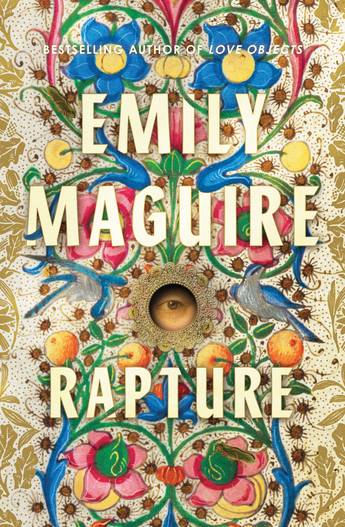
This month we start with Rapture by Emily Maguire. The motherless child of an English priest living in ninth-century Mainz, Agnes is a wild and brilliant girl with a deep, visceral love of God. At eighteen, to avoid a future as a wife or nun, Agnes enlists the help of a lovesick Benedictine monk to disguise herself as a man and secure a place at the revered Fulda monastery.

I haven’t read it and hadn’t heard of the author. According to a review in The Guardian she writes fiction and nonfiction and was shortlisted for the Stella prize, the Miles Franklin and book of the year at the Australian Book Industry awards for An Isolated Incident her 2016 novel. ‘In Rapture, her seventh novel, she turns her hand to historical fiction. Drawing inspiration from the life of Pope Joan, the woman who (according to legend) disguised herself as a man and served as pope for two years during the middle ages, Maguire examines questions of faith using the language of the body.’

I’ve had several false starts with this month’s chain, none of which I could complete. In the end I decided to start with another book about a pope, especially as the Roman Catholic Cardinals will start the procedure to elect a new pope on May 7.
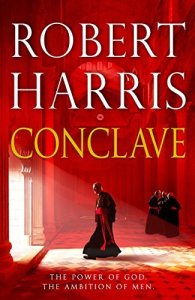
It’s Conclave by Robert Harris. I always learn a lot from reading Harris’s books. In this one he describes the procedure to elect a new pope. Cardinal Lomeli, the Dean of the College of Cardinals leads the 118 Cardinals through the voting stages. I felt as though I was a fly on the wall watching it throughout as the Cardinals are locked inside the Sistine Chapel, isolated from contact with the outside world. Harris has thoroughly researched the subject and seamlessly woven the facts into the novel. He visited the locations used during a Conclave that are permanently closed to the public and interviewed a number of prominent Catholics including a cardinal who had taken part in a Conclave, as well as consulting many reports and books.

The next book is another one by Robert Harris The Fear Index , a fast-paced story set in the world of high finance and computer technology, which is way out of my comfort zone. It’s about scientist Dr Alex Hoffman, who together with his partner Hugo Quarry, an investment banker, runs a hedge fund based in Geneva, that makes billions. Alex has developed a revolutionary form of artificial intelligence that tracks human emotions, enabling it to predict movements in the financial markets. It’s built around the standard measure of market volatility: the VIX or ‘Fear Index’. But I learnt a bit about hedge funds and how they operate, although I got lost in the computer technology details. 
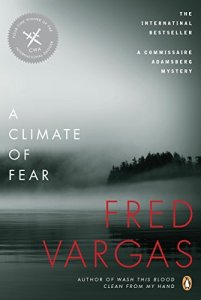
My third link is A Climate of Fear by Fred Vargas, 9th Commissaire Adamsberg book. I like Adamsberg; he’s original, a thinker, who doesn’t like to express his feelings, but mulls things over. He’s an expert at untangling mysteries, an invaluable skill in this, one of the most complicated and intricate mysteries I’ve read, involving a woman found bleeding to death in her bath, having apparently committed suicide, a strange symbol that appears at subsequent death scenes, and a secretive society studying and re-enacting scenes from the French Revolution.
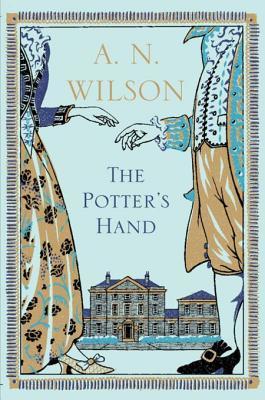
My fourth link is The Potter’s Hand by A N Wilson. it begins in 1768 and roughly follows the fortunes of the Wedgwood family until 1805, 10 years after the death of Josiah Wedgwood, an English potter and the founder of the Wedgwood company. For me it really did convey what it must have been like to live in that period – whilst the American War of Independence, and the French Revolution, were taking place. It’s full of ideas about colonialism, the abolition of slavery, working conditions, and women’s rights. There are many characters who come in and out of the narrative along the way, both fictional and historical, including Voltaire, George Stubbs (who painted the Wedgwood family portrait) and Samuel Taylor Coleridge.
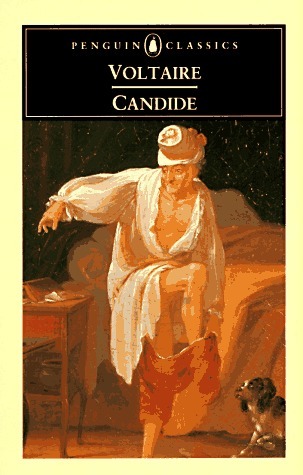
My fifth link is Voltaire’s Candide or Optimism, a small book I read many years ago. Candide was the most brilliant challenge to the idea endemic in Voltaire’s day, that ‘all is for the best in the best possible worlds‘.In Candide he whisks his young hero and friends through a ludicrious variety of tortures, tragedies and reversals of fortune, in the company of Pangloss, a ‘matapysico-theologo-cosmolo-nigologist’ of unflinching optimism. The result is one of the glories of the eighteenth-century satire. (Taken from the description on the back cover.)
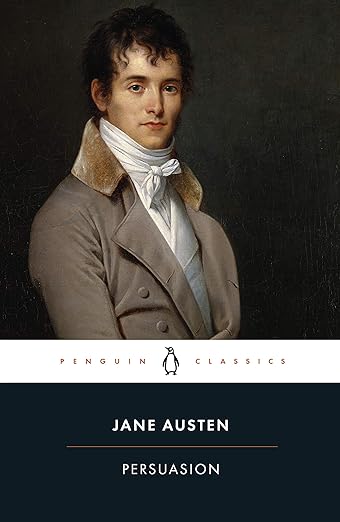
And my final link is Persuasion by Jane Austen. I read this first at school, when I was 17 for A Level GCE. It’s her last novel of missed opportunities and second chances centred on Anne Elliot, no longer young and with few romantic prospects. Eight years earlier, she was persuaded by others to break off her engagement to poor, handsome naval Captain Frederick Wentworth. ‘Set in the fashionable societies of Lyme Regis and Bath, Persuasion is a brilliant satire of vanity and pretension, and a mature, tender love story tinged with heartache.’ (Amazon) I’ll be re-reading it later in the year taking part with Brona at This Reading Life in her Austen 2025 project to reread her books, along with the Classics Club’s Sync Read (or readalong).

I certainly never thought I’d end my chain with Persuasion – but here it is! From Rapture to Persuasion in six moves. The links are the pope, books by Robert Harris, fear, the French Revolution, Voltaire and satire.

What is in your chain, I wonder?

Next month (June 7, 2025), we’ll start with Kate’s pick the 2025 Women’s Prize for Fiction All Fours by Miranda July.

Conclave by Robert Harris


Conclave

I really didn’t expect to enjoy Conclave as much as I did, but then I’ve enjoyed all of his books that I’ve read, so I shouldn’t have been surprised. Conclave is about an election of a Pope and I found it absolutely fascinating as the process of the election unfolded. Harris describes the procedure as Cardinal Lomeli, the Dean of the College of Cardinals leads the 118 Cardinals through the voting stages. I felt as though I was a fly on the wall watching it throughout as the Cardinals are locked inside the Sistine Chapel, isolated from contact with the outside world.

There are quite a lot of characters involved, which at first was a bit confusing but soon their personalities became clearer and I began to have my favourites and hope that one of them would be elected. It’s all seen from Lomeli’s point of view, so my thoughts were coloured by what he reveals about each of the main candidates. As they progress through the stages of the election, whittling down the candidates to just a few, lots of secrets, scandals and disagreements are revealed. It becomes increasingly tense with each stage and Lomeli, who had been wanting to retire before the last Pope had died, finds that he too is one of the contenders – most reluctantly:

All he had ever desired in this contest was to be neutral. Neutrality had been the leitmotif of his career. (page 98)

And he realised that, whoever was elected Pope would never be able to wander around the city at will, could never browse in a bookstore or sit outside a café, but would remain a prisoner here! (page 142)

It’s also dramatic as events in the outside world impact on the Conclave.  I was completely engrossed and hoping that my favourite would be elected. Harris has thoroughly researched the subject and seamlessly woven the facts into the novel. He visited the locations used during a Conclave that are permanently closed to the public and interviewed a number of prominent Catholics including a cardinal who had taken part in a Conclave, as well as consulting many reports and books.

There is one point that I found hard to accept (I think that to say any more would spoil the book), although it is something I’d thought might happen but I’d dismissed as rather fanciful. Nevertheless I still think this is a 5* book as I enjoyed it so much – one of the best books I’ve read this year.

  • Format: Kindle Edition
  • File Size: 3282 KB
  • Print Length: 287 pages
  • Page Numbers Source ISBN: 0091959179
  • Publisher: Cornerstone Digital; 01 edition (22 Sept. 2016)
  • Source: I bought it
  • My rating: 5*

My Friday Post: Conclave by Robert Harris

Book Beginnings Button

Every Friday Book Beginnings on Friday is hosted by Gillion at Rose City Reader where you can share the first sentence (or so) of the book you are reading, along with your initial thoughts about the sentence, impressions of the book, or anything else the opener inspires.

This week’s first paragraph is from Conclave by Robert Harris, a thriller set in the Vatican as the 118 cardinals meet in the Sistine Chapel to cast their votes for a new Pope.

Conclave

It begins:

Cardinal Lomeli left his apartment in the Palace of the Holy Office shortly before two in the morning and hurried through the darkened cloisters of the Vatican towards the bedroom of the Pope.

He was praying: O Lord, he still has so much to do, whereas all my useful work in Your service is completed. He is beloved, while I am forgotten. Spare him, Lord. Spare him. Take me instead.

Also every Friday there is The Friday 56, hosted by Freda at Freda’s Voice. These are the rules:

  1. Grab a book, any book.
  2. Turn to page 56, or 56% on your eReader.
  3. Find any sentence (or a few, just don’t spoil it) that grabs you.
  4. Post it.
  5. Add the URL to your post in the link on Freda’s most recent Friday 56 post.

Page 56

Lomeli reckoned the Holy Father had had it in mind to remove almost half of the senior men he had appointed.

From the back cover:

The Pope is dead. 

Behind the locked doors of the Sistine Chapel, one hundred and eighteen cardinals from all over the globe will cast their votes in the world’s most secretive election. 

They are holy men. But they have ambition. And they have rivals. 

Over the next seventy-two hours one of them will become the most powerful spiritual figure on earth.

I’ve thoroughly enjoyed other books by Robert Harris, so I’m expecting to like this one too.


Library Books

I reserved these books over the last few months and, wouldn’t you know it, they all arrived practically together!

IMG_20170925_190629502[1]

A Darker Domain by Val McDermid. This is the second Karen Pirie book. I’ve borrowed it because I loved the first one, The Distant Echo. In 1984, in Fife, heiress Catriona Maclennan Grant & her baby son are kidnapped. The ransom payoff goes horribly wrong. She is killed while her son disappears without trace. 2008, Tuscany. A jogger stumbles upon dramatic new evidence that re-opens the cold case. For Detective Sergeant Karen Pirie, it’s an opportunity to make her mark.

Conclave by Robert Harris – I’ve thoroughly enjoyed other books by Robert Harris, so I’m keen to read this one about how a new Pope is chosen as the cardinals meet in the Sistine chapel to cast their votes. This is a novel and Harris depicts the cardinals as holy men – but ambitious and rivals to become the most powerful spiritual figure on earth.

The Hidden Life of Trees:What They Feel, How They Communicate – Discoveries from a Secret World by Peter Wohlleben. I read Katrina’s review of this book and immediately thought it sounded an amazing book as I love trees. Wohlleben is a German forester and his book is about his love of trees and why they matter on a global scale. He makes the case that the forest is a social network – I like the idea that they communicate with each other – even if they don’t actually walk and talk like Tolkien’s ents.

Days Without End by Sebastian Barry – I loved his book, The Secret Scripture and am hoping I’ll like this one too. Thomas McNulty and John Coles signed up for the US army in the 1850s and fought in the Indian Wars and then in the American Civil War. The book was awarded the Costa Book Award 2016 and won the 2017 Walter Scott Prize. It was also longlisted for the Man Booker Prize 2017 – not that winning these awards automatically means that I’ll like it and I’m often not keen on books about war.