The Classics Club Spin Result

The spin number in The Classics Club Spin is number …

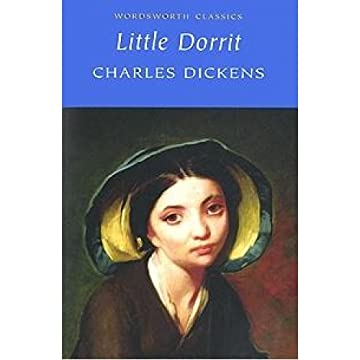
which for me is Little Dorrit by Charles Dickens. The rules of the Spin are that this is the book for me to read by 31 May, 2021.

Little Dorrit is a classic tale of imprisonment, both literal and metaphorical, while Dickens’ working title for the novel, Nobody’s Fault, highlights its concern with personal responsibility in private and public life. Dickens’ childhood experiences inform the vivid scenes in Marshalsea debtor’s prison, while his adult perceptions of governmental failures shape his satirical picture of the Circumlocution Office. The novel’s range of characters – the honest, the crooked, the selfish and the self-denying – offers a portrait of society about whose values Dickens had profound doubts.

Little Dorrit is indisputably one of Dickens’ finest works, written at the height of his powers. George Bernard Shaw called it ‘a masterpiece among masterpieces’, a verdict shared by the novel’s many admirers. (Description from Amazon)

I have started this a few times before, but found the small print in my paperback copy too off putting. I’ll be reading the e-book this time.

Did you take part in the Classics Spin? What will you be reading?

Oliver Twist by Charles Dickens

Charles Dickens oliver twist etc

5*

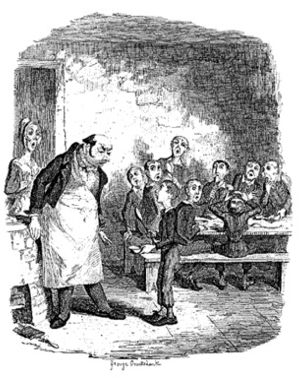
Oliver Twist by Charles Dickens was my latest Classics Club Spin book. I finished reading it on 16th January well before the finish date for the Spin, 31st January. It’s a well known story, although I realised that I only knew the beginning – Oliver’s birth in the workhouse and his early years, that famous scene where he has the audacity to ask for more, and then his escape from the workhouse only to end up in Fagin’s clutches – a den of thieves and pickpockets.

Oliver Twist
‘Please, sir, I want some more.’

I don’t intended to go into any more detail about the story, other than to say that whilst out with the Artful Dodger, attempting to steal handkerchiefs Oliver is caught by the police and rescued by Mr Brownlow. After that the story was new to me, although I knew the names of the other main characters, Nancy and the villain Bill Sykes, with his vicious dog, Bull’s Eye. But other characters in the later parts of the book, such as the Maylie family, Rose, adopted by Mrs Maylie, and her son, Harry and the mysterious man, Monks were new to me. 

Oliver Twist was first published as a serial from 1837-1839, under Charles Dickens’ pseudonym, ‘Boz’. It was his second novel, published in three volumes in November 1839. It’s full of terrific descriptions of the state of society at the time – the grim conditions that the poor suffered, the shocking revelations of what went on in the workhouse, and the depiction of the criminal underworld – the contrast of good and evil. Despite everything that happens to Oliver he remains a good boy, pure and innocent, whereas the villains are evil personified; whilst living with Fagin and his gang he existed in a state of both fascination and terror. Dickens was merciless in the satire he used in this book.

And yet in the middle of the book there is a romantic interlude full of sentimentality and melodrama. Rose Maylie is really a very pale character, being both virtuous and self-sacrificing but she contrasts well with the prostitute Nancy, who pities Oliver and tries to protect him from Fagin and Sykes. As the mystery surrounding Monks’ identity is revealed, Oliver is in more danger than anything he has faced before in his life.

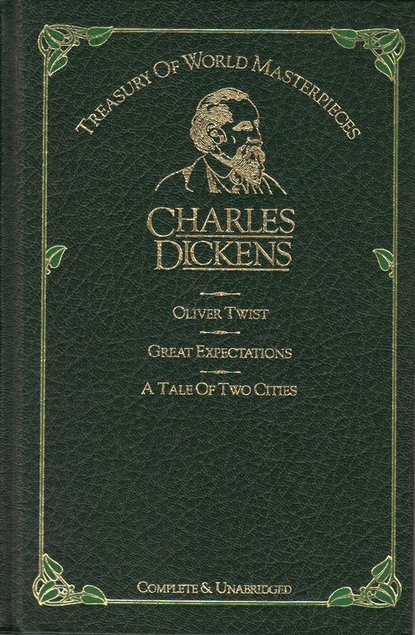
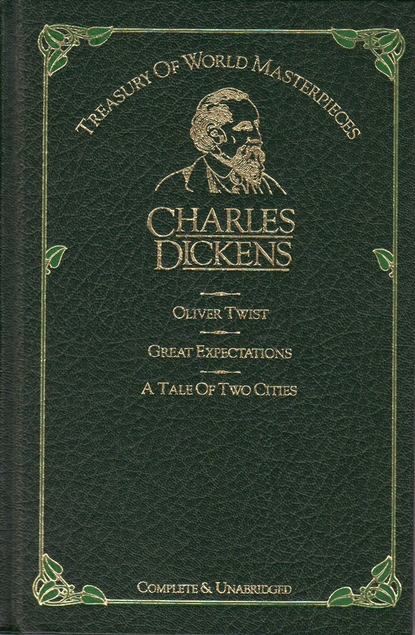
My copy also contains Great Expectations and A Tale of Two Cities (both of which I read as a teenager) and was a birthday present as long ago as 1981, so this is one of my TBRs as well as a Classics Club Spin book. In the introduction to this volume Oliver Twist is described as follows:

The story of Oliver … has become an immortal one. Hitherto Dickens had been content to entertain … with Oliver he tried to reach the deeper passions of his audience, rouse their indignation at the harsh injustice of the Poor Law and open their eyes to the horror of the London slums, while at the same time show that there is  a certain innocence in humanity (personified by Oliver) that can never be sullied. There have been some critics who have found that the two themes make uneasy bedfellows and certain contemporaries of Dickens complained that he was being purely sensational in his horrific descriptions of life in the criminal underworld. Most of his readership, however, have been both fascinated and moved.

And I can say that I too found it shocking, fascinating and moving.

The Classics Club Spin Result

Classics Club
The spin number in The Classics Club Spin was announced yesterday. It’s number … 13

which for me is Oliver Twist by Charles Dickens. The rules of the Spin are that this is the book for me to read by January 31, 2020.

Charles Dickens oliver twist etc

I’m delighted with this as I’ve been meaning to read it for years and never got round to it.

The story of the orphan Oliver, who runs away from the workhouse to be taken in by a den of thieves, shocked readers with its depiction of a dark criminal underworld peopled by vivid and memorable characters – the arch-villain Fagin, the artful Dodger, the menacing Bill Sikes and the prostitute Nancy. Combining elements of Gothic romance, the Newgate novel and popular melodrama, Oliver Twist created an entirely new kind of fiction, scathing in its indictment of a cruel society and pervaded by an unforgettable sense of threat and mystery.

Did you take part in the Classics Spin? What will you be reading?

This is my last post until after Christmas, so I’m wishing you all a very …

Christmas bells

Six Degrees of Separation from The Poisonwood Bible to …

I love doing Six Degrees of Separation, a monthly link-up hosted by Kate at Books Are My Favourite and Best. Each month a book is chosen as a starting point and linked to six other books to form a chain. A book doesn’t need to be connected to all the other books on the list, only to the one next to it in the chain.

This month the chain begins with The Poisonwood Bible by Barbara Kingsolver, one of my favourite books. I’ve read it several times.

The Poisonwood Bible

Told by the wife and four daughters of Nathan Price, a fierce evangelical Baptist who takes his family and mission to the Belgian Congo in 1959, The Poisonwood Bible is the story of one family’s tragic undoing and remarkable reconstruction over the course of three decades in postcolonial Africa.

I bought The Poisonwood Bible in Gatwick airport bookshop just before boarding a plane to go on holiday. So my first link in the chain is to another book I bought in an another airport bookshop waiting to board another plane:

Fortune's Rocks

It’s Fortune’s Rocks by Anita Shreve. I had never heard of Anita Shreve, but I liked the look of this book – and the fact that it’s a chunky book of nearly 600 pages, good to read on holiday. It’s set in the summer of 1899 when Olympia Biddeford and her parents are on holiday at the family’s vacation home in Fortune’s Rocks, a coastal resort in New Hampshire. She is fifteen years old and this is the story of her love affair with an older man.

When I looked at it today, I saw that it’s written in the present tense. Recently I’ve been writing about my dislike of the present tense – but I obviously haven’t always disliked it, because I remember really enjoying this book.

Wolf Hall (Thomas Cromwell, #1)

Another book written in the present tense that I loved is Wolf Hall by Hilary Mantel, the story of Thomas Cromwell, the son of a blacksmith, and his political rise, set against the background of Henry VIII’s England and his struggle with the Pope over his desire to marry Anne Boleyn. Historical fiction is one of my favourite genres, which takes me to my next link, another book set in the reign of Henry VIII –

Lamentation (Matthew Shardlake, #6)

Lamentation by C J Sansom set in 1546, the last year of Henry VIII’s life. Shardlake, a lawyer is asked by Queen Catherine (Parr) for help in discovering who has stolen her confessional book, Lamentation of a Sinner. It evokes the people, the sights, smells and atmosphere of Henry’s last year and at the same time it’s an ingenious crime mystery, full of suspense and tension.

Barnaby Rudge

The next book also combines historical and crime fiction – Barnaby Rudge by Charles Dickens, set in 1780 at the time of the Gordon Riots.  It’s a story of mystery and suspense which begins with an unsolved double murder and goes on to involve conspiracy, blackmail, abduction and retribution.

Barnaby Rudge is a simple young man, living with his mother. His pet raven, Grip goes everywhere with him. He’s a most amazing bird who can mimic voices and seems to have more wits about him than Barnaby. Grip is based on Dickens’s own ravens, one of whom was also called Grip.

Ravens form the next link-

The Raven's Head

to The Raven’s Head by Karen Maitland, set in 1224 in France and England about Vincent, an apprentice librarian who stumbles upon a secret powerful enough to destroy his master. He attempts blackmail but when this fails Vincent goes on the run in possession of an intricately carved silver raven’s head. The plot revolves around the practice of alchemy – the search for a way to transform the base soul of man into pure incorruptible spirit, as well as the way to find the stone, elixir or tincture to turn base metals into precious metals.

And finally to the last link in this chain another book featuring alchemy –

Crucible (Alexander Seaton, #3)

Crucible by S G MacLean, the third of her Alexander Seaton books. Set in 1631 in Aberdeen Robert Sim, a librarian is killed. Alexander investigates his murder and finds, amongst the library books, works on alchemy and hermetics – the pursuit of ancient knowledge and the quest for ‘a secret, unifying knowledge, known to the ancients’ since lost to us. S G MacLean’s books are full of atmosphere. I think her style of writing suits me perfectly, the characters are just right, credible well-rounded people, and the plot moves along swiftly with no unnecessary digressions.

My chain this month has travelled from Africa to Scotland via America and England, and spans the years from the 13th century to the mid 20th century. It has followed a missionary and his family, a teenager in love with an older man, and looked in on power struggles in Tudor England, and the pursuit of the secret to turn metal into gold.

Links are: books I bought to read on holiday, books in the present tense, crime fiction and historical fiction (and a combination of these genres), ravens and alchemy.

Next month  (June 2, 2018), we’ll begin with  Malcolm Gladwell’s debut (and best seller), The Tipping Point, a book and author I’ve never come across before.

The Classics Club Spin Result

Classics Club

The spin number in The Classics Club Spin was announced yesterday. It’s number …

3

which for me is Little Dorrit by Charles Dickens. The rules of the Spin are that this is the book for me to read by April 30, 2018.

Little Dorritt

I don’t know whether to laugh or cry. As it’s on my list I do want to read it – sometime – maybe not right now.

I know very little about Little Dorrit, just that it’s long and my copy is one of the Wordsworth Classics in a very small font. I stopped watching the TV adaptation with Tom Courtney as William Dorrit – such a dark and dreary production with him in the Marshalsea debtors’ prison. The blurb on the back cover says that Dickens’ working title for the book was Nobody’s Fault. Well, it’s his fault for writing it – and mine for for putting it on the Spin List – oh, yes and the Spin God for spitting out number 3.

I just hope I enjoy it!

Here’s the blurb from Amazon:

Little Dorrit is a classic tale of imprisonment, both literal and metaphorical, while Dickens’ working title for the novel, Nobody’s Fault, highlights its concern with personal responsibility in private and public life. Dickens’ childhood experiences inform the vivid scenes in Marshalsea debtor’s prison, while his adult perceptions of governmental failures shape his satirical picture of the Circumlocution Office. The novel’s range of characters – the honest, the crooked, the selfish and the self-denying – offers a portrait of society about whose values Dickens had profound doubts.

Little Dorrit is indisputably one of Dickens’ finest works, written at the height of his powers. George Bernard Shaw called it ‘a masterpiece among masterpieces’, a verdict shared by the novel’s many admirers.

A ‘masterpiece‘ – that makes it sound OK – doesn’t it?

Did you take part in the Classics Spin? What will you be reading?

The Classics Club Spin Result

The spin number in The Classics Club Spin was announced yesterday. It’s number …

4

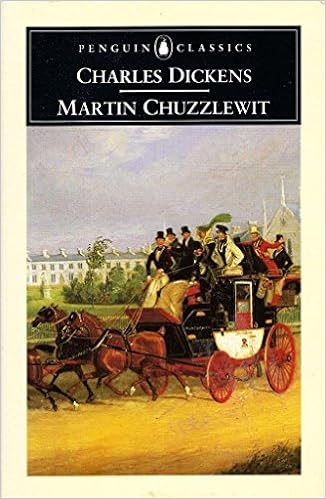
which for me is Martin Chuzzlewit by Charles Dickens. The rules of the Spin are that this is the book for me to read by December 31, 2017.

I’m pleased with the result as I’ve been meaning to read this book ever since I saw a TV version. I’ve just checked and it was shown in 1994 with Paul Scholfield as Old Martin Chuzzlewit – that’s 23 years ago! It really is time I read it.

Here’s the blurb from Goodreads:

While writing Martin Chuzzlewit – his sixth novel – Dickens declared it ‘immeasurably the best of my stories.’ He was already famous as the author of The Pickwick Papers and Oliver Twist . Set partly in America, which Dickens had visited in 1842, the novel includes a searing satire on the United States. Martin Chuzzlewit is the story of two Chuzzlewits, Martin and Jonas, who have inherited the characteristic Chuzzlewit selfishness. It contrasts their diverse fates of moral redemption and worldly success for one, with increasingly desperate crime for the other. This powerful black comedy involves hypocrisy, greed and blackmail, as well as the most famous of Dickens’s grotesques, Mrs Gamp. 

Did you take part in the Classics Spin? What will you be reading?