Top Ten Tuesday: Books Set in the 1950s

Top Ten Tuesday is a weekly meme created by The Broke and the Bookish and now hosted by Jana at That Artsy Reader Girl. For the rules see her blog

Today the topic is a Freebie and I’ve chosen books Books Set in the 1950s.
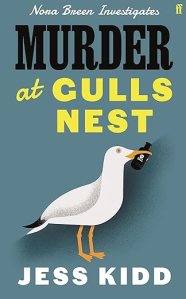
Murder at Gulls Nest by Jess Kidd. The first in a sparkling new 1950s seaside mystery series, featuring sharp-eyed former nun Nora Breen.

After thirty years in a convent, Nora Breen has thrown off her habit and set her sights on the seaside town of Gore-on-Sea. Why there? Why now? Instinct tells her it’s better not to reveal her reasons straight away. She takes a room at Gulls Nest guest house and settles in to watch and listen.

I enjoyed this. It’s quirky with some odd characters. At times it feels like a cosy crime mystery, but it’s also rather dark and foreboding, whereas at other times there’s some humour and also a hint of a romance. The setting is good in a fictional 1950s British seaside town.
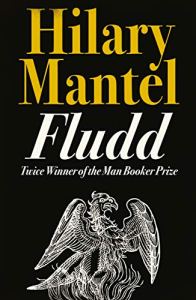
 Fludd by Hilary Mantel. I enjoyed this immensely – partly about religion and superstition, but also a fantasy, a fairy tale, told with wit and humour and with brilliant characterisation. It’s one of her earlier novels, set in Fetherhoughton, a drab, dreary town somewhere in a magical, half-real 1950s north England, a preserve of ignorance and superstition. The story centres on Fludd, a young priest who comes to the Church of St Thomas Aquinas to help Father Angwin, a cynical priest who has lost his faith. The Bishop, a modern man, is concerned about Father Angwin and wants to bring him and the Catholic community up to date – so the statues in the church have to go. This has a most disturbing effect on all concerned – not just the church and Father Angwin, but also the the nuns in the convent, and the school, both under the stern eye of Mother Perpetua.
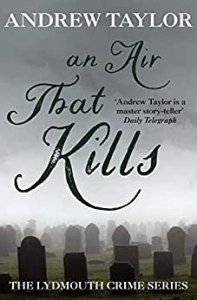
An Air That Kills by Andrew Taylor, the first book in his Lydmouth crime series. The setting is Lydmouth, a small market town on the Welsh/English border in the early 1950s, just after the end of the Second World War. It begins as journalist, Jill Francis arrives to stay with her friends, Philip and Charlotte in Lydmouth, to recover from a bad experience.  Also new to the town is Inspector Richard Thornhill, who is finding it difficult to adjust to working in the local police force. Workmen digging out a drain discover a wooden box containing baby’s bones, an old brooch and some scraps of yellowed newspaper. When Major Harcutt, the local historian is consulted he found that there could be a connection to an old murder trial. 
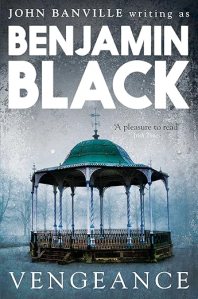
Vengeance by Benjamin Black (a pseudonym used by John Banville), number five in Black’s Quirke Mysteries series set in Ireland in the 1950s. It begins with a suicide, that of Victor Delahaye, a business man who takes his boat out to sea and shoots himself. He had taken his partner’s son, Davy Clancy out to sea with him. The Delahayes and Clancys are interviewed – Mona Delahaye, the dead man’s young and very beautiful wife; James and Jonas Delahaye, his identical twin sons; Marguerite his sister; Jack Clancy, his ambitious, womanizing partner and Sylvia, Jack’s long-suffering wife. Then there is a second death. Why did Victor kill himself and who is the murderer, wreaking vengeance on the families?

The setting is excellent, both in location and time, with the characters wreathed in cigarette smoke, and having to find public telephones for example. 
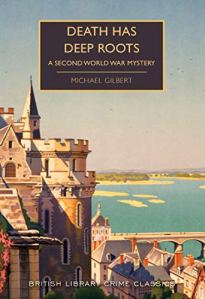
 Death Has Deep Roots: a Second World War Mystery by Michael Gilbert. Set in 1950 it’s a mix of courtroom drama, spy novel and an adventure thriller. Victoria Lamartine, a hotel worker, and an ex-French Resistance fighter is on trial for the murder of Major Eric Thoseby, her supposed lover, and alleged father of her dead child. She is the obvious suspect – she was found standing over Thoseby’s dead body in his room at the Family Hotel in Soho, a room that was only accessed by one staircase – making this a variation on a locked room murder mystery. It was written not long after the end of the Second World War and it conveys a vivid impression of what life was like in both France and England, with memories of the war still fresh on people’s minds.
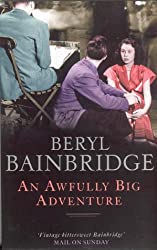
An Awfully Big Adventure, a semi-autobiographical novel set in 1950, based on Beryl Bainbridge’s own experience as an assistant stage manager in a Liverpool. A Liverpool repertory theatre company are rehearsing its Christmas production of Peter Pan. The story centres around Stella, the assistant stage manager. On the face of it this is a straight forward story of the theatre company but underneath it’s packed with emotion, pathos and drama. And it’s firmly grounded in a grim post-war 1950s England, food rationing still in operation and bombed buildings still in ruins overgrown with weeds.
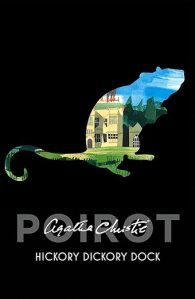
Hickory Dickory Dock by Agatha Christie, a Poirot mystery, first published in 1955. It’s set in a crowded London house, owned by Mrs Nicolstis, a Greek and full of a mixed group of young students from a variety of backgrounds and cultures – from America, West Africa and India as well as an assortment from the British Isles.Items have gone missing and then one of the students commits suicide – or is it murder? And more deaths follow.

Agatha Christie reveals contemporary attitudes (1950s) to race and politics, as the characters’ prejudices come out in their discussions. There are some interesting reflections on crime and the psychology of behaviour. 
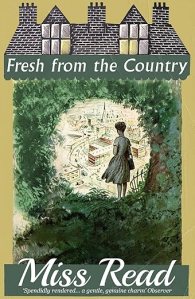
Fresh from the Country by Miss Read, set in the 1950s, this is a stand-alone novel telling the story of Anna Lacey, a newly qualified teacher, as she spends her first year teaching in Elm Hill, a new suburb in London. It highlights the differences between life in the country and the suburbs, which transported me back to the 1950s, when children were taught in large classes and the pace of life was slower than today. It was a bit disconcerting to read that Anna enjoyed smoking, but then the dangers of cigarettes were not emphasised in those days and many people did smoke.
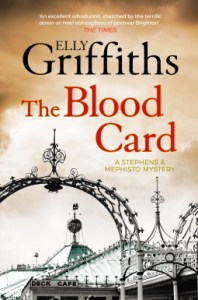
The Blood Card by Elly Griffiths, the third book in the DI Stephens and Max Mephisto series. Known as the ‘Magic Men’ they had been part of a top-secret espionage unit during the War. This book captures the atmosphere of 1953 – a time of great change and optimism. Britain is looking forward with eager anticipation to the new Queen’s coronation. The newspapers and newsreels are full of it and more than half the homes in the country have bought a television in order to watch the coronation live- it was the first British coronation to be broadcast on television, a momentous occasion. But there are fears that an anarchist group is plotting to disrupt the coronation.

I enjoyed the insight into the history of television as Max is sceptical about performing magic on TV thinking the ‘smug grey box’ will be the death of the days of music hall, that magic tricks needed to be performed on stage not in close up with a camera over his shoulder. But he is persuaded to take part in a new show after the coronation.
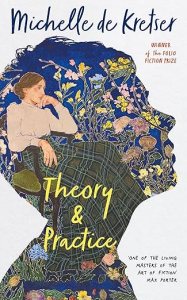

Six Degrees of Separation from Theory and Practice to The Night Hawks

It’s time again for Six Degrees of Separation, a monthly link-up hosted by Kate at Books Are My Favourite and Best. Each month a book is chosen as a starting point and linked to six other books to form a chain. A book doesn’t need to be connected to all the other books on the list, only to the one next to it in the chain.

This month we start with Theory & Practice by Michelle de Kretser, the winner of the Stella Prize for Fiction 2025, praised for its innovative structure and exploration of young love, jealousy, and literary inheritance.  I’ve not read it but it looks interesting. This is Amazon’s description:

It’s 1986, and ‘beautiful, radical ideas’ are in the air. A young woman arrives in Melbourne to research the novels of Virginia Woolf. In bohemian St Kilda, she meets artists, activists, students – and Kit. He claims to be in a ‘deconstructed’ relationship, and they become lovers. Meanwhile, a dismaying discovery throws her work on ‘the Woolfmother’ into disarray.

Theory & Practice is a mesmerising account of desire and jealousy, truth and shame. It makes and unmakes fiction as we read, expanding our notion of what a novel can contain. Michelle de Kretser, one of Australia’s most celebrated writers, bends fiction, essay and memoir into exhilarating new shapes to uncover what happens when life smashes through the boundaries of art..

I’ve read some of Virginia Woolf’s books, including my first link: Orlando, a fictionalised biography of Vita Sackville-West, based on her life. It tells the tale of an extraordinary individual who lives through centuries of English history, first as a man, then as a woman. This is a book steeped in history showing how the passage of time had changed both the landscape and climate of England along with its society. There are many vivid passages – such as her description of the ‘Great Frost’ of 1608, when the Thames was frozen for six weeks and Frost Fairs were held on the ice.

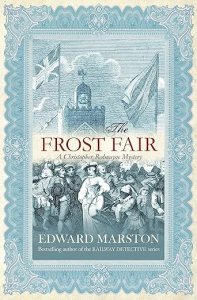
Second link: There have been several Frost Fairs over the centuries. Another one in 1669 is described in Edward Marston’s The Frost Fair, the fourth in the Christopher Redmayne Restoration series about an architect and Jonathan Bale, a parish constable. They are both visiting the fair when one of Bale’s sons gets into trouble on thin ice. They rescue the boy but in the process make a grim discovery – the frozen corpse of a man. The dead man is Jeronimo Maldini, an Italian fencing master who has been missing for some time. Redmayne is inclined to dismiss the case and leave the investigation to Bale; but all that changes when his own brother, Henry Redmayne, is charged with the murder.

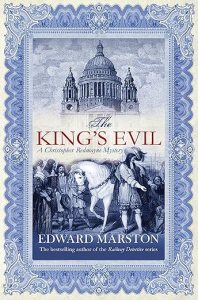
Third link: The first Christopher Redmayne book is The King’s Evil set in London in September 1666, just as the Great Fire of London has begun, eventually devastating a large part of the old medieval City of London. It’s also a murder mystery. Redmayne is working to restore London after the Fire, when he becomes involved in investigating the murder of Sir Ambrose Northcott. whose body was found in the cellars of his partly built new house.

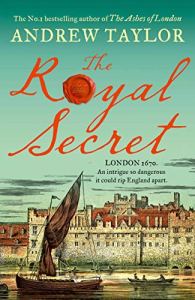
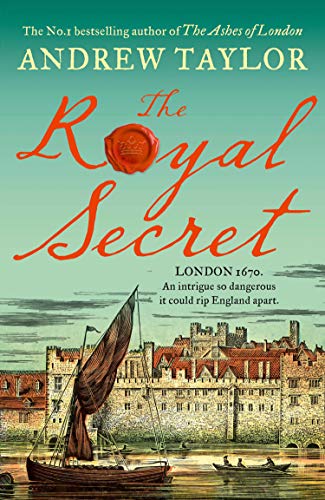
Which links nicely to my fourth link about another architect, Cat (Catherine) Hakesby: The Royal Secret by Andrew Taylor set in 1670. This is the 5th book in the Marwood and Lovett series. After designing a poultry house for the young daughter of Lord Arlington, the Secretary of State, Cat Hakesby (formerly Lovett) gains a commission to design one for Charles II’s sister, ‘Minette,’ the Duchess of Orléans. This is a complicated book, as Marwood is investigating the mysterious death of Richard Abbott, one of Lord Arlington’s men. It’s full of political intrigue, danger and conspiracy, involving witchcraft, poisonings, and tricky international relationships.

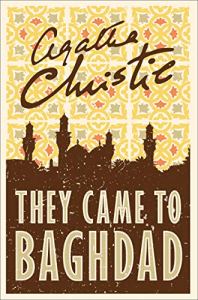
My Fifth link is conspiracy, which brings me to Agatha Christie’s They Came to Baghdad. Set in 1950 this is a story about international espionage and conspiracy. The heads of the ‘great powers‘ are secretly meeting in Baghdad, where if it all goes wrong ‘the balloon will go up with a vengeance.’ And an underground criminal organisation is out to make sure it does go wrong, aiming at ‘total war – total destruction. And then – the new Heaven and the new Earth.’ Victoria Jones, a short-hand typist, a courageous girl with a ‘natural leaning towards adventure’ and a tendency to tell lies gets involved after meeting with a young man, Edward, who is going out to Baghdad the following day to join an archaeological dig. 

My sixth link is archaeology in The Night Hawks by Elly Griffiths. Ruth Galloway is now Head of the Department of Archaeology at her old university, the fictional University of North Norfolk. The body of a young man who Detective Chief Inspector Nelson guesses is an illegal immigrant, an asylum seeker, is found on the beach at Blakeney Point. Then a skeleton, buried in a mound of what appears to be Bronze Age weapons, is also discovered on the beach by the group known as the Night Hawks when they were searching for buried treasure. Ruth, however is more interested in the hoard of Bronze Age weapons. 

My chain is mostly made up of two of my favourite genres, historical fiction and crime fiction. What is in your chain?

Next month (August 5, 2025), we’ll start with the 2025 Women’s Prize winner, The Safekeep by Yael Van Der Wouden.

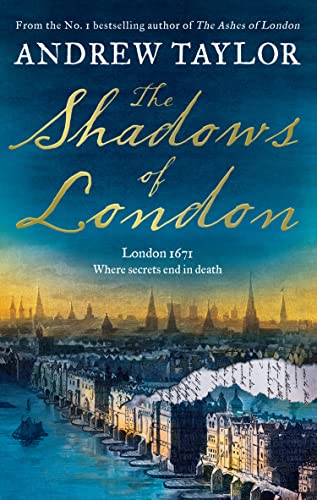
The Shadows of London by Andrew Taylor

Harper Collins| 2 March 2023 | 454 pages|e-book |Review copy|5*

London 1671
The damage caused by the Great Fire still overshadows the capital. When a man’s brutally disfigured body is discovered in the ruins of an ancient almshouse, architect Cat Hakesby is ordered to stop restoration work. It is obvious he has been murdered, and Whitehall secretary James Marwood is ordered to investigate.

It’s possible the victim could be one of two local men who have vanished – the first, a feckless French tutor connected to the almshouse’s owner;
the second, a possibly treacherous employee of the Council of Foreign Plantations.

The pressure on Marwood mounts as Charles II’s most influential courtiers, Lord Arlington and the Duke of Buckingham, show an interest in his activities – and Marwood soon begins to suspect the murder trail may lead right to the heart of government.

Meanwhile, a young, impoverished Frenchwoman has caught the eye of the king, a quiet affair that will have monumental consequences…

My thoughts

The Shadows of London by Andrew Taylor is historical crime fiction, the 6th book in his James Marwood and Cat Lovett Restoration series. I’ve read all of the previous books, set in 17th century England, during the reign of Charles II, and thoroughly enjoyed each one So I was delighted to find that this one is just as good, maybe even better. Although it does work as a stand-alone book I do think it’s best to read them in sequence to get the full background of the Restoration period and the relationship between James Marwood and Cat Hakesbury (formerly Lovett).

At the beginning of the book there is a list of the main characters, which I find very useful. It includes where they live and their professions and relationships with each other, including the real historical characters. There is also a Historical Note at the end of the book in which Taylor explains that the origins of the novel had germinated over a number of years following the Harvey Weinstein and Jeffrey Epstein cases, whilst the catalyst came when he read Dr Linda Porter’s Mistresses: Sex and Scandal at the Court of Charles II. In one chapter Dr Porter focuses on the career of Louise de Keroualle, who became Charles II’s chief mistress during the second half of his reign. In The Shadows of London the story of Louise’s seduction with its political implications, based on fact, is interwoven with the mystery of the murder of the man found dead, brutally killed, in the grounds of a ruined almshouse that Cat’s workman were restoring.

The murder mystery is complicated first of all because the victim had no face, and nothing by which he could be identified. Both the characters and the settings are well described and the mixture of fact and fiction works well. It is fast paced, full of action and intrigue. The narrative is told from both Cat’s and James’s viewpoints switching from one to the other throughout the book. Their relationship continues to develop as they work together to find the culprit and it reaches a turning point in this book. I hope that there will be a 7th book as I really want to know what happens next …

One of the things that I really enjoyed in this book is the picture it paints of John Evelyn, the writer and diarist, bibliophile and horticulturalist. He was a contemporary of Samuel Pepys. His diary covers the years from 1640 to 1706 when he died. And now I want to find out more about him.

Andrew Taylor is a bestselling crime and historical novelist, and the winner of the Diamond Dagger of the Crime Writers Association, the Gold Crown of the Historical Writers Association and many other awards. He’s written nearly fifty books,  listed here, three of which have been televised. I’d leave to see the Marwood and Lovett series adapted for television!

My thanks to the publishers and NetGalley for my review copy.

The Royal Secret by Andrew Taylor

Harper Collins UK| 29 April 2021| 476 pages| e-book| Review copy| 4*

Description:

From the No.1 bestselling author of The Last Protector and The Ashes of London comes the next book in the phenomenally successful series following James Marwood and Cat Lovett during the time of King Charles II.

Two young girls plot a murder by witchcraft. Soon afterwards a government clerk dies painfully in mysterious circumstances. His colleague James Marwood is asked to investigate – but the task brings unexpected dangers.
 
Meanwhile, architect Cat Hakesby is working for a merchant who lives on Slaughter Street, where the air smells of blood and a captive Barbary lion prowls the stables. Then a prestigious new commission arrives. Cat must design a Poultry House for the woman that the King loves most in all the world.
 
Unbeknownst to all, at the heart of this lies a royal secret so explosive that it could not only rip apart England but change the entire face of Europe

My thoughts:

I’ve read all of the previous Marwood and Lovett books, set in 17th century England, and thoroughly enjoyed each one, so I was delighted when Rachel Quin at HarperCollins asked me if I’d like a proof copy of  The Royal Secret to review. It is the 5th book in the series and although it does work as a stand-alone book I do think it’s best to read them in sequence to get the full background of the Restoration period and the relationship between James Marwood and Cat Hakesbury (formerly Lovatt).

The year is 1670, two years have passed since the end of the previous book, The Last Protector. Cat Hakesby’s work as an architect continues after her husband’s death and after designing a poultry house for the young daughter of Lord Arlington, the Secretary of State, she gains a commission to design one for Charles II’s sister, ‘Minette,’ the Duchess of Orléans. Meanwhile Marwood is a government clerk clerk to Joseph Williamson and also working for Lord Arlington. They find themselves involved in a complicated situation that is full of danger.

Marwood is instructed to investigate the mysterious death of Richard Abbott, one of Lord Arlington’s men, and retrieve some confidential papers from the victim’s home. Abbott’s step-daughter, Maria and the maid, Hannah have been dabbling in witchcraft and Maria believes she is responsible for his death. Marwood’s investigation brings him into contact with a merchant, Mr Fanshawe (also one of Cat’s clients) and through him with a mysterious Dutch gentleman, Henryke Van Riebeeck. Van Riebeeck just happens to be Anna Abbott’s brother, and Fanshawe’s son was Anna Abbott’s first husband and the father of Maria. After Abbott’s death she and Maria together with Hannah had gone to live in Fanshawe’s house. Fanshawe is an interesting character, who has recently bought a lion, who he named Caliban, a mangy bad-tempered beast that he keeps in the stables at his house in Slaughter Street.

So, Cat and Marwood are both involved with the same people, although in different circumstances. Their relationship is somewhat ambiguous. She is a strong-minded woman, a widow who values her independence in a society where women, although used to running households and dealing with their families’ financial matters, were only just beginning to find a place in society outside the home. And she doesn’t welcome Marwood’s interference in her life. That the two of them are attracted to each other is not acknowledged by either of them – especially, in this book, when Cat finds herself drawn romantically to Van Riebeeck. Her work takes her to the Royal Court in Paris to discuss her designs for the poultry house, although Minette seems more concerned with political matters and Cat wonders what the real reason for her visit is.

This is a well researched historical novel, mixing fact and fiction, bringing the streets of London and the royal court in Paris to life. At the same time it presents a mystery full of political intrigue, danger and conspiracy, involving witchcraft, poisonings, and tricky international relationships. It is only towards the end of the book that the royal secret is revealed – and I had had no idea until then what it was. I do hope there will be a sixth book for Marwood and Lovatt.

My thanks to the publishers and NetGalley for my review copy.

Can’t-Wait Wednesday: The Royal Secret by Andrew Taylor

Can’t-Wait Wednesday is a weekly meme hosted by Wishful Endings, to spotlight and discuss the books we’re excited about that we have yet to read. Generally they’re books that have yet to be released.

I love Andrew Taylor’s James Marwood and Cat Lovett series, historical fiction set during the reign of Charles II. So I was delighted when I was invited to read the latest instalment, The Royal Secret, due to be published on 29 April.

Description

From the No.1 bestselling author of The Last Protector and The Ashes of London comes the next book in the phenomenally successful series following James Marwood and Cat Lovett during the time of King Charles II.

Two young girls plot a murder by witchcraft. Soon afterwards a government clerk dies painfully in mysterious circumstances. His colleague James Marwood is asked to investigate – but the task brings unexpected dangers.
 
Meanwhile, architect Cat Hakesby is working for a merchant who lives on Slaughter Street, where the air smells of blood and a captive Barbary lion prowls the stables. Then a prestigious new commission arrives. Cat must design a Poultry House for the woman that the King loves most in all the world.
 
Unbeknownst to all, at the heart of this lies a royal secret so explosive that it could not only rip apart England but change the entire face of Europe…

~~~

The earlier books are – The Ashes of London (set in 1666, six years after Charles II was reinstated as King) and The Fire Court (set in 1667, eight months after the Great Fire of London), The King’s Evil (set seven months later), and The Last Protector (set in 1668 as the exiled Richard Cromwell, son of Oliver, heavily in debt, has returned in disguise to England.)

It is not necessary to read the earlier books as I think they all work well as standalones, but I think it really helps if you do.

An Air that Kills by Andrew Taylor

An Air That Kills is the first book in Andrew Taylor’s in his Lydmouth crime series. I’ve read several of his other books and thoroughly enjoyed them, but none in this series.  It has a slow beginning but once it had established the characters and set the scene the pace picks up. The setting is Lydmouth, a small market town on the Welsh/English border just after the end of the Second World War.

It begins as journalist, Jill Francis arrives to stay with her friends, Philip and Charlotte in Lydmouth, to recover from a bad experience – the details are are only revealed later in the book.  Also new to the town is Inspector Richard Thornhill, who is finding it difficult to adjust to working in the local police force. There’s been a spate of burglaries and there are whispers that a black marketeer is heading to their area. So there is plenty going on and then workmen digging out a drain discover a wooden box containing baby’s bones, an old brooch and some scraps of yellowed newspaper. When Major Harcutt, the local historian was consulted he found that there could be a connection to an old murder trial. 

Harcutt is elderly, living on his own and estranged from his daughter, Antonia. But when he is involved in a road accident and is then burgled Charlotte contacts Antonia and she reluctantly returns home to help him. Meanwhile, Jill is persuaded to help Inspector Thornhill in his investigation into the mystery of the baby’s bones.

It’s a good mix of police investigation, and personal stories, including those of Richard and Jill, of Jill and Philip and Charlotte, of Harcutt and his daughter, and the burglar and the black marketeer.  There is a strong sense of time and place – I thought the 1950s setting was well done. I enjoyed the interaction between the characters and and will definitely read on in the series to see how the relationship between Jill and Richard develops.

  • Format: Kindle Edition
  • File Size: 1382 KB
  • Print Length: 384 pages
  • Publisher: Hodder & Stoughton; New Ed edition (13 Sept. 2012)
  • Source: I bought it
  • My Rating 4*