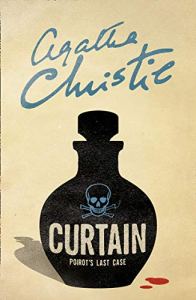
Today I’m looking back at my post on Curtain: Poirot’s Last Case by Agatha Christie, one of my favourite Agatha Christie books. I first reviewed it on December 2, 2010.
My review begins:
Curtain was first published in 1975, but it was written in the 1940s during the Second World War. Agatha Christie had written it with the intention that it be published after her death, but in 1975 her publishers persuaded her to release it so that it could appear in time for the Christmas season – a ‘Christie for Christmas’.
In this book Poirot and Hastings have come full circle, returning to Styles, the scene of their first case. Poirot is now an old man (just how old is not revealed – I think if you go by the chronology of the novels he must have been about 120, but there is no need to be too precise), and close to death. Hastings is the narrator of this mystery. He is saddened by the devastation age has had on Poirot
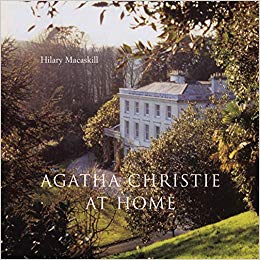
Today I’m looking back at my post on Agatha Christie at Home by Hilary Macaskill, which I first posted on 19 August 2013.
Here’s the first paragraph:
One of the things that struck me when I was reading Agatha Christie’s An Autobiography was her love of houses. It stemmed from her childhood dolls’ house. She enjoyed buying all the things to put in it – not just furniture, but all the household implements such as brushes and dustpans, and food, cutlery and glasses. She also liked playing at moving house, using a cardboard box as a furniture van.
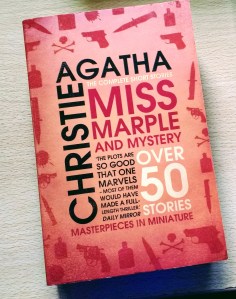
Today I’ve read one of the short stories from Agatha Christie’s collection Miss Marple and Mystery .
This collection contains 55 stories, 20 of them featuring Miss Marple. I’ve read some of these in other short story collections but there are still many I haven’t read. There is an Short Story Chronology in the Appendix with a table aiming to present all Agatha Christie’s short stories published between 1923 and 1971, listed in order of traced first publication date.
Counting how many there are in total is a difficult task – some stories that first appeared in weekly or monthly magazines were later re-worked and became chapters in a larger work, some in Partners in Crime were sub-divided into smaller chapters, 13 were re-worked into the episodic novel, The Big Four, and some were rewritten so substantially that they appear separately in different books!
The Lonely God has also been published as an e-book. It was first published in the Royal Magazine in July 1926.
This is an unusual story from Agatha Christie. It’s a love story about two lonely people who meet in the British Museum. Frank is forty, recently returned to England after spending 30 years in Burma. He has no friends and feels he is out of touch with the times, having spent so long abroad. He wanders around aimlessly and strolls into the British Museum one day to look at the Asian curiosities. There he spots a little grey stone idol, a pathetic little figure sitting hopelessly in isolation, elbows on his knees and his head in his hands; ‘a lonely god in a strange country.’
One day he finds a young woman in front of the ‘lonely god‘. Although dressed shabbily she is obviously a poverty stricken lady, fallen on hard times. They are both fascinated by the little stone god and gradually begin a conversation. And then they have tea together in an ABC shop near the Museum. Frank is in love. But when he goes to the see the lonely god again she doesn’t come – and he has no idea where she lives, or even know her name, because she wouldn’t tell him, wanting them to be just ‘two lonely people, who’ve come together and. made friends. It makes it so much more wonderful – and different.’ Frank is heartbroken. Will he ever find her again?
I really enjoyed this little story. As I said not crime fiction, but just a touching little romance that appealed to me. Agatha Christie, however described it in her Autobiography as ‘ regrettably sentimental‘. She had written it after reading The City of Beautiful Nonsense. (Autobiography page 198 in my paperback copy). I had to look up that book. It’s by Ernest Temple Thurston, published in 1909 and described as a ‘sentimental novel’. It is a tale of two cities: mainly about the life of the shabby genteel in Edwardian London, but also in Venice.
Today I’ve read one of the short stories from Agatha Christie’s collection Miss Marple and Mystery .
This collection contains 55 stories, 20 of them featuring Miss Marple. I’ve read some of these in other short story collections but there are still many I haven’t read. There is an Short Story Chronology in the Appendix with a table aiming to present all Agatha Christie’s short stories published between 1923 and 1971, listed in order of traced first publication date.
Counting how many there are in total is a difficult task – some stories that first appeared in weekly or monthly magazines were later re-worked and became chapters in a larger work, some in Partners in Crime were sub-divided into smaller chapters, 13 were re-worked into the episodic novel, The Big Four, and some were rewritten so substantially that they appear separately in different books!
Manx Gold has also been published as an e-book. It was first published in the Manchester Daily Dispatch between 23-28 May 1930, and as a booklet distributed throughout the island, as a treasure hunt to promote tourism in the Isle of Man. She received a fee of £65 (in today’s money over £4,000!)
Cousins, who are engaged, Fenella and Juan are left an intriguing puzzle by their uncle who lived in the Isle of Man – to find four ‘ treasure chests’, not gold ingots or coins, but actually snuff boxes. In addition there are two more relatives also search for the ‘gold’.
I thought it sounded good, but I have to say that I was rather disappointed by the slightness of this short story. Their uncle has left cryptic clues leading to the ‘chests’ and a couple of sketch maps to guide them to the treasure. But I had no idea what the clues mean and could only read Fenella’s exclamations when they work it out and find the little snuff boxes. Oh, there is also a murder – one of the other relatives is bashed on the head by the other one and left to die.
It’s quite an entertaining little story, but I much prefer Agatha Christie’s full length books.
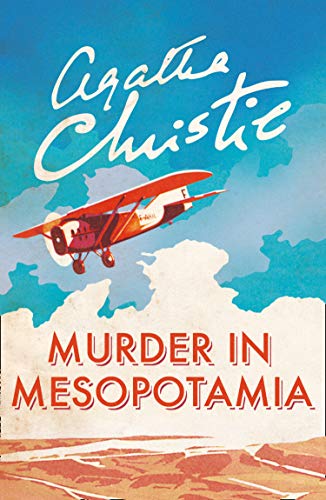
I first read Agatha Christie’s Murder in Mesopotamia in 2012 but never got round to writing about it. It was a good choice to re-read for the 1936 Club as I didn’t remember much about it. It’s a Poirot mystery, but he doesn’t appear until about halfway. As the title tells you it is set in Mesopotamia, the area in the Middle East between the two rivers, Tigris and Euphrates (the area of present-day Iraq, Kuwait, and parts of Iran, Syria, and Turkey).
An archaeologist’s wife is murdered on the shores of the River Tigris in Iraq…
It was clear to Amy Leatheran that something sinister was going on at the Hassanieh dig in Iraq; something associated with the presence of ‘Lovely Louise’, wife of celebrated archaeologist Dr Leidner.
In a few days’ time Hercule Poirot was due to drop in at the excavation site. But with Louise suffering from terrifying hallucinations, and tension within the group becoming almost unbearable, Poirot might just be too late…
Agatha Christie had first visited the Middle East in 1929 travelling on the Orient Express to Istanbul and then on to Damascus and Baghdad. She visited the excavations at Ur and returned there the following spring where she met archaeologist Max Mallowan – by the end of the summer they had decided to marry, which they did on 11 September 1930.So, by 1936 when she wrote Murder in Mesopotamia she had frequently accompanied Max on his archaeological digs and her books set in the Middle East are based on the everyday life that she experienced on a dig and on the people she met.
The murder victim is Louise Leidner, the wife of the leader of the expedition. The novel is narrated by Nurse Amy Leatheran, who had been asked by Dr Leidner to care for Louise, although he is vague about what is wrong with her. It seems she is scared and has nervous terrors. She has fearful visions and the other members of the expedition blame her for the oppressive atmosphere on the dig.
It’s a seemingly impossible murder – she is found in her room, dead from a blow on her head, and suspicion falls on Louise’s first husband who had been sending her threatening letters, or so she had claimed. But no strangers had been seen on or near the expedition house and it is down to Poirot to discover what had actually happened. Fortunately Poirot was in the area, having sorted out a military scandal in Syria (referred to at the beginning of Murder on the Orient Express) and was passing through the expedition site on his way to Baghdad before returning to London.
I thoroughly enjoyed this book, although I think the details of how the murder was committed are rather far-fetched. I was hoping that Agatha Christie had mentioned writing it in her Autobiography, but I couldn’t find any reference to it, although she wrote extensively about her time in the Middle East with Max, and in her fascinating memoir, Come, Tell Me How You Live she wrote about how much she loved the country and its people.
The topic this week is Favourite Book Quotes. At first I didn’t think I would tackle this topic, with so many to choose. But in the end I came up with the following quotations from just three authors.
First from Roger Deakin, Wildwood: A Journey through Trees, a book about Deakin’s journeys through a wide variety of trees and woods in various parts of the world.
“To enter a wood is to pass into a different world in which we ourselves are transformed. It is no accident that in the comedies of Shakespeare, people go into the greenwood to grow, learn and change. It is where you travel to find yourself, often, paradoxically , by getting lost. Merlin sends the future King Arthur as a boy into the greenwood to fend for himself in The Sword in the Stone. There, he falls asleep and dreams himself, like a chameleon, into the lives of the animals and the trees.”
And later in the book he writes about pencils:
“The pencil whispers across the page and is never dogmatic.‘ And this, ‘Rub your finger long enough on a soft-pencilled phrase and it will evaporate into a pale-grey cloud. In this way, pencil is close to watercolour painting.’
Thinking about trees led me on to The Woodlanders by Thomas Hardy, one of my favourites of Hardy’s books, full of beautiful descriptions of the landscape and woods. In this passage he is describing Giles Winterbourne:
“He looked and smelt like Autumn’s very brother, his face being sunburnt to wheat-colour, his eyes blue as corn-flowers, his sleeves and leggings dyed with fruit stains, his hands clammy with the sweet juice of apples, his hat sprinkled with pips, and everywhere about him that atmospheres of cider which at its first return each season has such an indescribable fascination for those who have been born and bred among the orchards.”
Next from Agatha Christie’s Autobiography:
“I am today the same person as that solemn little girl with pale flaxen sausage-curls. The house in which the spirit dwells, grows, develops instincts and tastes and emotions and intellectual capacities, but I myself, the true Agatha, am the same. I do not know the whole Agatha. The whole Agatha, so I believe, is known only to God.
So there we are, all of us, little Agatha Miller, and big Agatha Miller, and Agatha Christie and Agatha Mallowan proceeding on our way – where? That one doesn’t know – which of course makes life exciting. I have always thought life exciting and I still do.”
“Always when I woke up, I had the feeling which I am sure must be natural to all of us, a joy in being alive. I don’t say you feel it consciously – you don’t – but there you are, you are alive, and you open your eyes, and here is another day; another step as it were, on your journey to an unknown place. That very exciting journey which is your life. Not that it is necessarily going to be exciting as a life, but it will be exciting to you because it is your life. That is one of the great secrets of existence, enjoying the gift of life that has been given to you.”
“Naturally happy people can be unhappy and melancholic people enjoy themselves. But if I were taking a gift to a child at a christening that is what I would choose: a naturally happy frame of mind.”
“If I could write like Elizabeth Bowen, Muriel Spark or Graham Greene, I should jump to high heaven with delight, but I know that I can’t, and it would never occur to me to attempt to copy them. I have learnt that I am me, that I can do the things, that as one might put it, me can do, but I cannot do the things that me would like to do.”
And this is probably my favourite of all:
“I like living. I have sometimes been wildly, despairingly, acutely miserable, racked with sorrow, but through it all I still know quite certainly that just to be alive is a grand thing.”