Book Beginnings & The Friday 56: Death in Berlin by M M Kaye

Every Friday Book Beginnings on Friday is hosted by Gillion at Rose City Reader where you can share the first sentence (or so) of the book you are reading. You can also share from a book you want to highlight just because it caught your fancy.

Death in Berlin by M M Kaye is one of the 20 Books of Summer that I’m aiming to read this summer. It is crime fiction set in war-scarred Berlin in the early 1950s. Miranda is on the night train when she discovers a dead body. Years ago I read The Far Pavilions and it is only in recent years that I discovered she wrote the Death in … series. This is the 2nd book in the series first published in 1955.

It begins with a Prologue:

With nightfall the uneasy wind that had sighed all day through the grass and the gorse bushes at the cliff edge died away, and a cold fog crawls in from the sea, obliterating the darkening coastline and muting the drag of waves on shingle to a rhythmic murmur barely louder than the unrelenting and monotomous mutter of gunfire to the east.

followed by Chapter 1

Miranda Brand knelt on the floor of a bedroom in the Families’ Hostel in Bad Oeynhausen in Berlin, searching her suitcase for a cake of soap, and regretting that she had ever accepted her cousin Robert Melville’s invitation to spend a month with him and his family in Berlin.

Also every Friday there is The Friday 56, hosted by Freda at Freda’s Voice, where you grab a book and turn to page 56 (or 56% of an eBook), find one or more interesting sentences (no spoilers), and post them.

Page 56:

Miranda’s eyes widened suddenly and she caught her breath in a little gasp. ‘Yes. There was something else. I heard a door being opened and then I heard someone moving about in there. I thought it was funny – “funny peculiar”, I mean.’

Synopsis from Amazon

Miranda Brand is visiting Germany for what is supposed to be a month’s vacation. But from the moment that Brigadier Brindley relates the story about a fortune in lost diamonds–a story in which Miranda herself figures in an unusual way–the vacation atmosphere becomes transformed into something more ominous. And when murder strikes on the night train to Berlin, Miranda finds herself unwillingly involved in a complex chain of events that will soon throw her own life into peril.

What are you planning to read this summer?

Throwback Thursday: An Uncertain Place by Fred Vargas

Today I’m looking back at my post on An Uncertain Place by Fred Vargas. I first reviewed it on June 10, 2017.

My review begins:

I loved An Uncertain Place, a clever and also a confusing book. It’s the sixth in Fred Vargas’ Commissaire Adamsberg series in which he investigates a macabre murder. I say confusing because I got a bit lost in the middle of the book, and looking back I think it’s because Adamsberg is not your normal detective – he works by intuition and I simply hadn’t followed his train of thought. With a bit of concentration I was back on track and caught up with him.

Click here to read my full review

~~~

Fred Vargas was born in Paris in 1957. As well as being a best-selling author in France, she is an historian and archaeologist.

She worked at the French National Centre for Scientific Research (CNRS), which she joined in 1988. She later joined the Institut Pasteur, as a eukaryotic archaeologist.

She mostly writes police thrillers (policiers). They take place in Paris and feature the adventures of Chief Inspector Adamsberg and his team. Her interest in the Middle Ages is manifest in many of her novels, especially through the person of Marc Vandoosler, a young specialist in the period. Seeking Whom He May Devour was shortlisted by the British Crime Writers’ Association for the last Gold Dagger award for best crime novel of the year, and the following year The Three Evangelists won the inaugural Duncan Lawrie International Dagger. She also won the award for the second year-running with Wash This Blood Clean From My Hand.

~~~

The next Throwback Thursday post is scheduled for June 30, 2022.

Stamboul Train by Graham Greene

Vintage Digital/ 2010/ e-book/ Print length: 216 pages/ My own copy/ 4*

Stamboul Train was first published in the UK in 1932 and was renamed Orient Express when it was published in the USA. My copy is an e-book, with an Introduction by Christopher Hitchins.

I read it in February and didn’t find time to write about it then, so this is just a mini review that really only skates over the surface of the novel. I enjoyed it, set in the early 1930s, about a three day journey on the luxurious Orient Express travelling from Ostend to Constantinople (Instanbul or Stamboul), via Cologne, Vienna and Belgrade.

Greene weaves a web of subterfuge, murder and politics around his characters, including Carleton Myatt, a Jewish businessman, who trades in currants; Coral Musker, a dancer, a chorus girl on her way to join the Dunn’s Babies dance troupe in Constantinople; a journalist, Mabel Warren, a lesbian who drinks too much; Dr Czinner, a Yugoslavian on his own mission of revolution (as Hutchins describes it), a dissident communist leader, travelling under the name of schoolteacher Richard John – Mabel has recognised him as Dr Czinner and is after a scoop from him for her newspaper; and Josef Grünlich, a murdurous burglar. .

It’s a dismal book in some respects. Written in 1931, it reflects the anti-Semitism of the period, although I think Greene’s description of Myatt’s generosity towards Coral in giving her his berth in a first-class sleeping compartment shows some sympathy towards Jews. Having said that, I also think the characters as a whole are stereotypical, but the tension that he builds around them is palpable.

Greene’s storytelling saved the book for me, with descriptions of the train itself and the glimpses of the countryside as the train speeds along – as well as Myatt’s dramatic car journey through the snow-laden countryside to and from the railway station at Subotica on the Yugoslavian border. Written just as the Nazi party was preparing to take power in Germany there is a sense of unease throughout the novel.

Top Ten Tuesday: Book Quote Freebie

Top Ten Tuesday is a weekly meme created by The Broke and the Bookish and now hosted by Jana at That Artsy Reader Girl. For the rules see her blog.

The topic this week is a Book Quote Freebie (Share your favorite book quotes that fit a theme of your choosing! These could be quotes about books/reading, or quotes from books. Some examples are: quotes for book lovers, quotes that prove reading is the best thing ever, funny things characters have said, romantic declarations, pretty scenery descriptions, witty snippets of dialogue, etc.)

These are from Agatha Christie’s An Autobiography:

About creating the character of Hercule Poirot:

Why not make my detective a Belgian? I thought. There were all types of refugees. How about a refugee police officer? A retired police officer. Not too young a one. What a mistake I made there. The result is that my fictional detective must be well over a hundred by now.

Anyway, I settled on a Belgian detective. I allowed him to grow slowly into his part. He should have been an inspector, so that he would have a certain knowledge of crime. He would be meticulous, very tidy, I thought to myself, as I cleared away a good many untidy odds and ends in my own bedroom. A tidy little man. (page 263)

About Miss Marple, who was about 65 -70 years old when she first appeared in The Murder at the Vicarage in 1930. Agatha envisaged her as 

‘the sort of old lady who would have been rather like some of my grandmother’s Ealing cronies’. But she was not like Agatha’s grandmother at all – being ‘far more fussy and spinsterish‘.

In The Murder at the Vicarage Miss Marple is not the popular figure she appears in the later books as not everybody likes her. The vicar does, liking her sense of humour, and describing her as 

‘a white-haired old lady with a gentle appealing manner’, whereas his wife describes her as ‘the worst cat in the village. And she always knows everything that happens – and draws the worst inference from it.

People suggested that Miss Marple and Poirot should meet, but Agatha dismissed that idea because she didn’t think they would enjoy it at all and wouldn’t be at home in each other’s world.

In one way Miss Marple was like her grandmother:

…I endowed my Miss Marple with something of Grannie’s powers of prophecy. There was no unkindness in Miss Marple, she just did not trust people. Though she expected the worst, she often accepted people kindly in spite of what they were. (pages 447 -50)

On Writing. Throughout her autobiography Agatha writes about writing, how she wrote, where she wrote and so on. Here are just two examples:

If I could write like Elizabeth Bowen, Muriel Sparl or Graham Greene, I should jump to high heaven with delight, but I know that I can’t, and it would never have occurred to me to attempt to copy them. I have learnt that I am me, that I can do the things that, as one might put it, me can do, but I cannot do the things that me would like to do. (page 422)

And:

… I knew that writing was my steady, solid profession. I could go on inventing my plots and writing my books until I went gaga.

There is always, of course, that terrible three weeks, or a month, which you have to get through when you are trying to get started on a book. There is no agony like it. You sit in a room, biting pencils, looking at a typewriter, walking about, or casting yourself on a sofa, feeling you want to cry your head off. (page 490)

On Writing Detective Stories:

One of the pleasures of writing detective stories is that there are so many types to choose from: the light hearted thriller, which is particularly pleasant to do; the intricate detective story with an involved plot which is technically interesting and requires a great deal of work, but is always rewarding; and then what I can only describe as the detective story that has a kind of passion behind it – that passion being to help save innocence. Because it is innocence that matters, not guilt. (page 453)

On Writing Short Stories:

I think myself that the right length for a novel is 50,000 words. I know this is considered by publishers as too short. Possibly readers feel themselves cheated if they pay their money and only get 50, 000 – so 60,000 or 70,000 are more acceptable. If your book runs to more than that I think you will usually find that it would have been better if it had been shorter. 20,000 words for a long short story is an excellent length for a thriller. Unfortunately there is less and less market for stories of that size and authors tend not to be particularly well paid. One feels therefore that one would do better to continue the story, and expand it to a full length novel. The short story technique, I think, is not really suited to the detective story at all. A thriller, possibly – but a detective story no. (page 352) (my highlighting)

I’m not a great fan of short stories, but I think that Agatha Christie’s collection of stories in The Mysterious Mr Quin contains some of her very best short stories. They were her favourites too. They are set in the 1920s and have a paranormal element to them, as well as a touch of romance. I found them all most entertaining. She describes Mr Quin as

… a figure who just entered into a story – a catalyst no more – his mere presence affected human beings. There would be some little fact, some apparently irrelevant phrase, to point him out for what he was: a man shown in a harlequin-coloured light that fell on him through a glass window; a sudden appearance or disappearance. Always he stood for the same thing: he was a friend of lovers, and connected with death. (page 447)

On living :

I like living. I have sometimes been wildly despairing, acutely miserable, racked with sorrow, but through it all I still know quite certainly that just to be alive is a grand thing. (page 11)

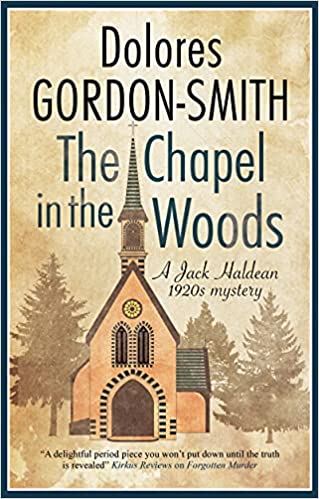
The Chapel in the Woods by Dolores Gordon-Smith

Severn House| 1 March 2022| 256 pages| e-book| Review copy| 3*

The Chapel in the Woods is the 11th Jack Haldean Murder Mystery, set in the 1920s.

Major Jack Haldean, a former World War I pilot, is a detective story writer. He and his wife Betty are visiting his cousin Isabelle and her husband Arthur in the hamlet of Croxton Abbas in Sussex. The neighbouring estate, Birchen Bower, had recently been bought by Canadian Tom Jago and his wife Rosalind. A fortnight earlier he had sent Derek Martin and his wife, Jean, in advance to open up the house and unpack their belongings, but when the Jagos arrive they discover the house open and that most of their things including Rosalind’s diamonds had been stolen. And the Martins have disappeared. But Jago can’t believe that Martin is the thief, maintaining he is perfectly honest. Jack has formerly helped his friend Detective Superintendent Ashley of the Sussex Police with a number of cases and as he is staying locally he gets involved in the police investigations.
Jago is renovating the 17th century house, built around 1620, by William Cayden, set in woodland. The chapel in the woods contains the tomb of Anna, Cayden’s wife who was a native of Peru. Her tomb, a box tomb, is decorated with an elaborately carved leaping jaguar – hence the legend of the Jaguar Princess who haunts the chapel and grounds taking the form of a jaguar.

It gets more and more complicated. In the Victorian period Josiah Cayden, an explorer and big game hunter had imported wild animals from South America, wanting to recreate a piece of the Amazon in the grounds. And now the locals are convinced that there is something in the woods that shouldn’t be there. There have been stories about dead and mutilated animals being found around Birchen Bower woods, and every so often dogs and ponies go missing. So, when Jago hosts the village fete, the local residents throng to the estate, some keen to follow the path into the woods to visit the chapel, only to find a dead body, apparently mauled by a jaguar.

And then there is another body … Is there really a jaguar roaming the woods, or is something supernatural going on? And who stole the diamonds, was it Derek Martin or someone else? Where is Derek Martin? What is the truth about the legend of the Jaguar Princess?

It is entertaining, with a mysterious, even supernatural atmosphere in parts, but it all seems to me too unlikely and fanciful and too convoluted. I liked the setting, the scenes in the woodlands and the historical aspects. But, there is too much repetition of the events and too much discussion about the various possibilities. I lost interest and just wanted to know how the mystery was resolved. It all gets sorted out and ends as Jack explains how he uncovered what had really happened.

My thanks to Severn House for a review copy via NetGalley.

Book Beginnings & The Friday 56: The Fellowship of the Ring by J R R Tolkein

Every Friday Book Beginnings on Friday is hosted by Gillion at Rose City Reader where you can share the first sentence (or so) of the book you are reading. You can also share from a book you want to highlight just because it caught your fancy.

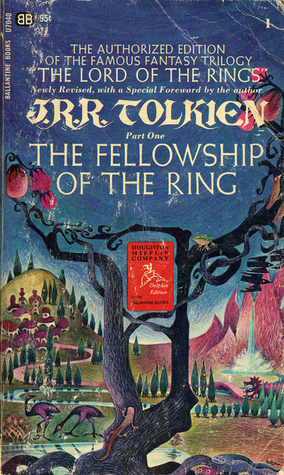
I’m currently reading The Fellowship of the Ring by J R R Tolkein, the first book in The Lord of the Rings, one of the few books I’ve previously read several times. I first came across it at the library when I was a teenager and I loved it so much that I decided I needed to buy my own copy for myself. It contains all three books, The Fellowship of the Ring, The Two Towers and The Return of the King.

The Book begins with a Prologue: Concerning Hobbits

Hobbits are an unobtrusive but very ancient people, more numerous formerly than they are today; for they love peace and quiet and good tilled earth: a well-ordered and well-farmed countryside was their favourite haunt.

Chapter 1: A Long-Expected Party

When Mr Bilbo Baggins of Bag-End announced that he would shortly be celebrating his eleventy-first birthday with a party of special magnificence, there was much talk and excitement in Hobbiton.

Also every Friday there is The Friday 56, hosted by Freda at Freda’s Voice, where you grab a book and turn to page 56 (or 56% of an eBook), find one or more interesting sentences (no spoilers), and post them.

Page 56:

Frodo took the envelope from the mantelpiece, and glanced at it, but did not open it.

‘You’ll find his will and all the other documents in there, I think,’ said the wizard. ‘You are the master of Bag-End now. And also, I fancy, you’ll find a golden ring.’

‘The ring!’ exclaimed Frodo. ‘Has he left me that? I wonder why. Still it may be useful.’

‘It may, and it may not,’ said Gandalf. ‘I should not make use of it, if I were you. But keep it secret, and keep it safe! Now I am going to bed.’

Synopsis from Goodreads

Sauron, the Dark Lord, has gathered to him all the Rings of Power – the means by which he intends to rule Middle-earth. All he lacks in his plans for dominion is the One Ring – the ring that rules them all – which has fallen into the hands of the hobbit, Bilbo Baggins.

In a sleepy village in the Shire, young Frodo Baggins finds himself faced with an immense task, as the Ring is entrusted to his care. He must leave his home and make a perilous journey across the realms of Middle-earth to the Crack of Doom, deep inside the territories of the Dark Lord. There he must destroy the Ring forever and foil the Dark Lord in his evil purpose.

~~~~~

Re-reading it now, it has lost none of the magic I found the first time. It is one of my all time favourite books