Nucleus by Rory Clements

Rating: 5 out of 5.

Zaffre| January 2018| 453 pages| Hardback| My own copy| 5 stars

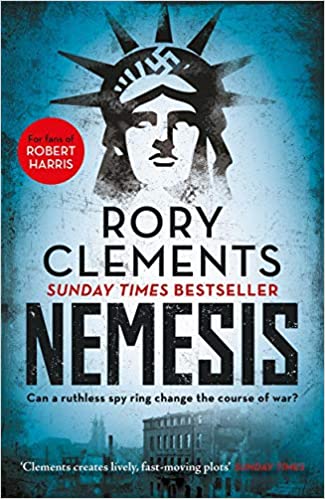
Nucleus by Rory Clements is the second book in his Tom Wilde series (the full list is at the end of this post). I have been reading them out of order, as I came across them. I think I’d have understood the relationship of the characters better if I had read the series in order from the start, but that has not stopped me from enjoying them.

Blurb

WINNER OF THE CWA HISTORICAL DAGGER 2018.
The eve of war: a secret so deadly, nothing and no one is safe

June 1939. England is partying like there’s no tomorrow . . . but the good times won’t last. The Nazis have invaded Czechoslovakia, in Germany Jewish persecution is widespread and, closer to home, the IRA has embarked on a bombing campaign.

Perhaps most worryingly of all, in Germany Otto Hahn has produced man-made fission and an atomic device is now possible. German High Command knows Cambridge’s Cavendish Laboratory is also close, and when one of the Cavendish’s finest brains is murdered, Professor Tom Wilde is drawn into the investigation. In a conspiracy that stretches from Cambridge to Berlin, and from the US to Ireland, can he discover the truth before it’s too late?

I’ve found this quite a difficult book to summarise as there are various elements to the plot. I think the publishers’ blurb merely skims the surface, but to go into detail would give away too much. With several plot lines, this is a mix of historical fact and fiction, set in 1939 when England and Germany are on the brink of war. It is a fast-paced and gripping book, involving murder, IRA bombers, and espionage, with many twists and turns

In Nazi Germany Jews are in fear of their lives, trying to leave the country. Some have made it to England and America. In both countries the race is on to develop an atomic bomb.

There’s a large cast of characters – the main one being Tom Wilde, an American professor of history at Cambridge University, who has returned from America after a meeting with President Roosevelt. There he was asked to liaise with two Americans in England, Colonel Dexter Flood and also to keep an eye on Milt Hardman, an American millionaire who is staying at Old Hall in Cambridgeshire with his family.

And so Wilde is drawn into Hardman’s world, meeting a Hollywood actress, drinking champagne, playing tennis, and partying. And then he soon finds himself having to deal with an increasingly complex situation when one of the Cavendish scientists, an introverted genius who was due to move to America to work with Oppenheimer, is found drowned in the River Cam, and then another one goes missing.

Meanwhile Albert, Eva Haas’ young son is also missing, apparently having been abducted from a Kindertransport train. Eva is a German Jewish physicist, who along with Arnold Lindberg, an elderly scientist rescued from Dachau, has arrived in Cambridge. Lydia, who is Tom’s neighbour and lover is a friend of Eva’s. She was to meet Albert in England and goes to Berlin to try to find out what has happened to him. There she is helped by Bertha Bracey and Frank Foley (real-life heroes). Bertha was working to rescue German Jewish children, organising Kindertransports, finding homes and schools for the children in Britain, and Frank, who was MI6’s top spy in Berlin. He broke all the rules to make sure as many Jewish people had visas to leave the country, saving many thousands of people.

I was totally immersed in the plot. It’s full of danger and action, and I thoroughly enjoyed it. I learned much – not only about atomic fission, but also about the situation in Germany leading up to the Second World War – I hadn’t heard of the work of Bertha Bracey and Frank Foley before.

I’ve read three of Rory Clements’ books in his Tom Wilde series, with links to my posts:

Book Beginnings & The Friday 56: The Island by Victoria Hislop

Every Friday Book Beginnings on Friday is hosted by Gillion at Rose City Reader where you can share the first sentence (or so) of the book you are reading. You can also share from a book you want to highlight just because it caught your fancy.

I’m currently reading The Island by Victoria Hislop, a book I’ve had on my bookshelves for years. The Wanderlust Bingo challenge has given me a massive nudge to read it now as it is the perfect book for the Island category! It is historical fiction inspired by a visit to Spinalonga, the abandoned Greek leprosy colony, an island off the coast of Crete, a stone’s throw from Plaka. I’ve now read 25% of this book and am enjoying it so far.

Plaka, 1953

A cold wind whipped through the streets of Plaka and the chill of the autumnal air encircled the woman, paralysing her body and mind with a numbness that almost blocked her senses but could do nothing to alleviate her grief.

Also every Friday there is The Friday 56, hosted by Freda at Freda’s Voice, where you grab a book and turn to page 56 (or 56% of an eBook), find one or more interesting sentences (no spoilers), and post them.

Page 57 (page 56 is blank):

1939

Early May brings Crete its most perfect and heaven-sent days. On one such day, when the trees were heavy with blossom and the very last of the mountain snows had melted into crystal streams, Elena left the mainland for Spinalonga. In cruel contrast to this blackest of events, the sky was brilliant, a cloudless blue

Synopsis from Amazon:


On the brink of a life-changing decision, Alexis Fielding longs to find out about her mother’s past. But Sofia has never spoken of it. All she admits to is growing up in a small Cretan village before moving to London. When Alexis decides to visit Crete, however, Sofia gives her daughter a letter to take to an old friend, and promises that through her she will learn more.

Arriving in Plaka, Alexis is astonished to see that it lies a stone’s throw from the tiny, deserted island of Spinalonga – Greece’s former leper colony. Then she finds Fotini, and at last hears the story that Sofia has buried all her life: the tale of her great-grandmother Eleni and her daughters and a family rent by tragedy, war and passion.

She discovers how intimately she is connected with the island, and how secrecy holds them all in its powerful grip…

I’ve read three other books by Victoria Hislop and enjoyed them so I’m expecting this one to be good too.

What do you think? Have you read this book ?

Top Ten Tuesday:Books I Love That Were Written Over Ten Years Ago.

Top Ten Tuesday is a weekly meme created by The Broke and the Bookish and now hosted by Jana at That Artsy Reader Girl. For the rules see her blog.

The topic this week is Books I Love That Were Written Over Ten Years Ago. This is a hard topic because there are so many books that I love that were written over ten years ago. So, I have tried to choose books I haven’t featured before on my blog. I’ve linked them to either Goodreads or Amazon UK.

Chatterton by Peter Ackroyd (published in 1987). I have had this book for so long that I can’t remember when I bought it. Thomas Chatterton was an 18th century poet, a forger and a genius, whose life ended under mysterious circumstances. He died in 1770 when he was 18. His death was thought to be suicide: But what really happened?

A Passage to India by E M Forster (published in 1924). This was the first of Forster’s books that I’ve read. Dr Aziz is a young Muslim physician in the British Indian town of Chandrapore. One evening he comes across an English woman, Mrs Moore, in the courtyard of a local mosque; she and her younger travelling companion Adela are disappointed by claustrophobic British colonial culture and wish to see something of the ‘real’ India. But when Aziz kindly offers to take them on a tour of the Marabar caves with his close friend Cyril Fielding, the trip results in a shocking accusation that throws Chandrapore into a fever of racial tension.

Gentlemen and Players by Joanne Harris (published in 2005). At St Oswald’s, a long-established boys’ grammar school in the north of England, a new year has just begun. For the staff and boys of the school, a wind of unwelcome change is blowing. Suits, paperwork and Information Technology rule the world; and Roy Straitley, the eccentric veteran Latin master, is finally – reluctantly – contemplating retirement. But beneath the little rivalries, petty disputes and everyday crises of the school, a darker undercurrent stirs.

Pictures of Perfection by Reginald Hill (published in 1994). High in the Mid-Yorkshire Dales stands the traditional village of Enscombe, seemingly untouched by the modern world. The disappearance of a policeman brings Detective Superintendent Andy Dalziel and DCI Peter Pascoe to its doors. As the detectives dig beneath the veneer of idyllic village life a new pattern emerges: of family feuds, ancient injuries, cheating and lies. And finally, as the community gathers for the traditional Squire’s Reckoning, it looks as if the simmering tensions will erupt in a bloody climax…

A Thousand Splendid Suns by Khaled Hosseini, one of the most devastating and heartbreaking novels I’ve read (published in 2007). The book, which spans a period of over 40 years, from the 1960s to 2003, focuses on the tumultuous lives and relationship of Mariam and Laila, two Afghan women. Mariam, an illegitimate child, suffers from the stigma surrounding her birth and the abuse she faces throughout her marriage. Laila, born a generation later, is comparatively privileged during her youth until their lives intersect and she is also forced to accept a marriage proposal from Rasheed, Mariam’s husband.

The Light Years by Elizabeth Jane Howard (published in 1988). The first in the Cazelet Chronicles. In 1937, the coming war is only a distant cloud on Britain’s horizon. As the Cazalet households prepare for their summer pilgrimage to the family estate in Sussex, readers meet Edward, in love with but by no means faithful to his wife Villy; Hugh, wounded in the Great War; Rupert, who worships his lovely child-bride Zoe; and Rachel, the spinster sister.

A Short History of Tractors in Ukrainian by Marina Lewycka (published in 2005). Sisters Vera and Nadezhda must aside a lifetime of feuding to save their émigré engineer father from voluptuous gold-digger Valentina. With her proclivity for green satin underwear and boil-in-the-bag cuisine, she will stop at nothing in her pursuit of Western wealth. But the sisters’ campaign to oust Valentina unearths family secrets, uncovers fifty years of Europe’s darkest history and sends them back to roots they’d much rather forget . . . .

Titus Groan by Mervyn Peake (published in 1946). I first read this as a teenager. It’s the first book in the Gormenghast trilogy, a gothic fantasy whose strange characters’ lives are dominated by the labyrinthine castle of Gormenghast and its ancient rituals.Titus, heir to Lord Sepulchrave, has just been born, he stands to inherit the miles of rambling stone and mortar that stand for Gormenghast Castle. There are tears and strange laughter; fierce births and deaths beneath umbrageous ceilings; dreams and violence and disenchantment contained within a labyrinth of stone.

Dark Fire by C J Sansom (published in 2004). I love all the books in the Shardlake series. This is the second book, set in England in 1540. Matthew Shardlake, believing himself out of favour with Thomas Cromwell, is busy trying to maintain his legal practice and keep a low profile. But his involvement with a murder case, defending a girl accused of brutally murdering her young cousin, brings him once again into contact with the king’s chief minister – and a new assignment . . .

A Jealous Ghost by A N Wilson (published in 2005). This is a re-writing of Henry James’s The Turn of the Screw. There is something rather disquieting about Sallie Declan, a young American in London, who is obsessed with The Turn of the Screw, the subject of her PhD. thesis. She leaves her studies for a temporary job as a nanny in a large country house and builds a fantasy about her emotional future there. Surely she can see it is all delusion? But a progressively darker reality unfolds leading inevitably to a terrible and shocking climax. It’s good, although not as good as Henry James’s novel.

Spell the Month in Books – August

Spell the Month in Books is a linkup hosted by Jana on Reviews From the Stacks on the second Saturday of each month. The goal is to spell the current month with the first letter of book titles, excluding articles such as ‘the’ and ‘a’ as needed. That’s all there is to it! Some months there are optional theme challenges, such as “books with an orange cover” or books of a particular genre, but for the most part, any book you want to use is fair game!

There’s no theme this month. These are all books I’ve enjoyed – the descriptions are taken from Goodreads and the links to my reviews are in the titles of each book.

A is for Absent in the Spring by Mary Westmacott (Agatha Christie)

Returning from a visit to her daughter in Iraq, Joan Scudamore finds herself unexpectedly alone and stranded in an isolated rest house by flooding of the railway tracks. This sudden solitude compels Joan to assess her life for the first time ever and face up to many of the truths about herself. Looking back over the years, Joan painfully re-examines her attitudes, relationships and actions and becomes increasingly uneasy about the person who is revealed to her.

U is for An Uncertain Place by Fred Vargas

Adamsberg travels to London, where a routine conference draws him into a disturbing investigation.

Commissaire Adamsberg leaves Paris for a three-day conference in London. With him are a young sergeant, Estalère, and Commandant Danglard, who is terrified at the idea of travelling beneath the Channel. It is the break they all need, until a macabre and brutal case comes to the attention of their colleague Radstock from New Scotland Yard.

Just outside the baroque and romantic old Highgate cemetery a pile of shoes is found. Not so strange in itself, but the shoes contain severed feet. As Scotland Yard’s investigation begins, Adamsberg and his colleagues return home and are confronted with a massacre in a suburban home. Adamsberg and Danglard are drawn in to a trail of vampires and vampire-hunters that leads them all the way to Serbia, a place where the old certainties no longer apply.

G is for The Graveyard Book by Neil Gaiman

Nobody Owens, known to his friends as Bod, is a perfectly normal boy. Well, he would be perfectly normal if he didn’t live in a graveyard, being raised and educated by ghosts, with a solitary guardian who belongs to neither the world of the living nor the world of the dead.

There are dangers and adventures for Bod in the graveyard: the strange and terrible menace of the Sleer; a gravestone entrance to a desert that leads to the city of ghouls; friendship with a witch, and so much more.

But it is in the land of the living that real danger lurks, for it is there that the man Jack lives and he has already killed Bod’s family.

U is for The Uncommon Reader by Alan Bennett

Led by her yapping corgis to the Westminster traveling library outside Buckingham Palace, the Queen finds herself taking out a novel by Ivy Compton-Burnett. Duff read though it is, the following week her choice proves more enjoyable and awakens in Her Majesty a passion for reading so great that her public duties begin to suffer. And so, as she devours work by everyone from Hardy to Brookner to Proust to Beckett, her equerries conspire to bring the Queen’s literary odyssey to a close.

S is for A Single Thread by Tracy Chevalier

1932. After the Great War took both her beloved brother and her fiancé, Violet Speedwell has become a “surplus woman,” one of a generation doomed to a life of spinsterhood after the war killed so many young men. Yet Violet cannot reconcile herself to a life spent caring for her grieving, embittered mother. After countless meals of boiled eggs and dry toast, she saves enough to move out of her mother’s place and into the town of Winchester, home to one of England’s grandest cathedrals. There, Violet is drawn into a society of broderers–wo men who embroider kneelers for the Cathedral, carrying on a centuries-long tradition of bringing comfort to worshippers.

T is for The Tapestry of Love by Rosy Thornton

A warm and uplifting story of how a woman falls in love with a place and its people: a landscape, a community and a fragile way of life.

A rural idyll: that’s what Catherine is seeking when she sells her house in England and moves to a tiny hamlet in the Cévennes mountains. With her divorce in the past and her children grown, she is free to make a new start, and her dream is to set up in business as a seamstress. But this is a harsh and lonely place when you’re no longer just here on holiday. There is French bureaucracy to contend with, not to mention the mountain weather, and the reserve of her neighbours, including the intriguing Patrick Castagnol. And that’s before the arrival of Catherine’s sister, Bryony…

The theme for September 10 is Space; books about exploring outer space, stars, science fiction set on different planets, etc. Anything that connects to space in any way.

Six Degrees of Separation from The Book of Form and Emptiness to Death at Wentwater Court

It’s time again for Six Degrees of Separation, a monthly link-up hosted by Kate at Books Are My Favourite and Best. Each month a book is chosen as a starting point and linked to six other books to form a chain. A book doesn’t need to be connected to all the other books on the list, only to the one next to it in the chain.

The starting book this month is Ruth Ozeki’s The Book of Form and Emptiness, which won the Women’s Prize for Fiction this year. The judges stated that: it stood out for its sparkling writing, warmth, intelligence, humour and poignancy. A celebration of the power of books and reading, it tackles big issues of life and death, and is a complete joy to read. Ruth Ozeki is a truly original and masterful storyteller.”

I haven’t read it. Amazon’s description makes me wonder whether I want to: After the tragic death of his father, fourteen-year-old Benny Oh begins to hear voices. The voices belong to the things in his house and sound variously pleasant, angry or sad. Then his mother develops a hoarding problem, and the voices grow more clamorous. So Benny seeks refuge in the silence of a large public library. There he meets a mesmerising street artist with a smug pet ferret; a homeless philosopher-poet; and his very own Book, who narrates Benny’s life and teaches him to listen to the things that truly matter.

First Link

There are a number of ways I could have started my chain, but I made it easy by linking to another ‘Book of’ title – The Book of Illusions by Paul Auster. It tells the stories of two men, David Zimmer, a professor whose wife and two sons were killed in a plane crash and Hector Mann, a silent movie star who disappeared mysteriously in 1929. David is plunged into depression and ‘lived in a blur of alcoholic grief and self-pity’ until he watched a clip from one of Hector’s films. It made him laugh. In typical silent movie style Hector, with his slicked-back hair, thin and greasy little mustache and white suit, is the target and focal point of every mishap.

Second link

Another silent movie, Safety Last!, features in Simon Garfield’s Timekeepers: How the World Became Obsessed with Time. Harold Lloyd climbs the outside of a department store, obstacles falling on him as he does so, until he reaches the giant clock at the top, grabs hold of it, and dangles above the street below. Garfield recalls that for the first audiences time just froze, some went into hysterics and others fainted. Garfield’s focus is on the concept of time that the movies portrayed and goes on to explain how films were originally produced and shown when the timing depended on the cranking skills of the cameraman during filming and the projectionist during showing.

Third link

I’m linking next to another book with the word ‘Safety‘ in the title – A Place of Greater Safety by Hilary Mantel, nonfiction about the French Revolution concentrating on three of the revolutionaries – Georges-Jacques Danton, Camille Desmoulins and Maximilian Robespierre, from their childhoods to their deaths. I never really sympathised with any of them – after all they were responsible for the deaths of many people, including their own friends and played a major part in the Reign of Terror. But at times I was drawn into hoping that they would escape their fate – they were all guillotined. 

Fourth Link

From a book about the French Revolution my next link is to : Wild Swans: Three Daughters of China by Jung Chang, about her grandmother, her mother and herself, telling of their lives in China up to and during the years of the violent Cultural Revolution from 1966 until Mao Zedong’s death in 1976. In it she casts light on why and how Mao was able to exercise such paralysing control over the Chinese people. His magnetism and power was so strong and coupled with his immense skill at manipulation and his ability to inspire fear, it proved enough to subdue the spirit of most of the population; not to mention the absolute cruelty, torture and hardships they had to endure.

Fifth Link

From a book about a grandmother, mother and daughter in China the next link is to another book about a grandmother, mother and daughter, in Kingsmarkham, a fictional English town, a novel Kissing the Gunner’s Daughter by Ruth Rendell, an Inspector Wexford mystery. Chief Inspector Wexford and Inspector Burden are faced with solving the brutal murders of author Davina Flory, her husband and daughter, shot dead at Tancred House. Only Daisy, her granddaughter survived, and wounded in the shoulder she had crawled to the phone to call for help. ‘Kissing the Gunner’s Daughter’ is a phrase derived from a tradition in the Royal Navy, as Wexford explains, it means being flogged.

Sixth Link

Another character called Daisy also in Death at Wentwater Court by Carola Dunn, the first book in her Daisy Dalrymple series, a typical country house murder mystery, with plenty of suspects. The Honourable Daisy Dalrymple, keen to be independent and earn her own living, is on her first writing assignment for Town and Country magazine, writing about country houses. One of the guests, Lord Stephen Astwick is found dead in the lake and it appears he has had a skating accident. Enter Detective Chief Inspector Alec Fletcher of Scotland Yard, who is also investigating a jewel robbery at Lord Flatford’s house nearby.

My chain this month has a variety of books linked in different ways – words in the titles, revolutions, daughters and characters with the same name. I has books of historical fiction, crime fiction and nonfiction.

Book Beginnings & The Friday 56: The Daughters of Cain by Colin Dexter

Every Friday Book Beginnings on Friday is hosted by Gillion at Rose City Reader where you can share the first sentence (or so) of the book you are reading. You can also share from a book you want to highlight just because it caught your fancy.

I began reading Colin Dexter’s Inspector Morse books years ago and have read 9 of the 13 books in the series, mostly out of order, so I’ve been reading the earlier books to fill in the gaps, as it were. Chief Inspector Morse is one of my favourite fictional detectives (maybe even the favourite). I first ‘met’ him years ago in the ITV series Inspector Morse and so, just as Joan Hickson is forever in my mind as Miss Marple and David Suchet is Poirot, John Thaw is Morse. This post is about the 11th book The Daughters of Cain.

It begins with a Prolegomena ie Prologue

Natales grate numeras?
(Do you count your birthdays with gratitude?)
(Horace, Epistles II)

On Mondays to Fridays it was fifty-fifty whether the postman called before Julia Stevens left for school.

Julia is a teacher, not a pupil.

Also every Friday there is The Friday 56, hosted by Freda at Freda’s Voice, where you grab a book and turn to page 56 (or 56% of an eBook), find one or more interesting sentences (no spoilers), and post them.

Page 56:

She’d never loved anyone in life really – except for her mum. But amongst her clients, that rather endearing, kindly, caring sort of idiot, Felix, had perhaps come nearer than anyone.

Synopsis from Goodreads:

Bizarre and bewildering – that’s what so many murder investigations in the past had proved to be… In this respect, at least, Lewis was correct in his thinking. What he could not have known was what unprecedented anguish the present case would cause to Morse’s soul.

Chief Superintendent Strange’s opinion was that too little progress had been made since the discovery of a corpse in a North Oxford flat. The victim had been killed by a single stab wound to the stomach. Yet the police had no weapon, no suspect, no motive.

Within days of taking over the case Chief Inspector Morse and Sergeant Lewis uncover startling new information about the life and death of Dr Felix McClure. When another body is discovered Morse suddenly finds himself with rather too many suspects. For once, he can see no solution. But then he receives a letter containing a declaration of love… 

What do you think? Have you read this book – or any of the Inspector Morse books?