Griff Rhys Jones – “Rivers”

I’ve been watching Griff’s TV series Rivers, so I was thrilled to read on the Mostly Books blog that he was giving a talk in Abingdon. Of course, by the time I read about it all the tickets were sold out, but I had a phone call yesterday morning – some tickets had been returned and did I still want to go!

griff1My thanks go to the person who returned the tickets – it was a great evening. Griff was up and running as soon as he was on stage – entertaining, funny and oh, so knowledgeable. So many facts spilled out of him with boundless enthusiasm and all without any notes. Griff explained how he came to do the TV series and how the producers like him to be “in jeopardy” – if you’ve seen any of his TV programmes, you’ll know what he means, from dangling on a cradle whilst cleaning windows of a New York skyscraper (his hairiest moment) to swimming the River Mersey, in danger of getting Weil’s disease when he fell straight in the sewage going underground with the team maintaining Manchester’s waterways, and kayaking in a canoe slalom on the River Derwent.

Griff is passionate about rivers and opening them up for people to use. He wanted to make a series about the landscape and how it is used – the waterways of Britain are the ancient transport routes only superceded by road and rail relatively recently. The rivers are there to be used, navigation rights that have been extinguished should be reinstated so that we can all use them. He also wanted it to be about the history of rivers – telling how the monks were the first people to use the rivers, creating the water meadows to irrigate the land, how people settled near rivers, how the towns grew up, how they were above all working rivers, and how we have lost our ancient connection with rivers.

griff21I bought his book – Rivers: a Voyage into the Heart of Britain, which he explained is not just about the TV series but is full of stories. I  joined the long queue waiting for him to sign it. I was almost the last person in the queue, but he was still cheerfully smiling and signing! I asked him how long it had taken him to write the book. He paused and screwed his eyes up whilst he thought back, “Well I started it in November … and had to have it finished by … February”, he said. “And then it was edited down, it was much longer than it is now.”

Well, that wasn’t very long to write such a detailed, hefty book, which looks  fascinating, complete with line drawings, maps and colour illustrations. I’ve only dipped into it so far, but here is an extract conveying the beauty of our rivers:

Down beyond Sudbury the River Stour closes in. It slinks through a perfect English landscape: Essex to the south, the much more mythically rural Suffolk to the north. “Suffolk” sounds eggy, buccolic, lost and lazy. Essex is equally as good, just not so equally named. I glimpsed wool merchants’ ochre or pink half-timbered hall houses. I slid into great mill ponds. There were plenty of startling grand churches, some paid for out of the profits of the local weaving industry, some like Stoke-by-Nayland, by rich medieval aristocrats. But mostly, despite the hard-won navigation rights, I was alone, hemmed in by tall banks of reeds, picking my way through over-hanging willows, negotiating passage rights with arrogant swans.

Frequently a stretch would open out with bullrushes standing up on either side, below whispering aspens. The way was clogged with waterlilies in full bloom: buttercup-coloured buds the size of small fists, and open petals like dishes, lying on flat floating leaves. The water itself was clear and waving with green cabbage-like undergrowth that ceaselessly, yearningly, writhed in the current. I could see right down to a river bottom reflecting sunlight off mother-of-pearl freshwater mussel shells. (page 277-8)

As well as meeting Griff I also met Annabel from Gaskella, who was on the stall selling books – she has the good fortune of having Mostly Books as her local bookshop. She’s also written about the event – see here.

Tuesday Teaser – And Then You Die

teaser-tuesdayTeaser Tuesday is hosted by MizB at Should Be Reading.

Grab your current read.
Let the book fall open to a random page.
Share with us two (2) ‘teaser’ sentences from that page.

I haven’t started to read And Then You Die by Michael Dibdin yet and actually it’s one that my husband has borrowed from the library, but it looks interesting and the first two sentences caught my attention:

Aurelio Zen was dead to the world. Under the next umbrella, a few desirable metres closer to the sea, Massimo Rutelli was just dead.

I think I’ll read it when he’s finished it.

Julius Caesar

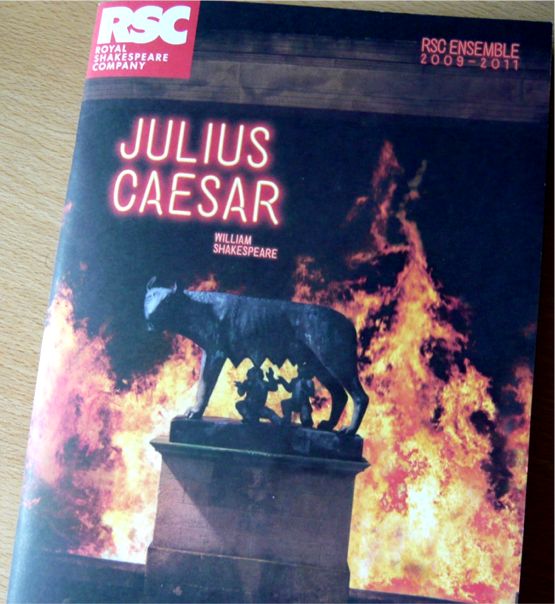
jc-progOur last visit to the RSC in Stratford was in 2007. We try to go for my birthday in August but last year left it too late to book tickets to see Hamlet; with David Tennant in the lead role tickets went very quickly!

This year we went to see Julius Caesar, at The Courtyard Theatre. (Work on the new auditorium is well underway but performances there still seem a long way off.) The RSC’s production emphasises how brutal, dangerous and violent the world of ancient Rome was.  As we entered the theatre and took our seats two scantily-clothed, dirt-streaked actors were fighting on stage like wild animals, portraying Romulus and Remus, the founders of Rome – a dramatic addition to Shakespeare’s original text. This was followed by the Roman fertility festival of Lupercal – Lupercal is a cave on the Palatine Hill believed to be where a wolf suckled Romulus and Remus. I thought this was a most effective beginning, with the statue of the wolf suckling the twins projected on the backdrop, and showing a Rome full of violence, panic and hysteria. The cast was aided by video scenes of the crowd projected onto screens. It was actually very clever, if rather distracting but as we were sitting to one side of the stage I was able to ignore most of it.

The performance has stayed fresh in my mind. It was certainly a most entertaining production, and I enjoyed it even though it was slightly marred because I found most of Brutus’s dialogue inaudible. This may be because for his quieter speeches Sam Troughton had his back to our side of the stage, and yet I had no difficulty in hearing the other actors. His portrayal of Brutus emphasised the flaws in Brutus’s character – is Brutus really an “honourable man”? Clearly not, as Troughton’s “scared rabbit”, hesitant portrayal of Brutus came over as weak in complete contrast to Greg Hicks’s Caesar and particularly to Darrell D’Silva’s brutish and battle-scarred Mark Antony. As Cassius reveals, Brutus is easily persuaded over to the conspirators’ cause.

Julius Caesar is a play that has never convinced me that Caesar’s actions were so ambitious, nor of the justice or otherwise of the conspirators’ cause and this performance didn’t help. The conspirators came over as self-seeking and just as autocratic as Caesar, although strangely I found myself sympathising with Cassius, a character I didn’t take to when I read the play, with his “lean and hungry look”. Maybe this Cassius was just not that hungry, but nevertheless he was dangerous and Caesar would have done well to follow his own advice and avoid him.

The play draws attention to difference between the idealised image of Caesar and his infirmities – he is deaf in one ear, a weak swimmer and epileptic and Greg Hicks’s performance was powerful, if rather over-emphasised. However, Mark Antony’s vigorous and convincing devastation at Caesar’s death probably swung me over to his side. Darrell D’Silva’s performance was by far the best of the night.

Sunday Salon – Birthday Books

Sunday Salon

We’ve been away from home again for a few days. This time it was to Stratford to celebrate my birthday by going to see the RSC’s Julius Caesar at The Courtyard Theatre. I finished re-reading the play just before we went to Stratford. I enjoyed it, but not as much as other performances I’ve seen. More about the play in a future post.

Stratford was packed – with bikers as well as the usual tourists – a constant whine and roar of their engines as they seemed to spend the days and evenings circling the town. We have visited Stratford many times but this time we did the tourist thing and visited Shakespeare’s Birth Place and other houses connected to him and his family – more about that in a future post.

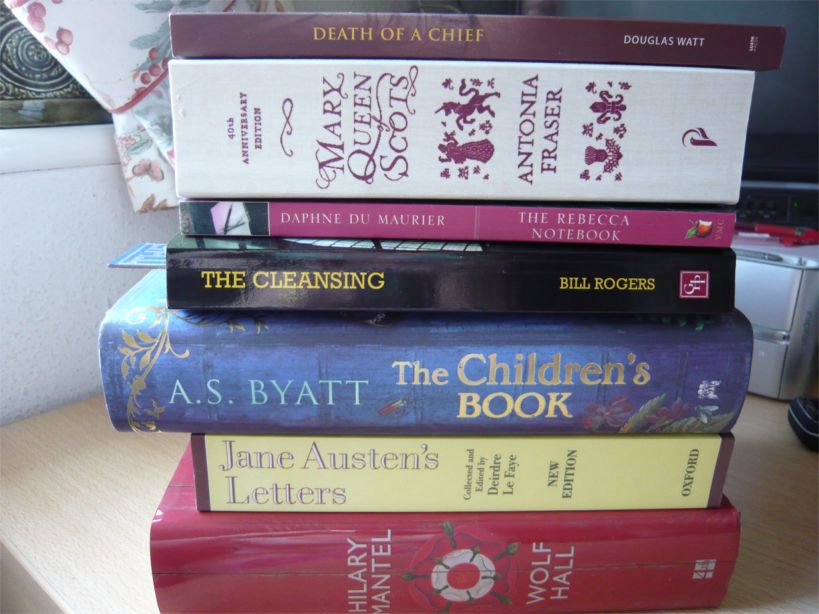
I always love books as birthday presents and was lucky enough to be given this pile this year. I just wish I could read them all at once:

  • Wolf Hall by Hilary Mantel. I’ve been reading about this one and it was high on my wish list.
  • Jane Austen’s Letters collected and edited by Deirdre Le Feye – another book I’ve been coveting for a while.
  • The Rebecca Notebook & Other Memories by Daphne Du Maurier. Rebecca is one of my favourite books and this book begins with Du Maurier’s thoughts on writing it with an alternative Epilogue.
  • The Children’s Book by A S Byatt. How could I not want this book – other bloggers have been giving it such praise!
  • The Cleansing by Bill Rogers. I’d actually forgotten this was on my wishlist, but I’m so glad D bought it for me. I’ve started to read it and so far I think it’s very good. Set in Manchester, it’s a murder mystery well grounded in police procedure. DCI Tom Caton leads the Specialist Detection Group investigating a very messy case involving a killer dressed as a clown.
  • Mary Queen of Scots by Antonia Fraser. I’m particularly drawn to historical biography and especially Mary Queen of Scots, so I’m looking forward to this one.
  • Death of a Chief by Douglas Watt. This looks excellent – a surprise present from my son. From the back cover: “The year is 1686. Sir Lachlan MacLean, chief of a proud but poverty-stricken Highland clan, has met with a macabre death in his Edinburgh lodgings. … Death of a Chief is set in pre-Englightenment Scotland – a long time before police detectives existed.”
birthday-books09

Recent Serious – Booking Through Thursday

btt button

Today’s question is

What’s the most serious book you’ve read recently?
(I figure it’s easier than asking your most serious boook ever, because, well, it’s recent!)

Iafter-the-victorians thought at first this would be an easy question to answer, but as I looked back over the books I’ve read recently I began to define “serious”. Does a serious book have to be non-fiction? If so then I didn’t have to think too hard and the book is one I’m currently reading – After the Victorians: the World Our Parents Knew by A N Wilson. I’m up to 1938-9, the build-up to the Second World War. What could be more serious than that?

However, “serious” isn’t limited to non-fiction. Fiction can be very grave, austere, earnest, thought -provoking and heavy (as opposed to light and fluffy). Thinking of books in this way it’s more difficult to choose “the most serious” book I’ve read recently.

remember-meBut I think the most serious and powerful novel I’ve read this year is Remember Me … by Melvyn Bragg. This is the tragic, emotional and heart-rending story of Joe Richardson as he tells it to his daughter. It’s a long book, very intense and very moving.