One of my favourite books is A Christmas Carol by Charles Dickens. And one of my favourite quotations is this one when Scrooge wakes up on Christmas Day a changed man:
He dressed himself “all in his best”, and at last got out into the streets. The people were by this time pouring forth, as he had seen them with the Ghost of Christmas Present; and walking with his hands behind him, Scrooge regarded every one with a delighted smile. He looked so irresistibly pleasant, that three or four good-humoured fellows said, “Good morning, sir! A merry Christmas to you!” and Scrooge said often afterwards, that of all the blithe sounds he had ever heard, those were the blithest in his ears. (Stave 5)
I wish you all a Very Merry Christmas! And as Tiny Tim said, “God bless Us, Everyone!”
This is yet another one of my short posts about books I’ve read this year. This one is a review copy by one of my favourite authors, due to be published in January:
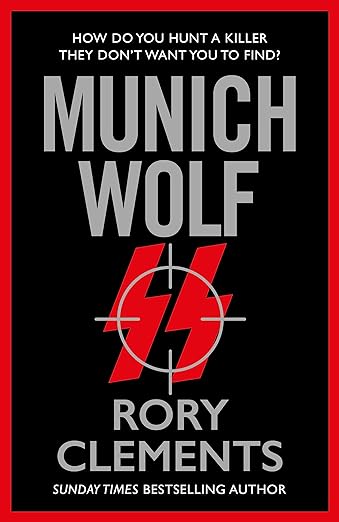
Bonnier Books| 18 January 2024|400 pages| E-book review copy| 3.5*
Description
Munich, 1935 – The Bavarian capital is a magnet for young, aristocratic Britons who come to learn German, swim in the lakes and drink beer in the cellars.
What they don’t see – or choose to ignore – is the brutal underbelly of the Nazi movement which considers Munich its spiritual home. When a high-born English girl is murdered, Detective Sebastian Wolff is ordered to solve the crime. Wolff is already walking a tight line between doing his job and falling foul of the political party he abhors. Now Hitler is taking a personal interest in the case. Followed by the secret police and threatened by his own son, a fervent member of the Hitler Youth, the stakes have never been higher. And when Wolff begins to suspect that the killer might be linked to the highest reaches of the Nazi hierarchy, he fears his task is simply impossible – and that he might become the next victim.
I’ve enjoyed several books by Rory Clements. Munich Wolf is a standalone murder mystery, a police procedural investigation set in Hitler’s Munich in 1935. I enjoyed it although I found the first half slow moving and disjointed, but the pace picks up in the second half. It is a darker novel than his Tom Wilde books, with some unsavoury and definitely unlikable characters, some of whom I found difficult to identify. The murder mystery takes second place to the historical setting. The novel is full of tension and suspense, some of which made it an uncomfortable read but conveyed what a dangerous time and place Germany was in the 1930s.
However, I really liked Detective Sebastian Wolff (Seb), and the way he investigates the murder of a young English woman, under orders from Hitler to close the case as soon as possible. And I really want to know more about Unity Mitford’s involvement. The time period seems well researched – I’m not familiar with the situation in Germany between the two World Wars as Hitler rose to power – and I found that fascinating.
I do hope Rory Clements will write more books featuring Seb Wolff.
Many thanks to Bonnier Books for a review copy via NetGalley.
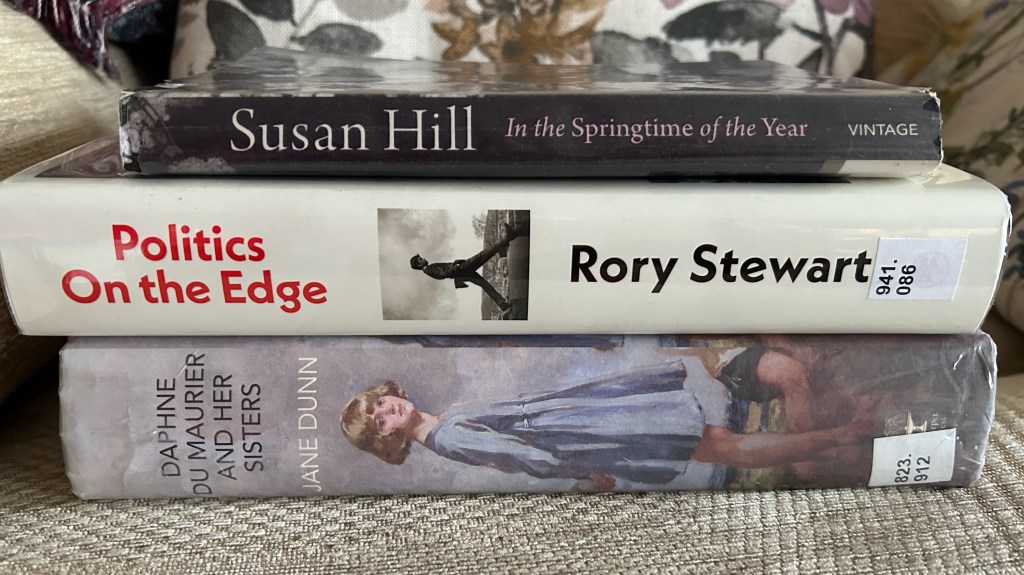
These are the books I have on loan from my local library:
Daphne Du Maurier and her sisters : the hidden lives of Piffy, Bird and Bing by Jane Dunn.The Du Mauriers – three beautiful, successful and rebellious sisters, whose lives were bound in a family drama that inspired Angela and Daphne’s best novels. Much has been written about Daphne but here the hidden lives of the sisters are revealed in a riveting group biography. The sisters are considered side by side, as they were in life, three sisters who grew up during the 20th century in the glamorous hothouse of a theatrical family dominated by a charismatic and powerful father. This family dynamic reveals the hidden lives of Piffy, Bird & Bing, full of social non-conformity, love, rivalry and compulsive make-believe, their lives as psychologically complex as a Daphne du Maurier novel.
Politics on the edge : a memoir from within by Rory Stewart. Over the course of a decade from 2010, Rory Stewart went from being a political outsider to standing for prime minister – before being sacked from a Conservative Party that he had come to barely recognise. Tackling ministerial briefs on flood response and prison violence, engaging with conflict and poverty abroad as a foreign minister, and Brexit as a Cabinet minister, Stewart learned first-hand how profoundly hollow and inadequate our democracy and government had become. Cronyism, ignorance and sheer incompetence ran rampant. Around him, individual politicians laid the foundations for the political and economic chaos of today. Stewart emerged battered but with a profound affection for his constituency of Penrith and the Border, and a deep direct insight into the era of populism and global conflict. This book invites us into the mind of one of the most interesting actors on the British political stage.
In the Springtime of the Year by Susan Hill. After just a year of close, loving marriage, Ruth has been widowed. Her beloved husband, Ben, has been killed in a tragic accident and Ruth is left suddenly and totally bereft. Unable to share her sorrow and grief with Ben’s family, who are dealing with their pain in their own way, Ruth becomes increasingly isolated, hiding herself in her cottage in the countryside as the seasons change around her. Only Ben’s young brother is able to reach out beyond his own grief to offer Ruth the compassion which might reclaim her from her own devastating unhappiness.
I’d love to know if you’ve read any of these books and if so what did you think? If you haven’t, do any of them tempt you?
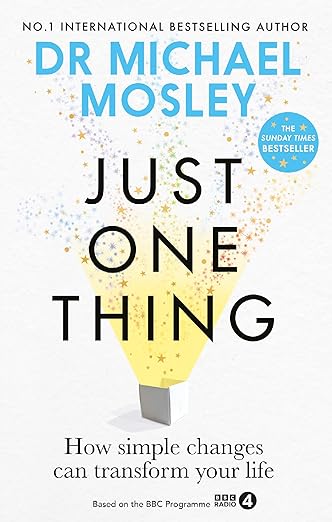
Octopus Publishing Short Books| 22 October 2022|206 pages| E-book review copy| 5*
I was keen to read Just One Thing by Michael Mosley because I’ve enjoyed his TV programmes and I wasn’t disappointed. I think it’s an excellent source of information about improving your health. He picked 30 of his favourite things that you could fit into your life and explains the benefits of each one. He divides the day into periods – morning, mid morning, lunch time, afternoon and evening, giving examples of things to try throughout the day.
I’ve highlighted just a few in this post. S0me of them I already knew about, like doing exercise, doing squats and lunges, drinking water, meditation, spending time outdoors, taking a break to reduce stress, deep breathing, and so on. And I was very pleased to see that reading fiction for 30 minutes a day is a whole brain workout!
Other ideas that were new to me are things like drinking coffee, which lowers the risk of strokes, heart disease, cancer and dementia, and eccentric exercise – which involves walking downhill, down stairs and lowering weights, which have been shown to be more effective than running uphill, up stairs and lifting weights.
I knew about eating an apple a day, but not about the benefits of eating beetroot (which I love) two to three times a week. One thing that really pleased me is finding out that eating two squares of dark chocolate a day instead of eating sweet treats, lowers blood pressure and boosts your brain. In fact most of the ideas improve your mood and sleep, how your brain functions, and reduce anxiety, stress, fatigue and depression and so on. Standing on one leg, for example improves your balance, improves your core strength, and posture which reduces the likelihood of falling and breaking bones. Singing loudly for 5 minutes a day not only boosts your mood, and reduces anxiety, but can also relieve chronic pain.
It’s an inspiring book to read for making small changes, and some not so small changes, to improve your health and well-being. I’ve already started to stand on one leg whilst brushing my teeth and doing squats/lunges whilst waiting for the kettle to boil and will be trying more of the ideas too.
Many thanks to the publishers for a review copy via NetGalley.
Top Ten Tuesday is a weekly meme created by The Broke and the Bookish and now hosted by Jana at That Artsy Reader Girl. For the rules see her blog.
The topic this week is a Books On My Winter 2023-2024 To-Read List. I hardly ever stick to any of the To-Be-Read lists I compile, mainly because I’m a mood reader. The books listed here are books that at the moment I fancy reading soon, but when the time comes I might find myself reading other books – we’ll see.
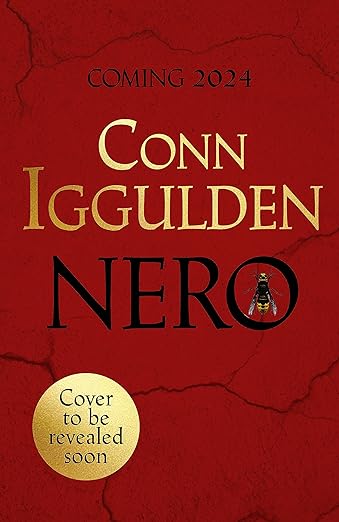
Nero by Conn Iggulden – historical fiction about the final emperor of the Julio-Claudian dynasty, reigning from AD 54 until his death in AD 68. It’s the first in a new trilogy covering Nero’s early childhood.To be published in May 2024.
Munich Wolf by Rory Clements – historical fiction set in Munich in the 1930’s, featuring murder squad detective Sebastian Wolff. I’ve enjoyed Clements’ Tom Wilde spy thrillers, so I’m hoping this new series will be just as good. To be published in January 2024.
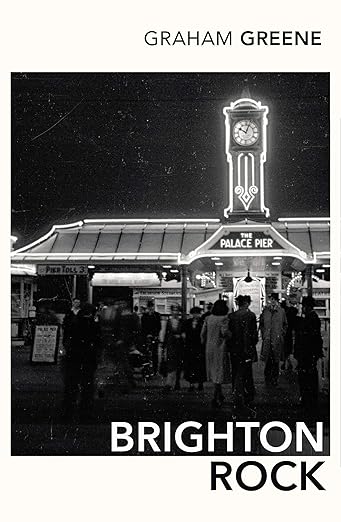
Brighton Rock by Graham Greene – A gang war is raging through the dark underworld of Brighton. Seventeen-year-old Pinkie, malign and ruthless, has killed a man. Greene’s gripping thriller exposes a world of loneliness and fear, of life lived on the ‘dangerous edge of things’.
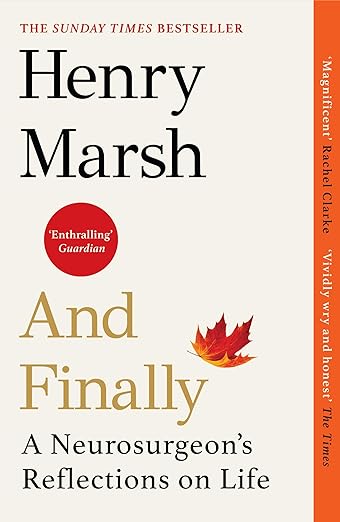
And Finally: Matters of Life and Death by Henry Marsh – as a retired brain surgeon, Henry Marsh thought he understood illness, but even he was unprepared for the impact of his diagnosis of advanced cancer. He navigates the bewildering transition from doctor to patient. As the days pass, his mind turns to his career, to the people and places he has known, and to creative projects still to be completed. Yet he is also more entranced than ever by the mysteries of science and nature, by his love for his family, and – most of all – by what it is to be alive.
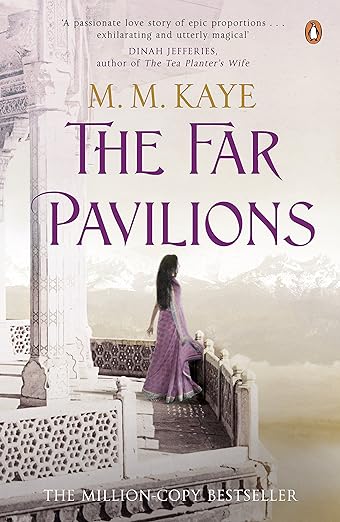
The Far Pavilions by M M Kaye – the story of an English man – Ashton Pelham-Martyn – brought up as a Hindu. It is the story of his passionate, but dangerous love for Juli, an Indian princess. It is the story of divided loyalties, of friendship that endures till death, of high adventure and of the clash between East and West.
The Rocks Below by Nigel P Bird, a novella telling the story of the aftermath of a massive storm off the East coast of Scotland. As people are clearing up the devastation, strange things happen. People and animals go missing. Amongst the debris strewn across the beaches, there are some huge boulders, which a local geology lecturer decides to analyse.
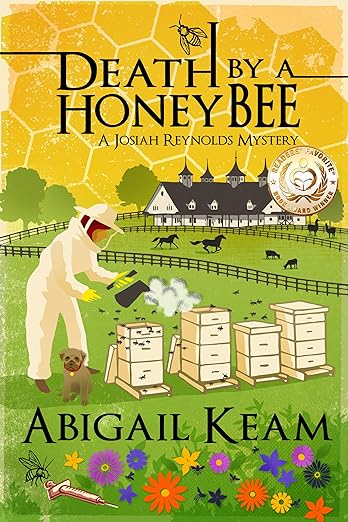
Death by a Honeybee by Abigail Keam – Josiah Louise Reynolds, a former art history professor, was once a celebrity with wealth, social position, and a famous husband. Now her circumstances have drastically altered. She is now a full time beekeeper who finds her world turned upside down when a man is found dead in her bee yard, only to discover the victim is her competitor and nemesis.
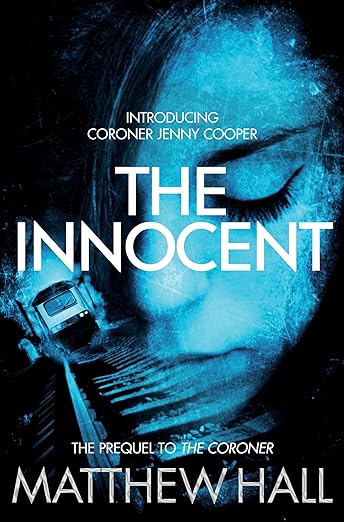
The Innocent by Matthew Hall – a prequel to the Jenny Cooper ‘Coroner series (I enjoyed reading two of these). When Coroner Jenny Cooper crashes her car one bright September morning, she finds her mind propelled back to the past – to ten years earlier when she was embroiled in the most difficult of cases when a fourteen year old girl in her care is killed, falling under a train. It seems both the girl’s family and the authorities are determined to prove Jenny responsible. But what is the real truth behind Natasha’s tragic death?
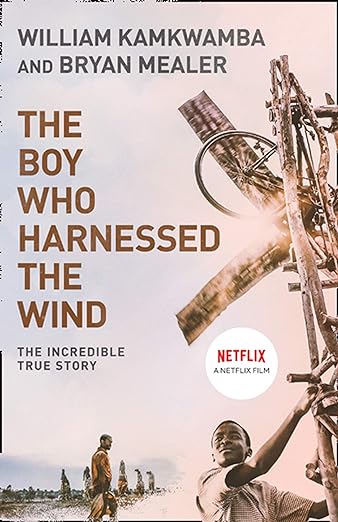
The Boy Who Harnessed the Wind: Creating Currents of Electricity and Hope by William Kamkwamba and Bryan Mealer – a remarkable true story of a boy’s life in Malawi, about human inventiveness and its power to overcome crippling adversity. It will inspire anyone who doubts the power of one individual’s ability to change his community and better the lives of those around him.
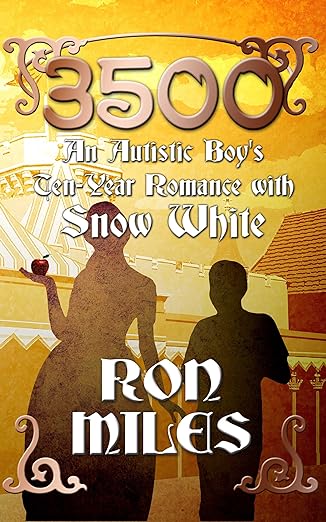
Benjamin, a nine-year-old autistic boy with a love of Disney, was taking his first trip to Walt Disney World. The last thing his parents expected was to see him come alive. What followed was a remarkable tale of inspiration, heartbreak, dedication and joy as Benjamin’s family relocated from Seattle to Orlando in order to capture that magic and put it to practical use.
Marg at The Intrepid Reader hosts the Historical Fiction Reading Challenge. Each month, a new post dedicated to the HF Challenge will be created where you can add the links for the books you have read.
Everyone can participate! If you don’t have a blog you can post a link to your review if it’s posted on Goodreads, Facebook, or Amazon, or you can add your book title and thoughts in the comment section if you wish.
Any sub-genre of historical fiction is accepted (Historical Romance, Historical Mystery, Historical Fantasy, Young Adult, History/Non-Fiction, etc.)
During the following 12 months you can choose one of the different reading levels:
20th Century Reader – 2 books Victorian Reader – 5 books Renaissance Reader – 10 books Medieval – 15 books Ancient History – 25 books Prehistoric – 50+ books
I love historical fiction so in 2024 I’m hoping to reach the Ancient History level, that is to read 25 books.



 BooksPlease