Weekend Cooking: Italian Cookbooks

Weekend Cooking is hosted by Beth Fish Reads. It’s open to anyone who has any kind of food-related post to share: Book (novel, nonfiction) reviews, cookbook reviews, movie reviews, recipes, random thoughts, gadgets, fabulous quotations, photographs.  For more information, see the welcome post.

I love Italian food. I have a few books such as Jamie’s Italy, the two River Cafe Cookbooks by Rose Gray and Ruth Rogers and Perfect Pasta by Anne Willan, but my favourite books to look at with longing are The Love of Italian Cooking by Mary Reynolds and The Heritage of Italian Cooking by Lorenza De’Medici.

The Love of Italian Cooking, now out of print was a birthday present from my son:

What I like, apart from the recipes and colour photos is the description of the various regions of Italy, highlighting their traditions and specialities, from Sicily and Sardinia moving north through the country to Piemonte in the north-west corner.

One of my favourite recipes in this book is Minestrone Alla Casalinga in the chapter on Lombardy, a large region that includes most of the Italian lakes. It stretches from the Alps in the north to the valley of the River Po in the south. It takes hours to make, plus the time overnight to soak the haricot beans and is very filling. If you click on the photo below you may be able to see the recipe, but if not here are the ingredients – haricot beans, onion, garlic, bacon rashers,  tomatoes, carrots, potatoes, turnip, celery, cabbage, macaroni pieces or small pasta (shells, stars etc), fresh marjoram and parsley, pepper and water.

Minestrone Alla Casalinga

Saute the onions, garlic and bacon for a few minutes, add water, tomatoes (skinned, seeded and chopped) and marjoram and parsley and simmer for 2 hours uncovered. Add the other ingredients – carrots (diced) first for 10 minutes then everything else sliced, diced or shredded and cook until tender. Stir in grated parmesan to taste.

I’ve made it without the bacon and with different vegetables, according to what I have at the time – I suppose then you could call it Minestrone Alla Margherita or Margaret’s Minestrone.

The Heritage of Italian Cooking is also out of print, but used copies are available. It is a most beautiful book, lavishly illustrated with not only photos of fantastic food, but also Italian Renaissance paintings of banquets, illuminated manuscripts, still-life, harvest-time and rural scenes. There are recipes from Renaissance menus, old diaries and Italian cookbooks  – traditional and modern recipes. It really is a sumptuous display of Italian food. A lovely book just to look at and read and also to inspire me to cook.

It’s arranged by type of dish, including chapters ranging from Antipasti and Pasta to Desserts, Breads and Menus. Here are a few photos from the book:

What am I cooking today? Even after looking at all this Italian food, I have to admit that later I’ll be cooking British roast beef with yorkshire puddings, roast potatoes and sprouts.
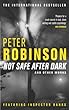
Not Safe After Dark by Peter Robinson

Not Safe After Dark and Other Works is a collection of twenty short stories by Peter Robinson. There are three Inspector Banks stories, one of which Going Back is a novella that had not been published before. The other stories are varied in length, technique and style.

 Of them all I prefer the Inspector Banks stories, in particular Going Back. There isn’t much mystery in this story, but a lot about Banks himself, his youth, relationships with his parents and brother Roy and about his old girlfriend, Kay. It’s his parents’ golden wedding anniversary and Banks goes home for the weekend for the party. He sleeps in his old bedroom with its old glass-fronted bookscase containing a cross-section of his early years’ reading, finds old records he’d forgotten he had, his old school reports, photos and his books of adolescent poetry. His mother treats him like she did as a child, prefering his younger brother Roy and his visit is spoilt by the presence of a new neighbour, the ever-helpful and charming Geoff Salisbury. He is suspicious of Geoff from the start – and with good reason.

Some are historical –In Flanders Field, Missing in Action and The Two Ladies of Rose Cottage. The latterwas inspired by Robinson’s visit to Brockhampton in Dorset where Thomas Hardy was born and also by his interest in Hardy. In 1939 the narrator of the story as a young man first met Miss Eunice and Miss Teresa, who had known Thomas Hardy – was she really the Tess on which he based Tess of the D’Urbervilles? She denied it but then it turned out that Miss Teresa was charged with murder, although  nothing was proved. Years later Miss Eunice had a shocking tale to tell.  This reminded me I still haven’t finished reading Claire Tomalin’s biography of Hardy – The Time-Torn Man.

Of  the other stories I also liked Some Land in Florida, in which Santa ends up in the pool with his electric piano thrown in after him – still plugged in. A private eye, there on holiday isn’t convinced it is an accident. April in Paris is a poignantly sad love story about happened when love turned to hatred.

Some of the stories were written when Robinson was asked for stories on a specific topic – Gone the the Dawgs, about American Football and The Duke’s Wife, a modern telling of Shakespeare’s Measure for Measure.

I enjoyed some of these stories more than others – mainly the longer ones. I do prefer novels where characters and plots are more developed than is possible in a short story. I wrote more about this book here.

Friday Finds

This week I received a copy of The Widow’s Tale by Mick Jackson, via LibraryThing’s Early Reviewers’ Programme.

I’ve never read anything by Mick Jackson before, but I’m hoping this will be good. It’s described on the back cover as

The long awaited third novel from the Booker Prize shortlisted author of Five Boys and The Underground Man.

A newly-widowed woman has done a runner. She just jumped in her car, abandoned her (very nice) house in north London and kept on driving until she reached the Norfolk coast. Now she’s rented a tiny cottage and holed herself away there, if only to escape the ceaseless sympathy and insincere concern.She’s not quite sure, but thinks she may be having a bit of a breakdown. Or perhaps this sense of dislocation is perfectly normal in the circumstances. All she knows is that she can’t sleep and may be drinking a little more than she ought to.

But as her story unfolds we discover that her marriage was far from perfect. That it was, in fact, full of frustration and disappointment, as well as one or two significant secrets, and that by running away to this particular village she might actually be making her own personal pilgrimage.
By turns elegiac and highly comical, The Widow’s Tale conjures up this most defiantly unapologetic of narrators as she begins to pick over the wreckage of her life and decide what has real value and what she should leave behind.

This meme is hosted by MizB at Should be reading.

Reading Dilemma – a Surfeit of Crime Fiction!

I feel I’m overdosing on crime fiction right now and need to read something else. I’m in the middle of Ian Rankin’s Dead Souls and whilst I think it’s a good story, I’m being sucked down to the dark side. Rebus is pessimistic:

…  once again Rebus’s speech had gone unspoken, the one about how he’s lost any sense of vocation, any feeling of optimism about the role – the very existence of policing. About how these thoughts scared him, left him either sleepless or scarred by bad dreams. About the ghosts which had come to haunt him, even in daytime. About how he didn’t want to be a cop any more. (page 17)

It doesn’t help that one of his colleagues has died after falling off Salisbury Crags – was it suicide or not? In addition as Mairie Henderson (journalist) says to him “I think something’s gone bad inside you.” He doesn’t disagree. There’s a paedophile who is being persecuted by his neighbours; an old girlfriend’s son has disappeared and he keeps wondering what his life would have been like if he’d not become a cop; he’s surveilling a killer who has returned to Edinburgh courtesy of the US government and he know it’s a waste of time; he has bad memories and is feeling guilty – he’s in a bad way.

I need to counter-balance this with something different, something unrelated to crime. But when I look at the other books I’ve started and those I’ve recently borrowed from the library I see they’re all crime fiction of one sort or another.

Back to my to-be-read piles, then. So, should I read … ?

  • The Snow Geese by William Fiennes. Marina Warner on the back cover states “he has renewed the variety and wonder of the world.”  It’s a blend of  natural history, the snow geese migration, and autobiography, meditations and philosophy.
  • The Pursuit of Happiness by Douglas Kennedy – but the back cover states it is a tragic love story of divided loyalties and the random workings of destiny. It’s set in 1945 in Manhattan. Not sure I want tragedy right now.
  • The Warrior’s Princess by Barbara Erskine. Maybe I’m in the mood for historical fiction. This is a dual time story – the present and two thousand years earlier at the time of Caractacus, king of the British tribes during a battle with the invading Romans.
  • An Equal Music by Vikram Seth. A friend gave me this one saying it’s a wonderful book. Again, (paraphrased) from the back cover – this is a book about love, music and loss – “the power of music to transform human experience.”
  • Maybe romantic comedy with The Sex Life of My Aunt by Mavis Cheek – “a modern morality tale … about the age-old conflict between love and money.”
  • Or how about Firmin: Adventures of  Metropolitan Lowlife by Sam Savage. Fimin is a rat, a literary rat living in the basement of a bookstore, who develops the ability to read.

Wondrous Words

Each Wednesday Kathy (Bermuda Onion) runs the Wondrous Words Wednesday meme to share new (to us) words that we’ve encountered in our reading.

My words this week are from The Hollow by Agatha Christie. This is a country house murder mystery featuring Hercule Poirot(see yesterday’s post for more details) in which I came across these wondrous words that were completely new to me.

  • Tritoma – here the victim is imagining himself in San Miguel, thinking of the “blue sky … smell of mimosa … a scarlet tritoma upright against green leaves … the hot sun … the dust … that desperation of love and suffering …”

Tritoma is obviously a plant of some sort, I thought and I discovered it’s a Red Hot Poker.

  • ‘Tuft-hunter’ – “Inspector Grange did not think much of the Chief Constable of Wealdshire – a fussy despot and a tuft-hunter.”

I had no idea what a tuft-hunter could be – it’s a toady, a hanger-on to noblemen, or persons of quality. ‘Tufts‘ were gold tassels formerly worn on a nobleman’s cap in English universities, a titled undergraduate – a person of consequence.

  • ‘Coloratura’ – “Lucy has to give the coloratura touch – even to murder.”

Something to do with colour, I thought. It means “florid”, “embellished”.

  • ‘Meretricious’ – “Edward knew nothing about women’s clothes except by instinct, but he had a shrewd idea that all these exhibits were somehow of a meretricious order.”

I was getting this word confused with ‘meritorious‘ meaning worthy of merit or praise, but that didn’t make sense in the context, because the next sentence is: “No, he thought, this place was not worthy of her.”

‘Meretricious’ means: ‘of the nature of or relating to prostitution; characteristic or worthy of a prostitute; flashy; gaudy’ – not at all ‘meritorious’!