Disaster! – Booking Through Thursday

Today’s Booking Through Thursday’s question is:

You’ve dropped your favourite out-of-print book in the bath, ruining it completely … what do you do?

I have done this with a library book. My immediate reaction was to panic and fish the book out of the water, abandon the bath and try to dry the book. Of course, it was useless, the book had been completely submerged. I had to take it back to the library and confess what I’d done. This was not the only library book I had to take back ruined. The second was one our dog had chewed. In both cases I had to pay for replacement books.

So after the bath disaster I’ve never read in the bath again.

It’s so difficult to replace a favourite book because even if I could find a second-hand copy it wouldn’t have the same meaning for me. I lost my copy of Robert Louis Stevenson’s A Child’s Garden of Verses that I had loved as a child. I have bought a replacement copy, but somehow it doesn’t have the same sentimental value for me, although it is better than not having it at all.

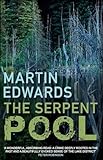
The Serpent Pool by Martin Edwards: Book Review

I’d been eagerly looking forward to reading Martin Edwards’s latest Lake District Mystery, The Serpent Pool and it didn’t disappoint. It’s a  terrific book. It has everything, a great sense of location, believable, complex characters, a crime to solve, full of tension and well paced to keep you wanting to know more, and so atmospheric. I loved all the literary connections, the secondhand bookshop, the book collectors and historian, Daniel Kind’s research into the 19th century writer, Thomas de Quincey and his history of murder.

The earlier books in the series are The Coffin Trail, The Cipher Garden, and The Arsenic Labyrinth, featuring DCI Hannah Scarlet, in charge of the Cumbria’s Cold Case Team, her partner Marc Amos, a rare book dealer and Daniel Kind, a historian and the son of Hannah’s former boss, Ben Kind. See Martin’s website for more information.

The Serpent Pool begins with the death of George Saffell, one of Marc’s customers, stabbed and then burnt to death amidst his collection of rare and valuable books.The motive for his killing, the subsequent death of another of Marc’s customers, Stuart Wagg, and the connection with the cold case Hannah is investigating gradually become clear.

Hannah is investigating the apparent suicide of Bethany Friend who had drowned 6 years earlier in the Serpent Pool, a lonely, isolated place below the Serpent Tower, a folly high on a ridge. Her mother refused to accept she had killed herself, she had no suicidal tendencies and no known history of depression. She had drowned in just eighteen inches of water and was found with her hands loosely tied behind her back and her ankles tied together. Hannah and Greg Wharf, her new detective sergeant set about re-interviewing all the witnesses.

When Hannah discovers that Marc knew Bethany she wonders what he is hiding and why he had never mentioned it to her. Their relationship is not going well and to make matters worse she is still attracted to Daniel. Marc, in turn, seems dangerously attracted to Cassie Weston, a new employee.

The complex plot kept me guessing to the end of this gripping murder mystery.

Agatha Christie Blog Tour

On 15 September 2010 Agatha Christie would have been 120 years old.

Over at the ACRC Blog Carnival we are taking part in world wide celebrations with a blog carnival tour from 1-30 September 2010.

My contribution will be on 22 September. The schedule for the blog tour is at the Agatha Christie Reading Challenge site, where you can check out what the other participants write each day.

RIP Challenge

It’s time for Carl’s R.I.P. (Readers Imbibing Peril) Challenge. This challenge runs from 1 September to 31 October. As he describes it, it’s that time of the year

where two short months are dedicated to reveling in all things creepy, eerie, mysterious, gothic, horrifying, suspenseful and strange.

It is time to celebrate things that go bump in the night; that favorite detective that always gets his man, or woman, in the end; that delicious chill of a creak on the stairs, of the rogue waiting in the dark, of the full moon and the flit of bats wings.

The categories of books to choose from are:

Mystery.
Suspense.
Thriller.
Dark Fantasy.
Gothic.
Horror.
Supernatural.

There are a number of Perils, but I’m going for the easy one – Peril the Third, which involves reading one book that fits within the R.I.P. definition.

I have a few books to choose from as I don’t like to commit myself too soon. These are from my TBR list. If I read more than one that it is all the better:

(The links go to Amazon.co.uk)

Thirteen Hours by Deon Meyer: Book Review

Thirteen Hours by Deon Meyer (translated from Afrikaans by K L Seegers) is a great book. I was engrossed in it right from the start. It’s tense, taut and utterly enthralling. Moving at a fast pace the book follows the events during the thirteen hours from 05:36 when Rachel, a young American girl is running for her life up the steep slope of Lion’s Head in Capetown.  The body of another American girl is found outside the Lutheran church in Long Street. Her throat slit had been slit. An hour or so later Alexandra Barnard, a former singing star and an alcoholic, wakes from a drunken stupor to find the dead body of her husband, a record producer, lying on the floor opposite her and his pistol lying next to her.

It’s not just the story that makes this book such a gripping read, but the characters are so well-drawn too. DI Benny Griessel is mentoring two inexperienced detectives who are investigating these crimes. I grew very fond of Benny, who is also an alcoholic and struggling to keep his marriage together. He deals with mentoring his charges very well, with patience and expertise, but also gets emotionally involved when Rachel’s father entreats him to save his daughter. There are many other memorable characters, such as Inspector Mbali Kaleni, a Zulu woman with a powerful personality who commands people’s attention, and the elderly Piet van der Lingen, who helped Rachel, looking like an ‘aged monk with his thinning grey hair around the bald spot that shone in the flourescent light.’

The two cases move along parallel to each other, keeping me desperate to know what happened next in both. The book also reflects the racial tension in the ‘new South Africa’ with its mix of white, coloured and black South Africans. There is a strong sense of location, not just from the cultural aspect but also geographical because although I know nothing about Capetown I had no difficulty in visualising the scenes from Meyer’s descriptions.

Without doubt this has to be one of the best books I’ve read this year, one that had me eager to get back to it each time I had to stop reading.