ABC Wednesday J is for …

… the Jabberwock

From Lewis Carroll’s Through the Looking Glass, illustration by John Tenniel.

This was a great favourite of mine as a child and I still love the poem, Jabberwocky which begins:

Twas brillig and the slithy toves

Did gyre and gimble in the wabe;

All mimsy were the borogroves,

And the mome raths outgrabe.

Beware the Jabberwock, my son!

The jaws that bite, the claws that catch!

Beware the Jujub bird, and shun

The frumious Bandersnatch.

I had no idea what the words meant but I loved the sound of them and learned them off by heart. Humpty Dumpty explains to Alice that ‘brillig’ means ‘4 o’clock’, ‘slithy’ means ‘lithe and slimy’ and ‘toves’ are something like badgers  and lizards and corkscrews, to ‘gyre and gimble’ means to go round and round like a gyroscope and make holes like a gimlet and the ‘wabe’ is a grass-plot around a sundial – as shown in this illustration also  by John Tenniel:

An ABC Wednesday post.

Crime Fiction Alphabet – K is for …

… Karen Maitland

Karen Maitland writes medieval mysteries. She has a doctorate in psycholinguistics and has done all kinds of jobs from cleaner to lecturer, egg packing to dance-drama, before she started writing for a living in 1996. She has travelled and worked in many parts of the world, from the Arctic Circle to Africa, and now lives in the medieval city of Lincoln in England. She is a member of the Crime Writers’ Association, the Historical Novel Society, the Society of Authors and of International Thriller Writers. And she is now one of the Medieval Murderers.

The first book of hers that I read is Company of Liars: a Novel of the Plague, set in the 14th century about a group of nine people travelling to escape from the plague and suspected of concealing the killer of a little girl. It’s a memorable book, with a colourful cast of characters. Although it is a long book (over 550 pages) and there are many other characters than the group of nine I had no difficulty keeping track of who was who. It’s full of suspense and drama and I loved it.

Her second medieval mystery is The Owl Killers: a Novel of the Dark Ages. Again this is set in 14th century England, this time in ‘an isolated village where pagan Owl Masters rule through fear superstition and murder’ (from the back cover). I haven’t finished reading this yet but it’s promising to be equally as good as Company of Liars. Karen Maitland is a wonderful storyteller and her descriptions of the place and period draw me in as though I was actually there.

Her latest book is The Gallows’ Curse, set in the reign of King John (1210). The ‘plot involves people-trafficking, murder and, oh yes… a very feisty dwarf and a eunuch with a hunger for revenge’.

For more crime fiction ‘K‘ entries see Kerrie’s Crime Fiction Alphabet.

The Sunday Salon

Today I’ve been reading more from Eden’s Outcasts: the story of Louisa May Alcott and Her Father. At long last, as I have been reading this book for ages, I have arrived at the time of Louisa’s life where she has written and published Little Women. Up to this point (about 60% of the book) most of it has been about Bronson Alcott, her father and it is Louisa who I find most interesting.

Louisa wrote in vortices – completely engrossed in her writing, with barely time for anything else, so intense was her concentration. Mostly she wrote in her bedroom at a desk Bronson had built for her, but sometimes she sat on the parlour sofa. Her family knew that if the bolster pillow next to her stood on its end they could speak to her, but if the pillow lay on its side they couldn’t disturb her. In two and a half months she had completed writing 402 manuscript pages and at the end of it she had briefly broken down.

Little Women was an instant success, the first printing of 2,000 copies sold out within days of the book’s release and another 4,500 copies were in print by the end of the year (1868). Three months later she had written the second part of Little Women – the book I know as Good Wives. She had

… plunged back into a creative cortex on November 1, vowing to write a chapter a day. She worked ‘like a steam engine’, taking a daily run as her only recreation and barely stopping to eat or sleep.  Falling behind the ambitious schedule she had set for herself, she spent her birthday alone’writing hard.’ (page 345)

She put her heart and soul into her writing.

Both Louisa and her father were complex characters and Matteson’s biography is detailed and in depth. It’s not a quick read, but then biographies never are in my experience.

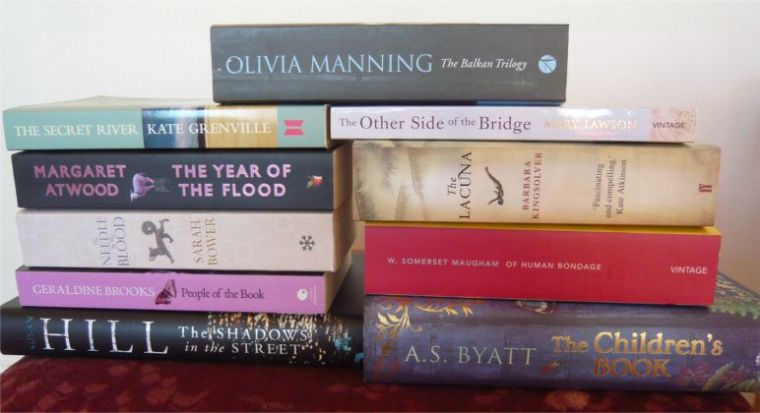
Top Ten Unread Books

Top Ten Books I Absolutely Had To Have – But Still Haven’t Read. I saw this on Litlove’s blog and thought it was a great idea. You never know it might just spur me on to read some of these.

They are all books I was driven to buy but the impulse to read them had passed by after I bought them, replaced by the urge to read other books. I still would love to read them.

They are:

  • The Balkan Trilogy by Olivia Manning. I’ve read and was deeply engrossed in the first two of these – The Great Fortune and The Spoilt City as separate books, three years ago! At the time I wanted to read the final book as soon as possible, but I couldn’t find it published as a separate book and so a year later I bought the Trilogy including all three books. I still haven’t read the third one Friends and Heroes. The three books are a portrait of Guy and Harriet Pringle’s marriage during the Second World War.
  • The Other Side of the Bridge by Mary Lawson. I bought this three years ago after I’d read and loved Crow Lake by Mary Lawson. Like Crow Lake, The Other Side of the Bridge is set in Canada, this time about two brothers in the 1930s, when their uneasy relationship is driven to breaking point.
  • The Lacuna by Barbara Kingsolver. The Poisonwood Bible by Barbara Kingsolver is one of my favourite books, so I just had to get this book. It’s so long though and I read several indifferent reviews which made me less inclined to start it – but I do intend to read it, just not yet.
  • Of Human Bondage by W Somerset Maugham. I’d read a few of Maugham’s books a while ago and full of enthusiasm wanted to read this one, said to be the most autobiographical of his masterpieces. I got it for a Christmas present in 2008 andI’m still anticipating it will be very good.
  • The Children’s Book by A S Byatt. I have this in hardback as I couldn’t wait for it to come out in paperback. I’ve read many conflicting reviews about how good or otherwise it is and have actually read some of it. But it’s got such a huge cast of characters and I wanted to read Wolf Hall at the same time and couldn’t cope with two such long and complicated books, so I temporarily put down The Children’s Book to read later – then other books got in the way. I’ll need to go back to the beginning when I do get back to it.
  • The Shadows in the Street by Susan Hill – another book I wanted to have before it was available in paperback. This one is the fifth in her Simon Serrailler novels.
  • People of the Book by Geraldine Brooks. I loved March by Geraldine Brooks, which prompted me to look for more by her. This one has had good reviews all round and I have absolutely no idea why I didn’t read it straight away.
  • The Needle in the Blood by Sarah Bowyer. I seem to have had this book for ages, spurred on to read it by so many good blog reviews a few years ago and it’s still sitting here unread, a novel about the women who created the Bayeux Tapestry.
  • The Year of the Flood by Margaret Atwood. Well, I love Margaret Atwood’s books, so how could I not buy this one? It covers the same time period as Oryx and Crake,  a book which I’d read some time ago and remembered as being one I had to concentrate on – not a book to skip through. So I thought I’d better wait for a suitable frame of mind to read this – it hasn’t arrived yet. But I do want to read this.
  • The Secret River by Kate Grenville – another book I’ve had for nearly three years, inspired by other bloggers to buy it I still haven’t started it. I love books about the settlers/convicts lives in 19th century Australia. I really must read this soon.


The Orange Prize Longlist

The Orange Prize longlist was announced yesterday. I like to follow this but actually I’ve read very few of the books listed in previous years. The ones I have read have been outstanding, so maybe I should pay more attention to the lists, but looking at this article in the Guardian I can’t say that the subjects are attractive:

Debut novelists will make up nearly half of the Orange prize for fiction longlist, which this year tackles strikingly difficult subjects: incest, sadistic cruelty, polygamy, child bereavement, hermaphroditism and mental illness. There is, though, also alligator wrestling in the 20-strong list, and Susanna Reid, the BBC Breakfast news presenter and judge for this year’s prize, insisted there was much joy to be derived from the books.

I’ve read just one book from this year’s longlist: Whatever You Love by Louise Doughty, which is about Laura whose nine-year old daughter, Betty has been killed by a hit and run driver. I found it to be well written but a harrowing book to read that is startling and shocking in parts.

The only other book that I know anything about is Room by Emma Donoghue, about a mother and son imprisoned in a room. I’ve seen several reviews and read the opening pages, which didn’t make me want to continue with the rest of the book. So far my knowledge of the books seems to confirm that they’re filled with depressing reading, but will I find the joy that Susanna Reid is talking about?

I’m looking at the other books on the list and there is a gallery with summaries of the books on this Guardian page. You can also download free samples from the Kindle Store on Amazon.

ABC Wednesday – I is for Irises

Irises by Vincent Van Gogh, 1889

Van Gogh painted Irises after he committed himself to the asylum at Saint Paul-de-Mausole in Saint-Remy, France. He began the painting only one week after he entered the asylum. He was probably influenced by Japanese woodblock prints; the black outlines in Irises is typical of the Japanese prints.

Irises is on the list of the most expensive paintings ever sold, selling for 54 million dollars in 1987.

It’s beautiful.