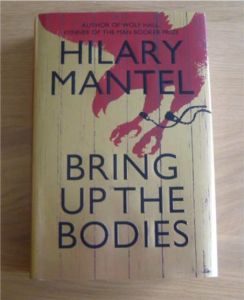
Bring Up the Bodies by Hilary Mantel

Synopsis from the book cover:

By 1535 Thomas Cromwell, the blacksmith’s son, is far from his humble origins. Chief Minister to Henry VIII, his fortunes have risen with those of Anne Boleyn, Henry’s second wife, for whose sake Henry has broken with Rome and created his own church. But Henry’s actions have forced England into dangerous isolation, and Anne has failed to do what she promised: bear a son to secure the Tudor line. When Henry visits Wolf Hall, Cromwell watches as Henry falls in love with the silent, plain Jane Seymour. The minister sees what is at stake: not just the king’s pleasure, but the safety of the nation. As he eases a way through the sexual politics of the court, its miasma of gossip, he must negotiate a ‘˜truth’ that will satisfy Henry and secure his own career. But neither minister nor king will emerge undamaged from the bloody theatre of Anne’s final days.

Some thoughts:

Bring Up the Bodies by Hilary Mantel is described on the sleeve of the book cover as ‘a speaking picture, an audacious vision of Tudor England that sheds its light on the modern world.’

It is, of course, the sequel to Wolf Hall and I was too keen to read it to wait for the paperback to come out. I finished it a while ago and have been mulling over in my mind what to write about it. On balance, I didn’t enjoy it as much as Wolf Hall and I had just a little feeling of anti-climax about it, but then the novelty of Wolf Hall for me was the way Hilary Mantel not only brought the Tudor world alive but also how she overturned my ideas of both Thomas Cromwell and Sir Thomas More. As there is no denying that I knew that Anne Boleyn was not going to make a go of her marriage to Henry VIII, so there was little drama there for me. I didn’t even want her to escape her fate.

And yet, Bring Up the Bodies is still a brilliant book. It’s beautifully written, even if it is in the present tense, full of colour and detail so that there is no doubt that this is 16th century England, with vivid descriptions of the people, buildings, fabrics, and landscapes of both town and countryside.

One of the things that stood out for me in Wolf Hall was just how much of a family man Cromwell was, how much he loved and protected them. In Bring Up the Bodies, my overall impression of him is as a politician, a schemer and an implacable enemy. Right from the start he’s in the thick of the action as he and Henry are out hunting, flying their hawks. Cromwell’s are named after his dead daughters, a reminder of him as the family man, but immediately we are made aware that he is very much in the king’s service.  

He never spares himself in the king’s service, he knows his worth and his merits and makes sure of his reward: offices, perquisites and title deeds, manor houses and farms. He has a way of getting his way, he has a method; he will charm a man or bribe him, coax him or threaten him, he will explain to a man where his true interests lie, and he will introduce that same man to aspects of himself he didn’t know existed. … he is distinguished by his courtesy, his calmness and his indefatigable attention to England’s business.  (pages 6-7)

Truly, a man not a man to ignore. A man to be wary of, and even though Henry fondly and familiarly calls him ‘Crumb’, a man needing to take great care of himself. Anne Boleyn, in contrast, by the end of the book is ‘ a tiny figure, a bundle of bones’  when she is brought to the scaffold. But Cromwell is not deceived:

She does not look like a powerful enemy of England, but looks can deceive. If she could have brought Katherine to this same place, she would have. If her sway had continued, the child Mary might have stood here; and he himself of course, pulling off his coat and waiting for the coarse English axe. (page 395)

However, this is not the end of Cromwell:

Summer, 1536: he is promoted Baron Cromwell. He cannot call himself Lord Cromwell of Putney. He might laugh. However. He can call himself Baron Cromwell of Wimbledon. He ranged all over those fields, when he was a boy.

The word ‘however’ is like an imp coiled beneath your chair. It induces ink to form words you have not yet seen and lines to march across the page and overshoot the margin. There are no endings. If you think so you are deceived as to their nature. They are all beginnings. Here is one. (page 407)

And so, on to the next book …

A Classics Challenge – June Prompt

This month’s prompt for the Classics Challenge is to create a visual tour using quotes from the book you are reading; a series of images that closely represents how you see the scene or description. It doesn’t have to absolutely follow the text but it must reflect the mood.

I’ve been reading Charles Dickens’ A Tale of Two Cities and so there are many scenes I could choose from, varying from London to Paris, from calm and peaceful scenes to trial scenes and scenes of violence, revolution and death by guillotine.

But I’ve decide to concentrate on the place described by Dickens as Doctor Manette’s house in London, the house he lived in with his daughter, Lucie after he was released from the Bastille in Paris.

The quiet lodgings of Doctor Manette were in a quiet street corner not far from Soho Square.

Soho Square illustration is South-west Corner of Soho Square in 1816. From an aquatint in John B. Papworth's Select Views of London

I was intrigued by it being described as a quiet street corner – in Soho. But the Soho of 1780 was rather different from what it later became, so I had to alter my mental picture of it. This view of Soho Square is from about 50 years after the events in the book, but it shows the rural nature of London at that time.

I wondered about the location of the Manettes’ lodging house, just where was it? And then I founnd this plan (see illustration below) showing the location of Soho Square, coloured in green. Just below the Square are Greek Street and Rose Street. It has been conjectured that Dr Manette’s house was No.1 Greek Street with its courtyard in Rose Street.  In 1895 Rose Street was changed to Manette Street after Dicken’s character:

Soho Square

However that may or may not been, at that time Soho was very much in the countryside:

A quainter corner than the corner where the doctor lived, was not to be found in London. There was no way through it, and the front windows of the doctor’s lodgings commanded a pleasant little vista of street that has a congenial air of retirement on it. There were few buildings then, north of the Oxford-road, and forest trees flourished, and wild flowers grew, and the hawthorn blossomed, in the now vanished fields.

Hawthorn Blossom
Hawthorn bushes

Somewhat different from the London scene these days!

Doctor Manette occupied two floors of the house, with a courtyard at the back:

where a plane-tree rustled its green leaves

It was where Lucie, Mr Lorry from Tellson’s Bank and Charles Darney sat under the tree talking and drinking wine and where Lucie and her father sat when she told him she was going to marry Darney:

Plane Tree - from Wikimedia © Copyright David Hawgood

I could just imagine the scene:

Never did the sun go down with a brighter glory on the quiet corner in Soho, than one memorable evening when the  Doctor and his daughter sat under the plane-tree together. Never did the moon rise on a milder radiance over great London, than on that night when it found them still seated under the tree, and shone upon their faces through its leaves.

Moonlight

Crime Fiction Alphabet : Letter D

This week’s letter in Kerrie’s Crime Fiction Alphabet is the letter D.

I’ve chosen to focus on Dana Stabenow, an Alaskan writer. I came across her books through Amazon Kindle, where her first book in the Kate Shugak seriesis available for free! It’s A Cold Day for Murder, which won an Edgar Award for Best Paperback Original in 1993.

Dana’s biography is on her website, where there is a complete list of her books. She’s a prolific writer who writes science fiction, mystery, and suspense/thriller novels.

The books in her series about Kate Shugak, an Aleut who is an investigator living in a National Park in Alaska, are:

1. A Cold Day for Murder (1992)
2. A Fatal Thaw (1992)
3. Dead in the Water (1993)
4. A Cold-blooded Business (1994)
5. Play With Fire (1995)
6. Blood Will Tell (1996)
7. Breakup (1997)
8. Killing Grounds (1998)
9. Hunter’s Moon (1999)
10. Midnight Come Again (2000)
11. The Singing of the Dead (2001)
12. A Fine and Bitter Snow (2002)
13. A Grave Denied (2003)
14. A Taint in the Blood (2004)
15. A Deeper Sleep (2007)
16. Whisper to the Blood (2009)
17. A Night Too Dark (2010)
18. Though Not Dead (2011)
19. Restless in the Grave (2012)
20. Bad Blood (2013)

Novellas:
Conspiracy (2011)
Nooses Give (2011)
Wreck Rights (2011)

There’s more information on Dana’s writing on her blog. I’m only part way into read A Cold Day for Murder, but so far I’m finding it fascinating with lots of description of both the setting, environmental issues and the characters. Kate comes across as a strong and independent female detective.


Saturday Snapshots – Jubilee Celebrations

Last Saturday I posted photos of the coronation procession I took part in in 1953. Irene asked if I would post photos of what was happening in my area for the celebration of the Queen’s Diamond Jubilee. Well, it was relatively quiet where we live, nearly 350 miles from London. We watched some of the River Pageant on television:

I liked the aerial views and the close-up shots of the Queen and Royal Family, but it was different from actually being there:

The next day our son and his family came to stay and we had a barbecue on the decking, decorated with our daughter-in-law’s hand knitted bunting:

Food was eaten, drinks were drunk and games were played:

Then in the evening we went to one of the 4,200 Diamond Jubilee Beacons that were lit all over the UK and the Channel Islands, Isle of Man, Commonwealth and Overseas UK Territories. Ours was at Watchlaw Farm in Northumberland, where there are magnificent views of the Cheviots and the Tweed Valley:

The beacon was lit just after 10pm:

and soon it was blazing away:

Click on the photos to enlarge them.

D took a video which is on YouTube – watch out for the rocket towards the end of the video!

For more Saturday Snapshots see Alyce’s blog At Home With Books.

Book Beginnings: The Glass Guardian

Linda Gillard’s latest book The Glass Guardian came out on Kindle on 1 June. It begins:

When I was a child I nearly drowned. In a pond. Nothing dramatic, apart from the fact that I nearly died. I fell into a big pool at my Aunt Janet’s house on the Isle of Skye.

I fell from a wooden bridge over the pool. At least I think I fell. I don’t remember falling. All I remember is drowning – almost drowning – and then I remember being very cold and so sick, I thought I must have vomited up my insides.

I’ve read and loved Linda’s previous books and I have high hopes that this one will be no exception. It’s described as a ‘supernatural love story‘. When Ruth prepares to put her Aunt’s old house up for sale, she’s astonished to find she’s not the only occupant. Worse, she suspects she might be falling in love again.

With a man who died almost a hundred years ago…

Edited 9 June with the following information from Linda:

TGG originally began with Ch 1. The Prologue was one of the last parts of the book to be written. I started writing TGG pre-Kindle, but when I got one myself & downloaded & read many samples without buying the whole book, I realised the importance of grabbing the reader on p.1. So I decided to insert a Prologue which I hoped would keep readers’ thumbs clicking.

Thanks, Linda – I think it’s a dramatic opening that certainly did grab my attention and makes me want to find out more.

For more Book Beginnings on Friday see Gilion’s blog Rose City Reader.

Crime Fiction Alphabet 2012 – Letter C

The Crime Fiction Alphabet is run by Kerrie at Mysteries in Paradise. This week’s letter is the letter C.

C is for Catriona McPherson, who writes the Dandy Gilver Mysteries. She is a Scottish author who was born in South Queensferry, near Edinburgh. Until 2010 she lived in Galloway and now lives in Northern California. Catriona, by the way, is pronounced Kuh-TREE-nuh (just like the hurricane). In addition to her website she has a blog, sitting typing alone in a room, where she writes about being a writer, gardening on her farm in North California, and reading.

Her favourite books include Rebecca, The Water Method Man, The Pursuit of Love, Agent to the Stars, The Bean Trees, Jane Eyre, After These Things, Wolf Hall, The World’s Wife, Oryx and Crake, The Handless Maiden,The Testament of Gideon Mack. (copied from her facebook page)

The first Dandy Gilver novel was short-listed for the CWA Ellis Peters Historical Dagger 2005 and the second was long-listed for the Theakston’s Crime Novel of the Year Award 2007.There are currently six Dandy Gilver books available with the seventh due out in July:

(Links are to my posts)

1. After the Armistice Ball (2005)
2. The Burry Man’s Day (2006)
3. Bury Her Deep (2007)
4. The Winter Ground (2008)
5. The Proper Treatment of Bloodstains (2009)
6. Unsuitable Day for a Murder (2010)
7. Bothersome Number of Corpses (2012)
After the Armistice BallThe Burry Man's DayBury Her DeepThe Winter Ground
The Proper Treatment of BloodstainsUnsuitable Day for a MurderBothersome Number of Corpses

My favourite of the series is The Burry Man’s Day.

She has also written a non-fiction book: Existence and Truth in Discourse. Catriona has an MA in Language and Linguistics and a PhD in Semantics.

and two books, writing as Catriona McCloud:

Growing Up Again (2007)
Straight Up (2008)