ABC Wednesday: D is for Degas

Edgar Degas (1834 – 1917) was a French artist and is perhaps most well known for his paintings of dancers; ballerinas were his favourite subject:

This is The Dance Class, oil on canvas, 1874 (the Metropolitan Museum of Modern Art). Here the dancers are in various poses at the end of a rehearsal. You can see the exhaustion on their faces and in their figures – see the girl at the front scratching her back, the girls at the back sunk to the floor, and the girl on the right, her arms folded, shoulders rounded and her head drooping down. I love the contrast between them and the rigid figure of the ballet master.Their flimsy tutus stand out so well against the hard diagonal floorboards.

I also like painting L’Absinthe, also called The Absinthe Drinker, A Sketch of a French Café,  or Figures at Café. It’s oil on canvas, 1876 (Musée D’Orsay). It’s a melancholy painting of a forlorn couple in the Café de la Nouvelle-Athènes in Paris.

They are drowning their sorrows. She is drinking absinthe, ‘the Green Fairy’, a lethal drink that was later banned. She is seen staring into space, sad, and desolate, lost in her own world. He is also in his own world, detached, his head turned away from her, as though they aren’t together. Degas’s models for the painting were Ellen Andre, an actress and Marcellin Desboutin, an engraver and artist. They were both annoyed by the painting, which depicted them as alcoholics and Degas had to state publicly that they were not.

I like it just because it tells a tale. It is so expressive and the detail is so fine, the slump of her shoulders, her air of exhaustion and his desire not to be there come over to me so powerfully. It gives the impression that Degas painted this from real life, but actually he painted it in his studio, with the pair carefully posed.

An ABC Wednesday post.

Opening Lines: A Room Full of Bones

First chapterDiane at Bibliophile By the Sea hosts this weekly meme. The idea is that you post the opening paragraph (sometimes maybe a few ) of a book you decided to read based on the opening paragraph (s).

I’d have read A Room Full of Bones anyway as it’s the latest Elly Griffiths’s latest Ruth Galloway Investigation and I’ve read and loved the earlier books, but the opening lines certainly set the scene and make me want to read more:

 The coffin is definitely a health and safety hazard. It fills the entrance hall, impeding the view of the stuffed Auk, a map of King’s Lynn in the 1800s and a rather dirty oil painting of Percival, Lord Smith, the founder of the museum. The coffin’s wooden sides are swollen and rotten and look likely to disgorge their contents in a singularly gruesome manner.

 Elly Griffiths’s website has more information.

Crime Fiction Alphabet: L is for …

Lord Edgware Dies by Agatha Christie. This was first published in the UK in 1933 and later the same year in the USA as Thirteen for Dinner. It’s the eighth book featuring Hercule Poirot, narrated by Captain Hastings. Agatha Christie had written it in the autumn of 1931 at her house in Ninevah, whilst with her husband, Max Malloran on his expedition in the Middle East sponsored by the British Museum.

Lord Edgware Dies is set far from Ninevah, in London’s West End. Poirot is having supper at the Savoy with Hastings after they had been to the theatre to see the celebrated American impressionist, Carlotta Adams. At the next table is Jane Wilkinson, Lady Edgware, also a celebrated actress, who Carlotta had impersonated during her show. Jane implores Poirot to help her to ‘get rid of her husband’ – to convince him to agree to a divorce. Poirot agrees to go and see Lord Edgware. Much to Poirot’s surprise, Lord Edgware readily agrees to a divorce, but as Poirot and Hastings leave the house, Hastings is surprised to see an astonishing change in Lord Edgware’s face:

That suave smiling face was transformed. The lips were drawn back from the teeth in a snarl, the eyes were alive with fury and an almost insane rage. (page 33 0f my copy)

The next morning Lord Edgware was found dead, stabbed in the back of the neck. Jane was seen at the house the night before, but there are witnesses who can testify that she was at a dinner party with twelve other guests.  Could Jane have been in two places at once and killed him? She had boasted to her friends that if Poirot couldn’t help her that she would

‘have to call a taxi to go round and bump him off myself. (page 17)

Or was it Carlotta Adams impersonating Jane?

It’s not a simple mystery and there is a second murder which complicates matters. Poirot is at his best, relying on his knowledge of psychology, the ‘employment of the little grey cells‘, which gives him such mental pleasure. There are small personal touches such as this where Poirot compares his moustache to that of Hastings in this conversation between the two of them:

‘You have made a hit, Poirot. The fair Lady Edgware can hardly take her eyes off you.’

‘Doubtless she had been informed of my identity’, said Poirot, trying to look modest and failing.

‘I think it is the famous moustaches’, I said. ‘She is carried away by their beauty.’

Poirot caressed them surreptitiously.

‘It is true that they are unique,’ he admitted. ‘Oh, my friend, the ‘tooth-brush’ as you call it, that you wear – it is a horror – an atrocity – a wilful stunting of the bounties of nature. Abandon it, my friend, I pray of you.’ (pages 12-13)

Yet again, another baffling case solved by Hercule Poirot – a very entertaining book.

The Crime Fiction Alphabet 2012 is a meme hosted by Kerrie at Mysteries in Paradise.

July’s Books and Crime Fiction Pick of the Month

In July I read 8 books, 6 of them crime fiction. They are (in the order I read them):

The other two books I read are:

  • A Mercy by Toni Morrison – review to follow in a later post
  • The Glass Guardian by Linda Gillard

And my Crime Fiction Pick of the Month is The Crimson Rooms by Katharine McMahon.

Kerrie has a round-up post of bloggers’ book choices for the month, so for more recommendations, go to Mysteries in Paradise.

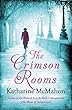
Crime Fiction Alphabet: K is for The Crimson Rooms by Katharine McMahon

Kerrie at Mysteries in Paradise hosts the Crime Fiction Alphabet each week. It has now reached the letter K and my choice is Katharine McMahon’s book The Crimson Rooms.

I bought The Crimson Rooms a couple of years ago because I’d enjoyed reading Katharine McMahon’s The Rose of Sebastopol, which I read in 2008. It’s been sitting with the other to-be-reads on my bookshelves since then and I hadn’t realised that this is not only historical fiction, but also historical crime fiction.

It’s set in London in 1924, with Britain still coming to terms with the aftermath of the First World War. Evelyn Gifford, one of the few pioneer female lawyers, lives at home with her mother, aunt and grandmother, still mourning the death of her brother James in the trenches. Evelyn is woken in the early hours one morning to find Meredith and her child, Edmund, aged 6 on the doorstep, claiming that Edmund is James’s son. Evelyn and the other women are thrown into confusion as Meredith upsets their memories of James.

Meanwhile Evelyn carries on with her work, taking on the case of Leah Marchant, who wants to get back her children who had been taken into care. She was accused of trying to kidnap her own baby. It’s early days for women to be accepted as lawyers and Evelyn struggles to defend Leah who distrusts her and wants Daniel Breen, Evelyn’s boss to defend her.

She is also involved in defending Stephen Wheeler, an old schoolfriend of Daniel’s. Stephen is accused of murdering Stella, his young wife of a fortnight. It’s obvious to Evelyn and Daniel that Stephen is innocent, but at first he refuses to talk and defend himself. After a humiliating experience in court, barrister Nicholas Thorne offers to help Evelyn much to her dislike. But she finds herself drawn to him and wonders how much she can trust him.

I was thoroughly engrossed in this book. It was not just the court cases, I was fascinated by the account of early women lawyers, represented by Evelyn, the central character. It clearly shows the prejudice these women had to overcome just to qualify as lawyers, never mind the difficulties of persuading law firms to employ them and clients to accept them. Katherine McMahon has included a Chronology of Women in Law from 1875 to 1950 at the back of the book and an analysis of why it took so long for women to be accepted. Evelyn is based on Carrie Morrison, who was the first British woman to be become a solicitor.

It’s not just about crime and the court cases, it’s also a novel about the way people’s lives were affected by the War, how men were unable to resume their old lives, some damaged by shell-shock and the horrors they had taken part in, or witnessed during the war. Women, too, had their lives completely changed, so many had their marriage prospects destroyed, and were replaced by work, becoming career women.

Katherine McMahon has done extensive research of the period but it all sits easily within the narrative. It’s beautifully written, full of imagery that creates a vivid picture of the setting and the characters. For example, she describes the moon:

… an extraordinary crescent moon which had, in the last few minutes, risen above the river, with the old moon burdening its lap like a fat round cushion.

and I like this description of one of the characters as she walked from the garden towards the house,

… the trailing hem of her robe a pool of ivory, her hair a swathe of black silk. (page 207)

Katharine McMahon’s other books are:

  • The Alchemist’s Daughter
  • A Way through the Woods
  • Footsteps
  • Confinement
  • After Mary
  • The Season of Light

More details are on her website.