Saturday Snapshot

I had intended to post some photos of our holiday near Glencoe, but I’m so pleased with ‘these’ that I decided to do a bookish Snapshot instead.

‘These’ are …

Book Darts

I first read about them a while ago and couldn’t find a supplier in the UK and then just the other day I was reminded of them by Stefanie’s post on Reading Accessories and searched for them again – and found they’re available in the UK  through Amazon!

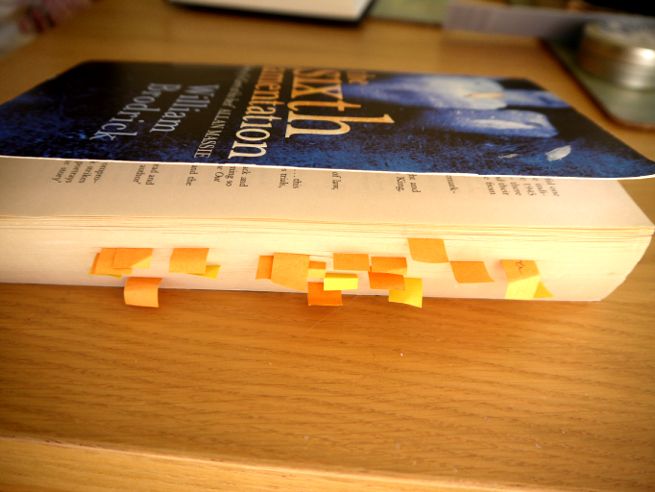
Sometimes I use the very small post-its to mark pages I want to refer to again, but the book darts look so much better. They’re archivally safe and won’t mark or stain the pages and are so neat …

… compared to the post-its:

Post-its

For more Saturday Snapshots see Alyce’s blog At Home with Books.

September’s Books

September was a good month for reading. In total I read 10 books:

I read 4 crime fiction, 4 non fiction, 1 ghost story and 1 science fiction. Two of the books were library books, 3 borrowed from a friend and 4 books were from my to-be-read books (books I’ve owned before January 2012).

It’s not been such a productive month for writing about the books I’ve read – more reading means less writing. So I’ve not previously written about the book I’ve chosen as my Pick of the Month. For more ‘Picks of the Month’ see Kerrie’s blog Mysteries in Paradise.

It is, by a short margin, The Sixth Lamentation by William Brodrick, the first Father Anselm novel.

Synopsis from Fantastic Fiction:

What should you do if the world has turned against you? When Father Anselm is asked this question by an old man at Larkwood Priory, his response, to claim sanctuary, is to have greater resonance than he could ever have imagined. For that evening the old man returns, demanding the protection of the church. His name is Eduard Schwermann and he is wanted by the police as a suspected war criminal.

With her life running out, Agnes Aubret feels it is time to unburden to her granddaughter Lucy the secrets she has been carrying for so long. Fifty years earlier, Agnes had been living in Occupied Paris, a member of a small group risking their lives to smuggle Jewish children to safety – until they were exposed by a young SS Officer: Eduard Schwermann.

As Anselm attempts to uncover Schwermann’s past, and as Lucy’s search into her grandmother’s history continues, their investigations dovetail to reveal a remarkable story.

It’s my Pick of the Month because it is historical fiction and it’s also a mystery. It looks back  to the Second World War in occupied France, telling a dramatic tale of love and betrayal, full of suspense, and interwoven stories.William Brodrick explains in his Author’s Note that the novel weaves fact and fiction, with accurate details of life in Paris during the Occupation and the subsequent war trials. He gathered facts for his novel from a variety of sources, although he has taken ‘small liberties’ with some of them.

William Brodrick has also drawn on his own personal experience. He was formerly in religious life but left before his final vows. He has degrees in philosophy and theology and after studying law he became a barrister, specialising in personal injury. The idea of smuggling Jewish children out of the Nazis’ hands was prompted by the war time experience of his own mother, Margaretha Duyker. She was part of a smuggling ring and took a child out of Amsterdam by train to Arnhem. She was caught by the Gestapo and imprisoned and eventually released. She died of motor neurone disease (the disease that Agnes is suffering from) in 1989.

I’ve read one other book by William Brodrick – The Gardens of the Dead, also a Father Anselm book. There are two more:

The Sixth Lamentation also fits into the R.I.P.VII Challenge.

Crime Fiction Alphabet: T is for …

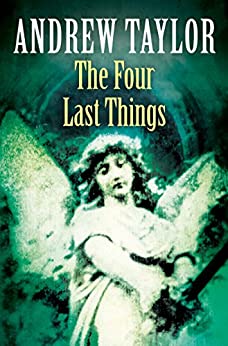
The Four Last Things by Andrew Taylor.

This is the first in the Roth trilogy, a tense and scary opening book. So chilling that I nearly stopped reading it and only continued because I couldn’t get the story out of my head and I wanted to know how it ended.

The complete trilogy is about the linked histories of the Appleyards and the Byfields. The books work backwards in time, with this first book being the last chronologically, set in the 1990s, and each book works as a stand-alone, self-contained story. Andrew Taylor states they are designed to work together, but they can be read in any order. The second novel, The Judgement of Strangers, describes events that took place during the summer of 1970, with the third, The Office of the Dead, ten years earlier again. But, having read the first book and the second, I think it is best to read them in that order, because there are people and things that happen that have roots in the second (and I suspect because I haven’t read it yet) the last book and it would spoil the story to know these in advance.

The Four Last Things tells the story of Lucy Appleyard, aged four, who is snatched from her child minder’s one cold winter afternoon. Her parents, Sally, a deacon in the church of England and Michael, a police sergeant, are distraught. Their fears mount as grisly body parts are discovered first in a graveyard and then in a church. A sense of evil and menace permeates the book, told from varying viewpoints conveying Sally’s and Michael’s terror and powerlessness. The characterisation is strong, so much so that I feared for Lucy’s safety and even sympathised with one of the kidnappers.

It’s not just the characters and the mysteries that kept me captivated reading The Four Last Things, because the settings are so well described and so atmospheric, so vivid that I could easily see them in my mind – the dingy London streets and alleyways, the old churches and graveyards, and the overgrown back garden of 29 Rosington Road.

The reason I found this book is so compelling to read is that, although there are horrific elements to it (although not in gratuitous detail) and it’s about the kidnapping of a little girl (which always horrifies me), it’s also a puzzle, posing questions such as why and how these events came about. And the answers aren’t all in this first book. There are tantalising glimpses of the kidnappers’ backgrounds and their psychological make-up, which in themselves are so disturbing. There are questions too about the parents – Sally wonders if there is a religious motivation behind the kidnapping, particularly after the incident in church where she is cursed by an old woman. And what is so troubling in Michael’s background, why is he so reliant on his ‘Uncle David’, an Anglo-Catholic known as Father Byfield? Where do the Reverend Francis Youlgreave and the parish of Roth fit in ? What had happened there when David was the vicar? It was these questions that made me pick up the next book as soon as I’d finished the first. I have just finished it this morning and have some of the answers, but also more questions. I’ll be writing more in another post on The Judgement of Strangers some time soon.

The title is a reference to a painting of the Last Judgement showing the ‘four last things’ identified in a passage in the Apocrypha as ‘Death and Judgement and Heaven and Hell.’ Sally comes to realise that ‘where hell is, there is Lucy.’

vaguely remembered watching a TV version of this with Emilia Fox and Charles Dance as two of the characters. Looking it up, I see that this was in 2007 under the title Fallen Angel. Fallen Angel is also the title of the HarperCollins paperback omnibus of the trilogy (formerly published as Requiem For an Angel). I think the books will stick in my mind longer than the TV version did. For me reading is almost always better than watching a film or TV drama.

A Crime Fiction Alphabet post for the letter T.

This book also fits very nicely into the R.I.P. VII Challenge.

  • Paperback: 368 pages
  • Publisher: HarperCollins; (Reissue) edition (5 Feb 2001)
  • Language: English
  • ISBN-10: 0007105118
  • ISBN-13: 978-0007105113
  • Source: my own copy
  • My rating: 4/5
  • Author’s website: Andrew Taylor

My Life According to Books, 2012 Edition

I saw this meme on Cath’s blog, Read Warbler. Like Cath I’m behind with writing book reviews but instead of doing that today I decided to do Pop Culture Nerd’s new version of the My Life as a Book meme. Every year she gives us fill-in-the-blank sentences to complete by using the titles of books we’ve read that year.

Here’s my contribution for the 2012 edition:

1. Every Monday I look like: The Help (Kathryn Stockett)

2. Last time I went to a doctor was because: (of) The Parasites (Daphne du Maurier)

3. Last Meal I ate was: Red Bones (by Ann Cleeves)

4. My savings account is: The Safe House (Nicci French)

5. When a creepy guy asks for my number I: Bring Up the Bodies (Hilary Mantel)

6. Ignorant politicians make me: (think of) The War of the Worlds (H G Wells)

7. Some people need to spend more time: (in) A Room Full of Bones (Elly Griffiths)

8. My memoir could be titled: A Quiet Life (Beryl Bainbridge)

9. If I could have, I would’ve told my teenage self: (to beware of the) Dark Matter (Michelle Paver)

10. In five years I hope I am: (in) A Place of Greater Safety (Hilary Mantel)

Saturday Snapshot: On Holiday

We’ve been away last week, over at Kentallen on the west coast of Scotland – near Glencoe. These were the views of Loch Linnhe from our bedroom windows, taken late afternoon on the day we arrived. Click on the photos to enlarge them:

Here’s a close-up of the flag:

We got back home last night and I’ve got lots more photos of the places we visited – I just need time to sort them all out.

For more Saturday Snapshots see Alyce’s blog At Home with Books.

Laurie Lee

Laurie Lee was born in Stroud in Gloucestershire and moved to Slad when he was three in 1917. He died there in 1997. His best known book is Cider With Rosie (1959) which I loved. It covers his childhood years in Slad and it is absolutely fascinating. He was also a poet and this book reads like a prose poem throughout – I wrote about it here.

I’ve recently read another two of Laurie Lee’s books – As I Walked Out One Midsummer Morning (1969), which is about his life after he left his home in Slad, and A Rose for Winter (1955), which is a record of his travels in Andalusia 15 years after he first went there.

 As I Walked Out One Midsummer Morning is the second of his autobiographical trilogy which began with Cider With Rosie followed by A Moment of War (1991). It begins in 1934 when Laurie Lee left his home in the Cotswolds and set out ‘to discover the world’. First he walked to London where he got a job on a building site and supplemented his income by playing the violin. He left for Spain a year later, landing at Vigo and then making his way on foot through to Castillo on the south coast, playing his violin in exchange for food and a bed for the night. Then the Spanish Civil War began in earnest and he came home on a Royal Navy destroyer that had been sent from Gibraltar to rescue any ‘British subjects who might be marooned on the coast.’ In an Epilogue he explains how he had shameful doubts about leaving Spain and so he returned to join the Republicans.

Lee writes vivid, lyrical prose with beautiful descriptions of the countryside, the scorching heat, the poverty and the people, so although I haven’t been to any of the places he describes it was easy to visualise the scenes. It’s not just the scenery he captures, but also the atmosphere, the splendour and squalor, and the desperation and also the love and enthusiasm for life.

In A Rose in Winter Lee writes about his travels in Andalusia which he visited with his wife fifteen years after his last time there during the Spanish Civil War. Again, he describes the towns and countryside beautifully, portraying the poverty, the hospitality and the changes the Civil War had inflicted. He takes part in religious processions, goes to a bull fight and watches the ‘most fundamental, most mysterious of all encounters in Andalusian folk-music – the cante flamenco’, a most dramatic and erotic performance.

Reading them one after the other I was struck by his descriptions of the towns – Seville, for example, in As I Walked Out One Midsummer Morning was

… dazzling – a creamy crustation of flower-banked houses fanning out from each bank of the river. The Moorish occupation had bequeathed the affection for water around which so many of even the poorest dwellings were built – a thousand miniature patios set with inexhaustible fountains which fell trickling upon ferns and leaves, each a nest of green repeated in endless variations around this theme of domestic oasis. (page 126)

and in A Rose for Winter

So Seville remains, favoured and sensual, exuding from the banks of its golden river a miasma of perpetual excitement, compounded of those appetites that are most particularly Spanish – chivalry, bloodshed, poetry and religious mortification. (page 34)

Katrina commented on my previous post about As I Walked Out One Midsummer Morning that she was disappointed to read that Laurie Lee’s Spanish experiences were almost all fiction. I tried to find out more about this. There are doubts that Lee falsified and embellished his involvement in the Spanish Civil War in A Moment of War (which I haven’t read). However, his widow denied this. In an interview recorded in The New York Times, 24 February 1985, Lee, talking about Cider With Rosie said  “… it is not so much about me as about the world that I observed from my earliest years. It was a world that I wanted to record because it was such a miracle visitation to me. I wanted to communicate what I had seen, so that others could see it.”

Whether his books are fictionalised accounts of his life or not, I like them. They evoke the past – a world long gone – and give a sense of what life was like. I like to think they portray truth, even if all the facts may not be strictly accurate.