Agatha Christie Reading Challenge

My progress in 2012:

The Agatha Christie Reading Challenge is run by Kerrie at Mysteries in Paradise. I don’t think of it as a Challenge – it’s really a reading project, as it is quite simply to read Agatha Christie’s books. I’m not reading them in order of publication but as I come across them.

The full list of the 45 novels that I’ve read is on my Agatha Christie Reading Challenge page.

My favourite this year is One, Two, Buckle My Shoe, but with the exception of Postern of Fate I thought they all made fascinating reading.

This year I’ve read 11 books, which I’ve listed below in the order of publication:

  1. 1923 The Murder on the Links – this is the third book she wrote and the second featuring Hercule Poirot. Agatha Christie had the idea for the book after reading newspaper reports of a murder in France, in which masked men had broken into a house, killed the owner and left his wife bound and gagged. From these facts she then invented her plot, setting the book in the fictional French town of Merlinville.
  2. 1933 Lord Edgware Dies – this is the eighth Poirot book and is narrated by Captain Hastings. Poirot is at his best, relying on his knowledge of psychology, the ‘˜employment of the little grey cells‘˜, which gives him such mental pleasure.
  3. 1936 Murder in Mesopotamia (I haven’t written a post on this book). In 1936 Agatha Christie was with her husband Max Malloran at his archaeological dig in the Middle East and this book is the first she wrote set in that part of the world – in this case in that part of Iraq formerly known as Mesopotamia. The murder victim is the wife of the archaeologist!
  4. 1940 One, Two, Buckle My Shoewritten in 1939, this book reflects the economic and political conditions of the time, with a definite pre-war atmosphere of a world on the brink of war.  Hercule Poirot and Inspector Japp investigate the apparent suicide of Mr Morley, Poirot’s Harley Street dentist.  Each chapter is entitled after a line of the nursery rhyme and the first line contains an important clue.
  5. 1947 The Labours of Hercules. This is a collection of 12 short stories featuring Hercule Poirot, first published in 1947. Poirot is thinking of retiring, but before he does he wants to solve 12 more cases and not just any cases. These have to correspond to the Twelve Labours of Hercules, specially selected problems that personally appeal to him.
  6. 1953 After the Funeral, another Poirot book, full of red herrings, complicated family relationships and one where the motive for the crime is skilfully concealed.
  7. 1955 Hickory Dickory Dock brings the first appearance of Miss Lemon, Poirot’s secretary, in a full length novel. Set in a crowded London house, owned by Mrs Nicolstis, a Greek, with a mixed group of young people from a variety of backgrounds and cultures, where one of the students commits suicide ‘“ or is it murder?
  8. 1965 At Bertram’s Hotel, where Miss Marple stays for a week as a gift from her nephew and his wife. There’s a long build up to any crime being committed and It’s only towards the end of the book that a murder occurs. Miss Marple’s presence is vital to solving the mystery.
  9. 1967 Endless Night this is a psychological study with a suffocating air of menace throughout the book, and more than one twist at the end.
  10. 1973 Postern of Fate the fourth of the Tommy and Tuppence Beresford mysteries. It begins with the ageing couple, now retired and living in a new home. They investigate the fate of Mary Jordan who had lived there many years earlier. Not one of Agatha Christie’s better books.
  11. 1976 (but written in the 1940s) Sleeping Murder Agatha Christie had written this book during the Second World War. Miss Marple’s last case in which she investigates a murder that had happened 18 years earlier.

I have been trying to fill in the gaps and still have some of her earlier books to find (I haven’t listed her short stories):

  1. 1925 – The Secret of Chimneys
  2. 1927 – The Big Four
  3. 1930 – The Murder at the Vicarage
  4. 1931 – The Sittaford Mystery
  5. 1935 – Three Act Tragedy
  6. 1936 – Cards on the Table
  7. 1938 – Appointment with Death
  8. 1939 – Ten Little Niggers
  9. 1940 – Sad Cypress
  10. 1941 – N or M?*
  11. 1942 – Five Little Pigs
  12. 1942 – The Moving Finger*
  13. 1944 – Towards Zero
  14. 1944 – Death Comes as the End
  15. 1945 – Sparkling Cyanide
  16. 1950 – A Murder is Announced*
  17. 1952 – Mrs McGinty’s Dead
  18. 1952 – They Do It With Mirrors*
  19. 1954 – Destination Unknown
  20. 1958 – Ordeal by Innocence
  21. 1959 – Cat Among the Pigeons*
  22. 1966 – Third Girl*
  23. 1971 – Nemesis*

* books I own

Historical Fiction Challenge 2013

Historical FictionAt this time of year numerous challenges are being announced and I’m tempted to join them. It’s a bit like making New Year resolutions, full of enthusiasm at first … But there are some challenges that interest me because they fit in with my reading, such as the Agatha Christie Reading Challenge (more about that in another post to come), which I’ve been doing for the last three years. I don’t think of them as ‘challenges’ – they’re really ‘projects’.

As historical fiction is one of my favourite genres and I read a fair amount of it I’ve decided to join the Historical Fiction Challenge for 2013.

This Challenge is being hosted by Historical Tapestry and runs from 1 January to 31 December 2013. There are five different levels of participation to choose from:

20th century reader ‘“ 2 books
Victorian reader ‘“ 5 books
Renaissance Reader ‘“ 10 books
Medieval ‘“ 15 books
Ancient History ‘“ 25+ books

I shall be aiming for the Medieval level (but really hoping to make it to the Ancient History level).

If you’re interested in joining too, see this post at Historical Tapestry.

After the Funeral by Agatha Christie

I thoroughly enjoyed Agatha Christie’s After the Funeral, first published in 1953.

Synopsis (from the official Agatha Christie website):

‘When Cora is savagely murdered, the extraordinary remark she made the previous day at her brother’s funeral takes on a chilling significance. At the reading of Richard’s will, Cora was clearly heard to say, “It’s been hushed up very nicely, hasn’t it…But he was murdered, wasn’t he?”  In desperation, the family solicitor turns to Hercule Poirot to unravel what happened next …

Published in 1953, and appearing in the United States under the title Funerals are Fatal, Christie dedicated the novel to her nephew, James Watt III “in memory of happy days at Abney”, her sister’s family home. The novel  formed the basis for MGM’˜s Murder at the Gallop, although they chose to swap Poirot for Margaret Rutherford’s Miss Marple and took ‘˜artistic licence’ with the book’s plot!  It was broadcast in 2006 with David Suchet as Poirot.’

My view:

I read it quickly and consequently had little idea who had killed Cora. I did spend some time looking at the family tree at the beginning of the book, working out the family relationships and who was present at Richard Abernethie’s funeral and their reaction to Cora’s question. It seemed to me that any of the family could have done it – Agatha Christie goes through the actions and thoughts of each character and there’s cause for suspicion for each one.

None of them had had any close ties and consequently they didn’t feel any deep grief. His brother expected he would inherit as Richard’s only son had died six months before his father. Instead Richard had distributed his property equably between his brother and his nephews and nieces – everyone is disappointed.

Apart from trying to solve the mystery I was interested in the glimpses into life in post-war Britain, where jobs are scarce, servants even more scarce and there are complaints about the economic situation, with high taxation and the prospect of properties such as the Abernethie house being turned into a hotel, or institute, or even worse being pulled down and the whole estate built over.

  • Paperback: 378 pages
  • Publisher: HarperCollins; Masterpiece edition edition (6 May 2008)
  • Language: English
  • ISBN-10: 0007119364
  • ISBN-13: 978-0007119363
  • Source: I bought the book
  • Rating: 5/5

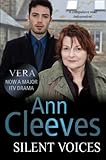
Silent Voices by Ann Cleeves

Ann Cleeves has become one of my favourite writers this year and Silent Voices is one of the best crime fiction books I’ve read recently. Although it’s the fourth in her Vera Stanhope series it’s the first that I’ve read. I did watch some of the TV versions of Vera earlier this year but I missed this one, so the plot was completely new to me.

Synopsis (taken from the back cover):

When DI Vera Stanhope finds the body of a woman in the sauna room of her local gym, she wonders briefly if, for once in her life, it’s a death from natural causes. But closer inspection reveals ligature marks around the victim’s throat…

Doing what she does best, Vera pulls her team together and sets them interviewing staff and those connected to the victim, while she and colleague Sergeant Joe Ashworth work to find a motive. While Joe struggles to reconcile his home life with the demands of the job, Vera revels being back in charge of an investigation. Death has never made her feel so alive.

And when they discover that the victim had worked in social services – and was involved in a shocking case involving a young child – it seems the two are somehow connected.

But things are rarely as they seem . . .

My view:

When I began reading I could visualise and hear Brenda Blethyn as Vera, but gradually that impression faded away and the character of Vera began to take shape in my mind from the words in this book alone. Vera is a truly eccentric individual, intelligent, single minded and dedicated to her job, single and with no family responsibilities. She finds it difficult to delegate and is exhilarated by her job. In the following extract she has phoned Joe late at night:

Her voice was loud. She’d never really got the hang of mobiles, yelled into them. She sounded as if she’d just woken up after a good night’s sleep. Murders took her that way, invigorated her as much as they excited the pensioners he’d spent all afternoon interviewing. Once, after too many glasses of Famous Grouse, she’d said that was what she’d been put on the Earth for. (page 67)

The other characters are equally as well- defined. As well as creating memorable and individual characters Ann Cleeves conveys a strong sense of place bringing the Northumbrian countryside, towns and villages to life as I read. The plot is nicely complicated and although I had an inkling about the killer I was wrong, but looking back I could see where I’d been misled. Silent Voices is an excellent book, one that kept me turning the pages and exercising my brain.

  • Paperback: 400 pages
  • Publisher: Pan (16 Sep 2011)
  • Language: English
  • ISBN-10: 0330512692
  • ISBN-13: 978-0330512695
  • Source: Library book
  • My Rating: 5/5

Tea and Books Reading Challenge 2013

Tea & Books challenge 2013

Birgit at The Book Garden is hosting the second edition of the TEA & BOOKS Reading Challenge! This challenge was inspired by C.S. Lewis’ famous words, “You can never get a cup of tea large enough or a book long enough to suit me.”
In this challenge you will only get to read … books with more than 650 pages!

  • You may pick both fiction and non fiction books!
  • Contrary to last year short story collections, anthologies or collected works in one volume are now allowed!
  • Re-reads will now also be ok (though preferably you should read one of those unread tomes that have been collecting dust on your shelves)!
  • Last year you had to read 700+ pages but for 2013 it has reduced to 650+ pages.
  • And as a little incentive – books with more than 1,200 pages will count for two books (so theoretically you can read four such super-chunksters to reach the Sencha Connoisseur level)!
  • Last but not least – no large print editions of a book, please!
There are four levels and I’ll be aiming for the Berry Tea Devotee!
  • 2 Books – Chamomile Lover
  • 4 Books – Berry Tea Devotee
  • 6 Books – Earl Grey Aficionado
  • 8 or more Books – Sencha Connoisseur

I have several books to choose from – some that I listed last year and never got round to reading. I had no idea I had so many books of over 650 pages! Here they are in ascending page number order:

  1. Into Temptation by Penny Vincenzi (654 pages)
  2. The Lacuna by Barbara Kingsolver (670 pages)
  3. Of Human Bondage by Somerset Maugham (704 pages)
  4. Dreams of Innocence by Lisa Appignanesi (712 pages)
  5. This Thing of Darkness by Harry Thompson (750 pages)
  6. Helen of Troy by Margaret George (755 pages)
  7. Mary Queen of Scots by Antonia Fraser (758 pages)
  8. Long Walk to Freedom by Nelson Mandela (769 pages)
  9. No Name by Wilkie Collins (784 pages)
  10. Nicholas Nickleby by Charles Dickens (800 pages)
  11. Martin Chuzzlewit by Charles Dickens (800 pages)
  12. The Mitfords: Letters between Six Sisters edited by Charlotte Mosley (834 pages)
  13. Little Dorrit by Charles Dickens (848 pages)
  14. The Count of Monte Cristo by Alexandre Dumas (894 pages)
  15. Parade’s End by Ford Madox Ford (906 pages)
  16. Ulysses by James Joyce (944 pages)
  17. The Pillars of the Earth by Ken Follett (1088 pages)

I’m just aiming to read four of them (last year I read just 3 books of over 700 pages each). I’d like to think I’ll read more than four of these books next year, but I’m being realistic – I do want to read other books and I can’t see myself reading more than one of them a month! I’m not deciding in which order I’ll be reading them – it has to be a spontaneous decision at the time.

This challenge will also contribute towards the Mount TBR Challenge, as I’ve owned these books for some time (years in some cases).