St Mawr by D H Lawrence

I liked  St Mawr even though there is so much philosophising and repetition (why use a word just once when you can repeat it three times) that the story is rather swamped. It’s a short novel (147 pages in my copy), first published in 1925, set in the English countryside and then in America, on a ranch in the Rocky Mountains.

This is the story of Mrs Witt, an American, Lou her daughter and Rico, her daughter’s artist husband and the influence of the stallion St Mawr on their lives. Initially desperately in love with each other Lou and Rico react badly on each other and being together makes them ill – they sap each other’s vitality.

As soon as Lou sees St Mawr she knows she just has to buy him:

She laid her hand on his side and gently stroked him. Then she stroked his shoulder, and then the hard, tense arch of his neck. And she was startled to feel the vivid heat of his life come through to her, through the lacquer of red-gold gloss. So slippery with vivid hot life.

In St Mawr Lou finds the vitality that is lacking in Rico. St Mawr represents to her freedom, and wildness as well as masculinity. He cannot be tamed. Bored with life Lou goes to America with her mother, Phoenix, her mother’s Mexican-Indian servant, St Mawr and his groom Lewis. There too she is bored; she leaves St Mawr and Lewis behind and travels to the Rocky Mountains of New Mexico with her mother and Phoenix. Here she comes across a tumbledown ranch, Las Chivas, that she immediately loves, aligning herself to the wild spirit that she says wants her. (The ranch is based on Lawrence’ s Lobo Ranch (later called Kiowa) at Questa, seventeen miles fro Taos, where Lawrence wrote the novel.)

This a richly written story, with beautiful descriptions of the landscape and the characters, full of symbolism and Lawrence’s views on male/female relationships, life and death, and the power of nature. I think I may need to re-read it to understand it better.

Ordeal by Innocence by Agatha Christie

Agatha Christie wrote in An Autobiography that Ordeal by Innocence and Crooked House were the two books she’d written that satisfied her the best. Neither book features Poirot or Miss Marple, so maybe she had become rather tired of them and had enjoyed introducing completely new characters.

Ordeal by Innocence (The Christie€¦Summary from the back cover of my copy:
According to the courts, Jacko Argyle bludgeoned his mother to death with a poker. Sentenced to life imprisonment, he died behind bars following a bout of pneumonia. Tragically, it was not until two years later that Dr Arthur Calgary came forward with the testimony that could have acquitted Jacko. Worse the doctor’s revelations were about to re-open old wounds in the family, increasing the likelihood that the real murderer would strike again.

My view:

Ordeal by Innocence is thus a stand-alone novel, first published in 1958, unlike the TV adaptation that had Miss Marple (in the form of Geraldine McEwan), solving the mystery.

Dr Calgary was surprised by the reception he received from the family when he visited them to tell them that Jacko was innocent and why he hadn’t come forward at the time to confirm his alibi. Instead of relief he was met with wariness and suspicion as the family members realised that one of them could be the murderer. This is a cold case that they wish had never been re-opened; they had been happy to accept that Jacko, a thoroughly nasty character, was guilty. Only Philip the eldest daughter’s wheelchair-bound husband is keen to discover the murderer’s identity. So, it is up to him, Doctor Calgary, helped by the family solicitor and Superintendent Huish to carry out fresh investigations.

What I liked about Ordeal by Innocence was the way Agatha Christie delved into the family relationships and their characters. Mrs Argyle was one of those mothers who was always right and thought she knew best and at times all her children had rebelled or wanted to rebel against her authority, so all were suspects, along with her long-suffering husband, who since her death was planning to marry his secretary.

The novel is as much about protecting the innocent as punishing the guilty, and the fact that stating your innocence is not proof of it. Calgary has to find the murderer so that the innocent will not suffer from the taint of guilt. Without knowing who was guilty they would have all come under suspicion, destroying their love and trust.

I swung from believing first one, then another character, was the guilty person and was quite taken in by all the red herrings Agatha Christie threw into the book. All is made clear in the last chapter when Dr Calgary presents his findings and reveals the killer. Although I don’t think it is one of Agatha Christie’s best books, I still enjoyed its complexity and admired her skill in plotting this novel.

The Steel Bonnets: the opening chapter

A friend has just lent me The Steel Bonnets : the Story of the Anglo-Scottish Border Reivers by George MacDonald Fraser and having looked at the opening chapter I know I just have to read on, rather than waiting for January when Peggy Ann’s Read Scotland 2014 Challenge starts. It’s a long, detailed book so I shall probably still be reading it in January anyway.

The Steel Bonnets 001I live on the English side of the Border with Scotland and the history of the area just fascinates me. The Steel Bonnets covers the period from the building of Hadrian’s Wall to 1603, when James VI of Scotland became James I of England. Four hundred or so years ago it was all very different around here and as the history of the Border Reivers is very complicated I’m hoping this book will guide me through it.

The opening paragraph took me by surprise:

At one moment when President Richard Nixon was taking part in his inauguration ceremony, he appeared flanked by Lyndon Johnson and Billy Graham. To anyone familiar with Border history it was one of those historical coincidences which send a little shudder through the mind: in that moment, thousands of miles and centuries away in time away from the Debateable Land, the threads came together again; the descendants of three notable Anglo-Scottish Border tribes – families who lived and fought within a few miles of each other on the West Marches in Queen Elizabeth’s time – were standing side by side, and it took very little effort of the imagination to replace the custom-made suits with leather jacks or backs-and-breasts. Only a political commentator would be tactless enough to pursue the resemblance to Border reivers beyond the physical, but there the similarity is strong.

In the following paragraphs he goes on to describe their physical features, particularly those of Nixon and Johnson, as ‘excellent specimens of two distinct but common Border types.’ I hadn’t expected this at all.

For more Book Beginnings see Gilion’s blog Rose City Reader.

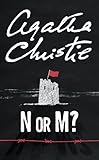
N or M? by Agatha Christie

N or M? is the third of the Tommy and Tuppence stories, set in 1940 and first published in 1941.  Agatha Christie wrote this at the same time as writing The Body in the Library. She explained the reason in her Autobiography:

I had decided to write two books at once, since one of the difficulties of writing a book is that it suddenly goes stale on you. Then you have to put it by, and do other things – but I believed that if  I wrote two books, and alternated the writing of them, it would keep me fresh at the task. One was The Body in the Library, which I had been thinking of writing for some time, and the other one was N or M?, a spy story, which was in a way a continuation of the second book of mine, The Secret Adversary, featuring Tommy and Tuppence. Now with a grown-up son and daughter, Tommy and Tuppence were bored by finding that nobody wanted them in wartime. However, they made a splendid come-back as a middle-aged pair, and tracked down spies with all their old enthusiasm. (An Autobiography by Agatha Christie page 506)

Tommy is asked to go under cover to track down members of the Fifth Column, two of the most important and trusted German agents, whose mission is to infiltrate British society, like the Trojan wooden horse. All that is known is that N is a man and M a woman and they are thought to be at Leahampton on the south coast. He tells Tuppence that he is being sent to Scotland and that she can’t go with him, but she surprises him by being at Sans Souci, a seaside guesthouse in Leahampton, when he arrives. So there they are, both under cover, Tommy as Mr Meadowes and Tuppence as Mrs Blenkensop.

There is definitely something not right about the guesthouse, it has the feel of something sinister, something evil. And it’s not long before Tommy and Tuppence are embroiled in a series of dangerous near-disasters, involving German spies, and Smuggler’s Rest, a cottage with a secret room, set on a cliff overlooking a little cove and ideal for enemy action.

N or M? is an easy book to read and not too demanding. Agatha Christie makes use, as in some of her other books, of nursery rhymes, in this one it’s ‘Goosey goosey gander’, which comes from a Mother Goose picture book Tuppence reads to little Betty Sprot. Of all the characters in the book (apart from Tommy and Tuppence) Betty, a toddler, who speaks her own baby language, is the most well-drawn, so much so that at one point I even found myself wondering if she could be M!!!

One of its attractions for me is its historical setting, although when Agatha Christie wrote this book it was very current, she did not know how the war would end. It is interesting to see how she portrays the general public’s attitude towards the war, about patriotism, and the fear of Fifth Columnists, of spies, and Fascists and Communists. Also of note is that whilst most of the characters thought the war would be over very quickly, which is what I thought was the general consensus at the time, one of them thought it would last at least six years.

Following the publication of N or M? Agatha Christie was investigated by MI5 because she had named one of the characters ‘Major Bletchley’ and MI5 suspected she had a spy in Britain’s undercover code breaking centre, Bletchley Park.

The Sc-Fi Experience: The Midwich Cuckoos

Sci-Fi Experience

Carl at Stainless Steel Droppings is hosting the 2014 Sci-Fi Experience beginning on
December 1st, 2013 and ending on January 31st, 2014. Carl is inviting readers to:

a) Continue their love affair with science fiction
b) Return to science fiction after an absence, or
c) Experience for the first time just how exhilarating science fiction can be.

There are no set numbers of books to read, no pressure, you just get to read what you like, be it one book or twenty: it’s up to you.

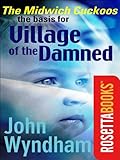
I think I fall into the second category. I used to read a lot of science fiction many years ago but these days I only read one or two now and then. As it happens, now is one of those rare occasions as I’ve recently read The Midwich Cuckoos by John Wyndham, first published in 1957.

Book Description from Amazon

In the sleepy English village of Midwich, a mysterious silver object appears and all the inhabitants fall unconscious. A day later the object is gone and everyone awakens unharmed €“ except that all the women in the village are discovered to be pregnant.

The resultant children of Midwich do not belong to their parents: all are blonde, all are golden eyed. They grow up too fast and their minds exhibit frightening abilities that give them control over others and brings them into conflict with the villagers just as a chilling realisation dawns on the world outside . . .

The Midwich Cuckoos is the classic tale of aliens in our midst, exploring how we respond when confronted by those who are innately superior to us in every conceivable way.

My view:

The story is set in an ordinary village, with a village green and a white-railed pond, a church and vicarage, an inn, smithy, post office, village shop and sixty cottages and small houses, a village hall, and two large houses, Kyle Manor and The Grange. A very ordinary village where not much goes on, which makes what happens there even more extraordinary.

It’s a product of its time and is dated in the way it portrays women – for example, comments about the female mind being empty because of the dullness of the majority of female tasks and focusing on the shame of being an unmarried mother. Maybe there is too much philosophising and discussion about topics about collective-individualism, morality, the nature of God and evolution. But even so the level of tension and fear rose as the children grew and revealed their powers and not having seen the film version I had no idea how it would end.

Actually, I really enjoyed The Midwich Cuckoos more than I thought I would. It’s eerie and very chilling, a story of alien invasion and the apparent helplessness of humanity to put up any resistance.

What's In a Name? 7

Whats in a name 7The What’s In A Name challenge, which has been hosted for the last few years by Beth Fish Reads, has now been taken over by Charlie at The Worm Hole for its seventh outing. It’s a challenge I’ve taken part in since it was started by Annie.

The challenge runs from January to December 2014. During this time you choose a book to read from each of the following categories (my choices are in brackets). In some of the categories I’m spoilt for choice from my stock of unread books and for some I have just a couple of books to choose from – I could, of course, read more than one book for each category!

  • A reference to time (The Sands of Time, In Our Time)
  • A position of royalty (King’s Evil, I’m the King of the Castle)
  • A number written in letters (One Hundred Years of Solitude, Eight Black Horses, Nineteen Eighty Four)
  • A forename or names (Helen of Troy, Martin Chuzzlewit plus many more)
  • A type or element of weather (Snow, The Year of the Flood, The Snow Geese)

For full details and the sign up post go to The Worm Hole.