First Chapter – First Paragraph

It will be a while before I can write a book review post as I’m in the middle of reading Gaudy Night by Dorothy L Sayers and it’s quite long – and complicated. So in the meantime here is a First Chapter – First Paragraph post.

First chapterEvery Tuesday Diane at Bibliophile by the Sea hosts First Chapter First Paragraph Tuesday Intros, where you can share the first paragraph, or a few, of a book you are reading or thinking about reading soon.

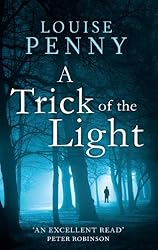
My choice this week is A Trick of the Light by Louise Penny, a book I’ve borrowed from the library.


It begins:

Oh, no no no, thought Clare Morrow as she walked towards the closed doors.

She could see shadows, shapes, like wraiths moving back and forth, back and forth across the frosted glass. Appearing and disappearing. Distorted, but still moving.

Still the dead one lay moaning.

The words had been going through her head all day, appearing and disappearing. A poem, half remembered. Words floating to the surface, then going under. The body of the poem beyond her grasp.

The title of this one caught my eye on the library van’s shelves and reading the opening paragraphs I decided to borrow it – mainly because the poem Clare can’t quite remember is one of my favourites. It’s Not Waving, but Drowning by Stevie Smith and I wondered what relevance it has to this book. There will be a body, I expect.

What do you think? Would you carry on reading?

A Trick of the Light is the 7th in Louise Penny’s Chief Inspector Gamache series and I’m hoping it will stand well on its own as I haven’t read the first six books even though I’ve seen them recommended on other book blogs.

If you’ve read Louise Penny’s books do you think they do stand well on their own – or should they really be read in sequence? Am I missing something by beginning with book 7?

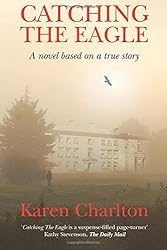
Catching the Eagle by Karen Charlton

I wanted to read a novel by a local author so I checked the library website for North East writers, where I found Catching the Eagle by Karen Charlton.

Summary from the book cover:

Easter Monday, 1809: Kirkley Hall manor house is mysteriously burgled. When suspicion falls on Jamie Charlton, he and his family face a desperate battle to save him from the gallows.

When 1,157 rent money is stolen from Kirkley Hall, it is the biggest robbery Northumberland has ever known. The owner sends for Stephen Lavender, a principal officer with the Bow Street magistrate’s court in London, to investigate the crime. Suspicion soon falls on impoverished farm labourer, Jamie Charlton, and the unpopular steward, Michael Aynsley.

Jamie Charlton is a loving family man but he is hot-tempered and careless. As the case grows against him, it seems that only his young brother, William, can save him from an impending miscarriage of justice.

But William is struggling with demons of his own–he is falling in love with Jamie’s wife.’Catching the Eagle’, the first novel in the Regency Reivers series, is a fictionalized account of a trial that devastated a family and divided a community.

This is not just by a local author, and set in Northumberland, it is also based on a true story –  that of Karen Charlton’s husband’s ancestors.

I liked the opening of Catching the Eagle beginning with a Prologue, setting the scene as an eagle soared over the Northumberland landscape:

… its huge shadow caressed the ruined walls of crumbling castles and the creaking rotting stumps of ancient gibbets.The eagle plucked unsuspecting prey from the bleak, snow-covered fells and drank from remote rocky waterfalls dripping with golden daggers.

It landed in a tree above a labourer’s cottage where Jamie Charlton lived with his wife Priscilla and their children. I like Karen Charlton’s leisurely descriptive style of writing and found the whole book to be fascinating.  She has written an even-handed account of the robbery and the subsequent trials, so much so that I began to wonder whether Jamie Charlton was innocent or guilty, although you know from the outset that he was transported as a convicted felon to New South Wales. Did he or did he not steal the money? And what will happen to the eagle?

This is the type of historical fiction that I like. The characters come across as real people, with real problems in a real time and place (Northumberland 1809 – 1811). It highlights the social and cultural setting. Jamie was without influence or money behind him up against a judicial system run by people with power who needed to find a culprit. His family suffered along with him as he languished in goal in squalor, where he was caged as he awaited trial – not once, but twice.

I wondered whether Stephen Lavender, the detective employed by  Nathaniel Ogle, the owner of Kirkley Hall was also a real historical figure. Karen Charlton has also written Seeking Our Eagle, another fascinating book, an account of how she came to write Catching the Eagle whilst researching her husband’s family history.  And yes, Stephen Lavender did exist and he was a detective. He later became the Deputy Chief Constable of Manchester after the formation of the police force by Sir Robert Peel.
Indeed reading Catching the Eagle reminded me of The Suspicions of Samuel Whicher by Kate Summerscale, featuring Detective Inspector Jonathan Whicher of Scotland Yard, the book that won the Samuel Johnson Prize for Non-Fiction in 2008.

Karen Charlton has done her research very well and has written a novel full of intrigue, tension and realism that kept me captivated from start to finish. See her website, Karen Charlton, to read more about Karen and her books.

She has also written The Heiress of Linn Hagh, a spin-off novel from Catching the Eagle, which features Detective Stephen Lavender and his sidekick, Constable Woods. And there are more Detective Lavender Series books on the way!

Catching the Eagle:

  • Paperback: 280 pages
  • Publisher: Famelton Publishing; 1 edition (19 July 2014)
  • ISBN-10: 0992803640
  • ISBN-13: 978-0992803643
  • Product Dimensions: 15.2 x 1.8 x 22.9 cm
  • Source: Library book

Seeking the Eagle:

  • Format: Kindle Edition
  • File Size: 1969 KB
  • Print Length: 166 pages
  • Publisher: Famelton Publishing; 1st edition (7 Aug. 2012)
  • Sold by: Amazon Media EU S.à r.l.
  • Language: English
  • ASIN: B008UZYOR2
  • Source: I bought it

As always I didn’t read either book just for any Reading Challenges, but Catching the Eagle does fit very well into a couple – the 2015  Historical Fiction Reading Challenge and the What’s in a Name Challenge, in the book with an animal in the title category and Seeking Our Eagle into the Nonfiction Reading Challenge.

Three Act Tragedy by Agatha Christie

Three Act Tragedy 001

I’ve been working my way through Agatha Christie’s books over the past few years and I have just a few left to read. Three Act Tragedy is one of them. It was first published in 1935 (as Murder in Three Acts in America).

As the title indicates the book is divided into three acts, or rather parts, First Act – Suspicion, Second Act – Certainty and Third Act – Discovery. It begins as though it were a theatre programme:

Directed by

SIR CHARLES CARTWRIGHT

Assistant Directors
MR SATTERTHWAITE
MISS HERMIONE LYTTON GORE

Clothes by
AMBROSINE LTD

Illumination by
HERCULE POIROT

Summary from the back cover:

Sir Charles Cartwright, the distinguished actor, was giving a party. Around him his guests stood talking and drinking. The Reverend Stephen Babbington sipped his cocktail and pulled a wry face. the chatter continued all around. Suddenly Mr Babbington clutched at his throat and swayed …

The beginning of the drama …

Sir Charles suspects that Mr Babbington was murdered but Hercule Poirot, one of the guests, disagrees and there is nothing to show that his death was by any other than natural causes and besides who could possible have cause to kill him! However, later when Sir Bartholomew Strange, a distinguished Harley Street doctor who was also a guest at Sir Charles’ party, drops dead after sipping a glass of port at another party with some of the original guests, it becomes clear that this is murder by poisoning.

This is one of those cases where Poirot plays a secondary role, preferring to think rather than act and it is Mr Satterthwaite and Sir Charles who investigate the deaths. Mr Satterthwaite is an interesting character – ‘ a  dried-up little pipkin of a man’, ‘ a patron of art and drama, a determined but pleasant snob’ and ‘a man of considerable intelligence and a very shrewd observer of people and things.’ An ideal partner in investigation for Poirot.

(This is Mr Satterthwaite’s first appearance outside a Harley Quin story – I have yet to read the Harley Quin stories.)

As for the other characters, some fade into the background, whilst others like Sir Charles and Hermione Lytton Gore, known affectionately as Egg are in the spotlight. This is one of Agatha Christie’s earlier books and is full of baffling clues, conjuring tricks, clues concealed in conversations, with larger than life personalities, and above all with puzzles to be solved. I really enjoyed it.

In this book Hercule Poirot reveals a little of his history, coming from a large and poor family he had worked hard in the Belgian police force, made a name for himself and an international reputation. He was injured in the First World War and came to England as a refugee, eventually becoming a private inquiry agent. He displays his usual vanity and egotism when talking to Mr Satterthwaite, who had realised that he might have accidentally have drunk the poisoned cocktail, by saying:

‘There is an even more terrible possibility that you have not considered. … It might have been ME.

First Chapter First Paragraph: The Zig Zag Girl

Every Tuesday Diane at Bibliophile by the Sea hosts First Chapter First Paragraph Tuesday Intros, where you can share the first paragraph, or a few, of a book you are reading or thinking about reading soon.
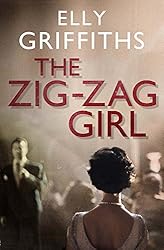
My choice this week is: The Zig Zag Girl by Elly Griffiths, a book I have just finished reading.

It begins:

 ‘Looks as if someone’s sliced her into three,’ said Solomon Carter, the police surgeon chattily. ‘We’re just missing the middle bit.’

I must not be sick, thought Edgar Stephens. That’s what he wants. Stay calm and professional at all times. You’re the policeman, after all.

What do you think? Would you read on?

I did. I’m a squeamish reader and don’t like anything too graphically gory and you might think this opening would put me off. But it didn’t – for one thing, it doesn’t go into detail about how the body got cut into three. Well, yes later down the page there’s mention of ‘clotted blood and smell of decaying flesh‘, but that’s it, it’s all secondhand, no scenes where the murderer is described doing the terrible act, no dwelling on what he/she was doing to the other person.

Blurb from the inside flap:

Brighton, 1950 – a post-war world of rationing, austerity, pea-souper fogs and seedy seaside resorts. When the body of a girl is found, cut into three, DI Edgar Stephens recalls a magic trick that he saw as a boy. The illusion is called the Zig Zag Girl and its inventor, Max Mephisto, is an old friend of his. They served together in the war as part of a shadowy unit called the Magic Men, formed to use stage trickery to confuse the enemy.

Edgar tracks down Max and asks for his help. Max is still on the circuit, touring seaside towns in the company of ventriloquists, sword-swallowers and dancing girls. Max is reluctant to get involved but the changes his mind when the dead girl turns out to be his former stage assistant. Another death follows, again gruesomely staged to resemble a magic trick, the Sword Cabinet.

Edgar and Max become convinced that the answer to the murders lies back in their army days and the antics of the Magic Men.

When Edgar receives a letter warning of another ‘trick’, he knows that they are all in danger. The Wolf Trap is the deadliest illusion of all, but who will be the next victim?

I’ve read some of Elly Griffiths’ Ruth Galloway, forensic archaeologist, crime novels, which I have enjoyed despite wishing they weren’t written in the present tense. So it was with relief that I came to The Zig Zag Girl and found it’s written in the past tense.

I enjoyed it in several ways – for its characters, particularly Edgar Stephens and its setting, recalling the atmosphere of the 1950s and how times were changing. The theatrical elements are fascinating – life on the variety circuit was not all glitz and glamour; and the activities of the  Magic Men unit during the war had of course an immense effect on all their lives. I worked out quite early on who the murderer was – but not why, which only dawned on me at the end of the book.

I don’t know if this is going to be the start of a new series – I’d read more if it is.

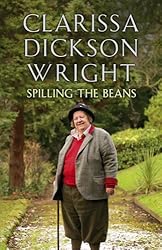
Spilling the Beans by Clarissa Dickson Wright

I’ve left it a bit too long to write about Spilling the Beans, Clarissa Dickson Wright’s autobiography because I’ve now forgotten much of the detail.  It’s a book I really enjoyed, but I finished it nearly two weeks ago! I’ve  been feeling a bit under the weather recently with a rotten cold and although I have been reading I haven’t been able to summon up enough mental energy to write much!

I quoted from the opening of the book in this post, with these details about Clarissa:

Clarissa Dickson Wright was an English celebrity chef ‘“ one of the Two Fat Ladies, a television personality, writer, businesswoman, and former barrister. She died last year on 15 March in the Edinburgh Royal Infirmary. Clarissa was a huge character in more than her size! Her autobiography is fascinating, coming from a privileged and wealthy background she had a difficult childhood- her father, a well respected surgeon was also an alcoholic who beat his wife and Clarissa.

After her mother died she took comfort from alcohol and at the mid point of the book she was as she described it ‘˜sunk in gin’ and homeless. I am looking forward to reading about her road to recovery.

In the rest of the book she described her period of homelessness, sleeping on benches in the Victoria Coach Station for two nights, but spending the rest of the time staying with friends, until she took jobs in domestic service, where she learned to cook. I liked her attitude to being a servant:

I have never understood the aversion to domestic service … I am not sufficiently bourgeoise to worry about my place in the class system and if you don’t understand this, well, that’s your problem. I had no sense of downshifting; maybe I should have had but pragmatism is the saving of many an alcoholic. (page 154)

She then went on to tell about her ‘dark night of the soul’ and her time at addiction centres, the treatment and her eventual recovery. All this took years and she was very honest and open.

She also wrote about her bookselling experience – all totally news to me – her time at ‘Cooks for Books’ changed her life and later after she had moved to Scotland in the late 1980s  she ran the Cook’s Bookshop in Edinburgh near the Grassmarket. She was declared bankrupt three times, was rector of Aberdeen University for six years. And then, of course, there were her TV shows – Two Fat Ladies, with Jennifer Paterson and Clarissa and The Countryman with Johnny Scott. She was a staunch supporter of the Countryside Alliance, against the ban on foxhunting .

Despite all her difficulties and her alcoholism this is an upbeat autobiography, ending on a positive note: “Believe me on one thing: I have a splendidly enjoyable life”. And believe me this is  a ‘splendidly enjoyable’ autobiography.

My copy is a hardback book, which I bought, but it is also available in paperback and ebook.

Note: I didn’t read this book to meet any challenges, but it does:

There is a spot just by the Scots Border at Berwick-upon-Tweed, where the train passes a stretch of the sea coast. Looking out of the window I felt, Oh it’s so lovely to be home, and if it’s home, I thought, I’d better stay and I have been here ever since. (page 225)

For another review see Cath’s blog Read Warbler.

Five of the Best (February 2011- 2015)

I saw this on FictionFan’s blog and thought it was a great idea. It was originally Cleo’s idea – see Cleopatra Loves BooksI hope they don’t mind if I also do the same! The idea is to look back over your reviews of the past five years and pick out your favourite for each month from 2011 – 2015.

So here goes: my favourite books for each February from 2011 to 2015 (click on the covers to see my original reviews, though one or two are mini reviews) are:

2011

 In February 2011 one of my favourite reads was Reginald Hill’s Exit Lines, a Dalziel and Pascoe crime novel. In this one there are three elderly victims who all died violently and a drunken Dalziel is a suspect in one as it seems he was driving the car that hit an elderly cyclist. The plot is intricate, each separate case being linked in one way or another. I thought it was an excellent crime fiction novel which kept me guessing until the end.

2012

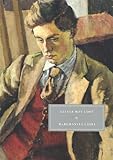
Little Boy Lost by Marghanita Laski is not just one of my favourite reads from February 2012, it is one of my all time favourite books. It is a beautiful book, the story of Hilary Wainwright, who is searching for his son, lost five years earlier in the Second World War. Hilary had left France just after his wife, Lisa, had given birth to John. Lisa, unable to leave France, worked for the Resistance, but was killed by the Gestapo and her son disappeared. It’s written in such clear, straightforward language and yet at the same time it is emotional, heart-wrenching and nerve-wracking, full of tension, but never sentimental.

2013

Redemption of AS 001It’s historical crime fiction, for February 2013 with The Redemption of Alexander Seaton by Shona MacLean, now known as S G MacLean. It’s set in 17th century Scotland, mainly in the town of Banff, where on a stormy night Patrick Davidson, the local apothecary’s assistant collapses in the street. The next morning he is found dead in the school house of Alexander Seaton, a failed minister, now a schoolteacher. I found the book totally absorbing, convinced I was back in Scotland in the 17th century, eager to find out who the murderer was and the motivation for killing Patrick Davidson.

2014

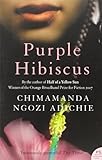
Purple Hibiscus by Chimamanda Ngozi Adichie, a fabulous book, beautifully written.  From the back cover: Fifteen-year-old Kambili lives in fear of her father, a charismatic yet violent Catholic patriarch who, although generous and well-respected in the community, is repressive and fanatically religious at home. Escape and the discovery of a new way of life come when Nigeria is shaken by a military coup, forcing Kambili and her brother to live in their aunt’s home, a noisy place full of laughter. The visit will lift the silence from her world and, in time, unlock a terrible, bruising secret at the heart of her family life.

I loved it even though at times I struggled to read the physical abuse scenes, they were so vivid.

2015

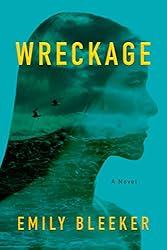
Wreckage by Emily Bleeker; it’s well written, full of suspense, tension and drama as well as love, loss and longing. It’s the story of Lillian Linden and Dave Hall, who were being interviewed following their rescue from a deserted island in the South Pacific where they had spent two years after their plane crashed into the sea. The thing is their interviews are full of lies ‘“ they are desperate to keep what really happened a secret from their families.