Agatha Christie’s Short Stories: The Mysterious Mr Quin

Agatha Christie blogathon

This post is my contribution to  Little Bits of Classics and and Christina Wehner‘s Agatha Christie Blogathon in honour of Agatha Christie’s 126th birthday on the 15th of September.

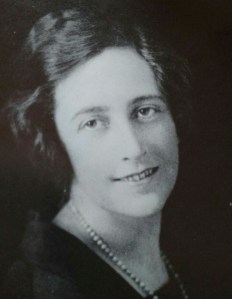
Agatha Christie is one of my favourite authors. I first began reading her books when I was in my teens but it was in 2008 when Kerrie at Mysteries in Paradise launched the Agatha Christie Reading Challenge that I began to read my way through all her books. There are 66 mystery and detective novels and numerous collections of short stories. In February of this year I completed my reading of her 66 mystery and detective novels and some but not all of her short stories.

The Short Stories

There is some confusion over how many short stories Agatha Christie wrote. The Agatha Christie website records that she wrote 150 stories, whereas Wikipedia records that she wrote 153 short stories, published in 14 collections in the UK and in the US. By my reckoning she wrote 157 short stories, published in a number of collections, but I may have included duplications  as some stories were published under different names in the US Collections. I’m hoping that as I read the stories the actual number will become clear. For my list of her short stories see my Agatha Christie Short Stories Page.
img_20160917_122804

But whatever the real total may be there can be no doubt that it is an impressive collection of stories originally published in several magazines and then in a number of collections. They do vary in quality, some are very short, almost skeletal, with the puzzle element given greater emphasis than characterisation.The first collection of her short stories, Poirot Investigates was published in 1924, when Agatha Christie was 34.

As today’s topic in this Blogathon is dedicated to anything about or by Agatha Christie not related either to Poirot or Miss Marple this post is about one collection of short stories:

The Mysterious Mr Quin
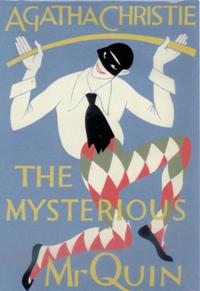
The Mysterious Mr Quin First Edition Cover 1930.jpg
The Mysterious Mr Quin First Edition Cover

This was first published in 1930 featuring Mr Harley Quin and Mr Satterthwaite. This is my favourite of her collections, containing some of her very best short stories.

In her Autobiography Agatha Christie said these stories were her favourites too. The stories were not written as a series, but one at a time at intervals of three or four months or longer and were first published in magazines. They are set in the 1920s and have a paranormal element to them, as well as a touch of romance. I found them all most entertaining.

In the Foreword she describes Mr Quin as:

… a figure invisible except when he chose, not quite human, yet concerned with the affairs of human beings and particularly of lovers. He is also the advocate for the dead.

Mr Satterthwaite, who was in his sixties, a little man, with an elf-like face, is Mr Quin’s friend:

Mr Satterthwaite, the gossip, the looker-on at life, the little man who without ever touching the depths of joy and sorrow himself, recognizes drama when he sees it, and is conscious that he has a part to play.

The titles are

1. The Coming of Mr. Quin
2. The Shadow on the Glass
3. At the “Bells and Motley”
4. The Sign in the Sky
5. The Soul of the Croupier
6. The Man from the Sea
7. The Voice in the Dark
8. The Face of Helen
9. The Dead Harlequin
10. The Bird with the Broken Wing
11. The World’s End
12. Harlequin’s Lane

In the opening story, The Coming of Mr Quin, Mr Satterthwaite first meets him on New Year’s Eve, at a house party when talk had turned to the suicide of Mr Capel, the man who had originally owned the house. The enigmatic Mr Quin, a tall, slender man, appears in the doorway.  The light shining through the stained glass above the door makes it appear that he is dressed in every colour of the rainbow but when he moves the effect fades and Mr Satterthwaite can see that he is  dressed conventionally. Whenever he appears in the stories, some trick of the light initially produces the same effect. Mr Quin subtly steers Mr Satterthwaite into discovering the truth behind Mr Capel’s suicide.

In the following eleven stories Harley Quin always appears unexpectedly and suddenly, and then just as suddenly disappears, having influenced Mr Satterthwaite to change people’s lives, and solve mysteries by producing clues and asking pointed questions, making the solution obvious. He is, without doubt, the most mysterious and unusual character in all of Agatha Christie’s books.

One of my favourite stories is The Man From The Sea. Mr Satterthwaite, who is a wealthy man, althought the source of his wealth is not revealed, is on a Mediterranean island. Walking along the cliffs he meets Anthony Cosden, about to leap to his death. He’d been planning to do so the previous evening but had been prevented when he’d met someone else at the edge of the cliff – a mysterious man in fancy dress, ‘ a kind of Harlequin rig‘. Anthony reveals he only had six months to live and doesn’t want a lingering end and in any case he has no one in the world belonging to him – if only he had a son …

Mr Satterthwaite next meets a woman in black in the quiet garden of what seems to be an empty house. The woman asks him if he would like to see inside the house and clearly needs someone to talk to, someone to hear the tragic story of her life. It’s a touching story of remorse and the desire to make amends.

Mr Quin’s role in this and in other stories is to help Mr Satterthwaite to see beneath the surface, to see things in a different light. At the end he takes his leave, and all Mr Satterthwaite see is his friend walking towards the edge of the cliff.

The final story, Harlequin’s Lane is another bittersweet tale of lost love and fate and rather eerie. Mr Satterthwaite goes to visit a married couple, the Denmans, who live at Ashmead, on Harlequin’s Lane. Mrs Denman is a Russian refugee whom John Denman had married after escaping Russia on the outbreak of the revolution.

They are out when he arrives and he takes a walk down the Lane, wondering about its name and was not surprised when he meets his elusive friend, Harley Quin, who tells him the Lane belongs to him; it’s a Lovers’ Lane. It ends at waste ground covered with a rubbish heap where they meet Molly  who is to be Pierrette in the masquerade the Denmans have planned for the weekend. A car accident interrupts the arrangments injuring some of the dancers, until Mr Satterthwaite intervenes, but still tragedy strikes. Mr Quin, seems to have cast a magical air of unreality over Mr Satterthwaite:

Mr Satterthwaite quailed. Mr Quin seemed to have loomed to enormous proportions … Mr Satterthwaite had a vista of something at once menacing and terrifying … Joy, Sorrow, Despair.

And his comfortable little soul shrank back appalled.

Truly a mystifying collection of stories. I enjoyed it immensely.

Reading Challenges: Agatha Christie Reading Challenge, Mount TBR Reading Challenge, R.I.P. Challenge and the Vintage Mystery Cover Scavenger Hunt in the category of a ‘performer’.

The current paperback edition:

  • Paperback: 320 pages
  • Publisher: HarperCollins; Masterpiece Ed edition (2 Jun. 2008)
  • Language: English
  • ISBN-10: 0007154844
  • ISBN-13: 978-0007154845

Favourite Books: September 2007 – 2010

Each month I’ve been looking back at some of my favourite books I read during the years 2007 – 2010. These are some of my favourite books I read in September in each of those years. September seems to have been a great month for books as I rated so many 5/5, but I’m highlighting just one for each month in this post. Revisiting these books makes me want to re-read all of them.

Click on the titles to see my original reviews.

2007


Crow Lake by Mary Lawson – this tells the story of a family of four children living at Crow Lake in the north of Canada in an isolated house miles away from any town, with just a few other families in the vicinity. The narrator is Kate Morrison and the story unfolds as she looks back on her life, triggered by an invitation to her nephew’s 18th birthday party.

When she was seven her parents were killed in a car crash, leaving her, her baby sister and two teenage brothers, orphaned. The trauma of their parents’ death affects the children in different ways and as Kate looks back on the events that followed she begins to see that not everything was as it seemed to her at the time.

Convincing characters combined with beautiful descriptions of Crow Lake and its ponds make this a memorable and lyrical novel.

2008

The Gravedigger’s Daughter by Joyce Carol Oates made a great impression on me in 2008 and I wrote three posts about it – see here and here for the first two and here for my final thoughts.

This is a melodramatic and memorable book depicting a grim, dark world, a violent and pessimistic world, gothic and grotesque. In some ways it reminds me of Hardy’s novels ‘“ you know something terrible will happen whatever the characters do to try to avert tragedy.

The main character is Rebecca Schwart, born in New York Harbor, the daughter of Jacob and Anna escaping from Nazi Germany in 1936. They live a life of abject poverty whilst Jacob can only find work as a caretaker of Milburn Cemetery, a non-demoninational cemetery at the edge of the town.

Soon the town’s prejudice and the family’s own emotional frailty results in unspeakable tragedy. In the wake of this loss, and in an attempt to put her past behind her, Rebecca moves on, across America and through a series of listless marriages, in search of somewhere, and someone, to whom she can belong.

The ending both surprised and touched me enormously.

2009

Pardonable Lies by Jacqueline Winspear – the third book in her Maisie Dobbs series. This one is set in 1930 when Maisie is asked by Sir Cecil Lawton to prove that his son, Ralph really did die in 1917 during the First World War. Sir Cecil’s wife, who had recently died, had been convinced that Ralph was still alive and on her deathbed made him promise to search for their son. This takes Maisie on a traumatic and dangerous trip to France ‘“ to the battlefields where she had been a nurse.

I like the Maisie Dobbs books. They’re easy to read, but not simple, the plots are nicely complicated and Maisie’s own story is seamlessly interwoven with the mystery. They give a good overall impression of the period, describing what people were wearing, the contrast between the rich and the poor and the all-pervading poisonous London smog. The horror of the War is still strong, people are still grieving for friends and relations killed or missing, visiting the battlefields and working to improve life for the soldiers who had returned home injured, and for the homeless children forced into life on the streets.

2010

The Fall by Simon Mawer – beautifully written, I was enthralled by this book. This is the story of Rob Dewar and Jamie Matthewson from their childhood up to Jamie’s death 40 years later and also the story of their parents and how their lives are interlinked.

The narrative moves between the two generations beginning in the present day, when Rob hears on the news that Jamie, a renowned mountaineer has fallen to his death in Snowdonia. No one is sure whether it was an accident or suicide. Then it moves  back 40 years to the time when the two boys met, both fatherless ‘“ Jamie’s dad, Guy went missing when climbing Kangchenjunga and Rob’s parents are divorced, and back yet further again to 1940 when Guy Matthewson met the boys’ mothers ‘“ Meg (later calling herself Caroline) and Diana. And so the drama unfolds in the mountains of Wales and the Alps, culminating on the North Face of the Eiger.

My Tuesday Post: The Pursuit of Happiness

Every Tuesday Diane at Bibliophile by the Sea hosts First Chapter First Paragraph Tuesday Intros to share the first paragraph sometimes two, of a book that she’s reading or planning to read soon.

The Pursuit of Happiness by Douglas Kennedy has been sitting on my bookshelves for so long I can’t remember when I bought it. It was one of the first books I recorded on LibraryThing in 2007, so I already had it then. I must have bought it sometime between 2002 when it was published and 2007. It is one of those chunky books, 646 pages, that I keep thinking I’ll read one of these days, and then I pick up a shorter book, or a book I’ve just bought or borrowed and it stays on the shelf. It’s time to decide whether to read it or not.

The Pursuit Of Happiness by [Kennedy, Douglas]Blurb:

New York, 1945 – Sara Smythe, a young, beautiful and intelligent woman, ready to make her own way in the big city attends her brothers Thanksgiving Eve party. As the party gets into full swing, in walks Jack Malone, a US Army journalist back from a defeated Germany and a man unlike any Sara has ever met before – one who is destined to change Sara’s future forever.

But finding love isn’t the same as finding happiness – as Sara and Jack soon find out. In post-war America chance meetings aren’t always as they seem, and people’s choices can often have profound repercussions. Sara and Jack find they are subject to forces beyond their control and that their destinies are formed by more than just circumstance. In this world of intrigue and emotional conflict, Sara must fight to survive -against Jack, as much as for him.

In this mesmerising tale of longing and betrayal, The Pursuit of Happiness is a great tragic love story; a tale of divided loyalties, decisive moral choices, and the random workings of destiny.

Chapter One

I first saw her standing near my mother’s coffin. She was in her seventies – a tall, angular woman, withe fine grey hair gathered in a compact bun at the back of her neck. She looked the way I hope to look if I ever make it to her birthday. She stood very erect, her spine refusing to hunch over with age. Her bone structure was flawless. Her skin had stayed smooth. Whatever wrinkles she had didn’t cleave her face. Rather they lent it character, gravitas. She was still handsome – in a subdued, patrician way. You could tell that, once upon a time, men probably found her beautiful.

Every Tuesday, Jenn from Books And A Beat hosts Teaser Tuesdays at which time participants grab their current read, open to a random page, and share two or three “teaser” sentences from that page while avoiding any spoilers.

From page 77:

‘Good afternoon Kate,’ she said, her voice controlled and untroubled by my outburst. ‘I’m glad you came.’

‘Who the hell are you? And what the hell is this?’ I said, again holding up the photo album as if it was the smoking gun in a murder trial.

What do you think? Would you keep on reading?

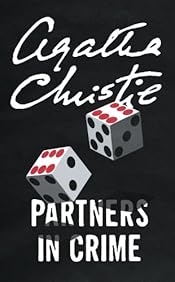
Partners in Crime by Agatha Christie

Tommy and Tuppence Beresford first appeared in Agatha Christie’s The Secret Adversary (first published in 1922) when they had just met up after World War One, both in their twenties. Their next appearance is in Partners in Crime, a collection of short stories, first published in 1929.

Life has become a little dull, especially for Tuppence. Tommy works for the Secret Service but wants to see more action, so when Tommy’s boss Mr Carter offers them both a new assignment they jump at the opportunity. It’s to take over for six months the running of the International Detective Agency under the name of Mr Theodore Blunt. It had been a front for Bolshevist-spying activity and in particular they were to look out for blue letters with a Russian stamp on them. They were also free to undertake any other detective work that comes their way.

All of the stories first appeared in magazines between 1923 and 1928 and they are parodies of fictional detectives of the period, some of whom I recognised and some I didn’t. When she came to write her autobiography many years later, even Agatha Christie couldn’t recognise some of them, noting that whilst some had become household names, others had ‘more or less perished in oblivion. Those I recognised include Sherlock Holmes, Father Brown, The Old Man in the Corner, and Hercule Poirot, himself.

Most of the stories are self-contained adventures. They are slight and brief, and not really taxing or difficult to solve. I enjoyed reading them, because they are written with a light touch, and a sense of humour and fun. Tommy and Tuppence are likeable characters; Tommy is not as dizzy as David Walliams played him in the recent TV series. I’ve now read all the Tommy and Tuppence stories. There are four full length novels as well as Partners in Crime (Tommy and Tuppence 2) and unlike Poirot and Miss Marple Tommy and Tuppence age with each book:

  1. 1922 The Secret Adversary (Tommy and Tuppence 1)
  2. 1941 N or M? (Tommy and Tuppence 3)
  3. 1968 By the Pricking of My Thumbs (Tommy and Tuppence 4)
  4. 1973 Postern of Fate (Tommy and Tuppence 5)

Reading Challenges: the Agatha Christie Reading ChallengeMount TBR Reading Challenge, and the Golden Age Vintage Cover Scavenger Hunt.

My copy is the current edition with this cover:


The first UK edition, however, has this cover, which I prefer.


So I’m choosing this cover for the Vintage Scavenger Hunt, in the category of a book showing a Shadowy Figure on its cover.

My Friday Post: Sunshine on Scotland Street

Book Beginnings ButtonEvery Friday Book Beginnings on Friday is hosted by Gillion at Rose City
Reader
 where you can share the first sentence (or so) of the book you are reading, along with your initial thoughts about the sentence, impressions of the book, or anything else the opener inspires.

I’ve just started reading Sunshine on Scotland Street by Alexander McCall Smith, one of his 44 Scotland Street novels.

It begins:

Even if she had not been an anthropologist, Domenica Macdonald would have understood the very particular significance of weddings. Anthropologists – and sociologists too, perhaps even more so – often tell us what we already know, or what we expect to hear, or what we are not surprised to learn. And so we all know, as did Domenica, that weddings are far more than marriage ceremonies; we know that they are occasions for family stock-taking and catharsis; that they furnish opportunities for naked displays of emotion and unscheduled tears; that they are a stage for sartorial and social ostentation; that they are far from the simple public exchange of vows they appear to be.

Also every Friday there is The Friday 56, hosted by Freda at Freda’s Voice.

Friday 56

These are the rules:

  1. Grab a book, any book.
  2. Turn to page 56, or 56% on your eReader.
  3. Find any sentence (or a few, just don’t spoil it) that grabs you.
  4. Post it.
  5. Add the URL to your post in the link on Freda’s most recent Friday 56 post.

Page 56:

He looked at his watch. That brief encounter with the two girls on Queen’s Street had taken place about twenty minutes previously. That gave him forty minutes to have a necessary cup of coffee, unpack his clothes and products, and have a quick shower before the girls arrived – if they arrived. They had laughed when he had shouted out the invitation, but it had been, he thought, a laugh of delight rather than a dismissive laugh.

The 44 Scotland Street books form a serial novel about the residents of 44 Scotland Street, a fictitious building in a real street in the author’s home town of Edinburgh. It first appeared in daily episodes in the Scotsman newspaper in 2004 and I read a few of them online some years ago.

I felt in the mood for something light and not about murder, psychologically disturbed characters, or full of doom and gloom and this seems to be just that – ‘a joyous, charming portrait of city life and human foibles‘ according to the Sunday Express (quoted on the back cover).

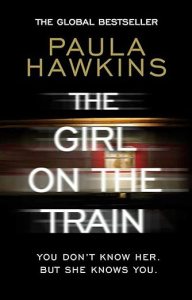
The Girl on the Train by Paula Hawkins

The Girl on the Train by Paula Hawkins has won a lot of awards and is a very popular book. It has good reviews, Stephen King for example describes it as a “Really great suspense novel. Kept me up most of the night. The alcoholic narrator is dead perfect.”

I thought it sounded good, so I decided to read it. But it didn’t live up to the hype for me. I wasn’t enthralled.

It began well with Rachel on the train each morning looking out at the houses on the road where she used to live before she was divorced. As the train stops at the same signal each day she enviously watches a young couple who are living the perfect life, or so she imagines. Then something happens that shocks her and everything changes and she begins to get involved in their lives, with disastrous results.

But I couldn’t easily distinguish between the three main characters, Rachel, Anna and Megan. Each one is an unreliable narrator and not very likeable. I had to keep referring to the chapter headings and dates to remind myself who was who and what happened when. I didn’t find it chilling or thrilling and any suspense rapidly disappeared with the repetition of Rachel being drunk, then being sorry, but unable to stop drinking. Then there are all the phone calls, text messages and emails that she sends when she is drunk. She has blackouts and can’t remember what happened, or what she said. Added to that she dreams and is unable to distinguish between them and reality. Overall it’s dreary and depressing.

So after a good start, the narrative lost impetus and dragged on to its conclusion, which by comparison seemed rushed, with a twist right at the end that took me by surprise. I suppose it is a ‘page-turner’ as I did want to know what what going to happen, but it left me feeling unsatisfied, irritated and rather out of sorts.

I’ve seen this book compared to Gone Girl, another book I have sitting waiting to be read. Now, I’m wondering if I’ll find that one disappointing as well. Do let me know your views on both or either of these books.

Reading challenges: Bev’s Mount TBR Reading Challenge 2016, 20 Books of Summer 2016 and although I didn’t find this book particularly perilous, Carl’s RIP XI (Readers Imbibing Peril), because plenty of other people have.