By Sword and Storm by Margaret Skea

By Sword and Storm (The Munro Scottish Saga Book 3)

Two of the best historical fiction books I’ve read in recent years are Margaret Skea’s Munro Scottish Sagas, Turn of the Tide,  and A House Divided, both of which transported me  back in time to 16th century Scotland and France, specifically to the world of the feuding clans of Cunninghame and Montgomerie.

By Sword and Storm is the third book in the Munro Saga. It stands well on its own but I recommend reading the earlier books to get the whole picture of what happened in the years before. It is now 1598 and the Munro family, Adam, his wife, Kate, and children, Robbie, Maggie and Ellie  are living in France. Adam and Robbie are in the Scots Gardes, serving Henri IV of France: Adam is a colonel  and Robbie is a sergeant.  The Scots Gardes were an elite Scottish regiment whose duties included the provision of a personal bodyguard to the French King.

The story is well grounded in research and based on historical facts, seamlessly interweaving fact and fiction. It is  complex novel with several plot lines, locations and characters, some based on real historical figures and others fictitious, such as the Munro family. There’s a useful list of the main characters and a map at the start of the book and a glossary and historical note at the end.

As the story begins the French Wars of Religion are drawing to an end and the Edict of Nantes has established religious freedom, placating the Catholics whilst making concessions to the Huguenots – but not in Paris or at the French court, where Protestants are still banned from openly practising their religion. When Adam saves Henri’s life as a shot is fired from the crowd, he and his family are summoned to live at the French court, despite their religious beliefs. Life in Paris holds many dangers for the Munros, especially for Robbie when he falls in love with a girl from a Huguenot family.

Back in Scotland some members of the Cunninghame and Montgomerie factions are still feuding, notably Hugh Montgomerie, the Laird of Braidstane and William, the son of the head of the Cunninghame clan, whilst other clan members try to maintain the peace.  James VI has banned duelling but that doesn’t deter Hugh and William. Meanwhile, Hugh’s wife, Elizabeth, pregnant and left on her own in the depths of winter with only her children and a servant for company, faces her own dangers.

There is so much to enjoy in this book – first of all the story itself, expertly narrated, full of tension and surprise, and also the characters. But I also loved the personal touches, revealing what life was like in the 16th century,  how both ordinary people and royalty lived, and the dangers that faced them in their daily lives, particularly for women in childbirth and sickness and for those who dissented from the established religion.

I loved all the details about the French court, in particular about Henri’s mistress and the relationship between her and Kate. As in the earlier books Margaret Skea writes such beautifully descriptive passages, bringing to life the details of the French court and of the landscape in both Scotland and France as well as the dangers of travelling by sea.

This is ostensibly the end of the Munro saga – but Margaret Skea has revealed on her blog that she is hoping to revisit the Munro story at a later date. I hope she does, but if not this is an excellent end to the series.

  • Format: Kindle Edition – also available in paperback
  • File Size: 1339 KB
  • Publisher: Corazon Books (Historical/Saga) (11 July 2018)
  • Source: Advance copy from the publisher
  • My rating 4*

WWW Wednesday: 15 August 2018

IMG_1384-0

WWW Wednesday is run by Taking on a World of Words.

The Three Ws are:

What are you currently reading?
What did you recently finish reading?
What do you think you’ll read next?

I’m currently reading:

I’ve started my Classics Club Spin book, He Who Whispers by John Dickson Carr. Set not long after the Second World War end this is a ‘locked room’ type of mystery, in which the body of Howard Brooks is found, stabbed to death, on the top of a tower, but the evidence shows that no one entered or left the tower during the time the murder took place.

And I’m still reading Wedlock: How Georgian Britain’s Worst Husband Met His Match by Wendy Moore, non fiction about Mary Eleanor Bowes who was the richest heiress in 18th century Britain. She fell under the spell of a handsome Irish soldier, Andrew Robinson Stoney and found herself trapped in an appallingly brutal marriage. Fascinating reading that if it was fiction you’d say you couldn’t believe it.

I’ve recently finished:  

The Story Keeper by Anna Mazzola, which was published on 26th July 2018. See yesterday’s post for the opening paragraphs and synopsis. It’s beautifully written and as I like folklore and legends, with a mystery interwoven within it, I’ve been enjoying this very much.

I’ll post my review in the next few days.


My next book could be:

The Way of All Flesh by Ambrose Parry, co-written by best-selling crime writer Chris Brookmyre and consultant anaesthetist Dr Marisa Haetzman, to be published on 30 August 2018.

Synopsis

Edinburgh, 1847. City of Medicine, Money, Murder.

Young women are being discovered dead across the Old Town, all having suffered similarly gruesome ends. In the New Town, medical student Will Raven is about to start his apprenticeship with the brilliant and renowned Dr Simpson.

Simpson’s patients range from the richest to the poorest of this divided city. His house is like no other, full of visiting luminaries and daring experiments in the new medical frontier of anaesthesia. It is here that Raven meets housemaid Sarah, who recognises trouble when she sees it and takes an immediate dislike to him. She has all of his intelligence but none of his privileges, in particular his medical education.

With each having their own motive to look deeper into these deaths, Raven and Sarah find themselves propelled headlong into the darkest shadows of Edinburgh’s underworld, where they will have to overcome their differences if they are to make it out alive.

Have you read any of these books?  Do any of them tempt you? 

First Chapter First Paragraph: The Story Keeper by Anna Mazzola

Every Tuesday First Chapter, First Paragraph/Intros is hosted by Vicky of I’d Rather Be at the Beach sharing the first paragraph or two of a book she’s reading or plans to read soon.

My book this week is one of the books I’m reading at the moment, The Story Keeper by Anna Mazzola.

The Story Keeper

September 1857

Shrieking split the leaden sky and Audrey looked up to see a host of birds, their wings ink-black against the grey.

‘Storm coming, d’you see? They know the wind’s changing.’ The man gestured upwards, but his eyes were on Audrey. ‘They feel it long before we can tell.’

Blurb (Amazon):

Audrey Hart is on the Isle of Skye to collect the folk and fairy tales of the people and communities around her. It is 1857 and the Highland Clearances have left devastation and poverty, and a community riven by fear. The crofters are suspicious and hostile to a stranger, claiming they no longer know their fireside stories.

Then Audrey discovers the body of a young girl washed up on the beach and the crofters reveal that it is only a matter of weeks since another girl disappeared. They believe the girls are the victims of the restless dead: spirits who take the form of birds.

Initially, Audrey is sure the girls are being abducted, but as events accumulate she begins to wonder if something else is at work. Something which may be linked to the death of her own mother, many years before.

What do you think? Would you keep reading?

I was captivated by the opening chapters of this book. Now, I’m nearing the end and it is still captivating me. It’s mysterious, full of folk and fairy tales, with a sense of foreboding.


The Rules of Seeing by Joe Heap

Harper Collins|9 August 2018|416 pages|Review copy| 2*

Nova, an interpreter for the Metropolitan police, has been blind from birth. When she undergoes surgery to restore her sight her journey is just beginning – she now has to face a world in full colour for the first time. Kate, a successful architect and wife to Tony, is in hospital after a blow to the head. There, she meets Nova and what starts as a beautiful friendship soon turns into something more.

Nuanced and full of emotion, The Rules of Seeing poignantly explores the realities and tensions of a woman seeing the world for the first time – the highs and lows, the good and bad.

I thought from reading the blurb that this would be a book I would enjoy reading. The idea of a book about a blind woman whose sight is restored sounded enlightening – how she learned to interpret what she can see, having been born blind. And I did enjoy that aspect of this book. It does give an excellent insight into Nova’s struggle to cope emotionally with a world she can now see as well as hear and touch, and learning what it all means. And I liked the Rules of Seeing that she compiles from her experiences, although I think they are only loosely linked to the main story.

But, this isn’t just the story of a blind person learning to see and it’s not the main focus of this book which is Kate’s relationship with her husband and with Nova, and I didn’t like Kate’s story; the violence and anger of her husband, Tony was hard to read. If this had been referred to in the blurb I wouldn’t have chosen to read this book. I also found the pace very uneven and by the end of the book I thought it was too drawn out and I just wanted it to end.

One of the drawbacks of reading a review copy prior to publication is that you can’t read the beginning of a book. And if I had read the opening pages I wouldn’t have chosen it. It is in the present tense – there are some books that work well for me in the present tense and it certainly helps if I like the plot, but this isn’t one of them. I didn’t like the constant changes of scene -a bit like watching a drama or film where the action is filmed with a hand-held camera constantly changing focus, zooming in and out. It makes me feel claustrophobic. The use of the present tense in this book made me feel I was watching TV with the audio description turned on, explaining what is happening on screen.

It’s a pity as the basic concept is good and the characters came over as real people. I’m sorry I just couldn’t like it.

Thank you to Harper Collins and NetGalley for my copy of this book for review.

Absent in the Spring by Mary Westmacott (Agatha Christie)

img_20180809_0727129331

⭐⭐⭐⭐⭐

I love Agatha Christie’s crime fiction but I’ve held back from reading her other books written under the name of Mary Westmacott, not sure just what to expect. So, I was very glad to find that Absent in the Spring is just as good as her other books and I was thoroughly absorbed in the story of Joan Scudamore who was stranded in the desert, after visiting her daughter in Baghdad.

Agatha Christie managed to keep the true identity of Mary Westmacott a secret for fifteen years! Absent in the Spring is the one book she wrote that  satisfied her completely – and having now read it I can see why. She wrote the book in just three days in 1944. It had ‘grown inside‘ her for six or seven years. She had visualised all the characters and they were there ready for her to write about them and she just had to get it down on paper, writing in a ‘white heat‘, without interruptions until it was finished, leaving her exhausted. She slept for more or less twenty-four hours afterwards. She took the title from Shakespeare’s sonnet that begins ‘From you I have been absent in the spring.’ (Sonnet 98)

It is a great example of an unlikeable character that makes fascinating reading – you don’t have to like a character to love a book. In her Autobiography she wrote that it was:

… the picture of a woman with a complete image of herself, of what she was, but about which she was completely mistaken. Through her actions, her feelings and thoughts this would be revealed to the reader. She would be, as it were, continually meeting herself, not recognising herself, but becoming increasingly uneasy. What brought about this revelation would be the fact that for the first time in her life she was alone – completely alone – for four or five days. (page 516)

The novel is set in Mesopotamia (corresponding to today’s Iraq, mostly, but also parts of modern-day Iran, Syria and Turkey) in a railway rest-house at Tel Abu Hamid on the Turkish border, where Joan is stranded, delayed by floods – no trains or vehicles can get through to Mosul, her next stop on her journey home to London. There are no other travellers there, only an Arab boy and an Indian servant who brings her meals, but who speak little English and there is nowhere to go, except to walk in the desert.

At first she occupies herself writing letters and reading the two books she has with her, The Power House by John Buchan and Memoirs of Lady Catherine Dysart. Then she starts thinking about herself and gradually relives her past life, all the time with a growing feeling of unease and anxiety as she reinterprets her past. She wonders, for the first time in her life what she is really like and what other people think of her, with that unsettling, anxious feeling that she is not the person she thought she was. And she resolves to put things right when she returns home.

She is jolted out of her complacency  and self deception as she remembers how Rodney had looked as she watched him leave Victoria Station:

Suddenly, in the desert,with the sun pouring down on her, Joan gave a quick uncontrollable shiver.

She thought, No, no – I don’t want to go on – I don’t want to think about this …

Rodney, striding up the platform, his head thrown back, the tired sag of his shoulders all gone. A man who had been relieved of an intolerable burden …

Really, what was the matter with her? She was imagining things, inventing them. Her eyes had played a trick on her.

Why hadn’t he waited to see the train pull out?

She was imagining – Stop, that didn’t make it any better. If you imagined a thing like that, it meant that such an idea was already in your head.

And it couldn’t be true – the inference that she had drawn simply could not be true.

She was saying to herself (wasn’t she?) that Rodney was glad she was going away …

And that simply couldn’t be true! (pages 55-56)

It really is a most remarkable book. On the surface it is a simple story, but in fact it is a complex and in-depth character study, with a growing sense of tension. The setting adds to the uneasiness as Joan walks in the desert to get away from the rest-house, with its refuse dump of tins enclosed by a tangle of barbed wire,  and a space where skinny chickens run about squawking loudly and with clouds of flies surrounding the area. There is a twist at the end of the book, which I had begun to anticipate as I approached the final pages, which rounded it off very well. An excellent book.

Now, I really must get hold of her other Mary Westmacott books!

My copy is a paperback, published by Fontana, 2nd impression 1983, 192 pages. This is the 4th book for my 10 Books of Summer 2018 Challenge.

Birthday Gifts!

img_20180805_132112229

There was a book in this beautiful little gift bag – see below.*

img_20180807_152051613

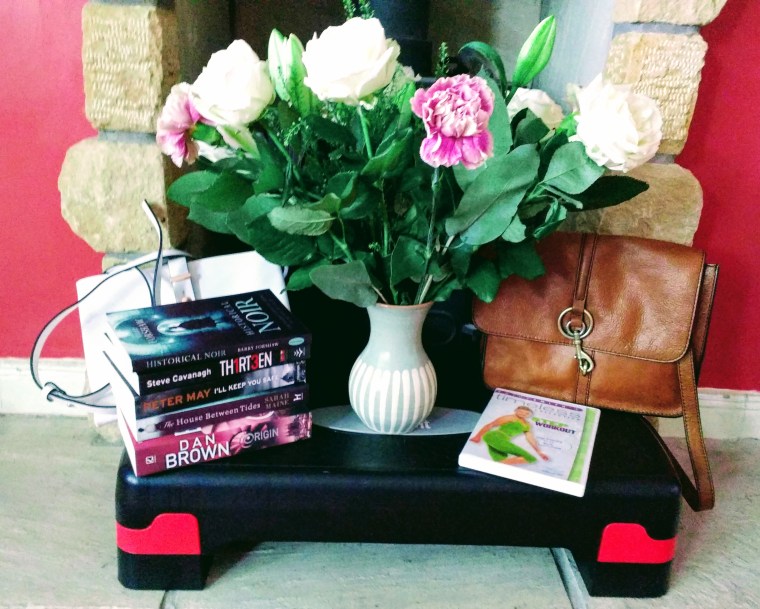
Yesterday was my birthday – these are some of the gifts I received, including a little pile of books. From top to bottom they are:

  • Historical Noir: the Pocket Essential Guide to Fiction, Film and TV by Barry Forshaw – a reference book that will keep me informed about historical and not so historical sleuths. One to dip into frequently, I suspect. (*This was the book in the gift bag.)
  • The Bedlam Stacks by Natasha Pulley – I loved her first book, The Watchmaker of Filigree Street, so I’m expecting (hoping) this will be just as fascinating.
  • I’ll Keep You Safe by Peter May – one of my favourite authors, writing such richly descriptive books. This is set in the Outer Hebrides, like his Lewis Trilogy.
  • Thirteen by Steve Cavanagh – a new-to-me author, so not sure what to expect, but Ian Rankin is quoted on the back cover: Great hook and the book lives up to it. I hope so.
  • The House Between Tides by Sarah Maine – another new-to-me author. Another book set in the Outer Hebrides, set in a crumbling estate with a century-old secret, historical fiction set in 2010  and in 1910, described as ‘An echo of Daphne du Maurier‘.
  • Origin by Dan Brown – I know lots of people criticise his writing but I find his books entertaining. I’ve read a few and whilst they are formulaic and not great literature I have enjoyed them – pure escapism!