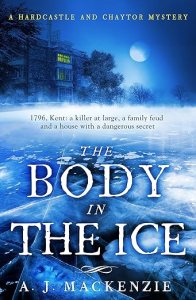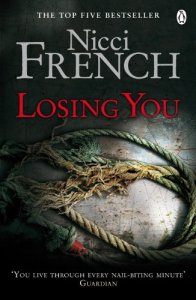
Reading Wales ’25 & Reading Ireland Month ’25

Yesterday saw the beginning of the Reading Wales Month 2025, now hosted by Karen at BookerTalk , formerly by Paula at BookJotter. March is a very busy reading month as it’s also Reading Ireland Month 2025 hosted by Cathy 746 Books. Both are now running between Friday 1 and Sunday 31 March 2025. For both events you just need to read what you want, when you want as long as the author is Welsh or Irish! And then add the links to your blog posts to the host blogs.

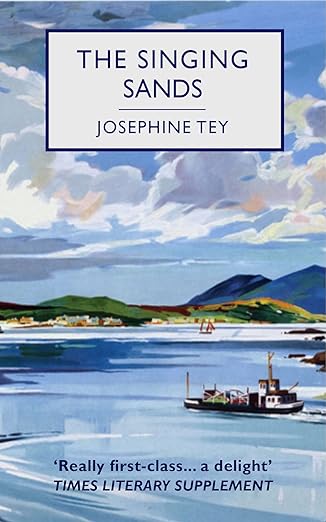
These are books I have in mind to read – at least one book for each event, more if time permits. I’ve listed them randomly as I discovered they are by Welsh or Irish authors – I don’t choose books based on the authors’ nationality. I had no idea I had so many to choose from. And there may be more hidden on my shelves.
For Wales:

  1. Resistance by Owen Sheers – I. It’s an alternative history novel by Welsh poet and author Owen Sheers. The plot centres on the inhabitants of a valley near Abergavenny in Wales in 1944–45, shortly after the failure of Operation Overlord and a successful German counterinvasion of Great Britain. 
  2. The Amorous Nightingale by Edward Marston
  3. The Repentant Rake by Edward Marston
  4. Winter of the World by Ken Follett
  5. Fall of Giants by Ken Follett
  6. World Without End by Ken Follett
  7. The Beautiful Dead by Belinda Bauer
  8. The Earth Hums in B Flat by Mari Strachan

For Ireland:

  1. Christine Falls by Benjamin Black
  2. The Vanishing Act of Esme Lennox by Maggie O’Farrell
  3. The Marriage Portrait by Maggie O’Farrell
  4. Whitethorn Woods by Maeve Binchy
  5. Inspector Tom Reynolds Mystery books 1-4 and 6 and Six Wicked Reasons by Jo Spain
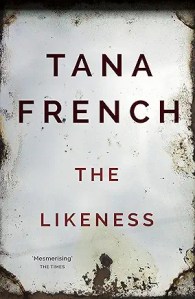
  6. Dublin Murder Squad books 2 – 3, 5 – 6 by Tana French
  7. Normal People by Sally Rooney
  8. Night of the Lightbringer by Peter Tremayne
  9. The Watch House by Bernie McGill
  10. Star of the Sea by Joseph O’Connor
  11. The House by the Churchyard by J Sheridan Le Fanu
  12. What You Did by Claire McGowan
  13. The Olive Tree by Lucinda Riley
  14. The Light Behind the Window by Lucinda Riley
  15. The Sun Sister books by Lucinda Riley – still not read The Pearl Sister, The Sun Sister, The Missing Sister
  16. Prince Caspian by C S Lewis

Six Degrees of Separation from  Prophet Song by Paul Lynch to

It’s time again for Six Degrees of Separation, a monthly link-up hosted by Kate at Books Are My Favourite and Best. Each month a book is chosen as a starting point and linked to six other books to form a chain. A book doesn’t need to be connected to all the other books on the list, only to the one next to it in the chain.

This month we start with Prophet Song by Paul Lynch, the winner of the Booker Prize in 2023. It’s set in a dystopic Ireland as it’s in the grip of a government turning towards tyranny and Eilish can only watch helplessly as the world she knew disappears. When first her husband and then her eldest son vanish, Eilish finds herself caught within the nightmare logic of a collapsing society.

I haven’t read Prophet Song so I decided to start my chain by linking to the word song in the title.

My first link is The Hangman’s Song by James Oswald, the third in his Inspector McLean series set in Edinburgh. a dark, tense book; crime fiction with elements of the supernatural  and parapsychology thrown in. McLean is working on two separate cases – one investigating a group of prostitutes and the subsequent death of their pimp, Malky Jennings, who was beaten to death – and the second, two suicides, which he and his DC, MacBride consider to be suspicious. Digging deeper, McLean finds answers something terrifying stalking the city streets.

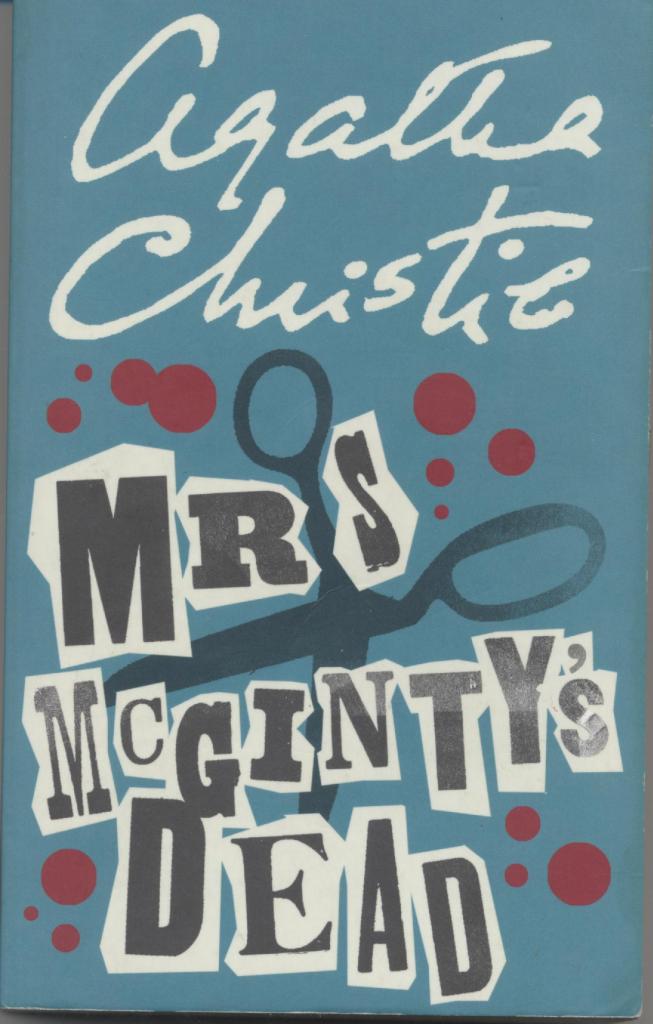
My second link is Murder in the Mews by Agatha Christie, one in a collection of short stories, featuring Hercule Poirot. At first it looks as though a young widow, Mrs Allen has committed suicide, but as the doctor pointed out the pistol is in her right hand and the wound was close to her head just above the left ear, so it’s obvious that someone else shot her and tried to make it look like suicide. The plot is tightly constructed, with a few red herrings to misguide Poirot and Inspector Japp and a moral question at the end. 

For my third link is a book I read just before Murder in the MewsThe Frozen Shroud by Martin Edwards. It’s the sixth book in his Lake District Mystery series. It begins at Halloween in Ravenbank, an isolated community on the shores of Ullswater. Gertrude Smith who was murdered on Hallowe’en, just before the First World War was found, battered to death, her face reduced to a pulp and covered with a woollen blanket like a shroud. Her murderer wasn’t hanged and the story goes that her tormented spirit 

I enjoyed the previous five, featuring historian Daniel Kind and DCI Hannah Scarlett, head of the Cold Case Review Team and this one is no exception; it kept me guessing almost to the end.

My fourth link is The Shroud Maker by Kate Ellis, the 18th Wesley Peterson Mystery.

It’s the Palkin Festival in Tradmouth, a town in Devon, when the body of a strangled women is discovered floating out to sea in a dinghy. A year earlier Jenny Bercival had disappeared from the festival and her mother returns to look for her bringing with her anonymous letters claiming she is still alive. DI Wesley Peterson and his boss DCI Gerry Heffernan are investigating the two cases. Are they connected and is there a link to a fantasy website called ‘Shipworld’ which features the 14th century mayor and privateer of Tradmouth, Palkin as a supernatural hero with a sinister, faceless nemesis called the ‘Shroud Maker’?

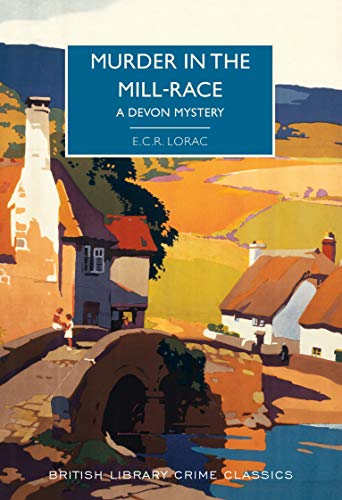
My fifth link is to another book set in Devon, Murder in the Mill Race by E R C Lorac, a Chief Inspector Robert Macdonald book.

A few months after the Dr Raymond Ferens’ arrival at Milham in the Moor in North Devon Sister Monica, the warden of a children’s home, is found drowned in the mill race, the stream leading into the water mill. Everyone says that Sister Monica is a saint – but is she? Chief Inspector Macdonald faces one of his most difficult cases in a village determined not to betray its dark secrets to a stranger.

My final link is to Once Upon a River by Dianne Setterfield, in which a drowned body is also found, this time it’s that of a little child in the River Thames.It’s mystifying as hours later the dead child, miraculously it seems, takes a breath, and returns to life. The mystery is enhanced by folklore, by science that appears to be magic, and by romance and superstition. It is a beautifully and lyrically told story, and cleverly plotted so that I was not completely sure at times what it was that I was reading. It’s historical fiction with a touch of magic that completely beguiled me.

What is in your chain, I wonder?

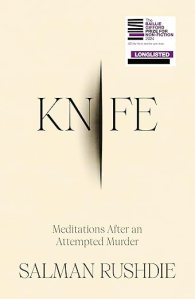
Next month (April 5, 2025), we’ll start with Salman Rushdie’s memoir, Knife.

Top Ten Tuesday: Books Set in Another Time

Top Ten Tuesday is a weekly meme created by The Broke and the Bookish and now hosted by Jana at That Artsy Reader Girl. For the rules see her blog.

The topic this week is Books Set in Another Time (These can be historical, futuristic, alternate universes, or even in a world where you’re not sure when it takes place you just know it’s not right now.)

The difficulty I had with this post was choosing which books to feature out of so many possibilities. I decided to pick books that are set in the past and also in the future. I’ve listed them in chronological order.

The Past:

1.Imperium by Robert Harris, the first in his Cicero Trilogy, beginning in 79 BC, this book set in the Republican era is a fictional biography of Marcus Tullius Cicero by Tiro, his slave secretary.

Tiro was a real person who did write a biography of Cicero, which has since been lost in the collapse of the Roman Empire. Harris has based Imperium on, among other sources, Cicero’s letters, which Tiro had recorded, successfully interweaving Cicero’s own words with his own imagination.  It is basically a political history, a story filled with intrigue, scheming and treachery in the search for political power as Cicero, a senator, works his way to power as one of Rome’s two consuls. I marked many passages that struck me as interesting and felt much of the struggle for power applies as much today as it did in Ancient Rome.

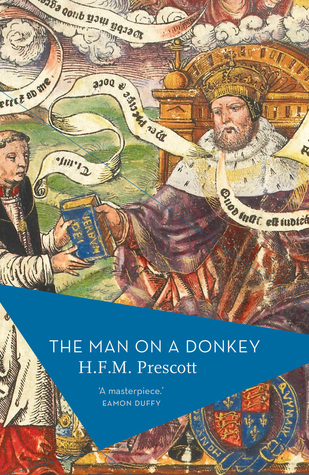
2. The Man on a Donkey by H,M, F. Prescott – set in 1536 -1537 (covering the same period as Hilary Mantel’s Wolf Hall trilogy)

An enthralling novel about a moment in history when England’s Catholic heritage was scattered to the four winds by a powerful and arrogant king. In 1536, Henry VIII was almost toppled when Northern England rose to oppose the Dissolution of the Monasteries. For a few weeks Robert Aske, the leader of the rebels, held the fate of the entire nation in his hand. It’s written in the form of a chronicle, written from the various characters’ viewpoints telling the story of the Pilgrimage of Grace. The Pilgrimage of Grace was not a revolution against Henry but an attempt to get him to change his mind and to understand how people felt. They wanted Henry to stop the dissolution and his attacks on the monks and nuns and to return the country to following the Pope.

Just like Mantel’s books, this book transported me back to that time, with lyrical descriptions of the settings, both of the countryside and of the towns, of Marrick Priory and of the king’s court, of the people, and the mood of the times, both religious and political. 

3. The Potter’s Hand by by A N Wilson – beginning in 1768 and roughly following the fortunes of the Wedgwood family until 1805, ten years after the death of Josiah Wedgwood, an English potter and the founder of the Wedgwood company.

For me it really did convey what it must have been like to live in that period – whilst the the American War of Independence, the French Revolution, were taking place. It was a time of great change (what time isn’t?) both social and political change as the industrial revolution got under way in England. It’s full of ideas about colonialism, the abolition of slavery, working conditions, and women’s rights. It brought about small changes as well as big ones.

It’s big on character (lots of them), the main ones being Josiah Wedgwood himself, ‘Owd Wooden Leg‘, his daughter Sukey, his nephew Tom Byerley, his childhood friend Caleb Bowers and Blue Squirrel, an American Cherokee Tom fell in love with in America. Overall it is the story of a remarkable family, their lives, loves, work, illnesses, depressions, addictions and deaths. 

4. Mrs Whistler by Matthew Plampin – 1876 to 1880

I loved this novel about the American artist James McNeill Whistler and his model and mistress, Maud Franklin, the ‘Mrs Whistler‘ of the title. The book covers two episodes in their lives during the years 1876 to 1880 – a bitter feud with his patron Francis Leyland about his fee for painting The Peacock Room, and the libel trial in which Whistler sued the art critic John Ruskin, over a review that dismissed him as a fraud. These two events brought Whistler to the point of bankruptcy.

It’s a long book that moves quite slowly through these four years. I loved all the detail – of Whistler’s impetuous and rebellious character, his relationship with his brother and mother (the real Mrs Whistler), as well as with Maud – and the details of the house he had built in London on Tite Street in Chelsea, which he called the White House, his flight to Venice and most of all about his paintings.

5. The Watchmaker of Filigree Street by Natasha Pulley – Victorian times, a mixture of historical fact and fantasy

This is set both in London and Japan, following the lives of the main characters, Thaniel Stapleton, Keita Mori and Grace Carrow. I was completely convinced by the setting in a different time in a world that was familiar and yet so different.

Keita Mori is an interesting character and as I read my opinion of him kept changing – just who is he? He is an enigma, why is he living in London, is he the bomb maker, does he in fact know what is going to happen, is he a magician? He baffled and confused me as much as he baffled and confused the other characters.

Equally fascinating are the sections set in Japan; Grace’s story, her research into luminiferous ether (a bit hard to follow), her relationship with Akira Matsumoto, the elegant son of a Japanese nobleman; the Japanese show village in Hyde Park where Gilbert and Sullivan went to research for the Mikado; the early days of the London Underground; and of course the clockwork inventions, in particular Katsu, the clockwork octopus.

6. The Summer Before the War by Helen Simonson – 1914

This is really a book of two parts – the months before the outbreak of the First World War and then the events as the war got underway. It’s set in the  summer of 1914, in Rye in East Sussex when spinster Beatrice Nash arrives to teach Latin at the local grammar school. It begins slowly with the first part describing the lazy, idyllic summer and in which all the characters are introduced. Although there is a clear distinction between the classes in society cracks are beginning to appear which will only widen as the century gets under way and the war acts as a catalyst for change.

Simonson doesn’t hold back on the horrific conditions under which the war took place and from a gentle beginning the book moves into a war novel, emotional and moving.

7. Corpus by Roy Clements – 1936

Set in 1936, a time when Europe was once more on the brink of war. Civil war has broken out in Spain, in Britain some people are openly supporting the Nazis in Germany and politicians are torn between wanting Edward VIII to abdicate the throne or give up his relationship with Wallis Simpson.

When a renowned member of the county set and his wife are found horribly murdered, Tom Wilde a history professor, finds himself dragged into a world of espionage which, until now, he has only read about in books. But the deeper he delves, the more he wonders whether the murders are linked to the death of the girl with the silver syringe – and, just as worryingly, to the scandal surrounding King Edward VIII and his mistress Wallis Simpson…

The Future:

8. The Passengers by John Marrs – the near future

This is a shocking book. I found it riveting, even if it is preposterous, and sinister with a frightening view of the future that may not be that ridiculous. It kept me glued to the page right to the end. Driverless cars have been developed to Level Five, with no steering wheels, pedals or a manual override option. A Hacker has taken over control of the cars, set them on a collision course, and tells each passenger that the destination they programmed into their GPS has been replaced with an alternative location. In approximately two hours time they are going to die. They are trapped inside unable to contact the outside world.

9.The Library of the Dead by T L Huchu, the first book in the Edinburgh Nights series, set in a future or alternative Edinburgh

It’s urban fantasy, with a wealth of dark secrets in its underground. Teenager Ropa, has dropped out of school to become a ghost talker and when a child goes missing in Edinburgh’s darkest streets, Ropa investigates his disappearance. Now she speaks to Edinburgh’s dead, carrying messages to those they left behind. A girl’s gotta earn a living, and it seems harmless enough. Until, that is, the dead whisper that someone’s bewitching children – leaving them husks, empty of joy and strength. It’s on Ropa’s patch, so she feels honor-bound to investigate. But what she learns will rock her world.

10. The Uncertain Midnight by Edmund Cooper – set on Earth in 2113

Earth is a world run by machines, androids, who have taken over the burdens of work and responsibility, a world where the humans are required to spend their lives in leisure pursuits, but are subject to ‘Analysis’ (brain-washing) if the androids think they are maladjusted.

John Markham emerges in 2113 after spending 146 years in suspended animation, frozen deep under ground after an atomic holocaust had devastated his world. In 2113 not all humans were happy to leave everything to the androids. Known as Runners these humans believed in ‘human dignity, freedom of action and the right to work’. Markham struggles to adapt and this raises the question of whether the androids could be said to be alive – leading to discussions about the definition of life, the difference between determinism and free will, and eventually leading to war between the androids and the Runners.

The Daylight Gate by Jeanette Winterson: Book Beginnings on Friday & The Friday 56

Every Friday Book Beginnings on Friday is hosted by Gillion at Rose City Reader where you can share the first sentence (or so) of the book you are reading. You can also share from a book you want to highlight just because it caught your fancy.

I’m featuring The Daylight Gate by Jeanette Winterson, one of the books I’ve borrowed from the library. It’s a novella, historical fiction set in 1612 in Lancashire, then a wild part of England at a time when the fear of witches and demons was strong, a time of superstition and fear.

The North is a dark place.

It is not safe to be buried on the north side of the Church and the North Door is the way of the Devil.

Also every Friday there is The Friday 56, hosted by Freda at Freda’s Voice, but she is taking a break and Anne at My Head is Full of Books has taken on hosting duties in her absence. You grab a book and turn to page 56 (or 56% of an eBook), find one or more interesting sentences (no spoilers), and post them.

‘You mistake me if you imagine I believe in no dark power. I believe in God and therefore I believe in the Devil.’

‘Who surely has better things to do than help the Demdike dry up cattle and sheep and bewitch pedlars.’

Description:

Good Friday, 1612. Pendle Hill, Lancashire.

A mysterious gathering of thirteen people is interrupted by local magistrate, Roger Nowell. Is this a witches’ Sabbat?

Two notorious Lancashire witches are already in Lancaster Castle waiting trial. Why is the beautiful and wealthy Alice Nutter defending them? And why is she among the group of thirteen on Pendle Hill?

Elsewhere, a starved, abused child lurks. And a Jesuit priest and former Gunpowder plotter, recently returned from France, is widely rumoured to be heading for Lancashire. But who will offer him sanctuary? And how quickly can he be caught?

This is the reign of James I, a Protestant King with an obsession: to rid his realm of twin evils, witchcraft and Catholicism, at any price…

Ever since I read Mist over Pendle by Robert Neill I’ve wanted to know more about the story of the Pendle witch trials, so this book interests me. Does it interest you too?

Library Books 19 February 2025

It’s been a while since I posted about the books I’ve borrowed from the mobile library van. It’s one of three mobiles in the County Library service that comes round once a month, visiting villages and remote rural areas. It parks near our house. This week I borrowed three books.

img_0909-2

The Daylight Gate by Jeanette Winterson. I thought this looks promising. The Trial of the Lancashire Witches in 1612 was the first witch trial to be documented. Thomas Potts, a lawyer, wrote his account: The Wonderfull Discoverie of Witches in the County of Lancashire. It’s supposedly an eyewitness verbatim account and Winterson follows the historical account and the religious background in telling her story. The places are real places and the characters were real people, although she has taken liberties with their motives and means. She states that the story of Alice Nutter (not the Alice Nutter of history) and Elizabeth Southern is her own creation and has no basis in fact. And she was pleased that there might have been a connection with Dr John Dee, and with Manchester, London as well as with Shakespeare himself. And she says: ‘Pendle Hill is still the enigma it ever was though the Malkin Tower is long gone.’

The Forest of Pendle used to be a hunting ground, but some say that the hill is the hunter – alive in its black-and-green coat cropped like an animal pelt.

Good Friday, 1612. Two notorious witches await trial and certain death in Lancaster Castle, whilst a small group gathers in secret protest. Into this group the self-made Alice Nutter stakes her claim and swears to fight against the rule of fear. But what is Alice’s connection to these witches? What is magic if not power, and what will happen to the women who possess it? (Amazon UK)

The Perfect Storm: A True Story of Men Against the Sea by Sebastian Junger I took this off the shelf and flicked through the pages, wondering what to expect from this book, described as creative nonfiction. It recounts a storm in October 1991 that resulted in the fishing boat Andrea Gail going down off the coast of Nova Scotia with the loss of all six crew members.

In 2000, the book was adapted by Warner Brothers as a film of the same name, starring George Clooney and Mark Wahlberg.

It was the storm of the century, boasting waves over one hundred feet high—a tempest created by so rare a combination of factors that meteorologists deemed it “the perfect storm.” In a book that has become a classic, Sebastian Junger explores the history of the fishing industry, the science of storms, and the candid accounts of the people whose lives the storm touched. The Perfect Storm is a real-life thriller that makes us feel like we’ve been caught, helpless, in the grip of a force of nature beyond our understanding or control. (Amazon UK)

Little Ern! the Authorized Biography of Ernie Wise by Robert Sellers and James Hogg. For years I loved watching comedians Morecambe and Wise, also known as Eric and Ernie, on TV. Their partnership lasted from 1941 until Morecambe’s sudden death in 1984. And watching their shows years later they still make me laugh.

Even though they are the most famous comedy double act Britain has ever seen, until now there has never been a biography of Ernie Wise. Seen by some as just the straight man in the partnership, in fact ‘Little Ern’ was regarded by his peers as a great comedian in his own right. It took no ordinary talent to be the perfect foil for the genius of Eric Morecambe, and to be his friend, business partner and co-performer for nearly forty years. Morecambe’s personality flared with ego and insecurity, and theirs was a personal relationship that had to be nurtured as carefully as were their on-screen personas.

Nearly thirty years after their last appearances, the pair still dominate the landscape of British comedy, and are loved and revered as ever. With the cooperation of Ernie’s widow Doreen, and drawing on unpublished material from the family archive as well as interviews with friends, Robert Sellers and James Hogg have shifted the spotlight sideways to examine for the first time the true and patient genius of one of the greatest entertainers of his generation. (Goodreads)

Top Five Tuesday:Top 5 books I want to reread in 2025

Top 5 Tuesday was created by Shanah at Bionic Book Worm, and it is now being hosted by Meeghan at Meeghan Reads. For details of all of the latest prompts for January to March, see Meeghan’s post here.

Today the topic is Top 5 books I want to reread in 2025. Are you planning to reread some favourites in 2025? Maybe that classic you read back in school. Or maybe there’s a new book coming out in a series, and you want to remind yourself what happened in the last book. Whatever it is, let’s share all of our reread plans!!

I don’t often reread books, with the exception of Pride and Prejudice and A Christmas Carol both of which have reread many times.

This year is the 250th anniversary of Jane Austen’s birth and I’ve joined Brona at This Reading Life in her Austen 2025 project to reread her books, along with the Classics Club’s Sync Read (or readalong), so two of these books are by Austen.

The descriptions are from LibraryThing:

Pride and Prejudice by Jane Austen. I first read this when I was about 11 or 12 and have reread it many times since. It never fails to delight me. This time I’ll be reading The Annotated Pride and Prejudice edited by David M Shapard. In this classic 19th century story of love battling pride, we meet Elizabeth Bennet. Elizabeth is a smart, well-rounded woman, and she is one of five unmarried daughters of the country gentleman, Mr. Bennet, a country gentleman. Marriage is at the forefront Mrs. Bennet’s mind, especially since her elderly husband’s estate will not pass down to any of their daughters. The Bennets’ small town is in an uproar when two highborn, eligible gentlemen, Mr. Bingley and Mr. Darcy, come to stay. Mr. Bingley takes and instant liking to the eldest Bennet daughter, Jane. Elizabeth’s prideful self does not realize her life is about to change when she meets the intolerable Mr. Darcy, who will make her questions her sensibilities.

Emma by Jane Austen. I’ve only read this once. Emma is the story of a charmingly self-deluded heroine whose injudicious matchmaking schemes often lead to substantial mortification. Emma, “handsome, clever, and rich, with a comfortable home and happy disposition, seemed to unite some of the best blessings of existence; and had lived nearly twenty-one years in the world with very little to distress or vex her.” Her own great fortune has blinded Emma to the true feelings and motivations of others and leads her to some hilarious misjudgments. But it is through her mistakes that Emma finds humility, wisdom, and true love. Told with the shrewd wit and delicate irony which have made Jane Austen a master of the English novel, Emma is a comic masterpiece whose fanciful heroine has gained the affection of generations of readers.

Bleak House by Charles Dickens. I first read this after watching the 2005 BBC adaptation with Gillian Anderson as Lady Dedlock and Charles Dance as lawyer Mr Tulkinghorn. A enthralling story about the inequalities of the 19th-century English legal system Bleak House is one of Charles Dicken’s most multifaceted novels. Bleak House deals with a multiplicity of characters, plots and subplots that all weave in and around the true story of the famous case of Jarndyce and Jarndyce, a case of litigation in England’s Court of Chancery, which starts as a problem of legacy and wills, but soon raises the question of murder.

A Christmas Carol by Charles Dickens. I can’t remember how old I was when I first read this, but I think I was about 10. It was a Christmas present. Dickens wrote A Christmas Carol under financial duress, but it became one of his most popular and enduring stories. The old miser Ebenezer Scrooge cares nothing for family, friends, love or Christmas. All he cares about is money. Then one Christmas Eve he is visited by three ghosts: Christmas Past, Christmas Present and Christmas Yet To Come. These encounters leave Scrooge deeply moved and forever changed. Historians believe that A Christmas Carol contributed greatly to the modern sentimental Christmas.

Lark Rise to Candleford by Flora Thompson. I first read this many years ago, whilst I was recovering from flu (years before Covid). I loved this book, beautifully written and capturing a vanishing way of life as countryside farming turns to Victorian towns An autobiography of “Laura” – as the author calls herself – which describes in detail her delightful life in a country village. Her self-sufficient world of farm labourers and craftsmen working to the rhythms of the seasons and enjoying their traditional festivities is preserved for readers in this interesting and entertaining narrative.