Chocolat by Joanne Harris – descriptions of delicious food – not just chocolate.
Peaches for Monsieur Le Curé by Joanne Harris – a diluted version of Chocolat, but it is too long and drawn out for the story line.
Cupcake by Mariah Jones – I haven’t read this one, but I like the cover – even better though if it was a chocolate cupcake.
Toast by Nigel Slater – a memoir of his childhood remembered through food.
Garden Spells by Sarah Addison Allen – a modern fairy tale/myth – Claire creates dishes from the plants in her garden.
The Woman Who Wanted More by Vicky Zimmerman – about a cookery manual, featuring menus for anything life can throw at ‘the easily dismayed’.
The Co-Op’s Got Bananas by Hunter Davies – a memoir of the Forties and Fifties… In among the rationing and the bombsites.
The Gourmet by Muriel Barber – tantalising glimpses of food that Pierre Arthens, France’s celebrated food critic recalls.
Bella Tuscany by Frances Mayes – the follow up book to Under the Tuscan Sun with more details about the restoration of the villa and its garden, plus recipes.
Katrina of Pining for the West is currently hosting Bookshelf Travelling in Insane Times originally hosted by Judith at Reader in the Wilderness. This week my ‘bookshelf’ holds some recent additions on my Kindle. I haven’t been to a bookshop since January but I have been acquiring e-books, some presents, some free books and some I’ve bought, mostly when they’ve been on offer at 99p.
These are just some of them:
I’ve read two of these – The Luminaries and Still Life. As there are too many here to write about all of the others today I’ve focused on these:
On the top row:
The Virus in the Age of Madness by Bernard-Henri Levy – I bought this book because I saw him talking about it on a TV programme recently. I think it’s time I read something about the pandemic. It’s just a short book – 128 pages.
Adventures of the Yorkshire Shepherdess by Amanda Owen – I bought this as we’ve been watching Our Yorkshire Farm on Channel 5. It is a documentary series following life on a remote sheep farm in Yorkshire for Clive and Amanda Owen and their nine children. I love it, so I wanted to read Amanda’s books. She’s written two more – The Yorkshire Shepherdess and A Year in the Life of a Yorkshire Shepherdess.
Year of Wonders by Geraldine Brooks – a book I’ve been wondering about reading for ages. I‘ve read some of herbooks and enjoyed them. This one is a novel set in 1666, when plague suddenly struck the small village of Eyam in Derbyshire.
On the bottom row:
Forensics: the Anatomy of Crime by Val McDermid. I love her Karen Pirie books and after reading Still Life, I saw she’s written this non-fiction book and I thought it looked interesting. She traces the history of forensics from its earliest beginnings to the cutting-edge science of the modern day.
Fludd by Hilary Mantel – another author whose books I love. This is one of her earlier novels, described on Amazon as a dark fable of lost faith and awakening love amidst the moors, set in Fetherhoughton is a drab, dreary town somewhere in a magical, half-real 1950s north England, a preserve of ignorance and superstition.
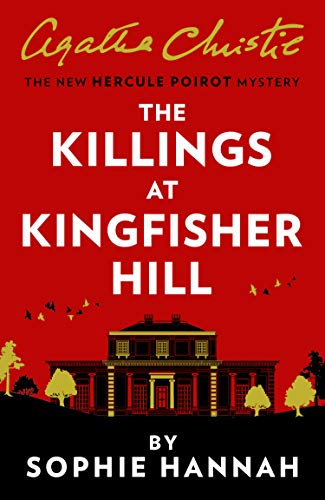
The Killings at Kingfisher Hill is Sophie Hannah’s fourth Hercules Poirot mystery novel and the first one I’ve read. I have read some of Hannah’s books previously. So, I know that she writes complicated and tricky plots. Whilst not attempting to reproduce Christie’s Poirot this book is loosely based on Christie’s books, as Hannah incorporates all the twists and turns, red herrings and misdirections that you find in them. There’s a country house setting, a number of suspects, and a gathering together at the end where Poirot reveals all.
Blurb:
Hercule Poirot is travelling by luxury passenger coach from London to the exclusive Kingfisher Hill estate, where Richard Devonport has summoned him to prove that his fiancée, Helen, is innocent of the murder of his brother, Frank. But there is a strange condition attached to this request: Poirot must conceal his true reason for being there.
The coach is forced to stop when a distressed woman demands to get off, insisting that if she stays in her seat, she will be murdered. Although the rest of the journey passes without anyone being harmed, Poirot’s curiosity is aroused, and his fears are later confirmed when a body is discovered with a macabre note attached…
Could this new murder and the peculiar incident on the coach be clues to solving the mystery of who killed Frank Devonport? And if Helen is innocent, can Poirot find the true culprit in time to save her from the gallows?
I wasn’t expecting a cloned Poirot and Hannah’s Poirot is not Christie’s Poirot. There’s no Captain Hastings in this book, Poirot’s faithful friend. Instead Poirot is accompanied by Inspector Catchpole from Scotland Yard. How on earth he got to be an inspector is beyond me – he comes across as rather dim and stupid and Poirot treats him as such, endlessly explaining things to him and telling him what to do in an officious manner.
There are three strands to the plot – who killed Frank Devonport; who is the hysterical woman with an ‘unfinished face’ who insists she will be murdered if she sits in a specific seat on the coach; and who is the mysterious woman who tells Poirot she is a murderer – what a stupid thing to do when she knows he is a ‘world-renowned detective’? And I wondered what makes Richard so sure that Helen didn’t kill Frank when she had immediately confessed that she had? And I’m still wondering why when he was invited to Kingfisher Hall, an exclusive and private country estate, he went by coach with 30 other passengers – even if it was a ‘luxury’ coach. I just can’t see Poirot travelling by coach!
This all makes the book extremely convoluted, confusing and tangled as well as long-winded. Poirot though works his way methodically through the mess and gets to the truth. However, I found it quite dull and repetitive and rather contrived. So, my rating for this book is 2.5 stars, rounded up to 3.
My thanks to HarperCollins for a review copy via NetGalley.
What are you currently reading? What did you recently finish reading? What do you think you’ll read next?
I’m currently readingWycliffe and How To Kill a Cat by W J Burley, one of my TBRs. It’s the second in the Wycliffe series, set in Cornwall.
Superintendent Wycliffe is on holiday, but popping into the local police station to see an old friend he hears that a woman has been found dead, probably murdered and he can’t resist offering to help. It’s immensely readable. The title puzzles me – I suspect that it’s not really about how to kill a cat – I hope not!
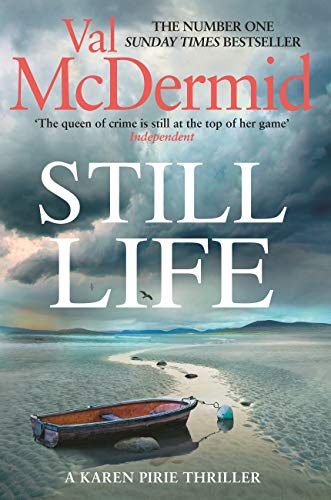
The last book I read was Still Life by Val McDermid, her latest Karen Pirie mystery. I’ll be writing more about this book. It combines a cold case investigation into a skeleton found in a campervan and a current investigation into the discovery of a body in the Firth of Forth. I loved it.
I see that ITV are adapting the first Karen Pirie book, The Distant Echo. Filming began in February this year, but I couldn’t find any other details – one to look out for.
I’d like to read several books next …
But at the moment I’m leaning towards reading the first book in the Inspector Lynley series, A Great Deliverance by Elizabeth George. I’ve dipped into it and it looks good.
Blurb:
Fat, unlovely Roberta Teys is found beside her father’s headless corpse, wearing her best dress and with an axe in her lap. Her first words are: ‘I did it. And I am not sorry’ and she refuses to say more. Inspector Thomas Lynley and DS Barbara Havers are sent by Scotland Yard to solve this particularly gruesome murder. And as they navigate their way around a dark labyrinth of secret scandals and appalling crimes, they uncover a series of shocking revelations that shatter the façade of the peaceful Yorkshire village.
Every Friday Book Beginnings on Friday is hosted by Gillion at Rose City Readerwhere you can share the first sentence (or so) of the book you are reading. You can also share from a book you want to highlight just because it caught your fancy.
My choice this week is Val McDermid’s latest book, Still Life, published yesterday. It’s a DCI Karen Piriethriller. I love that cover!
It begins with a Prologue:
Saturday, 15 February 2020
Billy Watson cast off from the quay without the faintest flicker of premonition.
And then Chapter 1
Saturday, 16 February 2020
Detective Sergeant Daisy Mortimer wasn’t easily put off her food. But for once, she stared at the bacon and egg roll she’d made for breakfast with a slightly jaundiced air.
Also every Friday there is The Friday 56, hosted by Freda at Freda’s Voice. *Grab a book, any book. *Turn to Page 56 or 56% on your ereader . If you have to improvise, that is okay. *Find a snippet, short and sweet, but no spoilers!
These are the rules:
Grab a book, any book.
Turn to page 56, or 56% on your eReader. If you have to improvise, that is okay.
Find any sentence (or a few, just don’t spoil it) that grabs you.
Post it.
Add the URL to your post in the link on Freda’s most recent Friday 56 post.
Grab a book, any book.
Turn to page 56, or 56% on your eReader. If you have to improvise, that is okay.
Find any sentence (or a few, just don’t spoil it) that grabs you.
Post it.
Add the URL to your post in the link on Freda’s most recent Friday 56 post.
Page 56:
‘According to the coastguard he likely went in on the east side of Elie. Probably somewhere around the ruin of Lady Janet Anstruther’s Tower. And probably about ten to twelve hours before the Bonnie Pearl fished him out. So, round about now, yesterday evening.
Blurb:
On a freezing winter morning, fishermen pull a body from the sea. It is quickly discovered that the dead man was the prime suspect in a decade-old investigation, when a prominent civil servant disappeared without trace. DCI Karen Pirie was the last detective to review the file and is drawn into a sinister world of betrayal and dark secrets.
But Karen is already grappling with another case, one with even more questions and fewer answers. A skeleton has been discovered in an abandoned campervan and all clues point to a killer who never faced justice – a killer who is still out there.
In her search for the truth, Karen uncovers a network of lies that has gone unchallenged for years. But lies and secrets can turn deadly when someone is determined to keep them hidden for good . . .
~~~
This is the sixth Karen Pirie book in the series. I think they read well as standalone books, but as they continue Karen’s own story I also think they are best read in order – and for once I am reading these books in order!
Faber and Faber Ltd/ 19 March 2020/ 256 pages/ Kindle edition/ 5*
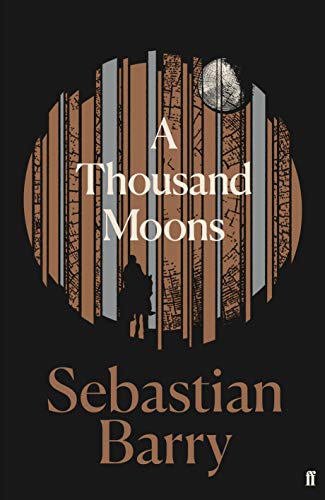
Three years ago I read Sebastian Barry’s Days Without End which has to be one of the best books I’ve read, so I began reading A Thousand Moons with great anticipation of a good read. I wasn’t disappointed and I loved it. It continues the story of Thomas McNulty and John Cole, and Winona, the young Indian girl they had adopted. It really helps if you have read Days Without End first to understand the characters’ history and relationships and how they got to this stage in their lives.
Winona is a young Lakota orphan adopted by former soldiers Thomas McNulty and John Cole. Living with Thomas and John on the farm they work in 1870s Tennessee, she is educated and loved, forging a life for herself beyond the violence and dispossession of her past. But the fragile harmony of her unlikely family unit, in the aftermath of the Civil War, is soon threatened by a further traumatic event, one which Winona struggles to confront, let alone understand.
They are living and working on a farm owned by Lige Magan in Tennessee, about seven miles from a little town called Paris. It is now the 1870s, some years after the end of the Civil War, but the town was still full of rough Union soldiers and vagabonds on every little byway. Dark skin and black hair were enough to get you beaten up – and it wasn’t a crime to beat an Indian. Life wasn’t any better for the other two workers on the farm, black ex-slaves, Rosalee Bouguereau and her brother, Tennyson. These are dangerous times not just in the town but also in the woods outside the town from Zach Petrie’s gang of ‘nightriders’.
Winona remembers little of her early life, beyond seeing in the back of her mind a ‘blackened painting’ of blood and screaming, bayonets, bullets, fire and death. But their lives are full of love at the farm; Winona is loved as a daughter by Thomas and John, who are themselves lovers. She works for lawyer Briscoe as his clerk and ventures into town for supplies, which was where she met Jas Jonski, a young man who declares he wants to marry her. At first she hopes that she might very much like to marry Jas. But, then things go disastrously wrong. First racism rears its ugly head as Jas is white and the Paris townspeople began to talk. As his employer said he thought Jas had gone mad or wicked in some way – ‘to want to go marrying something closer to a monkey than a man’ was how he put it.
And then came the dreadful day when Winona was brutally attacked so badly that she shook for two weeks and something deep within her was shaking a long time after. She can’t remember at first what had actually happened to her, except that she was plied with ‘distillery whiskey’, nor who had carried out the assault. But all the signs pointed to Jas Jonski. Then Tennyson Bouguereau was also attacked, and their peaceful happy life was shattered. Winona set out for revenge. And in so doing she began to remember more about her early life and about her mother, a strong Lakota woman, full of courage and pride.
‘A thousand moons’ was her mother’s deepest measure of time. To her time was ‘a kind of hoop or a circle not a long string and if you walked far enough she said you could find the people still living in the long ago’ – ‘a thousand years all at once’. As she sets off on her quest it is the thought of her mother’s courage that enabled Winona to find her own courage – the ‘courage of a thousand years’.
I just love everything about this book, so beautifully written, rendering the way the characters speak so that I could hear them, and describing the landscape so poetically and lyrically that the scenes unfolded before my eyes; and the characters too, all real people from the American West of the 1870s, as though I was there in their midst. It would make a superb film.
Sebastian Barry was born in Dublin in 1955. His novels and plays have won, among other awards, the Kerry Group Irish Fiction Prize, the Costa Book of the Year award, the Irish Book Awards Best Novel, the Independent Booksellers Prize and the James Tait Black Memorial Prize. He also had two consecutive novels, A Long Long Way (2005) and The Secret Scripture (2008), shortlisted for the MAN Booker Prize. He lives in Wicklow with his wife and three children.
My thanks to Faber and Faber Ltd for my copy of this book, via NetGalley.











 BooksPlease