The topic this week is Books I Meant to Read In 2020 but Didn’t Get To (You could take this opportunity to tell us what’s left on your seasonal TBRs from last year. Or books you were super excited about and then you didn’t get to them.)
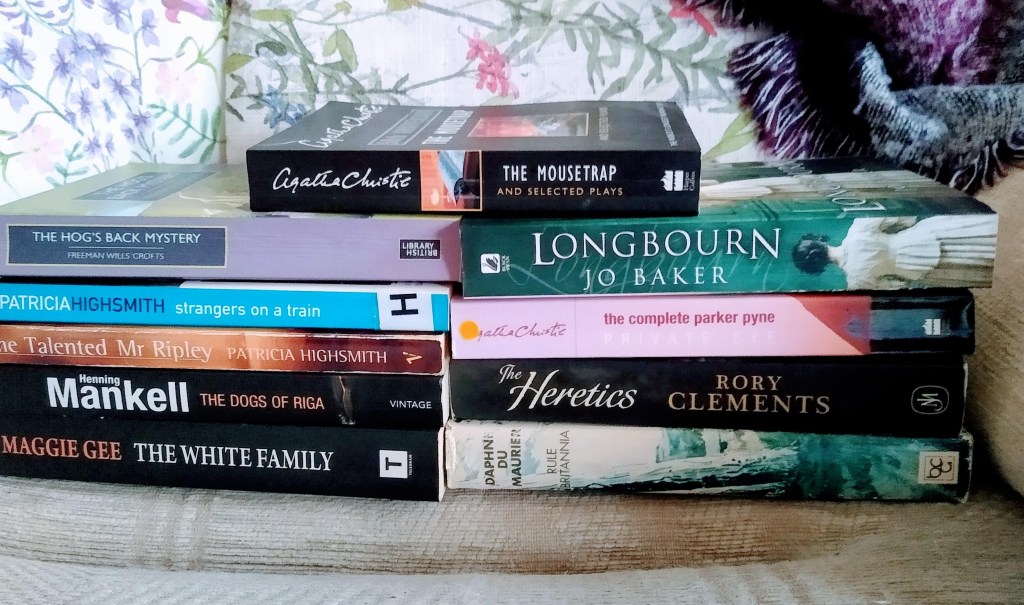
I don’t like to plan what I’m going to read next as when I do I hardly ever stick to my plan. I have hundreds of unread books to choose from, so for this topic I just picked out ten of them from the shelves. These aren’t books I wanted to read specifically in 2020 – they’re are just ten of the books that I really wanted to read when I first got them – but have still not got round to reading them. These are all used books from Barter Books in Alnwick.
The Mouse Trap and Selected Plays by Agatha Christie is a book I’m really keen to read, particularly as it is now extremely unlikely that I’ll be able to see it on stage. It ran continuously from when it first opened in 1952 and ran continuously until March 16, 2020, when the stage performances had to be discontinued due to the COVID-19 pandemic.
The Hog’s Back Mystery by Freeman Wills Croft, a Golden Age of British Crime Fiction. I’ve read several of these British Library Crime Classics, so this appealed to me. Dr James Earle and his wife live near the Hog’s Back, a ridge in the North Downs in the beautiful Surrey countryside. When Dr Earle disappears from his cottage, Inspector French is called in to investigate. At first he suspects a simple domestic intrigue – and begins to uncover a web of romantic entanglements beneath the couple’s peaceful rural life.
Strangers on a Train and The Talented Mr Ripley by Patricia Highsmith are books I’ve been meaning to read for years! In Strangers on a Train Guy Haines and Charles Anthony Bruno are passengers on the same train. But while Guy is a successful architect in the midst of a divorce, Bruno turns out to be a sadistic psychopath who manipulates Guy into swapping murders with him. The Talented Mr Ripley, is the first novel to feature, anti-hero, Tom Ripley. He wanted money, success, the good life – and he was willing to kill for it.
The White Family by Maggie Gee. I read one of Maggie Gee’s books years ago, The Cleaner, and wanted to read more. She’s published 12 novels and The White Family is her seventh. On the back cover it’s described as a novel on the subject of racial hatred as it looks at love, hatred, sex, comedy and death in an ordinary British family.
Longbourn by Jo Baker is a book I’ve dithered about reading for ages, finally I decided that I do want to read it. I wasn’t sure as it’s about the Bennet family (in Pride and Prejudice) but from the servants’ perspective. I dithered as I’m often disappointed by modern versions of classics, sequels and prequels etc. But this has so many good reviews that I’ve been persuaded to read it.
I’ve added Rory Clements to my list of favourite authors. He writes historical fiction and The Heretics is one of his John Shakespeare series of Elizabethan mysteries. Spanish galleys land troops in Cornwall in 1595 – is this a dry-run for a new invasion (seven years after the Armada) or something more sinister – a threat to Queen Elizabeth I’s life?
I loved Henning Mankell’s first Kurt Wallender mystery, so the second book, The Dogs of Riga is another book I’m really keen to read. Two bodies wash ashore on the Swedish coast in a life raft. The dead men were criminals, victims of what seems to have been a gangland hit. But what appears to be an open-and-shut case soon takes on a far more sinister aspect.
Rule Britannia by Daphne du Maurier. I’ve read a lot of her books, so when I saw this at Barter Books I picked it up immediately. However, when I got it home I looked it up in Margaret Forster’s biography of du Maurier and my enthusiasm fell, because she described it as the poorest novel du Maurier had ever written. Still, I want to read it to see for myself. Du Maurier described it to her granddaughter as ‘very funny, at least I think so … it takes the mickey out of everything, including as a family.’ First published in 1972 in this novel the UK has withdrawn from the Common Market (as it was then called) and has formed an alliance with the United States – supposed to be an equal partnership but it looks to some people like a takeover bid. Was du Maurier able to foresee the future, I wonder?
Another Agatha Christie novel I really want to read is The Complete Parker Pine, as I haven’t read any of the Parker Pine stories. Plump and bald, Christopher Pyne (although he is always referred to as J Parker Pyne) is a retired civil servant. Having worked as a government employee for 35 years, during which time he tirelessly compiled statistics, Pyne decides to set himself up as a private investigator, describing himself as a ‘heart specialist’.
Random House UK, Cornerstone| 21 January 2021| 336 pages| Kindle review copy| 4*
I wasn’t at all sure about Exit by Belinda Bauer when I first started to read it a few months ago, so put it to one side and only picked it up again a few days ago. What initially put me off was the opening chapter, which sets the scene for the work of the Exiteers, a group of people who provide support for people with a terminal illness to end their lives. Their role is ostensibly passive, just to be there to keep the dying company as they take their final breaths. But they do provide the means! And one assignment for John (real name Felix Pink) and Amanda goes wrong when they discover they have ‘helped’ the wrong man.
But I read on and what at first looks like a novel considering the ethics of assisted suicide turns into crime fiction as Felix and Amanda realise they have become murder suspects. It’s all mayhem after that as Felix, overcome with remorse, tries to put things right and to discover how and why the wrong man had died.
Far from being a ‘thriller’ it becomes a borderline ‘cosy’ murder mystery, verging on farce in places and I was amused by the wry humour and surreal scenes. It’s a comedy of errors, interspersed with poignant scenes as we learn about Felix’s grief over the deaths of his wife, Margaret and son James. His thoughts always end up with wondering what Margaret would do in the same situation.
It gets off to a slow start, the pace only gradually picking up in the later chapters, when the multiple twists kept me engaged and keen to know how it would end. There are quite a lot of characters in the book, which I found a bit confusing at first, although the main characters, Felix and Acting DC Calvin Bridges are clearly defined and distinctive characters. Some of the minor characters, such as old Greybeard and other clients in the betting shop, are clearly quirky and their actions absurd. And I particularly liked old Skipper, Albert’s father. But underneath the comedy there is a tragedy, as Felix discovers how he has been deceived all along. And the ending is bitter sweet. I began not sure I really wanted to read Exit and ended it feeling I’m glad I did. It’s unlike anything else I’ve read!
Thanks to the publishers and NetGalley for my proof copy.
Every Friday Book Beginnings on Friday is hosted by Gillion at Rose City Readerwhere you can share the first sentence (or so) of the book you are reading. You can also share from a book you want to highlight just because it caught your fancy.
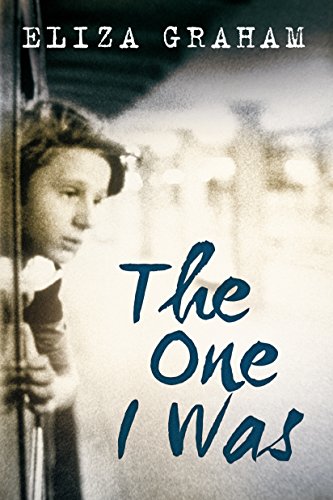
This morning I started to read The One I Was by Eliza Graham. I’ve read a couple of her books before and I’m hoping this one will be just as good.
It begins:
Every bone in my body screamed at me to run away from the elegant and classical white house at whose door I stood.
Also every Friday there is The Friday 56, hosted by Freda at Freda’s Voice. *Grab a book, any book. *Turn to Page 56 or 56% on your ereader . If you have to improvise, that is okay. *Find a snippet, short and sweet, but no spoilers!
These are the rules:
Grab a book, any book.
Turn to page 56, or 56% on your eReader. If you have to improvise, that is okay.
Find any sentence (or a few, just don’t spoil it) that grabs you.
Post it.
Add the URL to your post in the link on Freda’s most recent Friday 56 post.
Grab a book, any book.
Turn to page 56, or 56% on your eReader. If you have to improvise, that is okay.
Find any sentence (or a few, just don’t spoil it) that grabs you.
Post it.
Add the URL to your post in the link on Freda’s most recent Friday 56 post.
Page 56:
‘Sometimes people think it is strange to try so hard,’ he said.
‘The world depends on some of us refusing to be the same as everyone else.’
~~~
My first thought was, of course, to wonder why this person wanted to run away from the house so desperately.
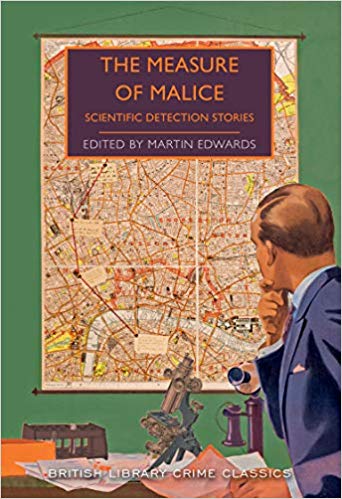
The Measure of Malice edited by Martin Edwards is one of the more enjoyable short story collections that I’ve read. It contains 14 stories in which scientific/technological methods are used in the detection of crime. There is an excellent introduction by Martin Edwards with information about the authors, five of whom were doctors, two were engineers and one was an academic chemist.
As always with short story collections some stories are better than others. I’m highlighting a few of the better ones here:
The Boscombe Valley Mystery by A Conan Doyle was originally published in the Strand Magazine in October 1891, and is the first short story to feature Inspector Lestrade. It’s a solid story, solved by Sherlock Holmes by inspecting and analysing the footprints and signs at the scene of the crime.
The Horror of Studley Grange by L T Meade and Clifford Halifax (1894), from Stories for the Diary of a Doctor, originally published in the Strand Magazine. I enjoyed this one although it was pretty easy to predict. Ostensibly a ghost story, the solution involves the use of a laryngoscope.
After Death the Doctor by J J Connington, a Scottish professor of chemistry. This one was first published in 1934, involving a contemporary scientific gadget. The doctor in question is Doctor Shefford who together with Sergeant Longridge, investigate the murder of old Barnaby Leadburn, found dead with his throat cut.
The next two are the ones I enjoyed the most:
The Broken Toad by H C Bailey, first published in 1934, featuring the surgeon and Home Office Consultant, Reggie Fortune as he considers the death of a police constable from poisoning. I enjoyed all the detailed complications and Bailey’s literary mannered style of storytelling.
In the Teeth of the Evidence by Dorothy L Sayers, first published in 1939, about forensic dentistry, which starts as Lord Peter Wimsey is sitting in his dentist’s chair. The police had just visited the surgery, wanting to see his predecessor’s records to identify the victim of a burnt out garage. An upper right incisor crown and the filling in a molar provided the clues to his death. Gory if you actually visualise what is involved!
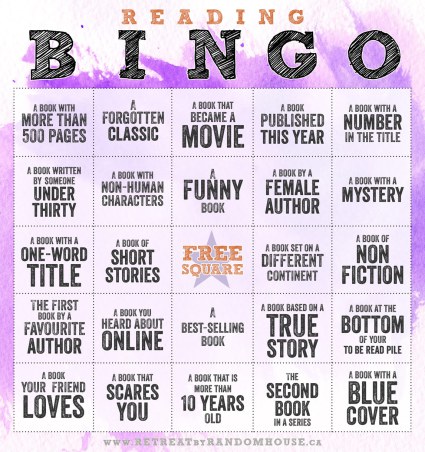
I’ve played the Reading Bingo Card since 2015, with the exception of last year. I like it because during the year I don’t look for books to fill in the card – I just read what I want to read and then see whether the books I’ve read will match the squares. I also like it because it is an excellent way of looking back at the books I’ve read and reminding me of how much I enjoyed them.
Here is my card for 2020:
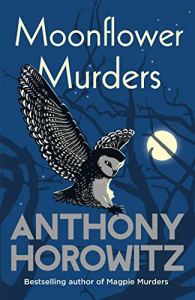
A Book With More Than 500 pages. – Moonflower Murders – 608 pages, this may be long but Anthony Horowitz’s style of writing suits me – so easy to read, I whizzed through it. This is a follow up novel to Magpie Murders. But it is a most complicated murder mystery, combining elements of vintage-style golden age crime novels with word-play, cryptic clues and anagrams. I thoroughly enjoyed trying to work it all out.
The British Library series of crime classics presents long forgotten classics many of which had been out of print. Somebody at the Door was first published in 1943 and it’s set in 1942 giving a vivid picture of what life was like in wartime England. It’s a murder mystery as Henry Grayling after travelling home on the 6.12 train from Euston, never reached his home. There are plenty of suspects for Inspector Holly to investigate.
A Book That Became a Movie – The Big Sleepby Raymond Chandler. It’s fast-paced, violent, and complicated, with damsels in distress, gangsters, corrupt officials, and plenty of dark, violent and bloody situations as well as murders.The Big Sleep has been adapted for film twice, in 1946 with Humphrey Bogart, Lauren Bacall, John Ridgely, Martha Vickers, and again in 1978, with Robert Mitchum, Sarah Miles, Richard Boone, Candy Clark.
A Book Published This Year – Fresh Water for Flowers by Valérie Perrin, published in July. This is a story of love and loss – and hope. Violette, the caretaker at a cemetery in a small town in Bourgogne, is a character I really warmed to; she is optimistic, brave, creative and caring. It’s a story full of warmth and happiness and life in the cemetery is full of surprises and joy. It was not what I expected to be and I am so pleased I’ve read it.
A Book with a Number in the Title – A Thousand Moons by Sebastian Barry. It continues the story of Thomas McNulty and John Cole, and Winona, the young Indian girl they had adopted, told in Days Without End. It’s historical fiction set in Tennessee in the 1870s in the aftermath of the Civil War. I just love everything about this book, so beautifully written, rendering the way the characters speak so that I could hear them, and describing the landscape so poetically and lyrically that the scenes unfolded before my eyes.
A Book Written by Someone Under Thirty – The Luminaries by Eleanor Catton, the winner of the 2013 Booker Prize. It’s historical fiction set in New Zealand in the 1860s, during its gold rush and it has everything – gold fever, murder, mystery and a ghost story too. Eleanor Catton was 25 when she began writing The Luminaries and 28 when she won the Booker Prize. I loved the pictures it builds up of the setting in New Zealand, the frontier town and its residents from the prospectors to the prostitutes, and the obsessive nature of gold mining.
A Book With Non-Human Characters – The Guest Cat by Takashi Hiraide. The main character in this book is a stray cat, Chibi, who made herself at home with a couple in their thirties who lived in a small rented house in a quiet part of Tokyo. At first the cat was cautious and just peeked inside their little house but eventually Chibi spent a lot of time with the couple coming and going as she pleased.
A Funny Book – the only story I read in 2020 that came anywhere near to being funny was a short story – Jeeves and the Yule-tide Spirit by P G Wodehouse. Actually I didn’t find this very funny at all, even though I’ve read other Jeeves and Wooster stories that are funny. There is no yule-tide spirit in this story!
A Book By A Female Author – The Haunting of Hill Houseby Shirley Jackson. This is a horror story, but it’s not gore. Instead it is macabre and has a chilling atmosphere. It’s more of a psychological study than a horror story. The best parts are, I think, the descriptions of Hill House – the dark horror at the centre of the story. Four people are staying at Hill House to investigate if it is really haunted.
A Book With A Mystery – Remain Silentby Susie Steiner. I could have chosen any one of the many crime fiction novels I’ve read this year, but I’ve picked Remain Silent, the third Manon Bradshaw book about the death of a young migrant. It is not just a gripping mystery, it is a tragedy, a scathing look at modern life, centred on the exploitation of immigrant labour, racism and abuse that some of the foreign workers have to endure.
A Book With A One Word Title – Sword by Bogdan Teodorescu. This is crime fiction in which a serial killer is on the loose, but with a difference – it’s a complex novel, a political thriller focusing on the political and social dimensions of the racial conflict between the Romanians and the Roma or ‘gypsies’. The killer is hunting down his victims from the minority Roma community. As the racial conflict continues the ethnic tension rises highlighting the corruption and manipulation by the politicians and by the mass media in particular.
A Book of Short Stories – Measure of Malice: Scientific Storiesedited by Martin Edwards. I’m cheating a bit here as by the end of the year I had only read four of the fourteen short stories in this collection. I like to take my time reading short stories and unfortunately I took too long and I only finished it a few days ago. I enjoyed the stories, as always some are better than others.
Free Square – for this square I’ve chosen The Shortest BookI read, which is The Shortest Day by Colm Tóibín, a novella of just 31 pages. It’s storytelling at its best – a tale of wonder and mystery, about a burial chamber, a prehistoric monument in County Meath in Ireland, that was built around 3200 BC – older than Stonehenge and the Egyptian pyramids. It’s ringed by a stone circle, stones brought from the Mournes and Wicklow Mountains.
A Book Set On A Different Continent – Thin Air by Michelle Paver, set in the Himalayas on Kangchenjunga. A group of five men set out to climb the mountain in 1935. Held to be a sacred mountain, Kangchenjunga is one of the most dangerous mountains in the world – believed to be the haunt of demons and evil spirits. Based on fact, this is a very atmospheric and chilling story.
A Book of Non Fiction – And Now For the Good News by Ruby Wax, a positive look at some recent developments in community, business, education, technology, and food that promise to make the world a better place. It’s easy reading, written clearly in a breezy conversational style, covering a large amount of information. She emphasises the importance of compassion and kindness, of community and on working for the good of all. Maybe, above all she focuses on the benefits of mindfulness and on positive experiences.
The First Book By a Favourite Author – The Dry by Jane Harper, the first Aaron Falk book, crime fiction set in a small country town in Australia, where the Hadler family were brutally murdered. I read and loved the second and third books, Force of Nature and The Lost Man, before I read The Dry. I was delighted to find it’s just as good as everyone said it is – it won many Literary Awards!
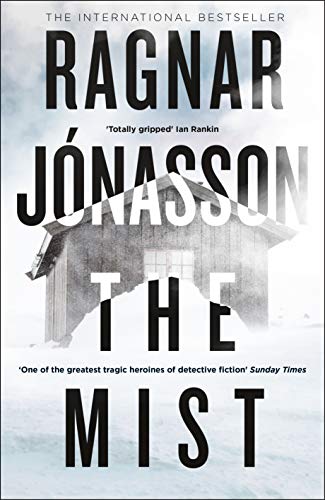
A Book You Heard About On Line – Many of the books I read these days are books I’ve heard about on line. I’ve chosen The Mist by Ragnar Jonasson, Nordic noir, the third novel in Ragnar Jonasson’s HiddenIceland series. It’s 1987 when Hulda is worrying about her daughter, Dimma and her relationship with her husband, Jon. Alongside the story of what is happening in her personal life, she is also investigating the disappearance of a young woman and a suspected murder case, a particularly horrific one in an isolated farmhouse in the east.
A Best Selling Book – Hamnet by Maggie O’Farrell. This book won the Women’s Prize for Fiction, was named one of the top 10 books of the year by the New York Times and the Washington Post, and is also the Waterstones book of the year. It is historical fiction inspired by Hamnet, Shakespeare’s son and is a story of the bond between him and his twin sister, Judith. (At the time the names Hamlet and Hamnet were considered virtually interchangeable.)
A Book Based On A True Story – The Guardians by John Grisham is a novel based on a real story and a real person, which gives it a really authentic feel. Guardian Ministries is based Centurion Ministries founded by James McCluskey, working to prove the innocence of convicted criminals, convinced of their innocence.
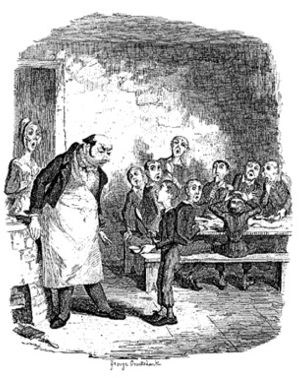
A Book At The Bottom of Your To Be Read Pile – Oliver Twist by Charles Dickens. This had been on my TBR list for many, many years, so I’m really pleased that at long last I have read the book.
A Book Your Friend Loves – The Mystery of Princess Louise: Queen Victoria’s Rebellious Daughter by Lucinda Hawksley was recommended to me by a friend, who thought it was very good. She was quite right and I loved this biography of Victoria’s sixth child – her fourth daughter, born on 18th March 1848. Louise She had a difficult childhood, disliked and bullied by her mother and she often rebelled against the restrictions of life as a princess. In her adult life she was a sculptor and painter, friend to the Pre-Raphaelites and a keen member of the Aesthetic movement. There were hints of love affairs dating as far back as her teenage years, and notable scandals and was the first member of the royal family to marry a commoner since the sixteenth century.
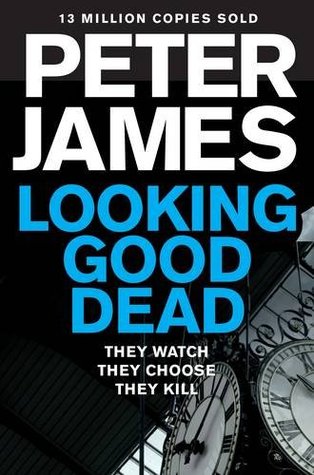
A Book that Scares You – There were parts of Looking Good Dead by Peter James. By the end of the book the tension rose and culminated in the most terrifying scenes by the end of the book. I raced through it, trying not to visualise the gruesome details and impatient whenever the action moved away from the murder mystery. It’s a thriller about Tom who puts himself and his family in great danger after he picked up a CD that another passenger had left on the train – it’s a snuff movie – enough said.
A Book That Is More Then Ten Years Old – A Killing Kindness by Reginald Hill the sixth Dalziel and Pascoe novel, first published in November 1980 and televised in 1997 with the actors Warren Clarke and Colin Buchanan in the lead roles. Three women have been found dead, strangled and a mysterious caller phones the local paper with a quotation from Hamlet. As more murders follow, the killer is soon known as the Choker and it seems as if his motive for the murders is compassion.
The Second Book In A Series – Stone Cold Heart by Caz Frear. I didn’t get on with it very well. However, I’m in the minority as there are lots of 4 and 5 star reviews on Amazon and Goodreads. It’s a police procedural written in the first person present tense narrated by DC Cat Kinsella who is part of the Murder Investigation Team 4, and her personal life is a major part of the book.
A Book With A Blue Cover – The Deep by Alma Katsu. This isa mix of fact and fiction. It moves between 1912 as the Titanic sets sail on its maiden voyage and 1916, as its sister ship the Britannic, converted to a hospital picks up soldiers injured in the battlefields to take them back to England. There is a large cast of characters, some are real people and others are fictional; the stories on the two ships are told from their different perspectives. It didn’t grip me as much as The Hunger, her earlier book, although it’s a very atmospheric novel.
This is a brand new challenge for 2021 devised by FictionFan.
This is the safe way to travel for 2021. Virtual travelling is the way to go, so I’m looking forward to seeing new places this year in my reading. Any type of book will count – crime, fiction, science fiction, non-fiction and a country can only appear once. Like FictionFan I’m not planning right now which books to read, but I’ll just wait and see what boxes I can fill from my general reading, and then towards the end I’ll frantically try to find books to fill in any missing squares!







 BooksPlease