The Hanging Valley by Peter Robinson: a Book Review

There are 20 books in Peter Robinson’s Inspector Banks series (listed at Fantastic Fiction). I’ve read a few of them, completely out of order, but it doesn’t seem to matter too much as each one stands alone, although I suspect I’d get a better idea of Banks’s personal life if I had read them in order!
The Hanging Valley is the fourth one in the series.

Synopsis (from the back cover):

A faceless corpse is discovered in a tranquil, hidden valley below the village of Swainshead. And when Chief Inspector Alan Banks arrives, he finds that no-one is willing to talk. Banks’s frustration only grows when the identity of the body is revealed. For it seems that his latest case may be connected with an unsolved murder in the same area five years ago. Among the silent suspects are the Collier brothers, the wealthiest and most powerful family in Swainsdale. When they start use their influence to slow down the investigation, Inspector Alan Banks finds himself in a race against time…

My view:

As well as the Collier brothers, there are other suspects, including John Fletcher, a taciturn farmer, Sam Greenock and his wife Katy who own the local Bed and Breakfast guest house. There’s something not quite right about Katy, she’s obviously troubled and hiding something, and she is dominated by Sam. As I read on I thought the killer was first one character, then another and never really worked out who it was until quite near the end. I enjoyed the puzzle.

Detective Chief Inspector Alan Banks had been transferred to Eastvale from London two years earlier and is still getting to know the area. He’d moved from London because of the sheer pressure of the job and the growing confrontation between the police and citizens in the capital had got him down. Crime in Eastvale had been slack until this murder happened. And it’s complicated, the locals close ranks and Banks has to work hard to get information, first of all to discover who the victim was and why he had been killed. The trail leads him abroad to Toronto before Banks discovers the truth.

The Hanging Valley is rich in description, both of the Yorkshire Dales and of Toronto. (Peter Robinson was born in Yorkshire and now lives in Toronto.) The hanging valley sounds a beautiful spot, a small, secluded wooded valley with unusual foliage:

… the ash , alders and sycamores … seemed tinged with russet, orange and earth brown. It seemed … like a valley out of Tolkien’s ‘Lord of the Rings’.

… the valley clearly had a magical quality. It was more luxuriant than the surrounding area, its ferns and shrubs more lush and abundant, as if, Neil thought, God had blessed it with a special grace. (page 5)

All of which makes the discovery of the corpse so shocking, with its flesh literally crawling. So, I enjoyed this book on two levels – the mystery and the writing itself. I did think, though, that it could have been shorter and more concise, and some of the characters were rather indistinguishable which is why I rated it 3/5.

  • Paperback: 324 pages
  • Publisher: Pan; New edition (8 Nov 2002)
  • Language English
  • ISBN-10: 0330491644
  • ISBN-13: 978-0330491648
  • Source: I bought it

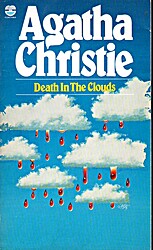
Death in the Clouds by Agatha Christie: a Book Review

Death in the Clouds is a kind of locked room mystery, only this time the ‘locked room’ is a plane on a flight from Paris to Croydon, in which Hercule Poirot is one of the passengers.

In mid-air, Madame Giselle, is found dead in her seat. It appears at first that she has died as a result of a wasp sting (a wasp was flying around in the cabin) but when Poirot discovers a thorn with a discoloured tip it seems that she was killed by a poisoned dart, aimed by a blowpipe.

At the inquest the jury’s verdict is that the murderer is Poirot! However the coroner refuses to accept this and finds that the cause of death was poison with insufficient evidence to show who had administered the poison. All the other passengers and flight attendants are suspects and Poirot together with Inspector Japp, studies the passenger list with details of their belongings. There is a helpful plan of the cabin at the front of the book showing who sat where, including a crime fiction writer, a flute-playing Harley Street doctor, two French archaeologists, a dentist, a hairdresser, a Countess (formerly an actress), a woman who is a compulsive gambler, a crime writer and a businessman . Despite all this I was quite unable to work out who did it.

The question is who could have acquired the rare poison and how could it have been shot at Madame Giselle without anyone noticing that happening. Why would anyone want to kill her, and how were any of the suspects connected with her? Even when Poirot details the clues, including the Clue of the Passenger’s Baggage (and I read through the list a few times), I still didn’t work it out.

Apart from the ingenious mystery, which the coroner describes as the most astonishing and incredible case he had ever dealt with, there were other things I enjoyed in reading this book. First of all the ‘psychological moments’  in which people don’t notice what is happening in front of them because their attention is diverted. Then there is the way Christie makes fun of crime fiction writers and readers, making Japp comment that:

I don’t think it healthy for a man always to be brooding over crime and detective stories, reading up all sorts of cases. It puts ideas into his head. (page 63)

Poirot’s denouement at the end of the book clears up all the confusion, detailing his impressions, precise ideas and methods in dealing with the case. Looking back through the book, all the clues were there, of course, but so cleverly concealed that in most cases I had overlooked them or not realised their significance. A most enjoyable book!

  • Paperback: 336 pages
  • Publisher: HarperCollins; Masterpiece edition (Reissue) edition (3 Mar 2008)
  • Language English
  • ISBN-10: 000711933X
  • ISBN-13: 978-0007119332
  • Source: I bought the book
  • My rating 4/5

What’s in a Name 5

In September I completed this year’s What’s in a Name Challenge and I’ve been wondering whether or not to join in again for next year’s challenge. On the one hand, I’ve done it most years and it’s one of the few challenges that I’ve joined that I’ve finished. On the other hand I’m not over keen on reading a book based on the fact that it has a particular word in the title. But, then again I do like making lists and seeing if I can find enough of my unread books to match the categories.

So, I am going to take part, because I’ve gone through my books and found that I have more than enough books to finish the challenge and after all it only involves reading 6 books over the year. It’s hosted by Beth at Beth Fish Reads:

The categories and my choices are as follows:

A book with a topographical feature in the title.  I have lots of choice for this category – 

  • On the Black Hill by Bruce Chatwin
  • The Way Through the Woods by Colin Dexter
  • The Secret River by Kate Grenville
  • Hanging Valley by Peter Robinson
  • The Ghost Road by Pat Barker
  • The River Midnight by Lilian Nattel
  • Shadows in the Street by Susan Hill
  • The Island by Victoria Hislop
  • The Road by Cormac McCarthy

A book with something you’d see in the sky in the title

  •  Cloud Atlas by David Mitchell
  • The Book of Air and Shadows by Michael Gruber
  • Death in the Clouds by Agatha Christie

A book with a creepy crawly in the title – just one book!

  • The Wasp Factory by Iain Banks

A book with a type of house in the title:

  • The Girl Who Kicked the Hornet’s Nest by Steig Larsson
  • The House of Spirits by Isabel Allende
  • Wycliffe and the House of Fear by W J Burley
  • I’m the King of the Castle by Susan Hill

A book with something you’d carry in your pocket, purse, or backpack in the title:

  • The Scarlet Letter by Nathaniel Hawthorne
  • Notes from an Exhibition by Patrick Gale
  • Schindler’s List by Thomas Keneally
  • Village Diary by Miss Read
  • They Do It With Mirrors by Agatha Christie
  • Book of Love by Sarah Bower

A book with something you’d find on a calendar in the title:

  • The Friday Night Knitting Club by Kate Jacobs
  • The Year of the Flood by Margaret Atwood
  • The Day Gone By by Richard Adams (autobiography of the author of Watership Down)

What’s In a Name 4 Challenge – Completed

I’ve  finished the What’s In a Name Challenge, hosted by Beth Fish Reads, reading a book from each of the set categories. Apart from Evil Under the Sun, which was a new purchase the books were all from my To-Be-Read books. They are listed below with links to my posts on them:

1. A book with a number in the title ‘“ One Good Turn by Kate Atkinson
2. A book with jewelry or a gem in the title ‘“ The Moonstone by Wilkie Collins
3. A book with a size in the title ‘“ Little Women by Louisa May Alcott
4. A book with travel or movement in the title ‘“ Exit Lines by Reginald Hill
5. A book with evil in the title – Evil Under the Sun by Agatha Christie
6. A book with a life stage in the title ‘“ Molly Fox’s Birthday by Deirdre Madden

I had read Little Women several times before, many years ago and I read it this time prior to reading a biography of Louisa May Alcott and her father – Eden’s Outcasts by John Matteson. I think re-reading Little Women has taught me to leave well-loved books in my memory.  Although some of the magic was still there I thought it was a dated, sentimental tale.

Four of the books are crime fiction, which seems to be my preferred genre this year. The book I enjoyed the most was Reginald Hill’s Exit Lines, which is an excellent crime fiction novel which kept me guessing until the end.

Evil Under the Sun by Agatha Christie: a Book Review

In Evil Under the Sun Poirot is on holiday in Devon staying in a seaside hotel – a seaside mystery instead of a country house mystery!

Here’s the blurb:

It was not unusual to find the beautiful bronzed body of the sun-loving Arlena Stuart stretched out on a beach, face down. Only, on this occasion, there was no sun! she had been strangled. Ever since Arlena’s arrival at the resort, Hercule Poirot had detected sexual tension in the seaside air. But could this apparent ‘crime of passion’ have been something more evil and premeditated altogether?

My thoughts:

It’s August, the sun is hot, people are enjoying themselves, swimming and sunbathing and yet Poirot remarks that the sight of the recumbent figures on the beach reminds him of the Morgue in Paris, ‘the bodies – arranged in slabs – like butcher’s meat!’  The other guests remark it’s an unlikely setting for crime but Poirot disagrees:

‘It is romantic, yes,’ agreed Hercule Poirot. ‘It is peaceful. The sun shines. The sea is blue. But you forget Miss Brewster, there is evil everywhere under the sun.’

And so it turns out, with the discovery of Arlena’s dead body. Arlena, who Major Barry describes as ‘a personification of evil’.

‘She’s the world’s first gold-digger. And a man-eater as well! If anything personable in trousers comes within a hundred yards of her, it’s fresh sport for Arlena!’

Her step-daughter, Linda hates her and wants to kill her, wishing she would die.

Arlena was strangled. Poirot  maintains that her murder has resulted from her character, and his investigations revolve around understanding exactly what type of person she was. The suspicion of guilt is cast over one person after another; either a man or a woman could have been strong enough to strangle Arlena and there are plenty of suspects. And even Poirot is puzzled because from the beginning it had seemed to him that one person was clearly indicated as the murderer but at the same time it seemed impossible for that person to have committed the crime.

Poirot describes the murder as a ‘very slick crime‘ and indeed it was perfectly planned and timed. At the end he explains at length how he collected together all the isolated significant facts and events to make a complete pattern to discover the identity of the murderer. Although I enjoyed this book I did think the explanation was too long and the characters  were a bit sketchy and sterotypical. It all seemed to be more of a puzzle solving exercise, than a captivating mystery.

Agatha Christie wrote Evil Under the Sun during 1938 and it was published in 1941, having first appeared as a serial in the USA at the end of 1940. I read it on my Kindle.

  • Format: Kindle Edition
  • File Size: 416 KB
  • Print Length: 320 pages
  • Publisher: Harper (14 Oct 2010)
  • Sold by: Amazon Media EU S.à r.l.
  • Language English
  • ASIN: B0046H95QS
  • Source: I bought it

Reading this book completes the What’s in a Name 4 challenge.

What’s In a Name Challenge 2011 – Update

The What’s In a Name Challenge is hosted by Beth Fish Reads.

Challenge: to read one book from each category. I’ve now completed five out of the six categories – one more to go! The links go to my posts on the books:

1. A book with a number in the titleOne Good Turn by Kate Atkinson
2. A book with jewelry or a gem in the titleThe Moonstone by Wilkie Collins
3. A book with a size in the title – Little Women by Louisa May Alcott
4. A book with travel or movement in the title – Exit Lines by Reginald Hill
5. A book with evil in the title
6. A book with a life stage in the title – Molly Fox’s Birthday by Deirdre Madden