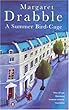
Book Beginnings: A Summer Bird-Cage by Margaret Drabble

Last Friday I quoted the opening sentences of Life Support by Tess Gerritsen, which was going to be the next book I read. I did read on for a couple of chapters but had to stop as I was just not in the mood for reading a medical thriller set in a hospital – too close to the bone! I fancied reading something less disturbing, so I took A Summer Bird-Cage by Margaret Drabble down from the bookcase and began to read that:

I had to come home for my sister’s wedding. Home is a house in Warwickshire, and where I was coming from was Paris. I was keen on Paris, but will refrain from launching into a description of the Seine. I would if I could, but I can’t. (page 7)

A Summer Bird-Cage was Margaret Drabble’s first novel. It was first published in 1963 and is set at the in the early 1960s, about the lives of two sisters – Sarah, the narrator who has just graduated from Oxford University and is wondering what to do with her life, and her beautiful sister Louise who at the start of the book is about to marry, Stephen, a rich novelist. From what I’ve read so far, neither of them seem happy and there is definitely tension between them.

Interesting I think, and I’m wondering if it maybe a bit autobiographical – Margaret Drabble is the younger sister of A S Byatt. Maybe this sentence was personal, comparing the two sisters, when Sarah says – ‘As far as tags go she is grande dame where I am jeune fille, and she leads all her life to match it.’ Or maybe I’m reading too much into that.

Book Beginnings on Friday is hosted by Katy at A Few MorePages.

Saturday Snapshot

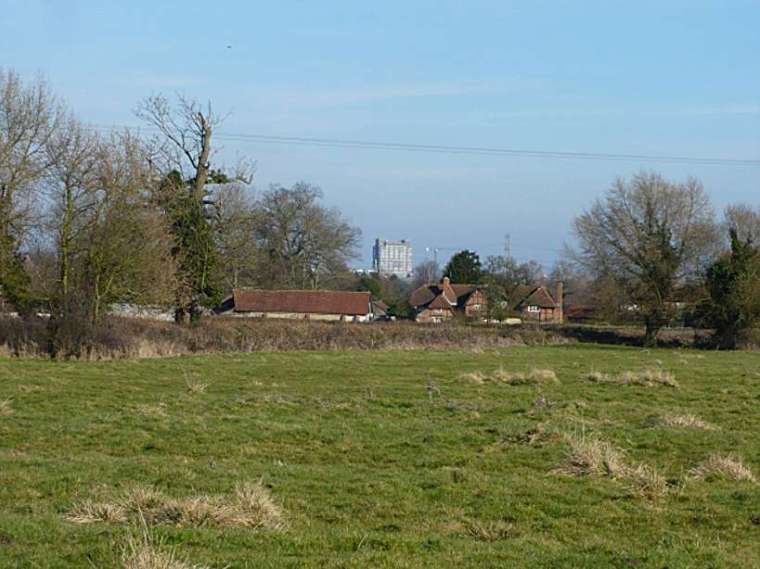
I have a scrolling photo viewer on the computer desktop and this photo greeted me this morning when I switched the computer on. It’s the view from the field near to my previous house looking towards the town of Aylesbury in Buckinghamshire. The grey tower block in the background is where I used to work at the County Council offices – I was on the 8th floor, just over halfway up the building.

I like this photo because it shows the contrast between the old and the new, although the County Hall tower block is not new, completed in 1966, it’s certainly centuries older than the timber-framed house in the foreground.

Believe it or not, the tower block, sometimes called Pooley’s Folly after the architect, is a Grade II Listed Building. It’s constructed out of concrete and glass and whilst I was working there it was discovered that the core of the building was crumbling and it had to be reinforced. We were surrounded by scaffolding for months. It’s also a most inconvenient building to work in, boiling hot in the summer, freezing in the winter, draughty windows and only two lifts serving 13 fours and no service lift. I spent hours in total over the years I worked there just waiting for the lift. Still, that meant I had more time to read whilst waiting.

Saturday Snapshot is hosted by Alyce of At Home with Books.

Book Beginnings: Life Support

Life Support by Tess Gerritsen is the fourth book I’ll be reading in the RIP IV Challenge. According to the back cover this is ‘a quick, delightfully scary read‘, which fits in well with the RIP challenge criteria.

It begins:

A scalpel is a beautiful thing.

Dr Stanley Mackie had never noticed this before, but as he stood with head bowed beneath the OR lamps, he suddenly found himself marveling at how the light reflected with diamondlike brilliance off the blade. It was a work of art, that razor sharp lunula of stainless steel. So beautiful in fact, that he scarcely dared to pick it up for fear he would somehow tarnish its magic. In its surface he saw a rainbow of colors, light fractured to its purest elements. (Page 13)

This will be the first book by Tess Gerritsen that I’ve read. It’s been on my bookshelves for quite a while now and I have been wary of reading it in case it’s too gory for me. I didn’t buy it, it was a free book with the magazine Woman and Home, which I buy now and then. When I read the Introduction I was even less sure this book was for me as Tess Gerritsen wrote that she got the idea for the book whilst at medical school (she is a doctor), when she heard the professor say the words ‘human cannibalism’ in his lecture on Creutzfeld-Jakob disease, a viral infection of the brain.

So I put this book way down on my to-be-read books, but since then I’ve read several favourable reviews of other books by Gerritsen so I thought I’d try this one. I like the style of writing in this first paragraph and it does make me want to read on, so when I’ve finished one of my current reads I’m going to start Life Support. Let me know what you think if you’ve read it?

Book Beginnings on Friday is hosted by Katy at A Few More Pages.

H is for Hardy

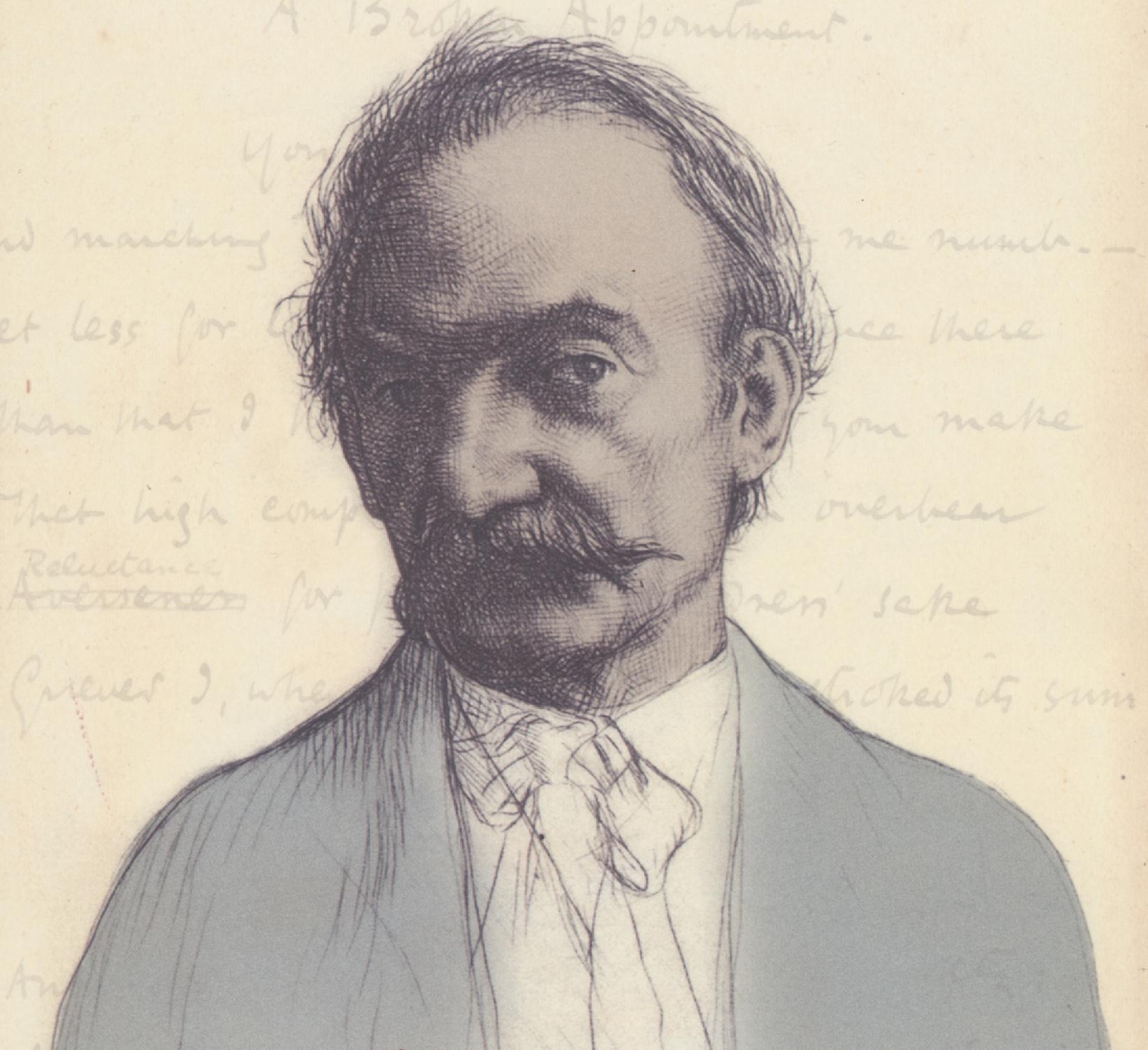
Thomas Hardy 001 (2018_05_20 15_18_26 UTC)

Thomas Hardy is one of my favourite authors. He was born in 1840 at Upper Bockhampton near Dorchester. What I love most about Hardy’s books are his lyrical descriptions of nature and the countryside and all his books show his great love and knowledge of the countryside in all its aspects. They also show his almost pagan sense of fate and the struggle between man and an omnipotent and indifferent fate. Hardy was a pessimist – man’s fate is inevitable, affected by chance and coincidence. It cannot be changed, only accepted with dignity. This is illustrated in his poem – Hap, written in 1866:

If but some vengeful god would call to me

From up the sky, and laugh: ‘œThou suffering thing,

Know that thy sorrow is my ecstasy,

That thy love’s loss is my hate’s profiting!’

Then would I bear, and clench myself, and die,      

Steeled by the sense of ire unmerited;

Half-eased, too, that a Powerfuller than I

Had willed and meted me the tears I shed.

But not so. How arrives it joy lies slain,

And why unblooms the best hope ever sown?

‘”Crass Casualty obstructs the sun and rain,

And dicing Time for gladness casts a moan’¦.

These purblind Doomsters had as readily strown

Blisses about my pilgrimage as pain

The first book by Thomas Hardy that I read was The Trumpet Major – I think it was in the second year at secondary school. I remember very little about it, except that it was set during the Napoleonic Wars and I wasn’t too impressed. Then I read The Mayor of Casterbridge for A level GCE and thought it was wonderful.
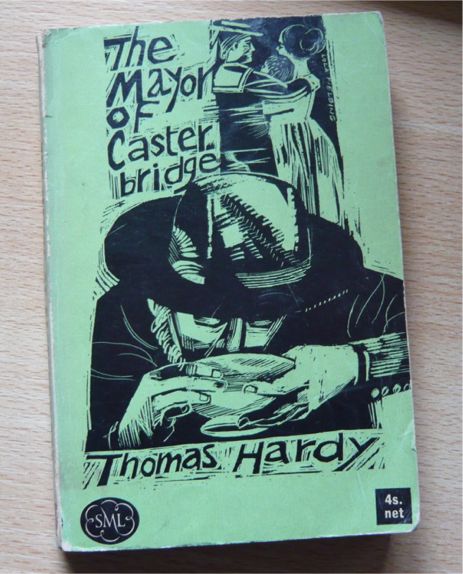
Hardy Casterbridge

I still have my copy, with passages underlined and notes at the tops of pages – all in pencil.It’s full title is The Life and Death of the Mayor of Casterbridge: A Story of a Man of Character. It tells the tragic tale of Michael Henchard, a man of violent passions, proud, impulsive with a great need for love. It opens dramatically as he sells his wife and child to a sailor at a fair. By his own hard work over the years he eventually became the rich and respected Mayor of Casterbridge. But then the re-appearance of his wife and her daughter sets off a train of events finally bringing Henchard to ruin and degradation.

Because I enjoyed The Mayor over the years I’ve read more of Hardy’s books, including Tess of the D’Urbervilles and Jude the Obscure, both dramatic tragedies. In Jude Hardy attacked the Church and the marriage state, which received a mixed reception at the time – the Bishop of Wakefield burned his copy of the book and W H Smith withdrew it from their circulating library, but the public bought 20,000 copies, whether or not due to the scandal it aroused.  These books were considered masterpieces by some and scandalous by others.

Of the two I prefer Jude to Tess and having re-read them both more recently I still feel the same, but now I’m less impatient with the way Hardy presents Tess as a helpless victim than I had been before.  She is an innocent, raped by Angel Clare, the man she loves and Hardy highlights the hypocrisy of the times in condemning the ‘fallen woman’.

In Thomas Hardy, the Time-Torn Man Claire Tomalin writes not only about his life but also how he became a writer, poet and novelist. I began reading this book a few years ago and every now and then think I really must finish it. I stopped, as usual, overtaken by the desire to read other books- including more by Hardy himself.

The Thomas Hardy Society is an excellent source of information on the man and his works.

This is an ABC Wednesday post for the letter H.
Saturday Snapshot

Earlier this year we visited Conundrum Farm:

We walked the farm trail where you can feed the animals. Our granddaughter liked the pygmy goats:

I wasn’t too keen on this somewhat larger goat that apparently often jumps over the fence and wanders around the farm:

There’s also a Battle Trail, which we didn’t do, across the battlefield of Halidon Hill, where the English recaptured Berwick-upon-Tweed from the Scots in 1333. We’re saving that for another visit.

See more Saturday Snapshots on Alyce’s blog At Home With Books.

A Book Meme

Musing Mondays from Should Be Reading is here on Tuesday this week!

This week’s musing is’¦ a book meme!
What was the last book you’¦

‘¢ borrowed from the library? 
‘¢ bought? 
‘¢ cried over?
  • I don’t often cry over books, I can’t remember the last one.
‘¢ disliked and couldn’t finish?
  • Cloud Atlas by David Mitchell – I think I’ve given up on this one after trying to read it three times. What am I missing?
‘¢ read & loved?
‘¢ got for review? (or: got in the mail?)
‘¢ gave to someone else?
  • I gave a pile of books to the book stall at my local hospital – can’t remember the titles.
‘¢ stayed up too late reading?
  • Blonde by Joyce Carol Oates – I fell asleep reading this book for many nights.