Note: I’ve found this hard to write about without giving away some spoilers.
I’d listed The Old Curiosity Shop in my Classics Club Spin, but was really hoping to get one of Thomas Hardy’s books. Without this push from the Classics Club this book would have stayed on my TBR list for a long time because all I knew about it was that it’s the book in which Little Nell suffers a melodramatic death and I feared it would be too sentimental for my liking. And much to my surprise I have finished it in time for the deadline for reading our Spin book this Friday, even though it’s such a long book.
Well, it was and it wasn’t. It’s not just a sentimental, melodramatic story. It’s also full of weird, grotesque and comic characters, a mix of everyday people and characters of fantasy. It has elements of folklore and myth, as Nell and her grandfather, go on an epic journey, fleeing from the terrifying dwarf, Daniel Quilp and travelling through a variety of scenes, meeting different groups of people on their journey. There are numerous allusions to the Bible, Shakespeare and popular songs of the day. There are long passages where Nell doesn’t feature and is hardly mentioned, so it’s by no means a totally sentimental tale.
Several of the characters stand out for me, Quilp is an obvious choice. He takes delight in inflicting pain and suffering on others. He’s scarcely human, grossly wicked, hideous in appearance, full of lust, ferocious, cunning, and malicious. A fiend who
… ate hard eggs, shell and all, devoured gigantic prawns with heads and tails on, chewed tobacco and water-cresses at the same time and with extraordinary greediness, drank boiling tea without winking, bit his fork and spoon until they bent again, and in short performed so many horrifying and uncommon acts that the women were nearly frightened out of their wits, and began to doubt if he were really a human creature. (page 47)
Other characters who stood out are Dick Swiveller and the Marchioness. Dick at first appears as a profligate friend of Nell’s brother, Fred but takes on a larger role later in the book. Working in a law office for Mr Brass and his sister, Sally Brass, he befriends the small, half-starved girl who is a servant locked in the basement, calling her the Marchioness. He rescues her and also Kit, Nell’s friend, when he is wrongly accused of robbery.
There are many more I could mention, including the people Nell and her grandfather meet on their travels – wonderful scenes of the travelling Punch and Judy show; Mrs Jarley’s wax-work figures, over a hundred of them that she takes around the countryside in a caravan; the gypsies who take advantage of Nell’s grandfather’s addiction to gambling; the poor schoolteacher who take in Nell and her grandfather; and the Bachelor who they meet at the end of their journey.
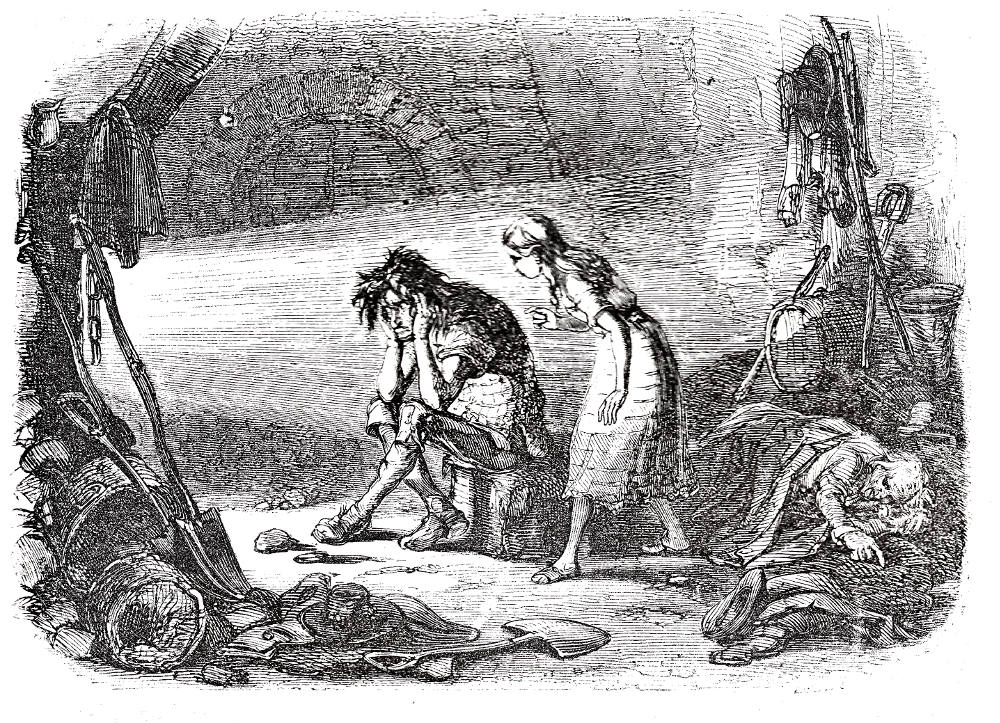
I also liked the description of the landscape as Nell leaves London, the change from town to countryside, then later through the industrial Midlands with its factories, furnaces and roaring steam-engines where people worked in terrible conditions. Nell and her grandfather spend a night in one of the furnaces, sleeping on a heap of ashes.
In a large and lofty building, supported by pillars of iron, with great black apertures in the upper walls, open to the external air; echoing to the roof with the beating of hammers and roar of furnaces, mingled with the hissing of red-hot metal plunged in water, and a hundred strange unearthly noises never heard elsewhere; in this gloomy place, moving like demons among the flame and smoke, dimly and fitfully seen, flushed and tormented by the burning fires, and wielding great weapons, a faulty blow from any one of which must have crushed some workman’s skull, a number of men laboured like giants. (pages 334-5)
Nell, herself, is a sweet, self-effacing and innocent character, who is left to look after her grandfather as he fails to overcome his gambling addiction. She goes into a decline and her slow death is, I suppose inevitable, although thankfully it is not described by Dickens. Child death is one of the themes of The Old Curiosity Shop as Nell’s death is not the only one.
The Old Curiosity Shop was written in 1840 – 1841 and serialised weekly in Master Humphrey’s Clock beginning on 4 April 1840 and ending on 6 February 1841. During this period the circulation of the periodical rose to a staggering figure of 100,000. It was Dickens’ fourth novel, influenced by the early death of his sister-in-law, Mary Hogarth, in 1837, which had profoundly shocked him. His work on The Old Curiosity Shop, particularly as he came to writing the end, revived the anguish he had experienced on her death.
The Old Curiosity Shop
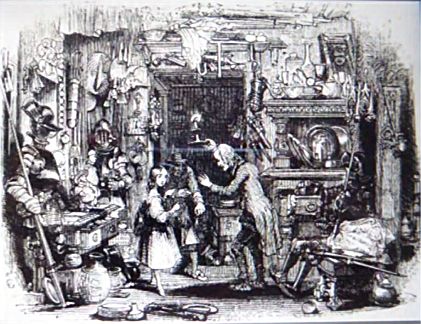
I read the Penguin Classics e-book which has the original illustrations by George Cattermole, Hablot K Browne (‘Phiz’), Daniel Maclise and Samuel Williams.
The furnace
Despite the sentimentality I did enjoy reading The Old Curiosity Shop andit has made me keen to read more of Dickens’ books.
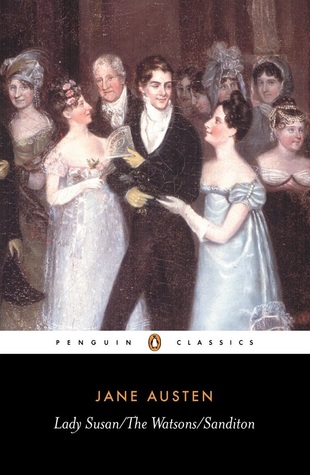
Jane Austen has long been one of my favourite authors, ever since I read my mother’s copy of Pride and Prejudice and since then I have re-read it several times and her other full length novels too. But I’ve never read Lady Susan, The Watsonsand Sanditon before. In fact it was only reading Carol Shields’ biography of Jane Austen quite some years ago now that I discovered that she had written these books, none of which were published in her lifetime. Lady Susan is a finished novella, whereas The Watsons and Sanditon are two unfinished fragments. Lady Susan and The Watsons were first published in 1871 by her nephew, James Edward Austen-Leigh in his Memoir of Jane Austen, including an account of Sanditon . The full text of Sanditon wasn’t published until 1925.
Lady Susan
According to Margaret Drabble’s introduction to my Penguin Classics edition there is some evidence that Lady Susan was probably written between 1793-4, when Jane Austen was about 20 years old. Drabble thinks this is the least satisfactory of the three stories, but I can’t agree with her view. I was completely taken with it.
Told in a series of letters, Lady Susan is the story of an unscrupulous widow who plans to force her daughter into a marriage against her wishes. Lady Susan is an attractive and entertaining and totally wicked character, who nevertheless almost manages to fool people for some of the time at least. She is also trying to captivate her sister-in-law’s brother, whilst still holding on to the affections of a previous lover.
As I was reading Lady Susan it reminded of Laclos’s Les Liaisons Dangereuses, not just because both are epistolary but also the content – manipulative and evil characters without any moral scruples, who delight in their power to seduce others. I wondered if it was possible that Jane Austen had known of this book. It was published in 1782, so it is possible that she knew of it, even if she had not actually read it.
To my mind Lady Susan is unique in Jane Austen’s works and I was delighted to read it. It’s written with style, confidence and humour convincingly illustrating 18th century morals and manners.
The Watsons
Jane Austen began writing this in 1804, her father died in 1805 and she never finished it. Its main character is Emma Watson who after fourteen years of absence returns to her father’s house after being brought up by a wealthy aunt. She had grown up in an affluent household and until her aunt had remarried she’d had expectations of an inheritance. She joins her three unmarried sisters, living with their invalid father and looking for husbands whilst struggling for money. Mr Watson is a clergyman, so on his death they will lose their home. Maybe it was the parallel with Jane and Cassandra Austen’s own situation that caused Jane to abandon the novel when her own father died.
In some ways it is a little like Pride and Prejudice with its account of a ball and Emma Watson has a spirited nature similar to Elizabeth Bennet’s. Women without money were often obliged to marry for money, but Emma doesn’t want to. Her sister Elizabeth points out that it is ‘very bad to grow old and be poor and laughed at‘, whereas Emma thinks she would ‘rather be a teacher at a school (and I can think of nothing worse) than marry a man I did not like.’
I liked The Watsons but with just this fragment to go off it is a bit basic and does seem rather similar to Pride and Prejudice. I wished she had finished it.
Sanditon
I thoroughly enjoyed Sanditon, even in its unfinished state. It’s the last fiction that Jane Austen wrote, beginning it in January 1817, the year she died. She was ill and the subject of health is one of its themes, but not in a serious or gloomy way. It has a lively, bright and humorous tone, with three of the characters being hypochondriacs, wonderfully satirised by Jane Austen.
The other theme is change in the form of the development of a seaside resort at Sanditon. It conveys the spirit of change of the times as Sanditon is developed by two of the landowners, Mr Parker and Lady Denham from ‘a quiet village of no pretensions‘ into ‘a fashionable bathing place‘. The two of them, realising its potential of becoming profitable ‘had engaged in it, and planned and built, and praised and puffed, and raised it to a something of young renown – and Mr Parker could think of nothing else.‘
It extols the benefits of sea air and sea bathing, Lady Denham decries the need for a doctor saying it would only encourage the servants and the poor to imagine they were ill – and pronouncing that if her husband had never seen a doctor he would still have been alive, ‘Ten fees, one after the other, did the man take who sent him out of the world. – I beseech you Mr Parker, no doctors here.‘
Sanditon contrasts the old world with the new upcoming world. Mr Parker has moved from his old comfortable family house set in a sheltered dip two miles from the sea to a new elegant house, which he has named Trafalgar House, not far from a cliff from which there is a descent to the sea and the bathing machines. Granted it has all the ‘grandeur of storms’, which rocked their bed whilst the wind rages around the house.
…
There is so much more in these stories than I can write about here (this post is far too long anyway). I shall enjoy re-reading them in the future. They are so different from each other, probably reflecting the different periods of her life when they were written. And I can’t decide between Lady Susan and Sanditon which one I like best.
The Classics Club has been so quiet for a while now that I was beginning to think it had folded – but no!
It’s time for another Classics Spin for any who are interested. By next Monday, August 24, list your choice of any twenty books you’ve left to read from your Classics Club list ‘” in a separate post. Next Monday morning, The Classics Club will announce a number and that is the book for you to read by October 23.
This is my list:
Moll Flanders by Daniel Defoe
Nicholas Nickleby by Charles Dickens
Little Dorrit by Charles Dickens
Martin Chuzzlewit by Charles Dickens
The Old Curiosity Shop by Charles Dickens
Oliver Twist by Charles Dickens
The Mill on the Floss by George Eliot
Romola by George Eliot
Parade’s End by Ford Maddox Ford
Mary Barton by Elizabeth Gaskell
North and South by Elizabeth Gaskell
Wives and Daughters by Elizabeth Gaskell
Far from the Madding Crowd by Thomas Hardy
The Return of the Native by Thomas Hardy
Love in the Time of Cholera by Gabriel Garcia Marquez
One Hundred Years of Solitude by Gabriel Garcia Marquez
Doctor Thorne (Barsetshire Chronicles, #3) by Anthony Trollope
The Color Purple by Alice Walker
The Age of Innocence by Edith Wharton
The Voyage Out by Virginia Woolf
I don’t mind which one of these comes up in the Spin, but I’m half hoping it will be one of the Hardy books and I’m not sure about reading The Voyage Out as I’ve started this in the past and put it back on the shelf unfinished.
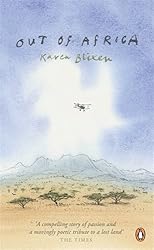
Well, it’s not one of the Dickens’ books I listed but it’s still a book I’ve been looking forward to reading, ever since I saw the film starring Meryl Streep and Robert Redford. It’s Karen Blixen’s memoir of life in Kenya on a coffee plantation in the early years of the 20th century.
List any twenty books you have left to read from your Classics Club list.
Number them from 1 to 20.
Next Monday the Classics Club will announce a number.
This is the book you need to read by 15th May.
I decided to list all the books by Charles Dickens, George Eliot, Elizabeth Gaskell and Gabriel Garcia Marquez that are on my list and then added Moby Dick because it will fit in well with a book I’m planning to read soon, In the Heart of the Sea by Nathaniel Philbrick, which was inspired by Moby Dick. I added the other books randomly.
Lorna Doone: A Romance of Exmoor by R D Blackmore
Out of Africa by Karen Blixen
No Name by Wilkie Collins
Nicholas Nickleby by Charles Dickens
Little Dorrit by Charles Dickens
Martin Chuzzlewit by Charles Dickens
The Old Curiosity Shop by Charles Dickens
Oliver Twist by Charles Dickens
Adam Bede by George Eliot
The Mill on the Floss by George Eliot
Romola by George Eliot
Silas Marner by George Eliot
Parade’s End by Ford Maddox Ford
Mary Barton by Elizabeth Gaskell
North and South by Elizabeth Gaskell
Wives and Daughters by Elizabeth Gaskell
Three Men in a Boat by Jerome K Jerome
Love in the Time of Cholera by Gabriel Garcia Marquez
One Hundred Years of Solitude by Gabriel Garcia Marquez
Moby Dick by Herman Melville
I quite fancy reading Dickens soon, so hope one of his is the spin book.
 It’s time for another Classics Spin.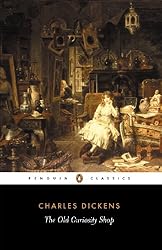
 BooksPlease