My Friday Post: A Foreign Field by Ben Macintyre

Book Beginnings Button

Every Friday Book Beginnings on Friday is hosted by Gillion at Rose City Reader where you can share the first sentence (or so) of the book you are reading, along with your initial thoughts about the sentence, impressions of the book, or anything else the opener inspires.

This week I’m featuring one of my TBRs, A Foreign Field by Ben Macintyre. It’s non-fiction about four young British soldiers who were trapped behind enemy lines at the height of the fighting on the Western Front in August 1914. 
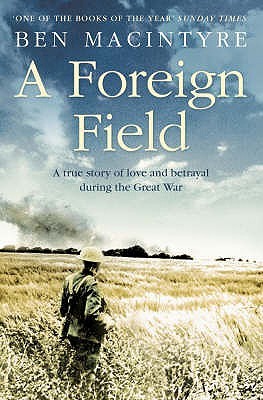
A Foreign Field

It begins with a Prologue:

Prologue

The glutinous mud of Picardy caked at my shoe-soles like mortar, and damp seeped into my socks as the rain spilled from an ashen sky. Ina patch of cow-trodden pasture beside the little town of Le Catelet we stared out from beneath a canopy of umbrellas at a pitted chalk rampart, the ivy-strangled remnant of a vast medieval castle, to which a small plaque had been nailed: ‘Ici ont été fusillés quatre soldats Britannique.’ Four British soldiers were executed by firing squad on this spot.

Followed by Chapter One – The Angels of Mons:

On a balmy evening at the end of August in the year 1914, four young soldiers of the British army – two English and two Irish  – crouched in terror under a hedgerow near the Somme river in northern France, painfully adjusting to the realisation that they were profoundly lost, adrift in a briefly tranquil no-man’s land somewhere between their retreating comrades and the rapidly advancing German army, the largest concentration of armed men the world had ever seen.

Also every Friday there is The Friday 56, hosted by Freda at Freda’s Voice.
30879-friday2b56These are the rules:

  1. Grab a book, any book.
  2. Turn to page 56, or 56% on your eReader. If you have to improvise, that is okay.
  3. Find any sentence (or a few, just don’t spoil it) that grabs you.
  4. Post it.
  5. Add the URL to your post in the link on Freda’s most recent Friday 56 post.

Page 56:

Local gossips thought that Jeanne was a’racy’ type; she smoked cigarettes, drove an automobile without gloves on, and treated everybody with exactly the same direct, penetrating and faintly lofty manner, usually from the saddle.

~~~

I enjoyed reading Ben Macintyre’s Operation Mincemeat about the Allies’ deception plan code-named Operation Mincemeat in 1943, which underpinned the invasion of Sicily, so I’m hoping I’ll like this one too.

What do you think? Would you keep reading?

Wakenhyrst by Michelle Paver

A tale of mystery and imagination laced with terror. 

Wakenhyrst

Head of Zeus|4 April 2019|e-book 5683 KB|Review copy|4*

Wakenhyrst by Michelle Paver is a dark and sinister tale, full of menace and suspense. It’s a slow-burner, told through different points of view, that builds to a climax with a sad twist in the story right at the end – one I hadn’t seen coming. It’s set in a remote hamlet in the Suffolk Fens, an eerie waterlogged landscape where Edmund Stearn, a historian, and his family live in a large manor house, Wake’s End, on the edge of the Fens, said to be the oldest and most rotten of fens. It was a place of dread, haunted by spirits and the home of eels and other foul creatures.

The novel begins with a magazine report in 1966 on the events that took place at Wake’s End in 1913 when sixteen-year old Maud Stearne watched her father, Edmund, leave the house, armed with an ice-pick and a geological hammer and murder the first person he came across in the orchard. Maud was the only witness. She is now a recluse and in 1913 she had only spoken briefly at his trial. But now she needs money to repair the ancient manor house that is her home and has invited the journalist to Wake’s End. He believes Edmund was innocent and hopes to discover the truth – was Edmund mad and what did he write in his notebook that Maud has never confirmed even existed? Maud’s evidence was full of holes – did she commit the murder and frame her father, who took the blame?

 Edmund never explained why he did it, or how he ended up in the well, screaming with terror as he fought off a mass of eels. He spent the rest of his life in an asylum, where he created three paintings that astonished the world – grotesque paintings full of colour and tiny malevolent faces leering out of the canvas, the stuff of nightmares. 

What follows is a story of disintegrating madness, revealed in Edmund Stearne’s notebook as the reporter persuades Maud to tell her story, going back to her childhood, when her mother was still alive. Her mother got the same illness every year, or so Maud believed – an illness where her middle swelled, resulting in a period of ‘groaning’, as her middle would burst and ending with either ‘a bloody chamberpot’, or a dead baby. When she died Maud blamed her father and believed he was insane when he became obsessed with the medieval painting  of the Last Judgement, known as the Doom, that he found in the churchyard. He connects the Doom with the writings of Alice Pyett, a medieval mystic whose book he was transcribing.

There is a sense of impending disaster as the tale unfolds. Whilst the fens are a source of dread and fear for Edmund, they are a place of solace and beauty for Maud. The book is full of the folklore and customs of the local people and their belief in the spirits that haunt the fen – ferishes, Jack-o’-Lanterns and Black Shuck – Michelle Paver notes in her Author’s Note that she has not invented these. Maud’s childhood, her fear of her father and his violence towards her and her mother, are scenes that are based on the misogynist attitudes of the period.

Maud’s life was run by her father’s rules. She had no friends or companions apart from the servants, whose lives were ruled by superstitions, until she met Jubal Rede, the wild man who lived in the fen. He was kind to her and taught her the ways of the fen. But there is also Chatterpie, the magpie she rescued from the well and grew to love, and then Clem, the young under-gardener who she also grew to love.

It’s a compelling story, steeped in atmosphere, with characters typical of an earlier age whose lives were oppressed and isolated from the wider world. I loved the setting, the mysterious fenland, the horrific gothic and dark nature of the story, the mystery of the murder and most of all I loved Maud and her independent spirit that brought her through the nightmare.

My thanks to the publishers, Head of Zeus for my review copy via NetGalley.

Top Ten Tuesday: Books On My Spring 2019 TBR

top-ten-tuesday-new

Top Ten Tuesday is a weekly meme created by The Broke and the Bookish and now hosted by Jana at That Artsy Reader Girl. For the rules see her blog.

This week’s topic is Books On My Spring 2019 TBR. Some of these books have been on my shelves unread for a long time, some are new additions and others are e-books from NetGalley that will be published soon. I’d like to think I’ll read all these books soon but realistically I know that I’ll only read a few of them this Spring!

Broken Ground by Val McDermid – DCI Karen Pirie investigates the discovery of a body in the remote depths of the Scottish Highlands.

In Cold Blood by Truman Capote – Capote reconstructs the crime and the investigation into the murders of the four members of the Clutter family on November 15, 1959, in the small town of Holcomb, Kansas.

How Green Was My Valley by Richard Llewellyn – a story of life in a mining community in rural South Wales as Huw Morgan is preparing to leave the valley where he had grown up. He tells of life before the First World War.

On the Beach by Neville Shute – set in Melbourne, Australia this is a novel about the survivors of an atomic war as radiation poisoning moves toward Australia from the North.

Iris and Ruby by Rosie Thomas – the story of a teenage girl, Ruby, who runs away from home to live with her grandmother, Iris in Cairo.

Here Be Dragons by Sharon Penman – set in 13th century Wales this is the story of Llewelyn, the Prince of North Wales, and his rise to power and fame and his love for Joanna, the illegitimate daughter of King John. 

A Beautiful Corpse by Christi Daugherty – crime reporter Harper McClain unravels a tangled story of obsession and jealousy after a beautiful law student is shot in Savannah, Georgia.

A Snapshot of Murder by Frances Brody – set in Yorkshire in 1928, when  amateur detective, Kate Shackleton investigates a crime in Brontë country.

Gone Girl by Gillian Flynn – on the day of Nick and Amy’s fifth wedding anniversary, Amy suddenly disappears. The police suspect Nick. Amy’s friends reveal that she was afraid of him, that she kept secrets from him. He swears it isn’t true.

The Island by Ragnor Jonasson – Nordic noir, set on the island of Elliðaey,  off the Icelandic coast. Four friends visit the island during a long, hot summer but only three return. Detective Inspector Hulda Hermannsdóttir is sent to investigate.

First Chapter First Paragraph: Dear Mrs Bird by A J Pearce

Every Tuesday First Chapter, First Paragraph/Intros is hosted by Vicky of I’d Rather Be at the Beach sharing the first paragraph or two of a book she’s reading or plans to read soon.

This week I’m featuring Dear Mrs Bird by A J Pearce, one of the books I’ll be reading soon.

Dear Mrs Bird


London, December 1940

Chapter One

An Advertisement in the Newspaper

When I first saw the advertisement in the newspaper I thought I might actually burst. I’d had rather a cheerful day so far despite the Luftwaffe annoying everyone by making us all late for work, and then I’d managed to get hold of an onion, which was very good news for a stew. But when I saw the announcement, I was cock-a-hoop.

Blurb (Amazon)

London, 1941. Amid the falling bombs Emmeline Lake dreams of becoming a fearless Lady War Correspondent. Unfortunately, Emmy instead finds herself employed as a typist for the formidable Henrietta Bird, the renowned agony aunt at Woman’s Friend magazine. Mrs Bird refuses to read, let alone answer, letters containing any form of Unpleasantness, and definitely not those from the lovelorn, grief-stricken or morally conflicted.

But the thought of these desperate women waiting for an answer at this most desperate of times becomes impossible for Emmy to ignore. She decides she simply must help and secretly starts to write back – after all, what harm could that possibly do?

~~~

Seeing all the 5 and 4 stars this book has gathered I’m hoping I’ll enjoy it too.

What do you think? Would you keep reading?

The Wych Elm by Tana French

The Wych Elm Penguin UK Viking|21 February 2019 |517 pages|e-book |Review copy|4*
First Chapter First Paragraph: An Advancement of Learning by Reginald Hill

Every Tuesday First Chapter, First Paragraph/Intros is hosted by Vicky of I’d Rather Be at the Beach sharing the first paragraph or two of a book she’s reading or plans to read soon.

This week I’m featuring An Advancement of Learning by Reginald Hill, one of the books I’m currently reading.

An Advancement of Learning (Dalziel & Pascoe, Book 2)

There had been a great deal of snow that December followed by hard frost. A few days before Christmas a thaw set in, temperatures rose steeply, the snow became slush. The sun greedily sucked up the moisture until it saturated the air and impinged on all the senses.

Blurb (Amazon)

All is not well at Holm Coultram College: lecturers having affairs with students, witches’ sabbaths, a body buried under a statue.

Detective Superintendent Dalziel, despite his cynical view of academics, doesn’t feel murder fits in here – let alone a rash of killings. But when he and DS Pascoe are sent to investigate a disinterred corpse at Holm Coultram College, that’s exactly what they find…

~~~

 This is the second Dalziel and Pascoe book. I’ve read some of the later books in the series and am now going back to the early ones that I haven’t yet read.  I first came across Dalziel and Pascoe via the TV adaptations and I think I remember watching the TV version of this one several years ago. Maybe it’s because I saw the TV versions before I read the books that I enjoy both so much – Warren Clark as Dalziel was so right in the role.

What do you think? Would you keep reading?