I’ve been lucky with some of the 99p e-books on offer on Amazon recently and bought three books, well five actually as one is a trilogy.
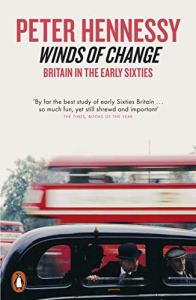
First a nonfiction book, Winds of Change: Britain in the Early Sixtiesby historian, Peter Hennessy. The centre of the book is 1963 – the year of the Profumo Crisis, the Great Train Robbery, the satire boom, de Gaulle’s veto of Britain’s first application to join the EEC, the fall of Macmillan and the unexpected succession to the premiership of Alec Douglas-Home. Then, in 1964, the battle of what Hennessy calls the tweedy aristocrat and the tweedy meritocrat – Harold Wilson, who would end 13 years of Conservative rule and usher in a new era. It’s the final book in Hennessy’s Post War trilogy.
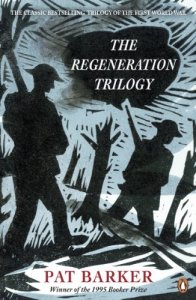
Then three novels – all historical fiction: The Regeneration Trilogy: Regeneration; The Eye in the Door; The Ghost Roadby Pat Barker, three novels set during the First World War. I already had the third book, but hadn’t read it because I wanted to read the trilogy in order. It tells the story of three men, shell-shocked soldiers, who were sent back to the front. It’s based on the experiences of poets, Siegfried Sassoon and Wifred Owen who met at Craiglockhart Hospital near Edinburgh.
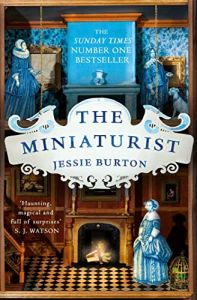
The MiniaturistbyJessie Burton – A few years ago I borrowed this book from the library but had to return it unread. Later on I watched the TV series and thought I’d like to read the book. So, when it was on offer for 99p I bought it. It’s set in Amsterdam in 1686. Nella Oortman marries a rich merchant, but life in her new home is unfulfilled. Even her cabinet house brings a mystery to the secretive world she has entered as the lifelike miniatures somehow start eerily foreshadowing her fate.
This last book is my choice this month from Amazon First Reads free books:
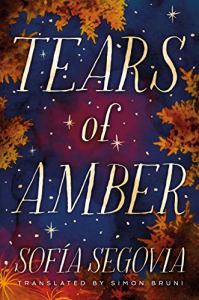
Tears of Amberby Sofía Segovia – a novel set during the Second World War in East Prussia between 1938 and 1947. In her author’s note Sofia Segovia says her novel was inspired by the story of Ilse and Arno Schipper, who established a factory in Monterrey, Mexico, her home town. It is a mix of fact and fiction. Publication date 1 May 2021. I have started reading and it’s looking good so far.
Every Friday Book Beginnings on Friday is hosted by Gillion at Rose City Readerwhere you can share the first sentence (or so) of the book you are reading. You can also share from a book you want to highlight just because it caught your fancy.
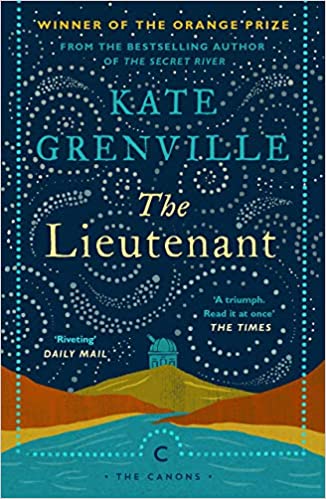
I’m currently reading A Room Made of Leaves by Elizabeth Grenville, her latest book, and have nearly finished it. I love her books and as I’ve nearly finished it I was wondering which book to read next and remembered I have one of her earlier books, The Lieutenant still waiting to be read. To my surprise when I opened it this morning I found that it is another book about one of the characters in A Room Made of Leaves. That character is William Dawes, a real person, a soldier in the first days of the Colony of New South Wales.
The Lieutenant is about Daniel Rooke, based on real events in William Dawes’ life, using his notebooks in which he recorded his conversations with a young girl, Patyegarang, (also in A Room Made of Leaves), in his efforts to learn the language of the indigenous people of Sydney. It is a novel that stays close to the historical events.
It begins:
Daniel Rooke was quiet, moody, a man of few words. He had no memories other than of being an outsider.
Also every Friday there is The Friday 56, hosted by Freda at Freda’s Voice. *Grab a book, any book. *Turn to Page 56 or 56% on your ereader . If you have to improvise, that is okay. *Find a snippet, short and sweet, but no spoilers!
Grab a book, any book.
Turn to page 56, or 56% on your eReader. If you have to improvise, that is okay.
Find any sentence (or a few, just don’t spoil it) that grabs you.
Post it.
Add the URL to your post in the link on Freda’s most recent Friday 56 post.
Page 56:
It seemed that the natives did not like the surgeon’s music any more than they had enjoyed his performance with the pistol. Their faces were stony. After a minute they took the two pieces of shield and disappeared into the woods.
Book description:
1788 Daniel Rooke sets out on a journey that will change the course of his life. As a lieutenant in the First Fleet, he lands on the wild and unknown shores of New South Wales. There he sets up an observatory to chart the stars. But this country will prove far more revelatory than the skies above.
Based on real events, The Lieutenant tells the unforgettable story of Rooke’s connection to an Aboriginal child – a remarkable friendship that resonates across the oceans and the centuries.
Transworld Publishers| 18 February 2021 |272 pages | Kindle review copy via NetGalley/ 2*
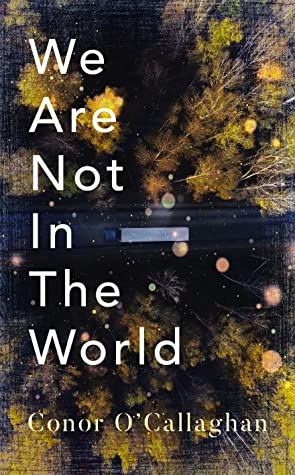
Heartbroken after a long, painful love affair, a man drives a haulage lorry from England to France. Travelling with him is a secret passenger – his daughter. Twenty-something, unkempt, off the rails.
With a week on the road together, father and daughter must restore themselves and each other, and repair a relationship that is at once fiercely loving and deeply scarred.
As they journey south, down the motorways, through the service stations, a devastating picture reveals itself: a story of grief, of shame, and of love in all its complex, dark and glorious manifestations.
My thoughts:
A strange, confusing and depressing book that I read as though I was in fog, never really getting to grips with the plot. It meanders and drifts through the characters, shifting between the past, the near past and the present, and from place to place, as Paddy drives the lorry from England down to the south of France. I was often not sure what was happening, when or where it was happening and to whom it was happening. It’s a stream of consciousness, as the various characters move in and out of focus.
There were times when I wondered why I was reading this, it was like a dream where the scenes move randomly through a number of sequences, and you wake up with that fearful feeling that something dreadful has been going on inside your head that was disturbing, and unsettling. There’s a sense of timelessness and of detachment from the day to day reality – they are not in the world. And yet I was compelled to read on, if only just to get to the end and see if my suspicions about what had actually happened were right. They were, although there is a little twist at the very end that I hadn’t expected.
The fairy tale of Oisin, a tale Paddy tells his daughter, interests me. Oisin was a warrior who fell in love with a fairy named Niamh. He takes her home to Tir na nOg, where they will stay forever young, but he can never return home. After three years he is homesick and returns on a magic horse, on the condition that he has to stay on the horse on pain of death. But three hundred years have actually gone by, not three, and everyone he knew is dead. He meets an old man who knew his father and moving to help him he slips off the horse, touches the ground and dies in an instant. He repeats this story several times to his daughter as they travel through France. It links with Tir na nOg, the name of his family home, now neglected and empty after his mother’s death three years earlier.
This is not an easy read, as you have to concentrate on all the different strands. Paddy’s life is a complete mess, he has lost everything: his family, his home and his sense of belonging. He looks back at the broken relationships with his parents, his brother, ex-wife, daughter, and ex-lover. It’s told in fragments and you have to read between the lines to understand it. I didn’t enjoy the book, and found it difficult to follow. It is too vague, and as soon as I thought I’d begun to understand it, it drifted away into obscurity. and I was left floundering.
My thanks to the publishers and to NetGalley for my advance review copy.
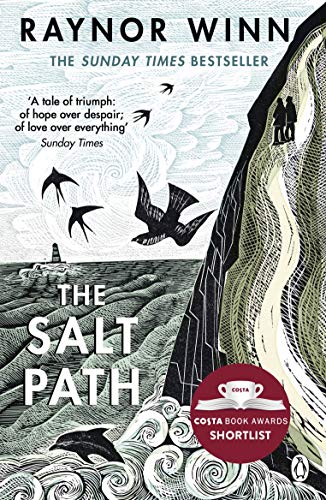
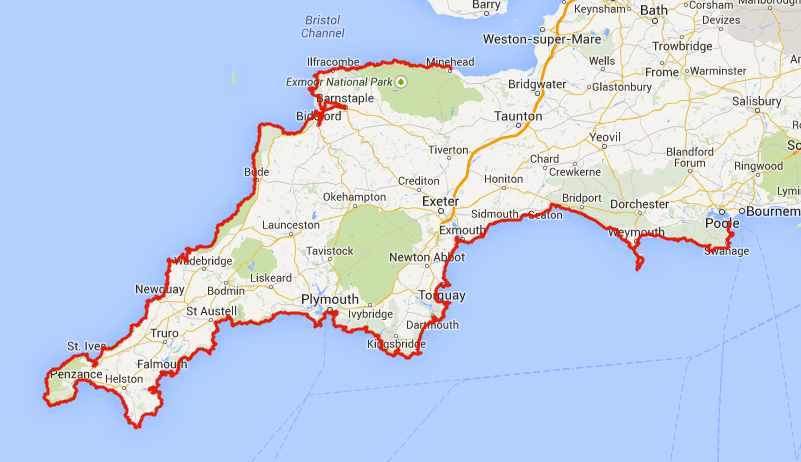
Just days after Raynor learns that Moth, her husband of 32 years, is terminally ill, their home is taken away and they lose their livelihood. With nothing left and little time, they make the brave and impulsive decision to walk the 630 miles of the sea-swept South West Coast Path, from Somerset to Dorset, via Devon and Cornwall.
Carrying only the essentials for survival on their backs, they live wild in the ancient, weathered landscape of cliffs, sea and sky. Yet through every step, every encounter and every test along the way, their walk becomes a remarkable journey.
The Salt Path is an honest and life-affirming true story of coming to terms with grief and the healing power of the natural world. Ultimately, it is a portrayal of home, and how it can be lost, rebuilt and rediscovered in the most unexpected ways.
I first wrote a short post about The Salt Path in this post. I bought the book in 2018 and was keen to read it, but so many other books intervened, and it was only when I saw Raynor Winn on Kate Humble’s Coastal Walks programme on the South West Coastal Path that I remembered about her book.
Raynor and Moth Winn, a couple in their 50s, were homeless, with no means of income except for £48 pounds a week. They had lost their home, business and livelihood, after investing in one of a friend’s companies that had failed. They found out that they were liable to make payments towards the debts of the company, were taken to court and ended up losing not only their savings but also their farm and home.
Despite finding out that Moth has a rare terminal illness, they decided to walk the South Coast Path. He had been diagnosed with corticobasal degeneration (CBD), a brain disease for which there is no cure or treatment apart from pain killers and physiotherapy. The consultant told him that he shouldn’t tire himself, or walk too far and to take care on the stairs. Their decision to walk the Path and camp wild seemed to me both brave and foolhardy and I read this book with absolute amazement that they could take themselves away from medical care and set off, almost totally unprepared and not fit enough to walk 630 miles along a coast path.
At first it was really difficult as Moth struggled with pain and exhaustion, and it horrified me that he could carry on in that condition. They had reached the Valley of Rocks in north Devon, when he sat down on the rocks. He felt he was eighty and was so tired that he hurt everywhere:
Can’t tell if I’m half asleep, or wide awake. It’s like my head’s in fog and I’m walking through treacle. This is the most bollockingly stupid thing we’ve ever done. I want to lie down.(page 58)
He had been taking Pregabalin to ease the nerve pain and had been told not to just stop taking them because of the immense list of withdrawal symptoms. But that is what he had done – they had left his supplies behind them, ready to put in the rucksack, but had forgotten them. Fortunately after a while the pain lessened, he felt much better and his head was clearer. The walking had helped!
They had little to live on, their diet involved lots of rice and noodles, supplemented with wine gums and foraging for blackberries, mushrooms and dandelions. They took it at their own pace, following Paddy Dillon’s Walking Guide of the trail from Minehead on the Somerset coast right round Devon and Cornwall to Poole in Dorset, stopping to pick up their money and buy supplies along the route. But as winter was on the way when they reached Lantic Bay and Pencarrow Head they decided to take up a friend’s offer to stay with her for the winter free of rent if they could help with her building and on her farm.
However, once they stopped walking, Moth’s stiffness and his neurological pain increased and he struggled to move. He seemed to be deteriorating so quickly without the Pregabalin. But they were determined to finish the walk and completed it the next year. Once more, as they walked Moth’s condition improved. He didn’t understand how, thinking it may have ‘something to do with heavy endurance exercise‘, causing some sort of reaction that that they didn’t understand. He didn’t know how it worked but he just felt great.
Living with a death sentence, having no idea when it will be enacted, is to straddle a void. Every word or gesture, every breath of wind or drop of rain matters to a painful degree. For now we had moved outside of that. Moth was on death row, but he’d been granted the right to appeal. He knew CBD hadn’t miraculously disappeared, but somehow, for a while, it was held at bay.(page 243)
The Salt Path is not a book about walking the South Coast Path because you love walking, nor because you want the challenge of walking 630 miles, nor because you love wild camping. And it is not just about about the beauty of the surroundings and the experience of being close to nature (although that is there in Ray Winn’s beautiful descriptive writing). It is about the determination to live life, about overcoming pain and hardship, and the healing power of nature. It is about homelessness and the different reactions and attitudes of the people they met when they told them they were homeless. Some were hostile, some recoiled in horror and moved away as though they were social pariahs. Others were sympathetic and generous.
In this post I have concentrated on Moth’s health, because that is what struck me most as I was reading the book. But there is so much more in it than that. It’s one of the most remarkable books that I have read. I admired their determination and persistence in the face of all the difficulties and obstacles they met, but it is definitely not something I could ever undertake. It both fascinated and appalled me.
After I read The Salt Path I wondered how Ray and Moth are now and came across this article in The Herald, dated 20 September 2020, in which Raynor Winn looks back over these life-changing and challenging events. At lot has happened since then and the story of that is in her second book, The Wild Silence. You can follow Raynor on Twitter @raynor_winn.
Publisher : Michael Joseph; 1st edition (3 Sept. 2020)
Top Ten Tuesday is a weekly meme created by The Broke and the Bookish and now hosted by Jana at That Artsy Reader Girl. For the rules see her blog.
The theme this week is: Books On My Spring 2021 TBR. Some of these books are physical books, others are e-books. They are just the tip of my TBR mountain and when the time comes to start a new book it might be one of these – or anyone of my other TBRs, but I hope I do get round to reading at least some of these books this spring.
First the physical books:
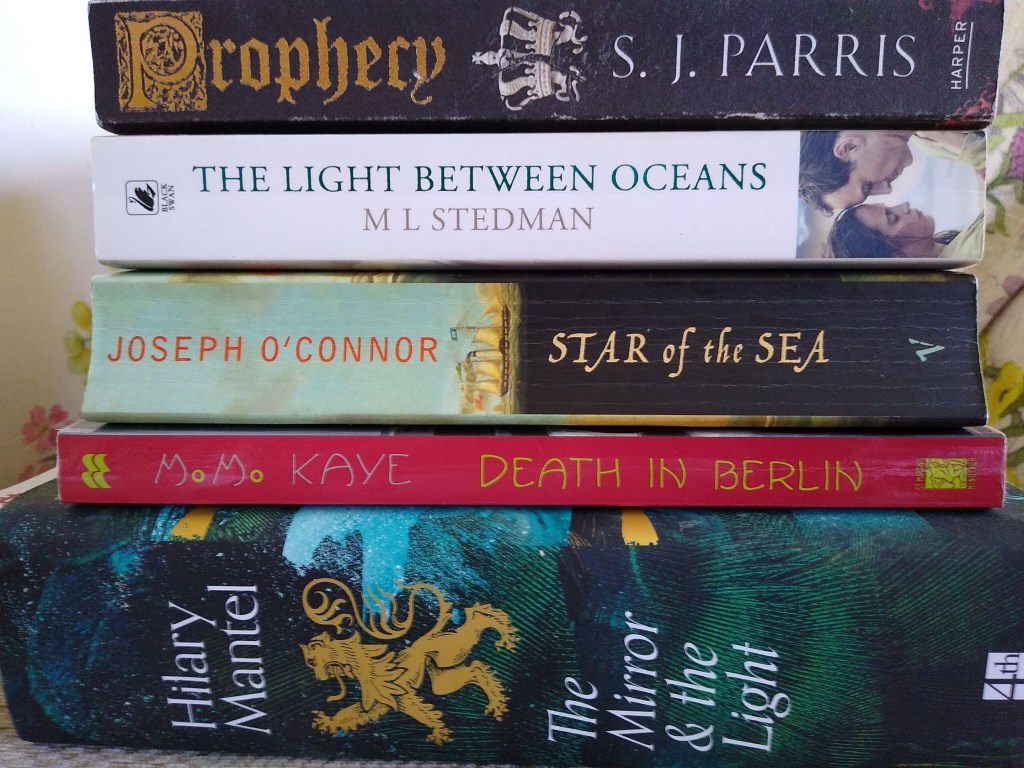
The Prophecy by S J Parris (library book) – historical fiction, 1583 – the second in her Giordano Bruno series set in the reign of Elizabeth I. Bruno was a monk, poet, scientist, and magician on the run from the Roman Inquisition on charges of heresy for his belief that the Earth orbits the sun and that the universe is infinite. Elizabeth’s throne is in peril, threatened by Mary Stuart’s supporters scheme to usurp the rightful monarch.
The Light Between Oceans by M L Stedman, set on a lighthouse keeper’s island, where the Indian Ocean washes into the Great Southern Ocean. A boat washes up on the shore of the island. It holds a dead man – and a crying baby. The only two islanders, Tom and his wife Izzy, are about to make a devastating decision.
Star of the Sea by Joseph O’Connor – historical fiction set in 1847 when the Star of the Sea sets sail from Ireland bound for New York. On board are hundreds of fleeing refugees, among them are a maid with a devastating secret, the bankrupt Lord Merridith and his family, and a murderer hungry for vengeance. It has the look of a Victorian novel but was first published in 2004.
Death in Berlin by M M Kaye – crime fiction set in war-scarred Berlin in the early 1950s. Miranda is on the night train when she discovers a dead body. Years ago I read The Far Pavilions and it is only in recent years that I discovered she wrote the Death in … series. This is the 2nd book in the series first published in 1955.
The Mirror and the Light by Hilary Mantel – the final book in her Wolf Hall trilogy. I bought this when it was published last year and started it just before the first lockdown. But for a variety of reasons I put it to one side for ‘awhile‘, where it has stayed! So I’m determined to read it this year. I loved the first two books – this one traces the final years of Thomas Cromwell, the boy from nowhere who climbed to the heights of power under Henry VIII, before he fell.
Next the e-books:
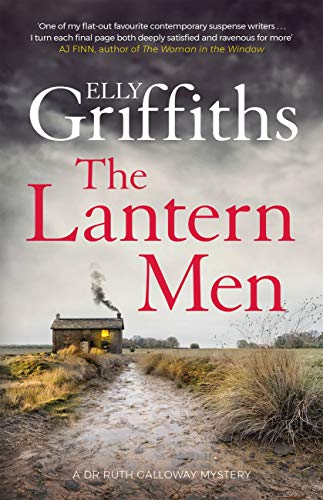
The Lantern Men by Elly Griffiths – the 12th Dr Ruth Galloway Mystery, Everything has changed for Dr Ruth Galloway. She has a new job, home and partner, and is no longer North Norfolk police’s resident forensic archaeologist. That is, until convicted murderer Ivor March offers to make DCI Nelson a deal. Nelson was always sure that March killed more women than he was charged with. Now March confirms this, and offers to show Nelson where the other bodies are buried – but only if Ruth will do the digging.
The Queen’s Gambit by Walter Tevis – set in 1950s/60s America this is a novel about chess. Orphan, Beth Harmon, addicted to tranquillisers, becomes a top chess player, competing for the US Open championship at the age of 16. There is a Netflix mini series of the book – we’ve watched the first episode, which made me want to read the book.
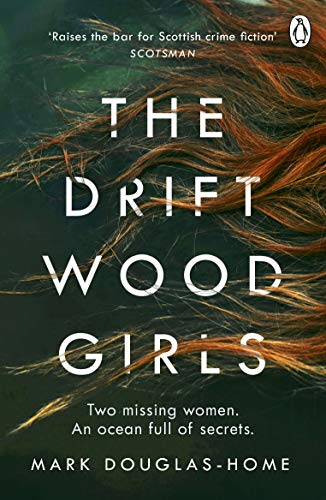
The Driftwood Girls by Mark Douglas-Home, the 4th Sea Detective book, with investigator Cal McGill who uses his knowledge of tides, winds and currents to solve mysteries. In this book when Flora Tolmie disappears her twin sister Kate asks Cal for help to discover what has happened to her and also to look into the disappearance of their mother,Christina, who had vanished without trace from northern France, 23 years earlier.
Three Hours by Rosamund Lipton – set in rural Somerset in the middle of a blizzard, where a school is under siege. Pupils and teachers have barricaded themselves inside the school and the headmaster lies wounded in the library, Outside, a police psychiatrist must identify the gunmen, while parents gather desperate for news.
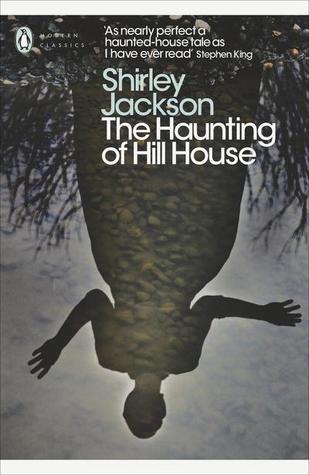
I read The Haunting of Hill House by Shirley Jackson at the end of September and it is one of the books that’s in my ‘to be reviewed pile’, which is getting far too big, as I keep reading book after book without writing about them!
About the book:
It is the story of four seekers who arrive at a notoriously unfriendly pile called Hill House: Dr. Montague, an occult scholar looking for solid evidence of a “haunting”; Theodora, the lighthearted assistant; Eleanor, a friendless, fragile young woman well acquainted with poltergeists; and Luke, the future heir of Hill House. At first, their stay seems destined to be merely a spooky encounter with inexplicable phenomena. But Hill House is gathering its powers—and soon it will choose one of them to make its own. (Goodreads)
This is a horror story, but thank goodness there is no gore. Instead it is macabre and has a chilling atmosphere. It’s more of a psychological study than a horror story and as such I don’t think it’s as good or as terrifying as her later book, We Have Always Lived in the Castle.
Dr. Montague, a doctor of philosophy with a keen interest in the supernatural and psychic manifestations had been looking for a ‘haunted’ house to investigate all his life. So, when he heard the stories about the strange goings on at Hill House he decided he would spend three months living there and see what happened, and he set about finding other people to stay there with him.
Eleanor is the main character in the book, next to the House itself, and what happens is told from Eleanor’s point of view. As a child Eleanor had once seemed to activate a poltergeist, although she doesn’t remember that. As an adult she had spent eleven years looking after her invalid mother and it had left her a lonely, embittered spinster of thirty two. After her mother died she sees Dr. Montague’s invitation to spend the summer at Hill House as something she had been waiting for all her life, an opportunity to change her life. Theodora is not at all like Eleanor – her ‘world was one of delight and soft colors’ and after arguing with her friend with whom she shared an apartment, she accepted Dr. Montague’s invitation too. The third person to accept was Luke, the nephew of the owner of Hill House, who would one day inherit the House. He was a liar and also a thief.
These four people arrived at Hill House where they were met by the Dudleys – Mr Dudley, the surly caretaker and his dour wife, the housekeeper. Neither of them live in the house but having told the guests which rooms they were to sleep in, and the arrangements for meals, they leave them alone at night. They leave before it gets dark.
Eleanor realises she should have turned back at the gate and a voice inside her tells her to ‘get away from here, get away.’ There are stories about the tragedies connected with the house, scandal, madness and a suicide – when a girl hanged herself from the turret in the tower. Dr Montague believes
the evil is in the house itself and that it has enchained and destroyed its people and their lives, it is a place of contained ill will.
Strange things happen, doors open themselves, the walls and floors are at odd angles, the rooms all connect so Eleanor and the others lose their sense of direction and get lost, the rooms they want to find eluding them. There are places where there are ‘cold spots’, and strange noises scare them at night. The tone shifts from the bright sunlight outside to the chill and foreboding of the house. Nothing is what it first appears to be and as I read on I felt I was sinking into the story in an unpleasant way – Eleanor becomes increasingly unstable and I began to realise that she is an unreliable narrator. The story took several ambiguous turns, so that I was not quite sure what was really happening. Was the house really haunted or was it all an effect of what was going on in their minds, or was it all just in Eleanor’s fevered imagination?
The book is well written, full of confusion and misdirection. There are moments of pure fear, a sense of excitement, friendship and even humour with the arrival of Dr Montague’s wife and her pompous friend Arthur Parker, and their ridiculous efforts with a ‘planchette’, a device similar to a Ouija Board. I thought was an odd interlude in the story, and not really necessary. The best parts are, I think, the descriptions of Hill House – the dark horror at the centre of the story.
No human eye can isolate the unhappy coincidence of line and place which suggests evil in the face of a house, and yet somehow a manic juxtaposition, a badly turned angle, some chance meeting of roof and sky turned Hill House into a place of despair, more frightening because the face of Hill House seemed awake, with a watchfulness from the blank windows and a touch of glee in the eyebrow of a cornice. …
It was a house without kindness, never meant to be lived in, not a fir place for people or for love or for hope. Exorcism cannot alter the countenance of a house; Hill House would stay as it was until it was destroyed. (pages 34 – 35)




 BooksPlease