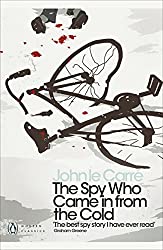
The Spy Who Came in from the Cold by John le Carré

I’ve recently read John le Carré’s biography by Adam Sisman and inevitably it made me want to read le Carré’s books. I decided to start with his third novel, The Spy Who Came in from the Cold, first published in 1963.

Blurb:

a gripping story of love and betrayal at the height of the Cold War. This Penguin Modern Classics edition includes an afterword by the author and an introduction by William Boyd, author of Any Human Heart.

Alex Leamas is tired. It’s the 1960s, he’s been out in the cold for years, spying in the shadow of the Berlin Wall for his British masters. He has seen too many good agents murdered for their troubles. Now Control wants to bring him in at last – but only after one final assignment. He must travel deep into the heart of Communist Germany and betray his country, a job that he will do with his usual cynical professionalism. But when George Smiley tries to help a young woman Leamas has befriended, Leamas’s mission may prove to be the worst thing he could ever have done. In le Carré’s breakthrough work of 1963, the spy story is reborn as a gritty and terrible tale of men who are caught up in politics beyond their imagining.

My view:

This is a dark, tense book and quite short, just 252 pages. It’s complicated and although the language le Carré uses is clear and straight forward at times I wasn’t sure just what was going on, what lay behind the scenes – just what was Leamas up to, amidst the various deceptions and subterfuges? George Smiley does appear briefly in the book, but is there throughout in that he is masterminding Leamas’ mission.

Back from Berlin where he had seen his last agent killed whilst trying to cross the Berlin Wall, Leamas is apparently no longer useful. He goes to seed whilst working out his contact in the Banking Section, transforming into a drunken wreck no longer of use to the Secret Services, left without any money or a job until he finds work as a helper in a library for Psychical Research. Here he meets Liz Gold, who then unwittingly gets drawn into Smiley’s plan.

The atmosphere throughout is of secrecy, manipulation, of human frailty and its duplicitous nature. As the German, Fiedler says for a secret agent:

… deception is first a matter of self-defence. He must protect himself not only from without, but also from within, and against the most natural of impulses; though he earns a fortune, his role may forbid him the use of a razor, though he  be erudite, it can befall him to mumble nothing but banalities; though he be an affectionate husband and father, he must under all circumstances withhold himself from those in whom he should naturally confide. (page 143)

By the end of the book Leamas is in despair as his mission seems to have failed. Liz can’t work out which side he is on and he says:

What do you think spies are: priests, saints, martyrs? They’re a squalid procession of vain fools, traitors too, yes; pansies, sadists and drunkards, people who play cowboys and Indians to brighten their rotten lives. (page 243)

I hate it; I hate it all; I’m tired. But it’s the world, it’s mankind that’s gone mad. We’re a tiny price to pay … but everywhere’s the same, people cheated and misled, whole lives thrown away, people shot and in prison, whole groups and classes of men, written off for nothing. (pages 244-5)

But then again did his mission fail? This is one of those books that I find so hard to write about without giving away too much of the plot – the introduction by William Boyd begins with this statement, ‘New readers are advised that this Introduction makes details of the plot explicit.‘ And indeed it does. I was glad I read it after reading the book, though, as it also gives an interpretation that I found helpful – in particular just what Boyd thought was meant by ‘coming in from the cold‘.

This fulfils the “Broken Object” category on the Silver Vintage Scavenger Hunt card.
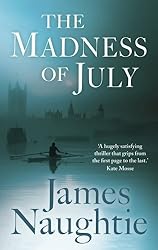
The Madness of July by James Naughtie

When I began reading The Madness of July I was immediately drawn into the story. I used many markers as I read it because it has such a complicated plot. It’s a political thriller set in London in the mid 1970s one sweltering July as Will Flemyng the foreign office minister and former spy finds himself drawn back into the world of espionage, a world of deception, manipulation and diplomacy. It’s the Cold War period and Will discovers politics can be just as dangerous as espionage.

I really wasn’t sure what was going on at first, not sure what was relevant for me to remember and understand, not even sure who was who as the narrative switched between London, New York, Washington and the Highlands of Scotland. So there were times when I had to backtrack when I came across a character or an event, that turned out to be important to the story, which I hadn’t realised earlier on. The characters know what has gone before, know each other, know what they are talking about – but we don’t.

In a different book this would be a major drawback – in this book it is necessary. It’s as though we’re peering through the fog, until gradually the fog lifts and things become clearer. Or it’s like beginning a cryptic crossword where you have all the clues and no idea about the answers. Anyway, I loved it. If the content isn’t too clear at first the writing is, Naughtie uses beautiful imagery and the characters are vividly drawn, in particular the part set in Scotland at Altnabuie, the Flemyngs Highland estate:

At Altnabuie, they woke to a trembling dawn. Flemyng had raised his bedroom window before turning in, and when he opened his eyes, very early, he could smell the highlands. There was a edge to the warmth and the damp, and the tang of tree and field lured him on. He looked towards the loch and saw swirls of mist rising up in thin pillars, like the guilty secrets of hidden smokers, leaving a thin topping of white cotton on the water that crept over the surface and was beginning to disperse here and there with the coming of a soft breeze. It would be gone within the hour. The herons were on their favourite stone, prim and still like a pair of disapproving clerks. The crows cawed in the woods beyond, and behind him, on the eastern side of the house where the sun was already giving life to the place, he could hear the cockerel at work. Everything was crisp and clean, the stifling urban fog a world away. (page 173)

The events that July take place over just 6 days. An American, Joe Manson dies, apparently of an overdose and is found in a store cupboard (it was a large one full of boxes and all sorts of spare objects) in the House of Commons – except that as the House is technically a royal palace deaths are not allowed and bodies have to be discreetly removed and ‘expire’ elsewhere. And thus begins a political crisis – who was Manson, how did he die, what did he know, what had he said – and to whom? And there is a letter on House of Commons notepaper that Will found on the photocopier – an anonymous letter that is puzzling him, a letter from someone who is desperate and who feels he/she is being driven insane.

A secondary plot, but to my mind just as interesting, maybe even more so, concerns Will and his family. He has two brothers, an older on, Mungo who lives at Altnabuie, and a younger one, Abel, who goes by the name of Grauber, their mother’s maiden name, and lives in New York. Mungo has been researching their family history and has discovered a secret about their mother that he finds disconcerting, even frightening.

And the madness? At one point Flemyng, talking about politics says that the rules of the game mean that you have to behave irrationally. A point is reached where you invited destruction, he’d said, as if it were inevitable. ‘Maybe madness isn’t an aberration, but the natural end to our game.’ Everyone aspired to it in politics, even if they didn’t recognise it for what it was. (page 110)

Madness has been haunting Flemyng: Because in these corridors – balance and rational though we believe ourselves to be – there’s madness on the loose. (page 326)

If you like a quick easy read, then The Madness of July is not the book for you. It, however, like me, you like a book that makes you think, that keeps you on your toes as you read, that both puzzles and entertains you, then you’ll probably enjoy it as much as I did.

James Naughtie (pronounced Nochtee, or ‘“ /ˈnɔːxti/ as it is given in Wikipedia, which doesn’t mean anything to me) is a British radio and news presenter for the BBC. From 1994 until 2015 he was one of the main presenters of Radio 4’s Today programme. He is now a ‘Special Correspondent’ with ‘responsibility for charting the course of the constitutional changes at the heart of the UK political debate’, as well as the BBC News’s Books Editor, contributing a book review to the Saturday morning editions of Today. The Madness of July is his first novel. He has also written books on politics and music. He was born in Aberdeenshire and lives in Edinburgh and London.

His second novel, Paris Spring, also featuring Will Flemyng, is due to be published in April this year.

…………………….

Reading Challenge: Read Scotland 2016 and What’s in  Name? 2016 – in the category of a book with a month of the year in the title.