Greenshaw's Folly: a Miss Marple Mystery

Agatha Christie’s Marple last night was Greenshaw’s Folly. I saw in the Radio Times that it was based on Christie’s short story of the same name and so I read it before watching the programme. It’s less than 20 pages and I wondered how the script writers were going to make it last 2 hours, even with the advert breaks. Well, of course, they padded out with other plot elements and characters. And there are more murders, and some farcical scenes with policemen running wild – all a bit of a mess really, but lightly done.

Greenshaw’s Folly is a house, visited by Raymond West (Miss Marple’s nephew), who does not appear in the TV version and Horace Bindler, a literary critic (an undercover reporter in the TV version). It’s an unbelievable architectural monstrosity, built by a Mr Greenshaw. Raymond explained:

‘He had visited the chateaux of the Loire, don’t you think? Those turrets. And then, rather unfortunately, he seems to have travelled in the Orient. The influence of the Taj Mahal is unmistakeable. I rather like the Moorish wing,’ he added, ‘and the traces of a Venetian palace.’ (extract from the short story)

The short story is compact, whereas the TV version is packed with poisonings, ghosts, locked rooms, concealed identities, and so on. But apart from that, I’m not going to try to compare the TV show to the short story as there are so many differences that they are really two separate entities. And both are enjoyable in their own way. Julia Mackenzie is nearly right as Miss Marple, not as good as Joan Hickson, but then who could be. I just wish the sweet smile was toned down a little. The rest of the cast included Fiona Shaw, Julia Sawalha, Joanna David, Judy Parfitt, Robert Glenister and Jim Moir (aka Vic Reeves). All were very good, especially Bobby Smalldridge as Archie Oxley (Mrs Oxley’s young son who does not appear in the short story).
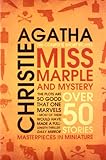
Greenshaw’s Folly was first published in the Daily Mail 3 – 7 December 1956 and is included in Miss Marple and Mystery The Complete Short Stories.

I see that one of the plot elements involving the use of atropine and its antidote has been taken from one of the other stories in this collection, The Thumb Mark of St Peter, first published in 1928. I think the script writers must have had great fun with these stories.
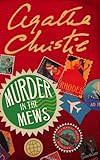
Murder in the Mews by Agatha Christie

I don’t usually find short stories as satisfying as novels, but the stories in Murder in the Mews are good, mainly, I think, because with one exception they are novellas, longer than the average short stories. The collection was first published in 1937.

There are four stories about crimes solved by Hercule Poirot:

  •  Murder in the Mews – at first it looks as though a young widow, Mrs Allen has committed suicide, but as the doctor pointed out the pistol is in her right hand and the wound was close to her head just above the left ear, so it’s obvious that someone else shot her and tried to make it look like suicide. The plot is tightly constructed, with a few red herrings to misguide Poirot and Inspector Japp and a moral question at the end. The book begins on Guy Fawkes Day and I like this conversation between Poirot and Inspector Japp:

(J): ‘Don’t suppose many of those kids really know who Guy Fawkes was.’

(P): ‘And soon, doubtless, there will be confusion of thought. Is it in honour or in execration that on the fifth of November the feux d’artifice are sent up? To blow up an English Parliament, was it a sin or a noble deed?’

Japp chuckled. ‘Some people would say undoubtedly the latter.’ (page 7)


  • The Incredible Theft – Poirot is called in to investigate the theft of top secret plans of a new bomber from the home of a Cabinet Minister, Lord Mayfield, where a number of guests are gathered for a house party: Mrs Vanderlyn is an American siren who had formed friendships with ‘a European party’ (this was written in 1936). Air Marshall Sir George Carrington  wonders why she is there. Lady Julia Carrington, Sir George’s wife is a keen bridge player, who has ‘the most frightful overdraft’ and their son Reggie, fancies the French maid. Also present are Mrs Macatta MP, and Mr Carlile, Lord Mayfield’s private secretary. This is perhaps the weakest story in the collection.
  • Dead Man’s Mirror – a conventional murder mystery. Sir Gervase Chevenix-Gore is found dead in his locked study, shot through the head. The bullet had shattered the mirror on the wall behind his desk. Again it looks like suicide, but the question is why he should kill himself. Poirot considers it’s all wrong psychologically – Sir Gervase was known as The Bold Bad Baronet, with a huge ego, much like Poirot, considering himself to be a man of great importance. This is another story, complicated by family relationships. Things of interest I noted are that Poirot studies the footprints in the garden outside the study, Mr Satterthwaite (seen in later stories) makes an appearance, and on a personal note I wondered if this was Agatha Christie’s cynical view of divorce?

 I can’t see it makes a ha’p’orth of difference who you marry nowadays. Divorce is so easy. If you’re not hitting it off, nothing is easier than to cut the tangle and start again. (page 115)


  • Triangle at Rhodes – although this is the shortest story, not my preferred length, I think this is the best one in the book. It’s similar to her later book Evil Under the Sun in that it is about a love triangle and a crime of passion. Poirot is on holiday in Rhodes and observes the jealousy and passion between two couples as he sits in the sun on the beach. He foresees trouble ahead and is worried as he traces a triangle in the sand. There aren’t many people on holiday there and he wonders if he is imagining things , reproaching himself for being ‘crime-minded‘. But he is not wrong and Valentine Chantry, a famous beauty, married to a commander in the navy, a strong, silent man, is murdered.

These stories demonstrate some of Agatha Christie’s plot elements and endings – the locked room murder, the murderer conceals the motive, Poirot foresees murder, the clues (often odd clues) are there hidden or in plain sight, there are red herrings and bluffs, chance remarks that have significance, and the final denouement, explaining the solution to the mystery.

Crime Fiction Alphabet: Letter O

Kerrie’s Crime Fiction Alphabet has reached the letter O.

I was surprised quite recently to discover that Baroness Orczy had not only written books about the Scarlet Pimpernel, but had also written crime fiction.

Emmuska Orczy (1865 – 1947) was born in Hungary and she and her family moved to London in 1880, where she went to the West London School of Art and then Heatherley’s School of Fine Art.  Several of her paintings were exhibited at the Royal Academy. She married Montague MacLean Barstow in 1894 and encouraged by him, she began writing in 1900. As well as the Scarlet Pimpernel stories she wrote mysteries for the Royal Magazine and Cassell’s Magazine. She created one of the earliest female detectives in a collection of short stories about Molly Robertson-Kirk – Lady Molly of Scotland Yard in 1910.

The Old Man in the Corner
The Old Man in the Corner, Greening & Co. 1910, Design by H. M. Brock. From Flickr

Her book of short stories, The Old Man in the Corner features one of the earliest armchair detectives. It was first published in 1909, although she had written the stories before that and published them in magazines. The ‘Old Man’ sits in the corner of an A. B. C. (Aerated Bread Company) tearoom and relates the mysteries to Polly Burton of the Evening Observer. She was amused by his appearance:

Polly thought to herself that she had never seen anyone so pale  so thin, with such funny light-coloured hair, brushed very smoothly across the top of a very obviously bald crown. He looked so timid and nervous as he fidgeted incessantly with a piece of string; his long, lean and trembling fingers tying and untying it into knots of wonderful and complicated proportions. (Location 47 of 2760)

Tying knots in a piece of string seems to be essential to his deductive powers, for as he unravels the knots so he solves the mysteries. His philosophy is:

There is no such thing as a mystery in connection with any crime, provided intelligence is brought to bear upon its investigation.  (Location 29)

Very like Hercule Poirot, I thought, but the resemblance ends there. The Old Man’s sympathies are with the criminal rather than the police; he solves the mysteries just for the love of doing it, to discover the motive and method. He doesn’t pass his information onto the police and in most of the cases there is still an element of doubt.

The mysteries included in The Old Man in the Corner are:

The Fenchurch Street Mystery
The Robbery in Phillimore Terrace
The York Mystery
The Mysterious Death on the Underground Railway
The Liverpool Mystery
The Edinburgh Mystery
The Theft at the English Provident Bank
The Dublin Mystery
An Unparalleled Outrage (The Brighton Mystery)
The Regent’s Park Murder
The De Genneville Peerage (The Birmingham Mystery)
The Mysterious Death in Percy Street

They seem to be the most baffling cases that the police had been unable to solve, involving murder, blackmail, forgeries and puzzling crimes. I enjoyed reading them, although they don’t overtax the brain.

  • Format: Kindle Edition
  • File Size: 302 KB
  • Print Length: 186 pages
  • Sold by: Amazon Media EU S.à r.l.
  • Language: English
  • ASIN: B0084BMM6W
  • Source: my own copy
  • My Rating 3/5


Guilty Consciences: a Crime Writers’ Association Anthology

I’ve taken my time reading this collection of short stories Guilty Consciences: a Crime Writers’ Association Anthology, edited by Martin Edwards, who has also contributed one of the stories. I read them one or two at a time, which for me is the best way.

The contributors are Robert Barnard, Ann Cleeves, Bernie Crosthwaite, Judith Cutler, Carol Anne Davis, Martin Edwards, Jane Finnis, Peter James, Alanna Knight, Susan Moody, Sarah Rayne, Claire Seeber, L.C.Tyler, Dan Waddell and Yvonne Walus, and there is an introduction from the current Chair of the CWA, Peter James.

I haven’t been too keen on short stories in the past but I enjoyed this collection and think it’s one of the best I’ve read. As Peter James writes in his introduction:

I believe the short story is long overdue for a renaissance, and the ideal literary form for our increasingly busy, time-poor modern lives. What better for a quick read between tube station stops, or using your e-reader to turn a tedious airport security queue into fifteen minutes of surprises and delight?

Or as I found the ideal length to read at breakfast.

As the title suggests the stories all reveal various aspects of a guilty conscience. I find it hard to write about short stories without giving away the plot, so here are just a few notes on some. There are many I could pick out but these particularly stand out in my memory, now that I’ve read the book:

  • Hector’s Other Woman by Ann Cleeves – an intriguing insight into Vera Stanhope’s past and her motivation for joining the police, as Vera recollects her visit to Holy Island with her father whilst she was in the middle of her A-level year.
  • Squeaky by Martin Edwards – about a couple who both have something to hide and how their marriage began to fall apart when Squeaky came into their lives.
  • Deck the Hall with Poison Ivy by Susan Moody – a cautionary story about Christmas and a family’s arrangements.
  • The Train by Dan Waddell – as a husband anxiously waits for the return of his estranged wife he remembers their lives together and vows it will be different this time.

All the contributions were written specially for this collection with the exception of The Visitor by H R F Keating, who died in 2011, a story that had previously been included in a Penguin India collection, featuring Inspector Ghote. Ghote’s visitor is consumed with guilt about something that he had done in the past – but had he?

An excellent collection.

Library Loot

It’s been ages since I did a Library Loot post. These reflect the variety of books that I enjoy. For more details about the books click on the links which take you to Amazon UK:

  • D H Lawrence – Daughters of the Vicar. This is a novella written in 1911. I’d never come across this before and thought it looked interesting. It has a foreword by Anita Desai – she writes that ‘here in the little story, Daughters of the Vicar (could any title be more redolent of the England of its time?) we have the essential D H Lawrence – the little contained world in a mossy valley of coal-veined hills from which that D H Lawrence grew’.
  • Kate Atkinson – Started Early, Took My Dog. This is the fourth Jackson Brodie book, described by The Times as ‘A comic novel of great wit and virtuosity.’ I’ve been meaning to get this since it came out a couple of years ago.
  • Edna O’Brien – The Country Girls. This was first published in 1960 and it’s set in a country village in Ireland in the early 1960s – a period piece now. Her books then were both successful and scandalous. In her native Ireland she was considered irreligious.
  • Guilty Consciences: a Crime Writers’ Association Anthology, edited by Martin Edwards (himself a successful crime fiction writer and blogger). I had to borrow this collection of short stories from some of my favourite crime fiction authors.
  • Peter James – Looking Good Dead. Even though I’ve had a couple of Peter James’s books for a few years I’d never read them, until I started Dead Simple (the first Detective Superintendent Grace book) this week. I’m hooked – it’s really good. So when I saw this in the library today I was delighted – it’s the second of his Roy Grace books!
  • M R Hall – The Flight. Another series of crime fiction that I like – this is the fourth in Hall’s Coroner Jenny Cooper series. I’ve read the first and the third – Jenny Cooper is a coroner who acts as a detective. Again, another series that has me captivated.

And finally, two books on a subject that is equally as absorbing as reading and blogging – painting:

Both books include demonstrations and advice on techniques, types of paint and pastels, and composition. I just need to get painting – and reading!

Best Books January to June

Kerrie at Mysteries in Paradise recently asked what are your favourite crime fictionbooks so far this year, which got me to thinking about my favourite books as a whole (not just crime fiction). About half the books I read are crime fiction and the other half is a mixture of fiction (of many genres) with a smattering of non fiction.

After much thought I’ve decided on these ten books as my favourite reads so far. I’ve only included one book from Ian Rankin and Agatha Christie, although I’ve read several from each that I rate as highly as the ones I’ve chosen. Six of the books are crime fiction (marked *), there is one non fiction and one book of short stories. They are listed in the order that I read them.

I hope to vary my reading during the rest of 2010, maybe a few more non-fiction books as I have several biographies/autobiographies I’d love to read and more classics, but I expect crime fiction will still be high on my list of best books by the end of the year.