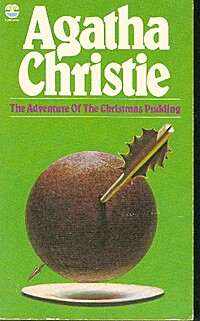
The Adventure of the Christmas Pudding by Agatha Christie

It seemed the right time of year to read The Adventure of the Christmas Pudding and a Selection of Entrées by Agatha Christie. It’s a collection of six short stories but only the first one, the title story, has any Christmas connection.

As Agatha Christie explained in her Foreword this story was an ‘indulgence‘, recalling the Christmases of her youth, spent at Abney Hall:

The Christmas fare was of gargantuan proportions. I was a skinny child, appearing delicate, but actually of robust health and perpetually hungry! The boys of the family and I used to vie with each other as to who could eat the most on Christmas Day. Oyster Soup and Turbot went down without undue zest, but then came Roast Turkey, Boiled Turkey and an enormous Sirloin of Beef. The boys and I had two helpings of all three! We then had Plum Pudding, Mince-Pies, Trifle and every kind of dessert. During the afternoon we ate chocolates solidly. We neither felt, nor were sick! How lovely to be eleven years old and greedy!

But I don’t think this story reflects her own Christmas experience apart from the setting, that is, for this is a collection of crime fiction! Poirot is invited to spend ‘a good old-fashioned Christmas in the English countryside’ in a 14th century English manor house, a prospect that fills him with apprehension, only agreeing to go when he hears there is oil-fired central heating in the house. There is of course a reason for inviting him – for a discreet investigation into the theft of a priceless ruby stolen from a Far Eastern prince. The Christmas Pudding in question is a ‘large football of a pudding, a piece of holly stuck in it and glorious flames of blue and red rising round it’. For a short story this is really complicated with several twists for Poirot to work through.

Four of the other stories feature Poirot, with the last one, Greenshaw’s Folly being a Miss Marple mystery, which I read last year in Miss Marple and Mystery.  Greenshaw’s Folly is a house, an architectural monstrosity, visited by Raymond West (Miss Marple’s nephew) and Horace Bindler, a literary critic. Later, Miss Greenshaw having drawn up a new will, is found murdered.

The remaining four stories concern the murder of a man found a Spanish chest (The Mystery of the Spanish Chest), a widow who is convinced her nephew had not killed her husband despite all the evidence against him (The Under Dog), a man who has inexplicable changed his eating habits is found dead (Four and Twenty Blackbirds), and a man who has the same dream night after night that he shoots himself is found dead (The Dream).

I enjoyed reading these stories. They are of varying length and are all cleverly done, if a little predictable.
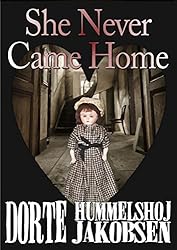
She Never Came Home by Dorte Hummelshoj Jakobsen

She Never Came Home is a perfect little ghost story for Halloween. Dorte Hummelshoj Jakobsen spins a suspenseful story of Alice and her husband Peter and their little dog, Foxy as they move into an old farmhouse deep in the Danish countryside. Just why is Foxy nervous about the cupboard under the sink, what is in the bedrooms upstairs that are excluded from their tenancy agreement, and why has the house been empty for over thirty years?

Both Peter and Alice are out of work, but Peter still has to work out his notice in Germany and leaves Alice alone in the house… Alice slowly discovers the horrible truth.

I really liked this short story, with its chilling atmosphere and shocking twist at the end. In just a few pages Dorte Hummelshoj Jakobsen has written such a compelling and entertaining tale.

This is my last entry in this year’s R.I.P. challenge and another one for the My Kind of Mystery challenge.

She Never Came Home – FREE for Halloween!

She never came home

To celebrate Halloween, Dorte Hummelshoj Jakobsen has made her latest ghost story, She Never Came Home, free today and tomorrow.

Short story of 9,000 words – crime & ghosts. 

Grab it while you can, and feel free to share the news with your friends or blog readers – and remember to keep the lights on! 

Muhahaha!

http://authl.it/1zt

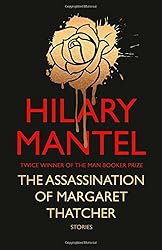
The Assassination of Margaret Thatcher and Other Stories by Hilary Mantel

When I first saw The Assassination of Margaret Thatcher I wasn’t sure I wanted to read it – not because of the controversy over the title story, but because I’m not especially keen on short stories. But Hilary Mantel is one of my favourite authors and after seeing her talk with James Runcie on The Culture Show I decided I definitely wanted to get the book.

I enjoyed this collection of stories,  which are brooding, somewhat melancholic, dark, disturbing and full of sharp and penetrating observations – brilliant! The title story is the last one in the book and is the only new story, the others having first appeared in other publications. I don’t find it easy writing about short stories, especially the very short ones, and so I’m not going to attempt to write about each of the ten stories in this book.

The first one, Sorry to Disturb, describes the dilemma of a British woman living in Jeddah in Saudi Arabia when she finds herself befriended by a young Pakistani businessman – a situation that was ‘ripe for misunderstanding‘. This is one of my favourites in the collection. It has a claustrophobic atmosphere, as feeling trapped in her flat, yet ‘always observed: overlooked, without being precisely seen, recognised’ she was unable to refuse a friendship, wondering if Jeddah had left her ‘for ever off-kilter in some way‘.

This view of life from a slightly different, skewed perspective and of being trapped is there in all these stories. The children in Comma, for example, spend their days during a long hot summer, ‘each day a sun like a child’s painted sun burned in a sky made white with heat’, drawn to watch what was happening at the Hathaways’ house, the house of the rich, built of stone, with a lofty round tower. In both this and Sorry to Disturb, there is an element of distinct class/cultural difference, of being outsiders.

Winter Break is one of the shorter stories, but complete in itself, unlike so many short stories I’ve read. A childless couple are taking a winter break, the husband trying to convince his wife she wants a child – she’s reluctant as she ‘had reached that stage in her fertile life when genetic strings got knotted and chromosomes went whizzing around and re-attaching themselves.’ A moment of anxiety on the journey to their hotel ends in horror.

How Shall I Know You is a much longer story. I often wonder what it’s like for authors going to venues and talking about their books and this story gives an insight into how it can be a dispiriting experience, staying in obscure and dingy places, feeling forlorn, exposed and generally insufficient. It has a grimly humorous side and underneath there is a darkness and bleakness. As with the other stories in this collection it is superbly written – you are there with the narrator, seeing the scenes, meeting the people and understanding their feelings and emotions.

And then the last story – The Assassination of Margaret Thatcher. Mantel sets the scene – of the ‘place where she breathed her last‘ – a ‘quiet street, sedate, shaded by old trees: a street of tall houses, their façades smooth as white icing, their brickwork the colour of honey.’  Waiting for the plumber to arrive, a woman lets a man into her flat, only to find out he has a gun and wants to shoot Margaret Thatcher from the flat window, as she leaves the hospital behind the flats. Far from being horrified or scared the woman sympathises with the gunman – her first reaction is that she should get a fee for the use of her premises. This too is a dark tale told with a dark sense of humour, and with depth of feeling.

Overall then this is a compelling book, brilliantly written, keenly observed, with the power to chill and shock me. It is one that I will re-visit.

  • Hardcover: 256 pages
  • Publisher: Fourth Estate (25 Sep 2014)
  • Language: Unknown
  • ISBN-10: 0007580975
  • ISBN-13: 978-0007580972
  • Source: I bought it

Knavesborough Stories by Dorte Hummelshoj Jakobsen

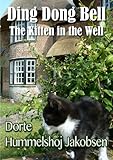
Recently Dorte Hummelshoj Jakobsen kindly made two of her short stories available to me (e-books) for review. They are both about the Gershwin family in Knavesborough, a fictional village in Yorkshire, namely Ding Dong Bell, the Kitten in the Well and Green Acres. I often find short stories lack the necessary depth to be convincing – either weak plots and/or characterisation, but these short stories are both convincing and satisfying. Maybe it helps that they are continuations of other stories, or in the case of Ding Dong Bell, the Kitten in the Well, a prequel.

Ding Dong Bell, the Kitten in the Well goes back in time to Rhapsody Gershwin’s childhood in the early 1990s. Rhapsody is the vicar’s daughter first featured in The Cosy Knave. In this short story Rhapsody and her sisters are worried about the disappearance of the black kitten they have called Black Pete. The last time they had seen him was when they had played in old Ursula Abbot’s garden and they wondered if he had he got locked in her cottage. Ursula had died but as she was nearly ninety it wasn’t entirely an unexpected death … but she had been in good health. Is Ursula’s death connected to Black Pete’s disappearance?Rhapsody helps to solve the mystery.
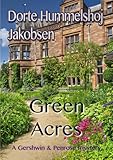
Green Acres* takes us to the latest in the Gershwin and Penrose Mysteries series. Green Acres, once a country mansion, has been converted into a home for the elderly. Rhapsody visits Rowan Dougal, a farmer who has broken his hip and is currently living at Green Acres. Lavinia Banbury staying in the room next to Rowan dies in her sleep. Nothing unusual in an old people’s home, but is her death really a natural one?

Green Acres* was originally published in the anthology The Red Shoes. This is a new and longer version.

I like these stories. They’re humorous crime fiction, with colourful characters all with quirky names. There’s no blood and gore and each story has an unexpected twist at the end. In other words, they are cosy crimes (if any crime could really be considered as ‘cosy’, that is).

Dorte Hummelshoj Jakobsen is Danish. After many years as a teacher she is now concentrating on a writing career, publishing in both Danish and English. As well as writing her cosy mysteries she has also written a full length psychological murder mystery novel, Anna Marklin’s Family Chronicles, which I thoroughly enjoyed too – see my post here.

The Rendezvous and Other Stories by Daphne du Maurier

When I finished reading The Rendezvous and Other Stories I had absolutely no hesitation in giving it 5 stars – I loved it. This is most unusual for me as generally I’m not too keen on short stories because they often leave me feeling dissatisfied, thinking they are lacking in substance or characterisation. Not so with this book, even though some of the endings were predictable and some of the stories are very short I think they all worked well!

Daphne du Maurier wrote some of these stories before she wrote her first novel (The Loving Spirit, 1931), when she under 23, and the rest between 1937 and 1947, when she was a well established writer. The earlier stories are shorter than the later ones as they were written for magazines

There are 14 stories:

  • No Motive ~ this begins with the suicide of an apparently happy woman expecting her first child. Her husband desperate to discover what could have caused her to take her own life and that of their unborn child employs a private detective to investigate. What he discovers is just so sad and tragic.
  • Panic ~ This is one of the shorter stories about a casual love affair that ends in death and the panic that ensued.
  • The Supreme Artist ~ Another shorter story of an aging actor trying to fight off the years.
  • Adieu Sagesse ~ I loved this one about a hen-pecked husband who plans to escape his tedious life and have an adventure.
  • Fairy Tale ~ A gambler and his long-suffering wife face destitution – unless he wins the lottery!
  • The Rendezvous ~ Now this story really caught my imagination. It’s the story of an ageing writer, who meets a fan of his books whilst on a trip to Switzerland to lecture about his work. As in some of Du Maurier’s books this is about an unequal relationship and the exploitation of one of the partners. It is vividly written, the sense of disappointment, the misunderstandings and subsequent let down is brilliant.
  • La Sainte-Vierge ~ A very short and predictable story about a naive young wife.
  • Leading Lady ~ a beautiful actress manipulates the men around her.
  • Escort ~ Another of the really good stories, full of atmosphere set in set in World War II on board a merchant ship as it sails across the North Sea. Just what is the ship that offers to escort it as a submarine threatens  – and who is its captain?
  • The Lover ~ More sexual manipulation, this time by a young man.
  • The Closing Door ~ A young man is told of his terminal illness and the devastating effect it will have on his life.
  • Indiscretion ~ An amusing tale of what happens when you say something without knowing the consequences – a bit signalled but still enjoyable.
  • Angels and Archangels ~ A bitter and cynical look at religion and hypocrisy.
  • Split Second ~ A brilliant story to finish the book – about a woman who leaves her highly organised house for a walk and finds everything has changed when she returns.

This is one of a set of Du Maurier’s books that I bought at least seven years ago. It was well worth the wait! I still have one more of the set to read – I’ll Never Be Young Again, her second novel.  And there are more that I don’t own to enjoy in the future too.