Top Ten Tuesday: Quotes from Hamlet

Top Ten Tuesday is a weekly meme created by The Broke and the Bookish and now hosted by Jana at That Artsy Reader Girl. For the rules see her blog.

The topic this week is Favourite Book Quotes (You can pick your favourite quotes from books, or about books! You can set a theme like quotes from books about love, friendship, hope, etc. or you can just share quotes you loved from your recent reads!)

Here are 10 quotes from my favourite Shakespeare play Hamlet.

O, that this too, too solid flesh would melt,
Thaw and resolve itself into a dew!
(Hamlet, Act 1 Scene 2)

Neither a borrower nor a lender be, 
For loan oft loses both itself and friend, 
And borrowing dulls the edge of husbandry.
(Polonius, Act 1 Scene 3)

That one may smile and smile and be a villain.
(Hamlet, Act 1 Scene 5)

There are more things in heaven and earth, Horatio,
Than are dreamt of in our philosophy.
(Hamlet, Act 1 Scene 5)

Brevity is the soul of wit.
(Polonius, Act 2 Scene 2) 

Though this be madness, yet there is method in’t.
(Polonius, Act 2 Scene 2) 

There is nothing either good or bad but thinking makes it so.
(Hamlet, Act 2 Scene 2)

To be, or not to be, that is the question.
(Hamlet, Act 3 Scene 1)

The lady protests too much, methinks.
(Gertrude, Act 3 Scene 2)

If it be now, ’tis not to come: if it be not to come, it will be now: if it be not now, yet it will come: the readiness is all.  
(Hamlet, Act 5 Scene 2)

Shakespeare: The Man Who Pays the Rent by Judi Dench and Brenden O’Hea

Rating: 5 out of 5.

St Martin’s Press| 23 April 2024 | 228 pages|e-book |Review copy| 5*

Synopsis:

Taking a curtain call with a live snake in her wig..

Cavorting naked through the Warwickshire countryside painted green...

Acting opposite a child with a pumpkin on his head…

These are just a few of the things Dame Judi Dench has done in the name of Shakespeare

For the very first time, Judi opens up about every Shakespearean role she has played throughout her seven-decade career, from Lady Macbeth and Titania to Ophelia and Cleopatra. In a series of intimate conversations with actor & director Brendan O’Hea, she guides us through Shakespeare’s plays with incisive clarity, revealing the secrets of her rehearsal process and inviting us to share in her triumphs, disasters, and backstage shenanigans.

Interspersed with vignettes on audiences, critics, company spirit and rehearsal room etiquette, she serves up priceless revelations on everything from the craft of speaking in verse to her personal interpretations of some of Shakespeare’s most famous scenes, all brightened by her mischievous sense of humour, striking level of honesty and a peppering of hilarious anecdotes, many of which have remained under lock and key until now. Instructive and witty, provocative and inspiring, this is ultimately Judi’s love letter to Shakespeare, or rather, The Man Who Pays The Rent.

My thoughts

I was enthralled by Shakespeare: the Man Who Pays the Rent. Reading it is like being in the room with Dame Judi Dench and Brendan O’Hea as they talked about Judi’s career, her love for Shakespeare, and the numerous roles she has played over the years. Shakespeare to Judi Dench is a passionate affair, she talks about it with love.

My introduction to Shakespeare was at secondary school, when each year we studied one of his plays. Then some years ago I took an Open University course on Shakespeare, so I’ve read and seen performances of many of the plays in which she has acted. Unfortunately she wasn’t acting in any of the plays I’ve seen on stage. I enjoyed Shakespeare at school but it was only when I took the Open University course and saw the plays live on the stage that I really began to love them. And when I read Shakespeare: the Man Who Pays the Rent it brought it all back to me.

This book is a wonderful run through the plays told from Judi’s perspective and, of course, her life, giving her insight not only into the characters but also into the world of the theatre. She talks about the rehearsals, the costumes, the sets, other actors, about critics, Shakespeare’s language – similes and metaphors, the use of rhyme, prose and verse, soliloquies, asides and how to adjust your breathing – and so on. Whatever she is talking about is all so clear and relevant, full of wit and humour and understanding. It brought back such wonderful memories of the plays I’ve studied and seen performed. And as for the plays I don’t know this book makes me want to see those as well.

It is a book I shall return to whenever I need a pick me up – I loved it, it gave me so much joy. There is so much more in this book than I’ve included here – I have only covered the surface in this post. If you like Judi Dench and Shakespeare you really should read Shakespeare: the Man Who Pays the Rent by Judi Dench with Brendan O’Hea. And it includes Illustrations by Judi Dench too!

With many thanks to the authors, the publishers and NetGalley for an Uncorrected Galley.

Six Degrees of Separation: from Sanditon to The Lambs of London

I love doing Six Degrees of Separation, a monthly link-up hosted by Kate at Books Are My Favourite and Best. Each month a book is chosen as a starting point and linked to six other books to form a chain. A book doesn’t need to be connected to all the other books on the list, only to the one next to it in the chain.
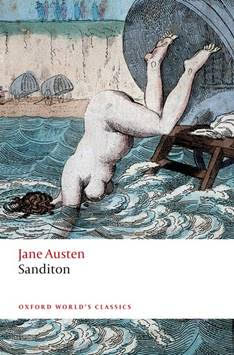
Sanditon

This month the chain begins with December 7, 2019), we’ll begin with Jane Austen’s unfinished manuscript, Sanditon. I read this a few years ago and enjoyed it very much.  It’s the last fiction that Jane Austen wrote, beginning it in January 1817, the year she died. She was ill and the subject of health is one of its themes, but not in a serious or gloomy way. It has a lively, bright and humorous tone, with three of the characters being hypochondriacs, wonderfully satirised by Jane Austen.

My first thought was to link to The Mystery of Edwin Drood, Charles Dickens’ unfinished novel. But I’ve already used it in an earlier Six Degrees post and I don’t like to use the same book twice in these posts, so my first link is to Castle Dor, which Sir Arthur Quiller-Couch had started to write  but had set aside unfinished before his death. His daughter asked Daphne du Maurier to finish it. It retells of the legend of the tragic lovers, Tristan and Isolde, transplanted in time and place to the early 1840s in Cornwall. 

The Last Enchantment by Mary Stewart also retells a legend, that of King Arthur and Merlin. It’s the third book of the Arthurian Saga, a book of myth and legend and about the conflict between good and evil.

My third link is King Arthur in King Arthur’s Bones by the Medieval Murderers, a group of five authors, all members of the Crime Writers’ Association. The book consists of five stories with a prologue and an epilogue tracing the mystery of Arthur’s remains. The legend is that King Arthur is not dead, but sleeping with his knights ready to return to defend his country in a time of great danger. One of the stories is set in the 17th century involving William Shakespeare’s brother Edmund who discovered a long thigh bone and a murder in the Tower of London in one of the compartments of the Lion Tower where the king kept lions and tigers. 

Another of Shakespeare’s brothers, Richard, appears in Fools and Mortals by Bernard Cornwell. It’s 1595 and the players are rehearsing a new play, A Midsummer Night’s Dream. Richard is longing to play a male role, but so far has only been given female roles. There is little brotherly love between the brothers and Richard is tempted to leave the Lord Chamberlain’s Men when Langley, the producer at the Swan in Southwark offers him a job, providing he will steal two of William’s new plays.

This brings me to Peter Ackroyd’s Biography of Shakespeare.  It is full of detail about the theatrical world, how the actors worked, about their patrons and managers, how Shakespeare interacted with other writers, and how his work was received by the public and the monarchy.

And so to my final link, another book by Peter Ackroyd, The Lambs of London, historical fiction based loosely on the lives of Mary and Charles Lamb. It also is a link to Shakespeare as Mary buys  a book from William Ireland, an antiquarian, a book that it is said once belonged to Shakespeare.

My chain is linked by unfinished books, books about legends, Tristan and Isolde and King Arthur, about Shakespeare and his brothers and books by Peter Ackroyd. It includes both crime and historical fiction and a biography.

Next month ( 4 January 2020), we’ll begin with Daisy Jones and The Six by Taylor Jenkins Reid, a book I’ve never heard of before. 

Shakespeare and The Classics Club’s July question

The question this month is:

Have you ever read a biography on a classic author? If so, tell us about it. If you had already read works by this author, did reading a biography of his/her life change your perspective on the author’s writing? Why or why not? // Or, if you’ve never read a biography of a classic author, would you? Why or why not?

This question came at just the right time for me because I’ve just finished reading Shakespeare: The Biography by Peter Ackroyd. It’s taken me a long time to read because I began it in March and have been reading it almost daily a few short chapters each day.

Shakespeare biography

I bought the book in Stratford-upon-Avon some years ago after going to the theatre there. I first came across Shakespeare’s plays at school – doesn’t everyone? Years later I took an Open University course and studied more plays and managed to see productions of each one, either at the Barbican in London or at the Stratford.

So, I’m familiar with several plays, which helps enormously with reading Ackoyd’s biography as he has structured it mainly around the plays.  But above all, he has placed Shakespeare within his own time and place, whether it is Stratford or London or travelling around the countryside with the touring companies of players. Shakespeare spans the reigns of two monarchs, which saw great changes and Ackroyd conjures up vividly the social, religious and cultural scene. It’s a very readable book, full of detail. My only reservation about it is one I often have when reading biographies – there are inevitably assumptions, those phrases such as ‘must have’  ‘would have’, ‘most likely’, ‘could have’, ‘there is also a possibility that’ and so on that biographers use.

I learnt a lot that I hadn’t known before as my study of Shakespeare hadn’t gone much beyond the plays, and studying them as entities in themselves is not the same as seeing them in their contemporary settings, or as a part of his whole work. I knew very little (or if I did learn anything years ago, I’ve forgotten) for example of the theatrical world, of how the actors worked, their patrons and managers, nor about how Shakespeare interacted with other writers, or of how his work was received by the public and the monarchy. I particularly liked the sections on religion and the religious conflicts of the late 16th and early 17th centuries and his discussion about Shakespeare’s own beliefs and practices:

This raises the vexed question of his religion, endlessly debated through the centuries. It is true that he used the language and the structure of the old faith in his drama, but that does not imply that he espoused Catholicism. His parents are likely to have been of the old faith, but he did not necessarily take it with him into his adulthood. The old religion was part of the landscape of his imagination, not of his belief.

His own adult beliefs are much more difficult to estimate. It is possible that he was, in the language of the period, a ‘church papist’; he outwardly conformed, as in the ceremony of christening, but secretly remained a Catholic. This was a perfectly conventional stance at the time. (pages 446 – 7)

Ackroyd’s account of the language of the plays is also fascinating. Understanding the plays can be demanding. I’ve found that when I’ve seen a play acted it makes much more sense to me than when I’ve only read it and I’ve often wondered how the plays were understood by their 16th century audiences. Ackroyd considers that

Some of Shakespeare’s more recondite phrases would have passed over them, as they baffle even the most highly educated contemporary audience, but the Elizabethans understood the plots and were able to appreciate the contemporary allusions. Of course scholars of a later age have detected in Shakespeare’s plays a subtlety of theme and intention that may well have escaped Elizabethan audiences. But it may be asked whether these are the inventions of scholars rather than the dramatist. (page 349)

In a book of over 500 pages there is much more to be said about it than I’ve attempted in this post – I’ve only just touched the surface!

My overall view of this biography is that it is well researched, with an extensive bibliography, notes and index. Ackroyd acknowledges that he ‘came to this study as a Shakespearian enthusiast‘ rather than as an expert and lists other biographies that he found ‘most illuminating’.

In answer to the Classics Club question on whether reading a biography has changed my perspective on an author’s writing I think the answer has to be that it hasn’t really changed it but it has enhanced my understanding of the world in which Shakespeare lived and wrote and emphasised the fact that the plays are/were made for an audience:

Shakespeare relied upon the audience and, with such devices as the soliloquy, extended the play towards it; the drama did not comprehend a completely independent world, but needed to be authenticated by the various responses of the crowd. (page 349)

Macbeth at the Royal Shakespeare Company

We’ve been away most of last week visiting family and going to Stratford-upon-Avon to see Macbeth at the transformed Royal Shakespeare Theatre.

Watching a live performance of any of Shakespeare’s plays is a special treat, one that we manage less frequently now that we’ve moved so far away from Stratford, but combining our visit with a family occasion made it possible this year. The new auditorium is impressive with a huge stage thrusting into the audience, seating around 1,000 people on three sides of the stage. Our seats were in the stalls, very close to the stage, with a group of school children seated in front of us, whose reactions were highly amusing.

The set design was dramatic and atmospherically dark, shattered stained glass windows in a ruined church with defaced images of saints and piles of rubble on the floor. At one point in the play Macbeth and Banquo erupted onto the stage through holes in the back wall. There are no weird sisters in this version of Macbeth; the prophecy is announced in suitably ghost-like tones by three children (the children of Macduff) suspended in the air above the stage as though they have been hung on meat hooks.

It was the children and Seyton the porter who stole the show for me, although the other actors all gave excellent performances. The murder of the children had me gasping and almost in tears as Macduff’s little daughter was taken away to her death. Jamie Beamish as Seyton was fantastic and his pyrotechnics really shocked me. Jonathan Slinger portrayed Macbeth as an frenetic lunatic who made me decidedly edgy and I never knew how close to me in the audience he was going to get – I was glad I wasn’t on the front row.

A hugely enjoyable performance.

The Comedy of Errors: Shakespeare in the Open Air

Yesterday afternoon we went to see The Comedy of Errors performed in a circular garden on the side of the Elizabethan Ramparts in Berwick-on-Tweed. It was a brilliant performance by  London’s Shakespeare Globe Touring Company. We both thought this was one of the best, if not the best, performance we’ve seen. 

The day didn’t look promising when I woke up – the garden was shrouded in mist, first thing and then it drizzled all morning. The play would go on regardless of the weather but we didn’t fancy watching in the rain. Much to our relief by the afternoon it was bright and sunny in Berwick and armed with our new folding director’s chairs we found our way to the circular garden – a perfect setting for the play. It’s surrounded by trees, so sheltered from the sea breeze with the ramparts making an impressive backdrop.

Photos weren’t allowed during the performance, but during the interval I took this one of the booth stage and some of the audience:

The audience was mixed with families, babies, toddlers, older children and a dog. People had brought picnics, sandwiches, wine and champagne and the atmosphere was relaxed and happy; “anyone got a corkscrew?” one lady asked and as people laughed one was handed to her. Everyone had brought their own seating – garden chairs – plastic and wooden, folding chairs, blankets and rugs. Seagulls swooped overhead, a little aeroplane chugged across the sky above, and people stood above on the ramparts looking down. There was a bar selling beer, wine, coffee and snacks. I had a red wine and a cup of coffee and D had beer.

The booth stage is designed from paintings and etchings from Shakespeare’s time, when the company of actors he worked with toured the country before they formed a company at the Globe and even after that, taking the show on the road. This gave the performance an authentic 17th century feel, and as we were all so near the stage it was as though we had a part to play as well.

The Comedy of Errors is a farce and in these actors’ hands it was hilarious as they dashed around the stage and in and out of the audience.  The cast of eight actors was fantastic, the play went at a fast pace, the energy was amazing as they doubled up the parts of the two sets of twins and other characters too – confusion and mayhem was at its peak. Their timing was so slick, as they switched from one character to the next. I was wondering how they were going to handle the finale where the twins come face to face and it was masterful. Each twin brought on to the stage a life-size cardboard cut-out figure of himself – it was true comedy. 

I can’t praise it enough!