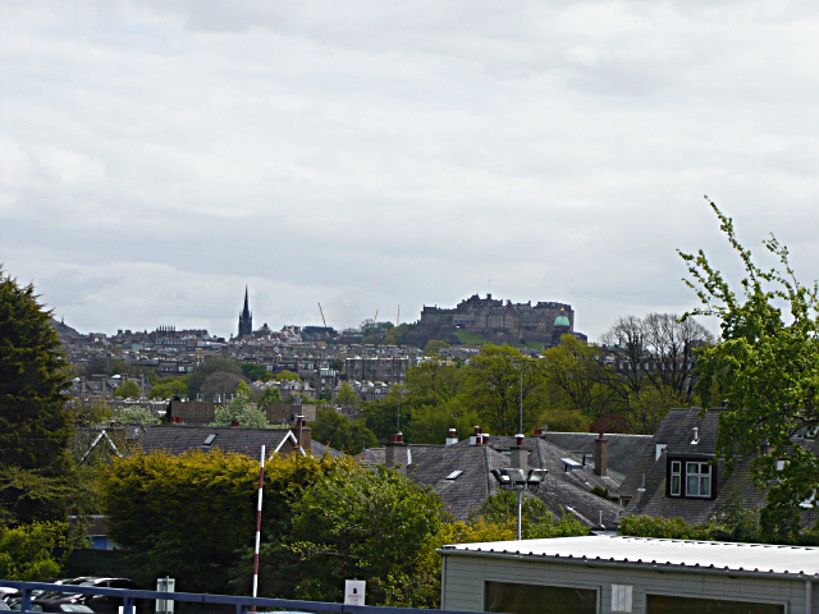
This scene has become very familiar to me over the last four weeks:
It’s the Edinburgh skyline I can see from the Edinburgh Western General Hospital. The tall spire towards the left of the photo is the Scott Monument in Princes Street Gardens. Moving to the right of that is the fortress that is Edinburgh Castle and below that the green dome is the copper-clad dome of West Register House, one of the buildings of the National Archive of Scotland, in Charlotte Square.
And this is why – it’s the view from the Edinburgh Cancer Centre, where I’ve been going for the last four weeks. (Last week I wrote about being diagnosed with a breast cancer – see this post.)
It’s not as grim inside as it looks outside – it’s quite nice actually. I’ve got two more sessions of radiotherapy next week and then that is the end of my treatment, apart from follow-up appointments and a bone density scan. I’ll be glad to get back to ‘normal’. Maybe then I’ll get back to writing about books – I’ve got quite a pile lined up to review.
A couple of years ago we went to the Glasgow Science Centre on the banks of the River Clyde .
Entrance to Glasgow Science Centre
There is so much to see and do in the Centre, not least the Planetarium which dominates the scene as you approach the entrance.
You can go up to the roof, where the view is excellent:
View of Glasgow from the Science Centre
The armadillo shaped building on the north bank of the Clyde is the Scottish Exhibition and Conference Centre, where, amongst other events, they hold hold auditions for X-Factor.
The Planetarium is fascinating – I wished it was possible to take photos inside, but of course I couldn’t. It was enough, though, to sit back and gaze upon the night sky and have constellations and planets pointed out to me.
Coldstream is our nearest Scottish town, the other side of the River Tweed. The view as you approach from the English side of the border is dominated by this monument that towers 70 feet above the town. It’s known as ‘Charlie‘ and was erected in 1834 as a tribute to Sir Charles Marjoribanks who was the first Liberal Member of Parliament for Berwickshire after the Reform Act of 1832. He died in 1833 at the age of 39.
'Charlie' - Sir Charles Marjoribanks
Below my photo is rather dark, just showing the silhouette of the statue as it rears up behind the houses in front and below it.
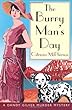
This is the second in Catriona McPherson’s Dandy Gilver series.
Synopsis (taken from the back cover):
August 1923, and as the village of Queensferry prepares for the annual Ferry Fair and the walk of the Burry Man, feelings are running high. Between his pagan greenery, his lucky pennies and the nips of whisky he is treated to wherever he goes, the Burry Man has something to offend everyone wherever he goes whether minister, priest or temperance pamphleteer. And then at the Fair, in full view of everyone – including Dandy Gilver, present at the festivities to hand out prizes he drops down dead.
It looks as though the Burry Man has been poisoned – but if so, then the list of suspects must include everyone in the town with a bottle of whisky in the house, and, here in Queensferry, that means just about everyone …
Part of my interest in The Burry Man’s Day is that it is set in South Queensferry, on the south shore of the Firth of Forth, now part of the city of Edinburgh, formerly in the County of Linlithgowshire. I’ve been there once. It’s close to the Forth Road Railway Bridge:
Forth Road Railway Bridge
I haven’t seen the Burry Man’s Parade, which features strongly in this book; it must be a strange sight.
The book has a rather slow start, but it’s one I enjoyed for all its historical detail about the place, its traditions and the people. It has a great sense of place, with amap of Queensferry at the beginning of the book which helps you follow the action. I wasn’t very taken with Dandy Gilver. I liked her more in a later book in the series. In this book she comes across as a busy-body, albeit kind-hearted, and a snob, but then that’s probably just a reflection of the class structure of the times. She’s married to Hugh, who seems to spend his life hunting and shooting and managing his large estate at Gilverton in Perthshire. Dandy doesn’t have much in common with him, being rather bored by life at Gilverton and Hugh doesn’t feature much in this book.
This is Dandy’s second investigation and I suppose if I read the first book, After the Armistice Ball, I might understand her relation with Hugh and with Alec Osborne, her co-investigator. That’s one of the drawbacks of reading a series out of order.
There’s a lot more to this mystery than the death of Robert Dudgeon, who been the Burry Man for 25 years. He’d been extremely reluctant to take the part this year and the question why was that remained unanswered for the majority of the book. I had an idea about the reason, but only guessed part of it. It’s a convoluted tale and the motive for the murder is buried deep in the descriptions of the characters and their histories. It’s a book you need to concentrate on, and at some points I did have difficulty in sorting out some of the minor characters. Other than that I think it’s a very good book, although maybe a bit too long.
I took these photos of Smailholm Tower, near Kelso in the Scottish Borders on a grey day in November last year. It’s open to the public, but in the winter it’s only open at the weekends and we went on a weekday! We keep meaning to go back and see the inside.
I think it’s an impressive sight!
It’s a peel tower perched on top of a rocky crag, originally built in the 15th/16th centuries to protect its occupants from English raiders. It’s now a Scheduled Ancient Monument in the care of Historic Scotland.
Although the Tower now stands alone on the crag it was once the centre of a small castle toun. Sir Walter Scott stayed with his grandparents who lived at Sandyknowe Farm in the hollow near the Tower, where his parents hoped his delicate health would improve. It was there that his love of the Borders began as his aunt and grandmother recited to him ballads and Border tales and legends.

 It’s not as grim inside as it looks outside – it’s quite nice actually. I’ve got two more sessions of radiotherapy next week and then that is the end of my treatment, apart from follow-up appointments and a bone density scan. I’ll be glad to get back to ‘normal’. Maybe then I’ll get back to writing about books – I’ve got quite a pile lined up to review.




 BooksPlease