Spell the Month in Books July 2025

Spell the Month in Books is a linkup hosted by Jana on Reviews From the Stacks on the first Saturday of each month. The goal is to spell the current month with the first letter of book titles, excluding articles such as ‘the’ and ‘a’ as needed. That’s all there is to it! Some months there are optional theme challenges, such as “books with an orange cover” or books of a particular genre, but for the most part, any book you want to use is fair game!

The optional theme this month is “set in a fantasy world or fictional place”. I thought this would be difficult but I managed to find books I’ve read for all the letters in JULY for this theme except for Y!
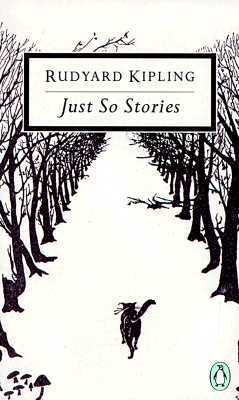
J is for Just So Stories for Little Children written and illustrated by Rudyard Kipling

This book contains Rudyard Kipling’s 1902 collection of short stories, Just So Stories. They are stories he told his daughter, Effie (Josephine) as bedtime stories – fantastic accounts of how various features of animals came to be. Kipling explained: ‘in the evening there were stories meant to put Effie to sleep, and you were not allowed to alter those by one single little word. They had to be told just so; or Effie would wake up and put back the missing sentence.’

My favourite is The Cat That Walked by Himself about when the tame animals were all wild. The wildest of all was the Cat and this is Kipling’s explanation of how the cat came to use humans for its own comfort but remained independent, walking in the Wet Wild Woods, ‘waving his tail and walking by his wild lone.’ Kipling’s illustrations in this book are perfect.

It also includes: ‘How the Whale got His Throat’, ‘How the Camel Got His Hump’, ‘How the Rhinoceros Got His Skin’, ‘How the Leopard Got His Spots’, ‘The Elephant’s Child’, ‘The Sing-Song of Old Man Kangaroo’, ‘The Beginning of the Armadillos’, ‘How the First Letter was Written’, and more. 
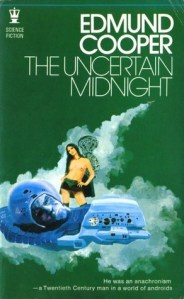
U is for The Uncertain Midnight by Edmund Cooper

The author wrote that he had written this book before the Space Age, before the development of lasers, before it was possible to give a man a new heart.

I like it because of that; it’s low on technology and high on philosophy. It’s not set in outer space, but firmly on Earth  – but Earth in the 22nd century, a world run by machines, androids, who have taken over the burdens of work and responsibility, a world where the humans are required to spend their lives in leisure pursuits, but are subject to ‘Analysis’ (brain-washing) if the androids think they are maladjusted .

John Markham emerges in 2113 after spending 146 years in suspended animation, frozen deep under ground after an atomic holocaust had devastated his world. In 2113 not all humans were happy to leave everything to the androids. Known as Runners these humans believed in ‘human dignity, freedom of action and the right to work’. Markham struggles to adapt and this raises the question of whether the androids could be said to be alive – leading to discussions about the definition of life, the difference between determinism and free will, and eventually leading to war between the androids and the Runners.

L is for The Ladies of Grace Adieu and other Stories by Susanna Clarke
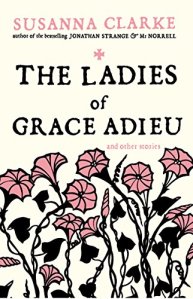
As a child I read all the fairytale books I could find and The Ladies collection takes me back to the magical world of those stories. They are full of deep dark woods, paths leading to houses that seemingly move locations, ladies who are never what they appear to be, princesses, owls, and above all fairies, including the Raven King.

The stories are all captivating and strange and set up echoes in my mind of such fairytales, as Rumpelstiltskin (in On Lickerish Hill). My favourite stories are The Ladies of Grace AdieuMrs Mabb, and The Duke of Wellington Misplaces His HorseThe Ladies explains why Jonathan Strange prevented his clergyman brother-in-law from an engagement with Cassandra Parbringer as Strange discovers that his magic is no match for Cassandra and her two friends, the three bewitching ladies of Grace Adieu.

The story I enjoyed the most was The Duke of Wellington Misplaces His Horse. I have not read any of Neil Gaiman’s books, but I think I really should. The story of the Duke’s horse is set in Wall, a village in the world created by Neil Gaiman and Charles Vess, where there is an actual wall dividing our world and the world of Faerie, guarded by burly villagers with cudgels. The proud Duke, the Nation’s Hero, passes unchallenged by the intimidated villagers into Faerie, in pursuit of his horse. His fate is then seemingly set in stitches in a magnificent piece of embroidery in exquisite pictures. The Duke’s fate depends on whether he can alter the future shown in the embroidery. The ending has a satisfying twist.
Y is for Young Wizards Series: The First Three Books  by Diane Duane. I haven’t read these books. If you have please let me know what you think about them.

Nita is just looking for an escape from her bullies when she stumbles upon an odd book in thelibrary: “So You Want to Be a Wizard.” Nita at first thinks it s a joke. But once she reads the mysterious book, an alternate universe of Manhattan reveals itself to Nita and her friend Kit. The pair embark on a terrifying adventure where real life and magic intertwine and they find themselves entrenched in a battle between good and evil.

Join Nita and Kit on their magical adventures in the Young Wizards starter pack dive deep into the ocean of Deep Wizardry where whales are wizards and ancient rituals are performed by sharks and dolphins. From the sea to the sky, join the dynamic duo on their third and most frightening challenge yet: Nita s little sister, Dairine. Not only is she too smart for a ten-year-old, but she just became a wizard with almost limitless power. Kit and Nita end up chasing her across the galaxy before she gets into trouble so deep no one can rescue her.

For fans of magic with a thirst for adventure, dive right in with the Young Wizards starter pack, which contains three books: “So You Want to Be a Wizard, Deep Wizardry, “and “High Wizardry. “”

The next link up will be on August 2, 2025 when the optional theme will be Written by your favorite author(s)
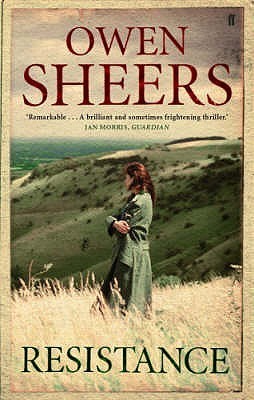
Resistance by Owen Sheers

I decided to read Resistance by Owen Sheers for the Reading Wales Month 2025 hosted by Karen at BookerTalk. It’s another one of my TBRs, a paperback that I bought in 2008. It was first published in 2007 by Faber and Faber (349 pages). Resistance was his first novel.

Owen Sheers was brought up in Abergavenny. The winner of an Eric Gregory Award and the 1999 Vogue Young Writer’s Award, his first collection of poetry, The Blue Book, was shortlisted for the Welsh Book of the Year.

From Owen Sheer’s website:

1944. After the fall of Russia and the failed D-Day landings, a German counter-attack lands on British soil. Within a month, half of Britain is occupied.

Sarah Lewis, a 26-year-old farmer’s wife, wakes to find her husband Tom has disappeared. She is not alone. All the other women in the isolated Welsh border valley of Olchon also wake to find their husbands gone. With this sudden and unexplained absence the women regroup as an isolated, all-female community and wait, hoping for news.

A German patrol arrives in the valley, the purpose of their mission a mystery. When a severe winter forces the two groups into co-operation, a fragile mutual dependency develops. Sarah begins a faltering acquaintance with the patrol’s commanding officer, Albrecht Wolfram. But as the pressure of the war beyond presses in on them, the valley’s delicate state of harmony is increasingly threatened, before being broken completely, with devastating consequences.

Imbued with immense imaginative breadth and confidence, Owen Sheers’ debut novel unfolds with the pace and intensity of a thriller. A hymn to the glorious landscape of the border territories and a gripping portrait of a community under siege, Resistance is a first novel of considerable grace and power.

My thoughts:

I love historical fiction, but this is different – it is alternate history. Sheers speculates upon how the course of history might have been altered if Germany had won the Second World War and invaded and occupied Great Britain, an alarming prospect. The plot centres on the inhabitants of the isolated Olchon valley in the Black Mountains of south-east Wales close to Hereford and the border between Wales and England.  It’s set in 1944–45, shortly after the failure of Operation Overlord and a successful German counter-invasion of Great Britain.  

I enjoyed it mainly for Sheers’ beautiful descriptions of the Welsh countryside, so vivid that I can easily imagine I was there, and the daily tasks of farming life, but this does make it slow reading. The main characters are Sarah, and the other women, Maggie, Mary, Menna and Bethan, living in the valley whose husbands had left, Albrecht, an English speaker and ex-Oxford scholar, who leads a German patrol ordered to establish an observation post in the valley, and George, a teenager, recruited by ‘Tommy Atkins’, a British Intelligence officer, to join the British Resistance movement observing the enemy troop movements.

This is a very visual book, and character driven with very little action until the second half of the book. After reading so much crime fiction and fast action novels I had to adapt my reading speed to appreciate this book and to fully enjoy it. It’s a book to read slowly absorbing the language and descriptions. I particularly liked the details about the Welsh poet, who told Sarah of the tales of King Arthur, Lancelot and Percival (knights of the Round Table) and about Welsh princes, Irish princesses and English armies. One of the stories was about a Welsh king and his army, beaten in the hills by Edward I. Beaten but not killed and not captured and never seen again.

Thousands of men swallowed within the muscles of the earth that formed Wales’ natural defences against her invaders. And they were still there. At this point the poet paused in his painting, placed his brush into a cloudy jar of water and leant closer to Sarah’s listening face. His voice dropped, so quiet she could barely hear him over the running of the streams. Yes, he’d whispered, still there in the hills, deep inside them, buried under the peat, heather, gorse, rowan, bog-cotton, stone and soil. Asleep. Not dead, asleep. An entire army and their king, ready to wake and defend the country in its hour of need. (pages 176 and 177)

Sarah wonders if that’s where their husbands have gone deep underground. She wanted to believe that it was so, that their husbands would be coming back to defend their country. This is a story I’ve come across before, but in England, a legend of a cavern beneath Alderley Edge in Cheshire, full of knights in armour awaiting a call to decide the fate of a great battle for England. There is no king named, but there is a wizard involved, who is referred to as Merlin in later versions of the legend.

Another part that struck a chord with me is when Albrecht took Sarah up into the hills, luring her through a crack in the rock in the cliff wall to a large cavity, where the Mappa Mundi was kept hidden from the SS. It’s a medieval map of the world – I’ve seen it in Hereford Cathedral. Scholars believe it was made around the year 1300 and shows the history, geography and destiny of humanity as it was understood in Christian Europe in the late thirteenth and early fourteenth centuries. In his Afterword Owen Sheers states that the Mapp Mundi was removed from Hereford Cathedral and eventually kept in a coal mine in Bradford-upon-Avon.

There is much more in this book that I’ve not described – the relationship between the women and the Germans, particularly that between Sarah and Albrecht, who eventually realised what they had in common, a love of music and literature. I haven’t described how the wider community reacted to the invasion, and the suspicion and fear that they all experienced. And, having said that there is very little action in this book there is plenty of detail and thoughts about war, occupation, death and above all about Wales. The ending is particularly poignant.

Owen Sheers’ Afterwood explains where he got the idea to write an alternative history. He had first heard of the plans for a British resistance organisation when he was working for a builder in the Llanthony valley and the builder told him how during the war some farmers in the area were given caches of arms which they’d hidden in underground bunkers in the hills. Should the orders come they were to leave their homes and wives and take to the Black Mountains to resist the German army. Later on, in 2001 he heard a radio interview on the Today programme with George Vater, who had, as a young man, been recruited into the Auxiliary Units Special Duties Section comprising local people trained to spy on an occupying German force. Sheers knew George Vater and visiting him, George had shown him cuttings, maps and photographs and told how he had been approached by a man calling himself ‘Tommy Atkins’ who invited to join his Special Duties Section. So, whilst this is a work of fiction it is based on fact, woven into Sheers’ story and he writes that only the valley is real.

I enjoyed it far more than I expected and I’d love to read more of Owen Sheers’ work.

Spell the Month in Books – March 2025

Spell the Month in Books is a linkup hosted by Jana on Reviews From the Stacks on the first Saturday of each month. The goal is to spell the current month with the first letter of book titles, excluding articles such as ‘the’ and ‘a’ as needed. That’s all there is to it! Some months there are optional theme challenges, such as “books with an orange cover” or books of a particular genre, but for the most part, any book you want to use is fair game!

This option this month is Science Fiction. I don’t read much science fiction these days, but I used to read a lot. I’ve chosen some books I read long before I began writing about books, some I’ve read more recently and some books that I own but haven’t read yet. The descriptions in italics are taken either from Amazon UK or from Goodreads.

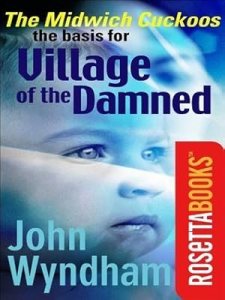
M is for The Midwich Cuckoos by John Wyndham (my review).

The story is set in an ordinary village, with a village green and a white-railed pond, a church and vicarage, an inn, smithy, post office, village shop and sixty cottages and small houses, a village hall, and two large houses, Kyle Manor and The Grange. A very ordinary village where not much goes on, which makes what happens there even more extraordinary. It’s eerie and very chilling, a story of alien invasion and the apparent helplessness of humanity to put up any resistance.

The Midwich Cuckoos is the classic tale of aliens in our midst, exploring how we respond when confronted by those who are innately superior to us in every conceivable way.

In the sleepy English village of Midwich, a mysterious silver object appears and all the inhabitants fall unconscious. A day later the object is gone and everyone awakens unharmed – except that all the women in the village are discovered to be pregnant.

The resultant children of Midwich do not belong to their parents: all are blonde, all are golden eyed. They grow up too fast and their minds exhibit frightening abilities that give them control over others and brings them into conflict with the villagers just as a chilling realisation dawns on the world outside . . .

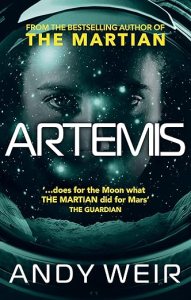
A is for Artemis by Andy Weir – a TBR, a book I bought after watching, The Martian, the film of his first book.

WELCOME TO ARTEMIS. The first city on the moon.
Population 2,000. Mostly tourists.
Some criminals.

Jazz Bashara is one of the criminals. She lives in a poor area of Artemis and subsidises her work as a porter with smuggling contraband onto the moon. But it’s not enough.

So when she’s offered the chance to make a lot of money she jumps at it. But though planning a crime in 1/6th gravity may be more fun, it’s also a lot more dangerous.

When you live on the moon, of course you have a dark side…

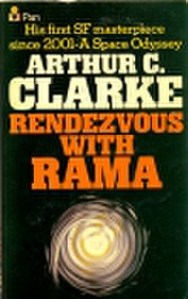
R is for Rendezvous with Rama. This is a book that we bought many years ago. I’m not sure whether I’ve read it or not. It was first published in 1973, so I’m guessing we bought it in the 1970s, the period when we were reading lots of science fiction.

The multi-award-winning SF masterpiece from one of the greatest SF writers of all time

Rama is a vast alien spacecraft that enters the Solar System. A perfect cylinder some fifty kilometres long, spinning rapidly, racing through space, Rama is a technological marvel, a mysterious and deeply enigmatic alien artefact.

It is Mankind’s first visitor from the stars and must be investigated …

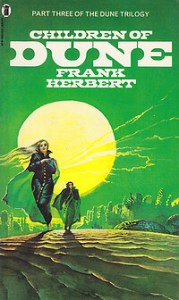
C is for Children of Dune by Frank Herbert, the third Dune novel. I read all the Dune books many years ago.

The Children of Dune are twin siblings Leto and Ghanima Atreides, whose father, the Emperor Paul Muad’Dib, disappeared in the desert wastelands of Arrakis nine years ago. Like their father, the twins possess supernormal abilities–making them valuable to their manipulative aunt Alia, who rules the Empire in the name of House Atreides.

Facing treason and rebellion on two fronts, Alia’s rule is not absolute. The displaced House Corrino is plotting to regain the throne while the fanatical Fremen are being provoked into open revolt by the enigmatic figure known only as The Preacher. Alia believes that by obtaining the secrets of the twins’ prophetic visions, she can maintain control over her dynasty.

But Leto and Ghanima have their own plans for their visions–and their destinies….

H is for The Handmaid’s Tale by Margaret Atwood – another book I read long before I began reviewing books.

Discover the dystopian novel that started a phenomenon.

Offred is a Handmaid in The Republic of Gilead. She is placed in the household of The Commander, Fred Waterford – her assigned name, Offred, means ‘of Fred’. She has only one function: to breed. If Offred refuses to enter into sexual servitude to repopulate a devastated world, she will be hanged. Yet even a repressive state cannot eradicate hope and desire. As she recalls her pre-revolution life in flashbacks, Offred must navigate through the terrifying landscape of torture and persecution in the present day, and between two men upon which her future hangs.

The next link up will be on April 5, 2025 when the theme will be: Animal on the Cover or in the Title.

Top Ten Tuesday: Books Set in Another Time

Top Ten Tuesday is a weekly meme created by The Broke and the Bookish and now hosted by Jana at That Artsy Reader Girl. For the rules see her blog.

The topic this week is Books Set in Another Time (These can be historical, futuristic, alternate universes, or even in a world where you’re not sure when it takes place you just know it’s not right now.)

The difficulty I had with this post was choosing which books to feature out of so many possibilities. I decided to pick books that are set in the past and also in the future. I’ve listed them in chronological order.

The Past:

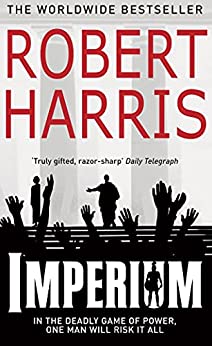
1.Imperium by Robert Harris, the first in his Cicero Trilogy, beginning in 79 BC, this book set in the Republican era is a fictional biography of Marcus Tullius Cicero by Tiro, his slave secretary.

Tiro was a real person who did write a biography of Cicero, which has since been lost in the collapse of the Roman Empire. Harris has based Imperium on, among other sources, Cicero’s letters, which Tiro had recorded, successfully interweaving Cicero’s own words with his own imagination.  It is basically a political history, a story filled with intrigue, scheming and treachery in the search for political power as Cicero, a senator, works his way to power as one of Rome’s two consuls. I marked many passages that struck me as interesting and felt much of the struggle for power applies as much today as it did in Ancient Rome.

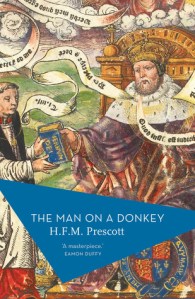
2. The Man on a Donkey by H,M, F. Prescott – set in 1536 -1537 (covering the same period as Hilary Mantel’s Wolf Hall trilogy)

An enthralling novel about a moment in history when England’s Catholic heritage was scattered to the four winds by a powerful and arrogant king. In 1536, Henry VIII was almost toppled when Northern England rose to oppose the Dissolution of the Monasteries. For a few weeks Robert Aske, the leader of the rebels, held the fate of the entire nation in his hand. It’s written in the form of a chronicle, written from the various characters’ viewpoints telling the story of the Pilgrimage of Grace. The Pilgrimage of Grace was not a revolution against Henry but an attempt to get him to change his mind and to understand how people felt. They wanted Henry to stop the dissolution and his attacks on the monks and nuns and to return the country to following the Pope.

Just like Mantel’s books, this book transported me back to that time, with lyrical descriptions of the settings, both of the countryside and of the towns, of Marrick Priory and of the king’s court, of the people, and the mood of the times, both religious and political. 

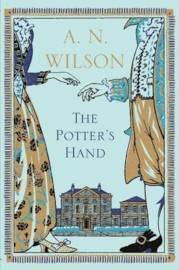
3. The Potter’s Hand by by A N Wilson – beginning in 1768 and roughly following the fortunes of the Wedgwood family until 1805, ten years after the death of Josiah Wedgwood, an English potter and the founder of the Wedgwood company.

For me it really did convey what it must have been like to live in that period – whilst the the American War of Independence, the French Revolution, were taking place. It was a time of great change (what time isn’t?) both social and political change as the industrial revolution got under way in England. It’s full of ideas about colonialism, the abolition of slavery, working conditions, and women’s rights. It brought about small changes as well as big ones.

It’s big on character (lots of them), the main ones being Josiah Wedgwood himself, ‘Owd Wooden Leg‘, his daughter Sukey, his nephew Tom Byerley, his childhood friend Caleb Bowers and Blue Squirrel, an American Cherokee Tom fell in love with in America. Overall it is the story of a remarkable family, their lives, loves, work, illnesses, depressions, addictions and deaths. 

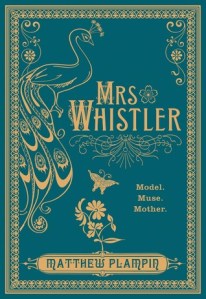
4. Mrs Whistler by Matthew Plampin – 1876 to 1880

I loved this novel about the American artist James McNeill Whistler and his model and mistress, Maud Franklin, the ‘Mrs Whistler‘ of the title. The book covers two episodes in their lives during the years 1876 to 1880 – a bitter feud with his patron Francis Leyland about his fee for painting The Peacock Room, and the libel trial in which Whistler sued the art critic John Ruskin, over a review that dismissed him as a fraud. These two events brought Whistler to the point of bankruptcy.

It’s a long book that moves quite slowly through these four years. I loved all the detail – of Whistler’s impetuous and rebellious character, his relationship with his brother and mother (the real Mrs Whistler), as well as with Maud – and the details of the house he had built in London on Tite Street in Chelsea, which he called the White House, his flight to Venice and most of all about his paintings.

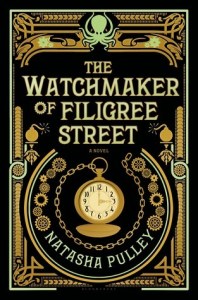
5. The Watchmaker of Filigree Street by Natasha Pulley – Victorian times, a mixture of historical fact and fantasy

This is set both in London and Japan, following the lives of the main characters, Thaniel Stapleton, Keita Mori and Grace Carrow. I was completely convinced by the setting in a different time in a world that was familiar and yet so different.

Keita Mori is an interesting character and as I read my opinion of him kept changing – just who is he? He is an enigma, why is he living in London, is he the bomb maker, does he in fact know what is going to happen, is he a magician? He baffled and confused me as much as he baffled and confused the other characters.

Equally fascinating are the sections set in Japan; Grace’s story, her research into luminiferous ether (a bit hard to follow), her relationship with Akira Matsumoto, the elegant son of a Japanese nobleman; the Japanese show village in Hyde Park where Gilbert and Sullivan went to research for the Mikado; the early days of the London Underground; and of course the clockwork inventions, in particular Katsu, the clockwork octopus.

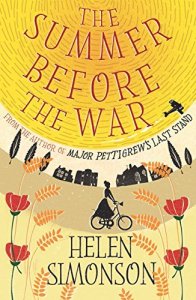
6. The Summer Before the War by Helen Simonson – 1914

This is really a book of two parts – the months before the outbreak of the First World War and then the events as the war got underway. It’s set in the  summer of 1914, in Rye in East Sussex when spinster Beatrice Nash arrives to teach Latin at the local grammar school. It begins slowly with the first part describing the lazy, idyllic summer and in which all the characters are introduced. Although there is a clear distinction between the classes in society cracks are beginning to appear which will only widen as the century gets under way and the war acts as a catalyst for change.

Simonson doesn’t hold back on the horrific conditions under which the war took place and from a gentle beginning the book moves into a war novel, emotional and moving.

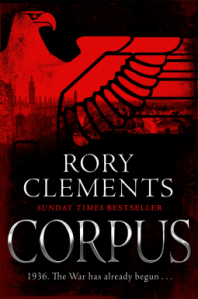
7. Corpus by Roy Clements – 1936

Set in 1936, a time when Europe was once more on the brink of war. Civil war has broken out in Spain, in Britain some people are openly supporting the Nazis in Germany and politicians are torn between wanting Edward VIII to abdicate the throne or give up his relationship with Wallis Simpson.

When a renowned member of the county set and his wife are found horribly murdered, Tom Wilde a history professor, finds himself dragged into a world of espionage which, until now, he has only read about in books. But the deeper he delves, the more he wonders whether the murders are linked to the death of the girl with the silver syringe – and, just as worryingly, to the scandal surrounding King Edward VIII and his mistress Wallis Simpson…

The Future:

8. The Passengers by John Marrs – the near future

This is a shocking book. I found it riveting, even if it is preposterous, and sinister with a frightening view of the future that may not be that ridiculous. It kept me glued to the page right to the end. Driverless cars have been developed to Level Five, with no steering wheels, pedals or a manual override option. A Hacker has taken over control of the cars, set them on a collision course, and tells each passenger that the destination they programmed into their GPS has been replaced with an alternative location. In approximately two hours time they are going to die. They are trapped inside unable to contact the outside world.

9.The Library of the Dead by T L Huchu, the first book in the Edinburgh Nights series, set in a future or alternative Edinburgh

It’s urban fantasy, with a wealth of dark secrets in its underground. Teenager Ropa, has dropped out of school to become a ghost talker and when a child goes missing in Edinburgh’s darkest streets, Ropa investigates his disappearance. Now she speaks to Edinburgh’s dead, carrying messages to those they left behind. A girl’s gotta earn a living, and it seems harmless enough. Until, that is, the dead whisper that someone’s bewitching children – leaving them husks, empty of joy and strength. It’s on Ropa’s patch, so she feels honor-bound to investigate. But what she learns will rock her world.

10. The Uncertain Midnight by Edmund Cooper – set on Earth in 2113

Earth is a world run by machines, androids, who have taken over the burdens of work and responsibility, a world where the humans are required to spend their lives in leisure pursuits, but are subject to ‘Analysis’ (brain-washing) if the androids think they are maladjusted.

John Markham emerges in 2113 after spending 146 years in suspended animation, frozen deep under ground after an atomic holocaust had devastated his world. In 2113 not all humans were happy to leave everything to the androids. Known as Runners these humans believed in ‘human dignity, freedom of action and the right to work’. Markham struggles to adapt and this raises the question of whether the androids could be said to be alive – leading to discussions about the definition of life, the difference between determinism and free will, and eventually leading to war between the androids and the Runners.

The Invisible Man by H G Wells

The Invisible Man is my Classics Club spin book The rules of the Spin are that this was the book for me to read by 3rd March 2024 and I did. In fact I finished it about two weeks early and only got round to writing about it a few days ago. The Invisible Man was first published in 1897, a science fiction novel, originating in Pearson’s Weekly. But it was not quite what I expected. And I certainly didn’t expect it to turn into slapstick comedy.

Synopsis from Amazon

‘The man’s become inhuman … He has cut himself off from his kind. His blood be upon his own head.’

One night in the depths of winter, a bizarre and sinister stranger wrapped in bandages and eccentric clothing arrives in a remote English village. His peculiar, secretive activities in the room he rents spook the locals. Speculation about his identity becomes horror and disbelief when the villagers discover that, beneath his disguise, he is invisible.

Griffin, as the man is called, is an embittered scientist who is determined to exploit his extraordinary gifts, developed in the course of brutal self-experimentation, in order to conduct a Reign of Terror on the sleepy inhabitants of England. As the police close in on him, he becomes ever more desperate and violent.

In this pioneering novella, subtitled ‘A Grotesque Romance’, Wells combines comedy, both farcical and satirical, and tragedy – to superbly unsettling effect. Since its publication in 1897, The Invisible Man has haunted not only popular culture (in particular cinema) but also the greatest and most experimental novels of the twentieth century.

My thoughts

Griffin, a scientist, is a stranger to the village of Iping in West Sussex, staying at the Coach and Horses Inn. His story is a sad one. Whilst experimenting he has managed to make himself invisible, and dresses from top to toe in clothes, which even in winter makes him stand out from the crowd. Everything he does leads everyone to wonder what is wrong with him and draws attention to himself. What follows grows in intensity, as Griffin causes first confusion, then panic and finally madness. There’s a lot of shouting, pushing and fighting and surprisingly (to me at any rate) quite a lot of comedy – after all the invisible man is as naked as a new born baby.

I enjoyed it. There’s not much to the plot, it’s mainly a character study really, but what an amazing personality. And being invisible is not what he had thought – having to walk around with no shoes or socks on, especially in winter is not funny, neither is the sight of undigested food floating around mid-air. But it is worse than that because Griffin is only at the start of his escapade. By the end he is stark staring bonkers. Wells demonstrates the dangers of using science beyond control. Griffin has succeeded in lowering the refractive index of his body to make it invisible – ‘Either a body absorbs light or reflects it, or refracts it, or does all these things. If it neither refracts nor absorbs light, it cannot of itself be visible.’

Sadly, the end is all violence and drama!

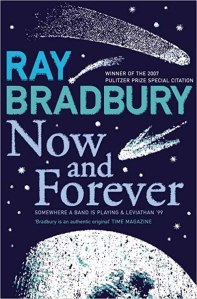
Two Novellas in Now and Forever by Ray Bradbury:#NovNov22

HarperVoyager| 25 June 2012| 240 page| e-book| 4*

Now and Forever is the first book by Ray Bradbury that I’ve read. It contains two novellas – Somewhere a Band is Playing, in which a young writer discovers that all is not as it seems in a nostalgic community, and Leviathan ’99, a retelling of Moby Dick set in space. Two very different stories, each one fascinating, and both with a long history, as Bradbury wrote each one over several decades. They contrast both in style and content. I enjoyed both, but Leviathan ’99 is my favourite.

In the first, Somewhere a Band is Playing, (102 pages) a reporter James Cardiff arrives in Summerton, a small town in the middle of Arizona, a town which seems perfect, a quiet peaceful place. He can hear in the air the quiet sound of a band playing. But the more he explores the more mysterious Summerton becomes. For one thing there are no children and no hospitals or doctors because no one gets ill and even stranger the graves in the cemetery are empty. The story has a nostalgic feel, a sense of melancholy and myth as James, under the guidance of a beautiful young woman, Nefertiti, discovers the truth about Summerton.

Bradbury’s introduction to Somewhere a Band is Playing explains that he begun writing a screenplay and short story about a small town somewhere in the desert and how he had kept encountering Katharine Hepburn either in person or on the screen and was attracted by the fact that she remained youthful throughout the years. Then in 1956 she had made the film Summertime and this had led him to put her at the centre of a story and so Somewhere a Band is Playing slowly evolved. Another element of the story came when he saw the film, The Wind and the Lion and was so taken with the score that he wrote a long poem based on the enchanting music. He then put these elements together to produce this novella, which he dedicated to Anne Hardin, who had encouraged his work and to Katharine Hepburn.

Leviathan ’99’ (101 pages) is dedicated to Herman Melville because after spending a year writing the screenplay for John Huston’s Moby Dick he’d fallen under the spell of Melville and his ‘leviathan whale’. Bradbury then wrote his first script of Leviathan ’99’, which was eventually produced by BBC Radio in London, then as a longer version as a play in 1972. Finally thirty years later he finished writing it as a novella as his ‘final effort to focus and revitalize what began as a radio dream.’

I haven’t read Moby Dick, but I enjoyed this story about spaceships instead of sailing ships, mad astronaut captains instead of seafaring captains and the blind white comet instead of the great white whale. It’s set in 2099 and begins as Ishmael, an astronaut joins the Cetus 7, the largest interstellar ship ever built. The spaceship is on a mission, travelling beyond the stars. His cubicle roommate is Quell, a seven feet tall, green spider who is a telepath. The captain is mad, obsessed with finding the comet, Leviathan, the largest comet in history that had blinded him thirty years earlier. As Quell described it ‘the universe set off a light-year of immensity of photographic flash. God blinked and bleached the captain to this colour of sleeplessness and terror.’

It is an incredible achievement transposing Melville’s 19th century epic into a hundred page novella set in the future.