Saturday Snapshots

My snapshots today are of Inchree Wood and Righ Falls in Glen Righ, on the eastern side of Loch Linnhe, near Glencoe. It was a cool day in September this year when we walked up the woodland trail to see the waterfalls, but the views were still spectacular.

The walk is through woodland with views of Loch Linnhe below:

The waterfall comes into view:

It cascades down the hill side:

The trail continues uphill through broad-leaf and conifer trees:

It’s a good place to see red squirrels:

through the viewing holes:

But we were disappointed not to see one!

See more Saturday Snapshots on Alyce’s blog At Home With Books.

Saturday Snapshot

My Saturday Snapshots this week are some holiday photos from our holiday in Brittany way back in 1988. We had quite an eventful beginning to our holiday because soon after we landed  our car broke down and my French was immediately tested trying to say ‘the accelerator cable has broken’.

After a wait of two hours it was mended and we eventually got to our camp site at Ploumanach, near Perros Guirec on La Cote de Granit Rose, the Pink Granite Coast. The coast with its amazing rock formations was a few minutes walk from our caravan.

Just a few miles along the coast is Le Gouffre, or ‘abyss’, a place where the waves crash against a gap in the cliffs.

And near by is this amazing house wedged between huge granite boulders

It was built in 1861.

For more Saturday Snapshots see Alyce’s Blog At Home With Books.

Saturday Snapshot: Rosslyn Castle

During our recent visit to Scotland we went to Rosslyn Chapel and also to Rosslyn Castle. This was our second visit to the Chapel, but our first to the Castle. (We went to Rosslyn Chapel three years ago – see this post for information on the Chapel and some photos.) On that first visit the Chapel was surrounded with scaffolding and you could go up to the roof. From there you can see the Castle far below the Chapel built on high on a rocky promontory in the Roslin Glen.

The Castle is in Roslin Glen – the nearby village is spelt Roslin, but the Chapel and Castle are spelt Rosslyn – like the earldom. The derivation of the name is from the Celtic words ‘ross‘, a rocky promontory and ‘lynn‘, a waterfall – not as described in The Da Vinci Code as deriving from a longitudinal Rose Line on the north-south meridian that runs through Glastonbury!

This time we decided to go to the Castle after seeing the Chapel. It’s down a little lane between trees and you walk over a bridge to get to the ruins.

It was a dismal rainy day but still the castle ruins stood out – stark and dramatic against the  skyline:

These are the ruins of the original 14th century castle, built in the 1330s for Henry Sinclair, the Earl of Orkney. At that time there was a drawbridge – replaced now by the modern access bridge. Behind the ruined walls you can see what looks like a house:

My photo is dark because by this time it was raining quite heavily. The castle was largely destroyed during the 15th and 16th centuries and was rebuilt in the 16th and 17th centuries as a fortified house with five floors. The building from this side looks like any other house, but from the other side it is enormous. We didn’t go round to see it, but there are photos on the Landmark Trust website showing its size and the renovated rooms that are available to let as holiday accommodation.

The photo below shows the remains of the west wall:

and here are the remains of the gatehouse:

There were only a few other people walking round the ruins, whereas the Chapel was packed, with people arriving in cars and coaches. In fact inside the Chapel it was so crowed you could hardly walk round for other people. I suppose it’s the popularity of The Da Vinci Code that attracts so many people, but it’s hard to get a proper sense of its history and to see its beauty with so many other people there. There is now a Visitor Centre, where you can buy books and souvenirs and get drinks and sandwiches etc, also very crowded.

I preferred the Castle – so atmospheric.

For more Saturday Snapshots see Alyce’s blog At Home With Books.

Saturday Snapshots: Stirling Castle

We spent last week in Scotland. Except for Monday the weather was atrocious with torrential rain on most days. But Monday brought blue skies and glorious sunshine, so we took advantage of the good weather and visited Stirling Castle, maintained and managed by Historic Scotland. This is a most spectacular castle standing high on a volcanic rock. It was one of the most favoured homes of Scottish kings and queens from the 12th century, although it is an ancient site.

I have many photos – here is just a small selection:

A statue of King Robert the Bruce stands outside the modern entrance to the castle:

Robert the Bruce statue

In the background is the National Wallace Monument which overlooks the scene of Scotland’s victory at the Battle of Stirling Bridge in 1297.

Stirling Castle Forework

The Forework (above) was installed by James V around 1500, originally the main entrance, it is now an inner entrance to the castle.

The photo below shows the Queen Anne Garden, which on Monday was being used for a crossbow demonstration – children were queuing to have a go for themselves. Behind the garden is James V’s Renaissance Palace of Princelie Virtue which he had built for himself and his French Queen, Mary of Guise (the parents of Mary Queen of Scots) on the site of earlier buildings.

The pale golden building peeping out beyond the Palace is the Great Hall, commissioned by James IV (who died at Flodden Field in 1513) and completed in 1503. It almost glows in the sunlight because it is covered with ‘king’s gold’ limewash. It has been renovated and was reopened by Queen Elizabeth II in 1999.

Stirling Castle Queen Anne Garden

Just visible in the photo above are the statues on the facade of the Palace and the Prince’s Walk. The statues are grotesque and warlike, portraying monsters hurling missiles south against any invaders. They include one of the Devil, with breasts:

Stirling Castle Devil Statue

There is so much to see and so much history within the Castle that I’d really like to go again one day. As well as the Official Souvenir Guide Book there are guided tours of the castle and an audio tour that you can listen to on your own, if you prefer – which I did.

I have far too many photos for one post, so maybe ‘ll post more photos in due course.

For more Saturday Snapshots see Alyce’s blog At Home With Books.

Saturday Snapshot

I still haven’t sorted out my photos of Glencoe and Glen Nevis from our holiday there the other week. So, in the meantime here are a few photos I took the day we didn’t go to Lyme Regis.

We were staying with my sister on New Year’s Eve nearly five years ago. We had wanted to go to Lyme Regis – to see the Cobb and so on, but when we got there it was so full of people and cars that there was nowhere to park and so we carried on along the coast to Seaton, a small traditional seaside town at the mouth of the River Axe. In contrast to Lyme Regis there were just a few people strolling along the promenade and beach.

Its coastline is part of the Jurassic Coast, a World Heritage Site. The whole Site is 95 miles long and covers a complete record through the Triassic, Jurassic and Cretaceous periods of geological time. The White Cliff at Seaton is composed of white chalk about 90 to 110 million years old.

At the other side of the bay the cliffs are red, which the interpretation board told me are from the Triassic period and the red colour (caused by iron oxide) indicates the climate was hot and dry for much of the year just like present day deserts in the Middle East!

I suppose the lure of fossils, combined with the literary association of Lyme Regis – the Cobb in Jane Austen’s Persuasion and John Fowles’s setting for The French Lieutenant’s Woman mean that more people are attracted to visit Lyme Regis but still Seaton is an interesting place to see – I don’t imagine there are many places you can see a 185 million-year ‘˜geological walk through time’. And I had walked along the Cobb the last time we went to Lyme Regis.

For more Saturday Snapshots see Alyce’s blog At Home With Books.

Saturday Snapshot

I had intended to post some photos of our holiday near Glencoe, but I’m so pleased with ‘these’ that I decided to do a bookish Snapshot instead.

‘These’ are …

Book Darts

I first read about them a while ago and couldn’t find a supplier in the UK and then just the other day I was reminded of them by Stefanie’s post on Reading Accessories and searched for them again – and found they’re available in the UK  through Amazon!

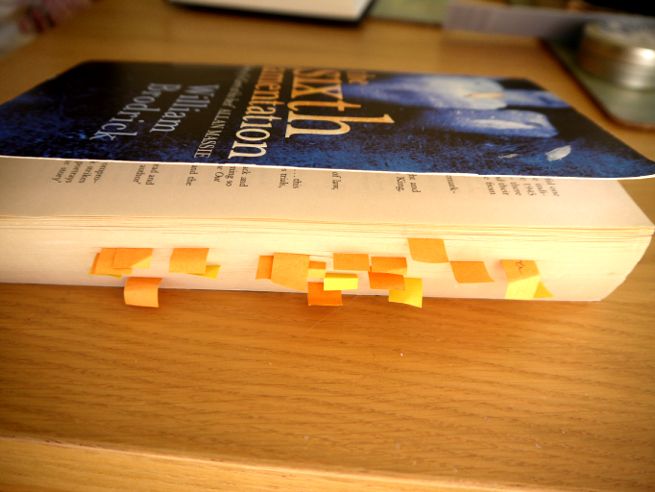
Sometimes I use the very small post-its to mark pages I want to refer to again, but the book darts look so much better. They’re archivally safe and won’t mark or stain the pages and are so neat …

… compared to the post-its:

Post-its

For more Saturday Snapshots see Alyce’s blog At Home with Books.