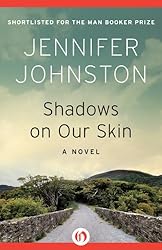
Shadows on Our Skin by Jennifer Johnston

Shadows on Our Skin by Jennifer Johnston has recently been re-issued as an e-book. It was first published in 1977 when it was shortlisted for the Booker Prize. I was pleased to be offered a copy for review as I have enjoyed a few of her books, such as The Illusionist and Two Moons.

This is the story of Joe, living in Derry (Londonderry), Northern Ireland before the Troubles and the Bloody Sunday attack in 1972. Joe is a schoolboy, living with his mother and his alcoholic father, a former war hero who reminisces and feeds on his memories. It’s a violent situation at home, as the father dominates his wife and son, with an even more violent conflict in the streets. To a certain extent Joe lives within his own head, writing poetry, and his mother is keen to keep him indoors once school has finished because she fears he will be shot as the British soldiers patrol the streets. However, he has made friends with Kathleen, a young English teacher and they meet after school. She encourages his writing, enhancing his escape from reality. But when his brother, Brendan returns home his involvement in the IRA brings Joe back to earth with a sharp shock, as the conflict comes closer to home.

Shadows on Our Skin is an engrossing book, the writing is taut and spare and yet poetical, the scenes standing out vividly in my mind. The characters’ interaction is full of emotion, and of tension; their feelings of despair and bitterness are all very evident. The book is certainly an enlightening read for me.

  • Format: Kindle Edition
  • File Size: 515 KB
  • Print Length: 177 pages
  • Publisher: Open Road Media (24 Jun 2014)
  • Sold by: Amazon Media EU S.à r.l.
  • Language: English
  • ASIN: B00KQ6PJZE
  • Source: Review copy

A Place for Us by Harriet Evans

Blurb:

The day Martha Winter decided to tear apart her family began like any other day.

When Martha, a wife and mother of three, sits down one late summer’s morning to write out the invitations to her eightieth birthday celebration, she knows that what she is planning to reveal at the party could ruin the idyllic life she and her husband David have spent over fifty years building…

But she has to let her family know what she and David have sacrificed. She can’t live a lie any more.

The invitation goes out far and wide, calling her three children and their families back home to Winterfold, their rambling house in the heart of the English countryside. They are Bill, the doctor; Florence, the eccentric academic; and Daisy, the child who never fit in. As the story unfolds, each character reveals the secrets, joys, and tragedies they are wrestling with through the confines of the family. What will happen when Martha finally tells the truth? 

My thoughts:

I haven’t read any of Harriet Evans’ books before I read A Place for Us, so I didn’t know what to expect. The Winters appear to be the perfect family, but no family can be that perfect and one by one their secrets begin to surface. Martha Winter is approaching 80 and invites all her family to a party stating that she has an important announcement to make. The book has a slow start as the Winter family is large and it took me a while to get them all clear in my mind – I drew a family tree for myself which helped. It turns out that they are by no means the perfect family – rather dysfunctional in fact.


I thought some characters were more fully developed than others, which makes the book rather disjointed and I was more interested in some at the expense of others, Florence, the younger daughter who is an art historian living in Italy is perhaps the most interesting.


However, after the slow start I soon guessed what the big secret was and I thought it all became too predictable. An entertaining, if undemanding book, which I think could have benefited from being shorter.

My thanks to Lovereading who sent me a copy of this book for review.

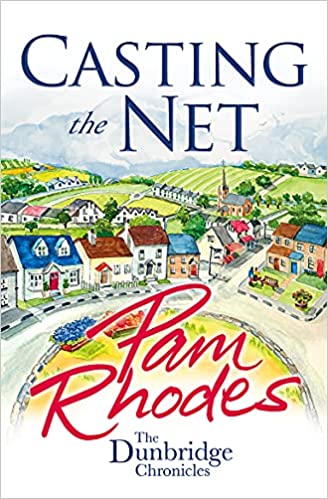
Casting the Net by Pam Rhodes

Blurb:

Heart-warming English comedy of manners, featuring the trials and tribulations of newly ordained minister, Neil FisherIn part two of the Dunbridge Chronicles, Neil Fisher returns from ordination inspired by his sense of ministry, but determined to distance himself from the two ladies in his life. This is not altogether well received, and a wide segment of the congregation of St Stephen’s, Dunbridge–including the music group–points Neil to the error of his ways.

Meanwhile Neil’s close friend Colin and his wife Jeannie are delighted by the birth of a daughter, but is all well with the baby? Neil’s mother Iris continues to meddle, to his irritation. Churchwarden Peter has said a relieved farewell to his flighty wife Glenda–or has he? Dunbridge is not as peaceful as it seems. 

My thoughts:

I liked this light easy-to-read book that deals with serious issues from the Christian perspective. Life in Dunbridge is far from peaceful and the Neil, the curate has many crises to face, not the least being his vicar’s loss of faith. It’s full of interesting characters, painting a picture of life in a small town.

  • Publisher ‏ : ‎ Lion Fiction; 1st New edition (21 Feb. 2014)
  • Language ‏ : ‎ English
  • Paperback ‏ : ‎ 256 pages
  • ISBN-10 ‏ : ‎ 1782640622
  • ISBN-13 ‏ : ‎ 978-1782640622
  • My Rating: 3*

He Wants by Alison Moore

I received a proof copy of He Wants by Alison Moore from Lovereading for review. It will be published in August this year. I began reading with high expectations because I thought I’d like it from the publishers’ synopsis:

Lewis Sullivan, an RE teacher at a secondary school, is approaching retirement when he wonders for the first time whether he ought to have chosen a more dramatic career. He lives in a village in the Midlands, less than a mile from the house in which he grew up. He always imagined living by the sea. His grown-up daughter visits every day, bringing soup. He does not want soup. He frequents his second-favourite pub, where he can get half a shandy, a speciality sausage and a bit of company. When an old friend appears on the scene, Lewis finds his routine and comfortable life shaken up.

However, this synopsis is a bit misleading. Lewis is not approaching retirement – he has already retired. He is looking back over his life and thinking about all the things he had wanted/wants/ does not want.  It’s a book about ageing and unfulfilled expectations. It jumps around mirroring Lewis thought processes as he remembers his childhood, his parents, his wife, his daughter and his friend Sydney.

He Wants is a short book (180 pages in the proof copy). Written in the present tense, it’s a bleak tale of a man whose life did not turn out as he expected or wanted. I don’t have to like the characters to enjoy reading a book, but despite the quality of writing, which is taut and effective in creating an atmosphere of unease and emptiness, I couldn’t take to this book. Lewis’s dissatisfaction with his life compared to how had imagined it would be was just too drab and unrelenting.

Lewis had wanted all sorts of fantastic things. The chapter headings indicate the things he wanted but never got, or the things he did not want and did get: he did not want soup or the sausages, he did not want the boy to be spoiled, he wanted to go to the moon, to live in Australia, to be seen, a time machine and a cup of tea and so on.

Sadly, it was not my cup of tea.

Alison Moore was shortlisted for the Man Book Prize in 2012 with her debut novel The Lighthouse, a book I haven’t read and may check just to see if it’s in the same vein as He Wants.

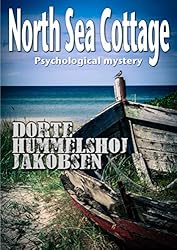
North Sea Cottage by Dorte Hummelshoj Jakobsen

Dorte Hummelshoj Jakobsen’s latest book, North Sea Cottage, is an e-book, a novella set in Denmark. It’s another dual time period book – it seems that each book I’ve read recently is one of these. This one is split between the present day and 1943/4 and it works very well.
I thoroughly enjoyed this book; the cottage in the title is owned by Tora’s aunt, Bergatora. As soon as I began reading I was immediately transported in place away to the other side of the North Sea to Denmark with Tora, and in time back to the Second World War, with her aunt, Bergatora. In just a few words Dorte Hummelshoj Jakobsen draws a vivid picture of the old fisherman’s cottage surrounded by dense sea fog.

Tora is struggling to overcome her own problems when she is faced with a new problem. The old stable next to the cottage catches fire during a thunder storm and in the aftermath of the fire Tora finds a skeleton in the potato cellar under the ruined stable. Who is it who had died in the cellar? Bergatora is reluctant to talk about the war years and her brother, Tora’s father, was too young at the time to help. It was a time when Denmark was under German occupation and a resistance movement was under way. Inspector Thomas Bilgren suspects the victim may have been related to the German occupation.

Tora, helped by Bilgren attempts to discover the truth, but is hampered by the strong character of her aunt and the silence surrounding what happened during the war. I loved this aspect of the book – the delving back into history, the way the narrative switches backwards and forwards, gradually revealing what had happened. North Sea Cottage is only about 90 pages but it has depth both in mystery and in characterisation and the setting is so atmospheric. I was fearful for Tora’s safety as she dug deeper into the mysteries from the past.

Thanks to Dorte Hummelshoj Jakobsen, who kindly sent me a copy of her book. She has a blog – Djskrimiblog and used to be a teacher. She writes both serious mysteries as well as humorous and cosy stories about the Gershwin family in Knavesborough, a fictional village in Yorkshire, publishing in Danish and English. I like her humorous stories but prefer the serious ones like North Sea Cottage and her previous novel, Anna Märklin’s Family Chronicles. She is currently at work on her next novel – Crystal Nights, to be published in 2014/5.

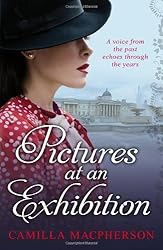
Pictures at an Exhibition by Camilla Macpherson

I enjoyed Pictures at an Exhibition by Camilla Macpherson very much. It’s a dual time period novel moving between the present day and the Second World War, a format I think that can be hard to do successfully. In this book, Camilla Macpherson’s first published novel, I think it is successful as I was equally keen to find out what happened next in both periods.

Pictures at an Exhibition is structured around Daisy’s letters to her cousin Elizabeth telling her about the paintings on display at London’s National Gallery during the war years – one a month. In the present day Claire reads the letters, left to her husband Rob, by his grandmother, Elizabeth. They are not just about the paintings but also about Daisy’s life and the man she meets and loves. Claire meanwhile, is struggling to recover from a tragedy that threatens to overwhelm her and wreck her marriage. She decides to read the letters, one a month, and visit the National Gallery to see the paintings and compare them with Daisy’s descriptions.

I found the characters thoroughly convincing, the settings and the time periods contrasting vividly and loved all the details about the paintings. I also liked the way the characters developed throughout the book. For example, at the beginning of the book, which I found so devastatingly sad, Claire is full of anger and grief, affecting her relationship with Rob:

It was the grief speaking. It could do strange things grief. She had not known that until now. She had never had to know. It had brought with it this desperate, physical need to blame someone, someone who would be right there when she had to lash out – Rob. The only person who was always there. (page 106)

She becomes obsessed with the letters, the paintings and with Daisy’s life. It’s a remarkable portrayal of a woman in crisis and how she managed to find herself again. Daisy’s story is just as convincing describing life in London during the Blitz and along with Claire I really wanted to know more about her and what happened to her.

I think it was the art that drew me to this book in the first place and I found those parts of the book absolutely fascinating. The National Gallery did display one painting a month after most of them had been transported away from London and the bombs for safe keeping. You can see the paintings described by scanning the QR codes at the beginning of each chapter and also see them on Camilla Macpherson’s website, and of course on the National Gallery’s site too. I knew of most of them before, but not all of them and as I was reading I printed copies to see what Daisy and Claire saw.

But by the end of the book it was the characters and the story that had captivated me too.  It’s about life and death, love and loss, grief and relationships and I found it compelling reading – when I wasn’t reading it I was thinking about it and keen to get back to it. It’s a book I want to re-read at some time – and there aren’t many of those.

My thanks go to Camilla Macpherson, who kindly sent me a copy of her book. I look forward to reading more of her work in the future.