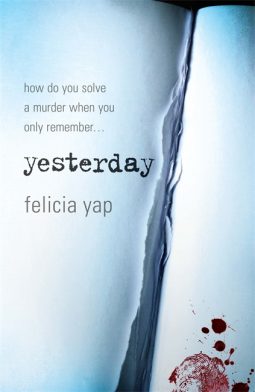
Yesterday by Felicia Yap

Blurb:

There are two types of people in the world. Those who can only remember yesterday, and those who can also recall the day before.

You have just one lifeline to the past: your diary. Each night, you write down the things that matter. Each morning, your diary tells you where you were, who you loved and what you did.

Today, the police are at your door. They say that the body of your husband’s mistress has been found in the River Cam. They think your husband killed her two days ago.

Can you trust the police? Can you trust your husband? Can you trust yourself?

My thoughts:

The nature of memory always fascinates me. Just how much can we rely on our memories – what is real and reliable, how well can we really remember what happened, how much do we bury in our subconscious? In Yesterday by Felicia Yap she has created a world where memory for everyone over the age of eighteen is limited for 70% of people to just one day (the Monos) whilst the rest (the Duos) have two days of memory. Each day everyone has to write down their actions, thoughts and feelings in their iDiaries and then memorise the ‘facts’. But are these ‘facts’ reliable?

This is a murder story, told through extracts from iDiaries and the perspectives of four people, that of the victim, Sophie, Claire a Mono, married for twenty years to Mark, a novelist and prospective MP who is a Duo, and DCI Hans Richardson, who is racing against time to find the murderer.

I found it rather confusing at first, getting my head around the fact that everyone has such a short-term memory. Just how reliable are the four narrators, are they even who they say they are and do they write the truth in their iDiaries?  I think it is an interesting book but I did have to suspend my disbelief, especially towards the end of the book, which I found farcical and rather annoying. It was one twist too far for me. And I couldn’t really get over the fact of how much time you would have to spend writing everything down and then learning what you had done and thought each day.

  • Format: Kindle Edition
  • File Size: 1112 KB
  • Print Length: 401 pages
  • Page Numbers Source ISBN: 0316465259
  • Publisher: Wildfire (10 Aug. 2017)
  • Source: NetGalley
  • My rating: 3*

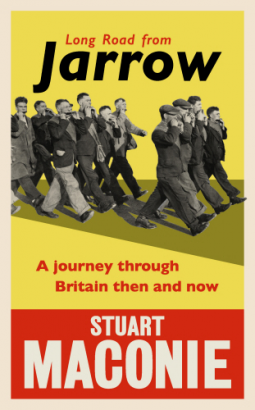
Long Road from Jarrow: A journey through Britain then and now by Stuart Maconie

I knew of the Jarrow March/Crusade in 1936, but not much about it beyond the fact that men from Jarrow in Tyneside marched from their home town to London to present a petition against the mass unemployment and extreme poverty in the north-east of England. Stuart Maconie has filled in the gaps in his excellent book Long Road from Jarrow: A journey through Britain then and now. In October last year he retraced the route they took, 300 miles, comparing what conditions and attitudes were like in 1936 with those of 2016. The men were accompanied for part of their march by Ellen Wilkinson, who was the MP for Middlesbrough East and it was Ellen who presented their petition to the House of Commons. But despite their protest and all Ellen Wilkinson’s efforts on their behalf it didn’t result in any improvements for employment in Jarrow.

Maconie a writer, broadcaster and journalist, writes fluently and with conviction. The Long Road from Jarrow is a mix of travel writing, social and cultural history and political commentary, with the main emphasis on the current social, cultural and political scene. It’s a thought-provoking book that both entertained and enlightened me. Maconie writes about the past, the history of the places he walked through and the tales and reminiscences of the people he met. He also writes with enthusiasm on such topics as football and music and food. It’s a lively, chatty account that includes the thorny topic of Brexit, the current and past state of the north/south divide and considers what it is to be ‘British’.

I was fascinated and thoroughly enjoyed this walk through England, past and present. My copy is an ARC from the publishers via Netgalley.

  • Format: Kindle Edition
  • File Size: 1617 KB
  • Print Length: 365 pages
  • Page Numbers Source ISBN: 1785036319
  • Publisher: Ebury Digital (20 July 2017)

Jane Austen at Home by Lucy Worsley

Jane Austen at Home

Synopsis (Amazon)

On the 200th anniversary of Jane Austen’s death, historian Lucy Worsley leads us into the rooms from which our best-loved novelist quietly changed the world.

This new telling of the story of Jane’s life shows us how and why she lived as she did, examining the places and spaces that mattered to her. It wasn’t all country houses and ballrooms, but a life that was often a painful struggle. Jane famously lived a ‘life without incident’, but with new research and insights Lucy Worsley reveals a passionate woman who fought for her freedom. A woman who far from being a lonely spinster in fact had at least five marriage prospects, but who in the end refused to settle for anything less than Mr Darcy.

My view:

I think it was a foregone conclusion that I would really enjoy Lucy Worsley’s Jane Austen at Home. I have loved Jane Austen’s books for many years, going back to when I was about 12 and read Pride and Prejudice for the first time. I’ve previously read Carol Shields’s biography Jane Austen and Claire Tomalin’s Jane Austen: a Life so there was really very little I learned reading Jane Austen at Home that surprised me or that I hadn’t known before.

I suppose what was new to me was the emphasis on what home life was like during the period of Jane’s life and seeing photos of the houses and places that she had lived or stayed in as a visitor. And I think I gained a better understanding of the social history of Georgian England and of Jane’s wider family connections and what her family and friends thought of her both as a person and as an author.

Lucy Worsley is an historian and has presented several television history programmes. I am not a great fan of her style – the play acting and dressing up – but she writes in a lively, chatty style and reading her book I could easily hear her voice. Jane Austen at Home is both very readable and very detailed, which is not an easy thing to achieve. There is an extensive section at the end of the book, listing sources, a bibliography, notes on the text and an index. There are two sections of colour plates.

Needless to say it has spurred me on to re-read Jane Austen’s books, and I shall probably begin with re-reading Emma, a book I’ve only read once.

I received an e-galley from the publishers via NetGalley for review and part way through reading it I bought a hardback copy to get the finished product.

  • Hardcover: 400 pages
  • Publisher: Hodder & Stoughton (18 May 2017)
  • Language: English
  • ISBN-10: 1473632188
  • ISBN-13: 978-1473632189
  • My rating: 4*

The Secret of Summerhayes by Merryn Allingham

In January I enjoyed reading The Buttonmaker’s  Daughter by Merryn Allingham and hoped there would be a sequel, so I was pleased when Midas Public relations on behalf of the publishers offered me a review copy of The Secret of Summerhayes.

The Secret of Summerhayes

Synopsis (publisher)

A war-torn summer

A house fallen into ruin

A family broken apart by scandal’¦

Summer 1944: Bombed out by the blitz, Bethany Merston takes up a post as companion to elderly Alice Summer, last remaining inhabitant of the dilapidated and crumbling Summerhayes estate. Now a shadow of its former glory; most of the rooms have been shut up, the garden is overgrown and the whole place feels as unwelcoming as the family themselves.

Struggling with the realities of war, Alice is plagued by anonymous letters and haunting visions of her old household. At first, Beth tries to convince her it’s all in her mind but soon starts to unravel the mysteries surrounding the aristocratic family’s past.

An evocative and captivating tale, The Secret of Summerhayes tells of dark secrets, almost-forgotten scandals and a household teetering on the edge of ruin.

My thoughts

I was hoping this would follow on from The Buttonmaker’s Daughter, which ended in 1914 at the beginning of World War One as I wanted to know what happened to the characters during the war, but The Secret of Summerhayes is set in Sussex in 1944 just before and during the D-Day landings in Normandy. So, forty years have gone by and only Alice Summers remains as one of the main characters. Alice’s daughter, Elizabeth had disappeared at the end of the first book and Alice is still hoping, forty years later, that she will return, especially as she has recently received anonymous letters that she thinks are from Elizabeth.

The two books are only loosely connected and I think that they can both be read independently. It’s hard to assess but maybe I would have enjoyed this second book more if I hadn’t read The Buttonmaker’s Daughter, as I kept hoping to find out more about what had happened to Elizabeth in the intervening years.

Summerhayes has changed, what is left of the gardens is overgrown and the house, except for an apartment for Alice, has been requisitioned by the Canadian army and an entire battalion had taken possession of the estate. Beth has been employed to look after Alice, now an old lady in her eighties, still sharp in her mind, although she is very disturbed by the anonymous letters and other unexplained accidents. The only other members of Alice’s family are Gilbert Fitzroy, her nephew and his young son, Ralph, who live at the neighbouring estate of Amberley, where Alice had lived until her marriage.

This is a slow-paced novel as Beth gradually learns a bit about the history of Summerhayes and in particular some of Elizabeth’s story and about the difficult relations between the Summer and Fitzroy families. I think  knowing what had happened in 1914 meant that some of mystery and tension just wasn’t there for me.  Beth becomes friendly with two of the Canadians, Eddie Rich and especially Jos Kerrigan, although she doesn’t want to get too close to Jos as the planned invasion of France draws nearer. Her relationship with Gilbert also complicates matters.

As in The Buttonmaker’s Daughter, the Italian garden plays a major role, but I think what eventually happened was rather predictable (I wonder though if I would think that if I hadn’t read the first book?) The characterisation is good and I liked the main characters very much. Although my knowledge of the events of D-Day is limited it seemed to me that the author has done her research and incorporated the facts seamlessly into the narrative. A list of sources and an author’s note would have been helpful.

  • Paperback: 350 pages
  • Publisher: HQ; First edition edition (27 July 2017)
  • Language: English
  • ISBN-10: 0008193851
  • ISBN-13: 978-0008193850
  • Source: review copy
  • My rating: 3.5*

The House by Simon Lelic

Publication date: 17 August 2017, Penguin

Source: review copy via NetGalley

Blurb:

What if your perfect home turned out to be the scene of the perfect crime?

Londoners Jack and Syd moved into the house a year ago. It seemed like their dream home: tons of space, the perfect location, and a friendly owner who wanted a young couple to have it. So when they made a grisly discovery in the attic, Jack and Syd chose to ignore it. That was a mistake. Because someone has just been murdered. Right outside their back door. And now the police are watching them…

Given the title, The House, I anticipated that the main focus would be a house. And it was, at the beginning, which really raised my expectations that this was going to be a suspense-filled creepy book with hints even of the supernatural. Syd found the house advertised on the internet; the owner had suddenly moved to Australia, leaving the house fully furnished and she was immediately smitten by it. Jack wasn’t so sure – he thought it was creepy, full of junk, with an overgrown garden. But they put in a bid and were amazed when they got it a bargain price.

Jack and Syd share the narrative, explaining how they came to buy the house and their feelings as they move in and experience strange, disgusting smells and scary noises in the night. Then Jack found something nasty in the attic, which I thought must be something so evil, because he didn’t want to tell Syd what it was. He began to worry why the owner had wanted him and Syd to have the house. It’s a nightmare scenario.

But then the focus changed and the mystery of the house was absorbed into a very complex story that is difficult to write about without giving away the plot. As I read on and found out more about Jack and Syd it became clear that this book is not really about the house – it’s about their past lives and in particular about Syd’s. I think that if I had known more about that before, I wouldn’t have chosen to read the book. It’s a story about despair, domestic violence, dark secrets and the effects of the past on the present.

Even thought the main issues are not topics that I want to read about, I did find the book compelling and it drew me along. The characters are believable, so much so that I didn’t like some of them; they are not people I’d want to meet. It was not what I expected from the title or synopsis – and there is nothing supernatural about it. Having said that it is well-written in a conversational style that makes each character easily distinguishable, with a well constructed plot.

My thanks to NetGalley and Penguin, the publishers for a review copy.

  • Format: Kindle Edition
  • File Size: 1289 KB
  • Print Length: 342 pages
  • Page Numbers Source ISBN: 0241983355
  • Publisher: Penguin (17 Aug. 2017)
  • My rating: 3.5*

The Unquiet Dead by Ausma Zehanat Khan

A powerful and thought provoking story

The Unquiet Dead by Ausma Zehanat Khan

I read The Unquiet Dead by Ausma Zehanat Khan in May. It’s due to be published by No Exit Press on 27 July 2017 (first published December 30th 2014).

Blurb:

One man is dead.

But thousands are his victims.

Can a single murder avenge that of many?

When Christopher Drayton’s body is found at the foot of the Scarborough Bluffs, Detectives Esa Khattak and Rachel Getty are called to investigate his death. But as the secrets of his role in the 1995 Srebrenica Massacre surface, the harrowing significance of the case makes it difficult to remain objective. In a community haunted by the atrocities of war, anyone could be a suspect. And when the victim is a man with far more deaths to his name, could it be that justice has at long last been served?

In this striking debut, Ausma Zehanat Khan has written a compelling and provocative mystery exploring the complexities of identity, loss, and redemption.

The harrowing account of the atrocities of Srebrenica in 1995 and the search for justice forms the basis of this intriguing novel. Extracts from statements and reports from survivors of the massacre head each chapter, giving voice to the ‘unquiet dead‘. These are immensely powerful and drive the novel. Alongside that is the investigation by detectives Esa Khattak and Rachel Getty into the death of Christopher Drayton who fell from the heights of the Scarborough Bluffs. Was it suicide, or an accident? Or was he pushed -and if so, who pushed him and why?

This is Ausma Zehanat Khan‘s debut novel but at times events in the past lives of the characters are referred to without much explanation and I felt I must have missed an earlier novel. For me, the investigation into Drayton’s death is the weaker part of the book. I think Rachel is the most convincing character, with Esa more of a shadowy personality, seemingly easily influenced by the women he meets. The other characters and there are a lot, aren’t particularly well-drawn and some are really just caricatures.

But these criticisms aside I think it is a powerful and thought provoking story that brought home to me the devastating and heart breaking horrors of the Srebrenica massacre of 8,000 Bosnian Muslims.

  • Paperback: 320 pages
  • Publisher: No Exit Press (27 July 2017)
  • Language: English
  • ISBN-10: 1843449447
  • ISBN-13: 978-1843449447
  • Source: Review copy via Lovereading
  • My rating: 3*