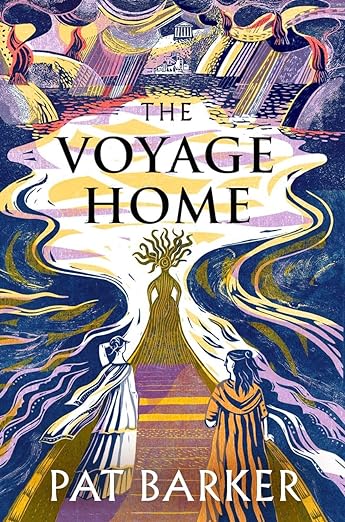
The Voyage Home by Pat Barker

Penguin| 22 August 2024 | 290 pages|e-book | Review copy| 4*

Description on Amazon UK:

After ten blood-filled years, the war is over. Troy lies in smoking ruins as the victorious Greeks fill their ships with the spoils of battle.

Alongside the treasures looted are the many Trojan women captured by the Greeks – among them the legendary prophetess Cassandra, and her watchful maid, Ritsa. Enslaved as concubine – war-wife – to King Agamemnon, Cassandra is plagued by visions of his death – and her own – while Ritsa is forced to bear witness to both Cassandra’s frenzies and the horrors to come.

Meanwhile, awaiting the fleet’s return is Queen Clytemnestra, vengeful wife of Agamemnon. Heart-shattered by her husband’s choice to sacrifice their eldest daughter to the gods in exchange for a fair wind to Troy, she has spent this long decade plotting retribution, in a palace haunted by child-ghosts.

As one wife journeys toward the other, united by the vision of Agamemnon’s death, one thing is certain: this long-awaited homecoming will change everyone’s fates forever.

My thoughts:

This is the third book in Pat Barker’s The Women of Troy trilogy. I loved the first two books, The Silence of the Girls and The Women of Troy both of which are based on Homer’s Iliad and Virgil’s Aeneid, so I was very keen to read The Voyage Home. I wasn’t disappointed but it is slightly different in that this third book is loosely based on the first part of Aeschylus’s Oresteia. The first two books are narrated by Briseis, who had been given to Achilles as a war prize, whereas Ritsa, a fictional character, replaces her as the narrator in the third book, which took me by surprise. I had been anticipating it would be Briseis again.

At the end of the Trojan War the Greeks and their prisoners eventually set sail for home. For King Agamemnon that is Mycenae, where Clytemnestra, his wife is waiting for him. But she is plotting his murder to avenge his sacrifice of her daughter Iphigenia to appease the Gods and gain a fair wind to sail to Troy. After ten years she is still full of grief and rage, her determination to kill Agamemnon is stronger than ever.

Also in the same boat are the captured Trojan women including Cassandra, a princess of Troy, a daughter of Priam and Helen’s half sister. All I knew of her before is that she was a prophetess, whose prophecies were never believed. She’s a strong, beautiful woman but a very fragile character, often ranting and raving. She is demented, and manic, who Ritsa says is ‘as mad as a box of snakes’. Ritsa, her slave calls herself Cassandra’s ‘catch fart’.

The first part of the book covers their voyage to Mycenae and the second part is about what happened when they arrived. Barker doesn’t pull her punches. This is a well written, brutal, bloody tale of revenge told in a modern, colloquial style, and full of grim detail of horror and squalor. Most of the characters are unlikable, with the exception of Ritsa. I think the best book of the trilogy is The Silence of the Girls, but I did enjoy The Voyage Home.

My thanks to NetGalley and Penguin, the publishers for the ARC.

Hemlock Bay by Martin Edwards

Head of Zeus — an Aries Book| 12 September 2024 | 372 pages|e-book | Review copy| 4*

Description from Amazon UK:

Basil Palmer has decided to murder a man called Louis Carson. There’s only one he doesn’t know anything about his intended victim, not who he is or where he lives.

Basil learns that Carson owns Hemlock Bay, a resort for the wealthy and privileged. Knowing that his plan will only work if he covers his tracks, he invents a false identity and, posing as Dr Seamus Doyle, journeys to the coast plotting murder along the way.

Meanwhile Rachel Savernake buys an intriguing painting of a place called Hemlock Bay, one that she cannot get out of her head. Macabre and strange, the image shows a shape that seems to represent a dead body lying on the beach.

Convinced that there is something sinister lurking amongst the glamour of the bay, Rachel books a cottage there – where she meets a mysterious doctor called Seamus Doyle…

My thoughts:

This is the 5th Rachel Savernack book, written in the style of the golden age of crime. I loved the first two books in the series but somehow managed to miss the next two. I had high expectations for Hemlock Bay and certainly wasn’t disappointed as I thoroughly enjoyed it.

Like the other two Rachel Savernack books this is also a complex mystery, with several strands and plenty of twists and misdirections. It begins with a Prologue. It is July 1930 as an unnamed couple in a basement room in Temple, London hear a newspaper vendor announce the death of Sir Arthur Conan Doyle. They are discussing death, ending as the man lifts a revolver and squeezes the trigger. Then in January 1931 Basil Palmer makes a New Year resolution – to murder a man he has never met, Louis Carson. But he doesn’t know where he lives, nor what he looks like. This sets in motion a sequence of events, involving numerous people, all with their own agendas, all gathered together in Hemlock Bay.

Hemlock Bay is a seaside resort on the north-west coast of Lancashire. It was originally just ‘a small bay with a splendid beach, flanked by a stretch of sheer cliffs on one side and a tiny secluded cove on the other side of the steep headland‘ and on ‘a treacherous outcrop of rock was an old lighthouse‘. J M W Turner had visited the Bay on a sketching trip and said it was ‘as pretty as Paradise‘. In the past, ships were often wrecked on the shore and contraband was smuggled through a maze of underground passages. But after the end of the First World War it had been developed into a small and select seaside resort. Pleasure Grounds had been built on Hemlock Head, with provision for dancing and all sorts of amusements, known as Paradise, adopting Turner’s description. Jackson, a speculator, and his wife had bought the resort and then opened a new venture, the Hemlock Sun and Air Garden, a nudist club.

Rachel Savernack is intrigued by a surrealist painting of Hemlock Bay depicting a body stretched out below the lighthouse. She and Jacob Flint go to Hemlock Bay, where among others, she meets Virginia Penrhos, the woman who painted the picture, a reclusive doctor named Seamus Doyle, a man named Louis Carson and Basil Palmer under an assumed name. It’s a well plotted novel with interesting characters in a beautiful setting.

Martin Edwards’ Author’s Note at the end of the book is interesting, explaining that although Hemlock Bay is a fictional place it is based on Heysham in Lancashire, overlooking Morecombe Bay (where I enjoyed several holidays as a child). The information in the Heritage Centre in Heysham helped him with the description of Paradise. And the ‘Cluefinder’ at the back of the book listing hints and clues is most enlightening. But I resisted the temptation to read it before I read the book. It is a baffling and most enjoyable murder mystery.

My thanks to NetGalley and Head of Zeus — Aries Fiction, the publishers for the ARC.

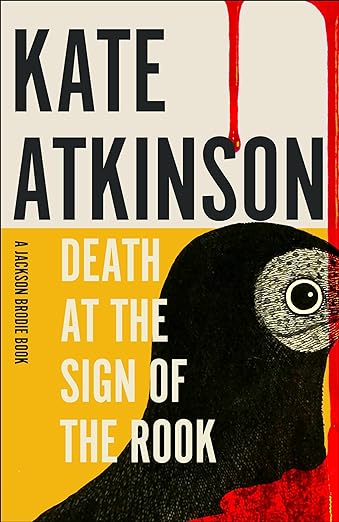
Death at the Sign of the Rook by Kate Atkinson

Random House UK| 22 August 2024 | 335 pages|e-book |Review copy| 2*

Description:

Ex-detective Jackson Brodie is staving off a bad case of midlife malaise when he is called to a sleepy Yorkshire town, and the seemingly tedious matter of a stolen painting. But one theft leads to another, including the disappearance of a valuable Turner from Burton Makepeace, home to Lady Milton and her family. Once a magnificent country house, Burton Makepeace has now partially been converted into a hotel, hosting Murder Mystery weekends.
As paying guests, a vicar, an ex-army officer, impecunious aristocrats, and old friends converge, we are treated a fiendishly clever mystery; one that pays homage to the masters of the genre―from Agatha Christie to Dorothy Sayers.

My thoughts:

Death at the Sign of the Rook by Kate Atkinson begins so well I thought that I was in for a treat. But sadly, as I read on I was disappointed. I was looking forward to reading more about Jackson Brodie, but he only has a minor role. It is amusing in parts. But there are so many other characters, and the story became far too long winded, the narrative jumping around from one set of characters to another, and then another, which made it confusing. The ending was just pure farce, which I’ve never liked, pushing it into the absurd.

Looking back at some of Kate Atkinson’s other books I’ve read I see I had the same reaction to her previous book, Shrines of Gaiety. My favourite books by her are Life After Life and A God in Ruins, both of which I loved.

My thanks to NetGalley and the publishers for my review copy.

The Cracked Mirror by Chris Brookmyre

Little, Brown Book Group UK| 18 July 2024 | 495 pages|e-book |Review copy| 3*

Description from the publishers

FORGET WHAT YOU THINK YOU KNOW
THIS IS NOT THAT CRIME NOVEL


You know Penny Coyne. The little old lady who has solved multiple murders in her otherwise sleepy village, despite bumbling local police. A razor-sharp mind in a twinset and tweed.

You know Johnny Hawke. Hard-bitten LAPD homicide detective. Always in trouble with his captain, always losing partners, but always battling for the truth, whatever it takes.

Against all the odds, against the usual story, their worlds are about to collide. It starts with a dead writer and a mysterious wedding invitation. It will end with a rabbit hole that goes so deep, Johnny and Penny might come to question not just whodunnit, but whether they want to know the answer.

A cross-genre hybrid of Agatha Christie and Michael Connelly, The Cracked Mirror is the most imaginative and entertaining crime novel of the year, a genre-splicing rollercoaster with a poignantly emotional heart.

My thoughts:

I’ve read several books by Chris Brookmyre and those he’s co-written with his wife, Marisa Haetzman under the pseudonym Ambrose Parry and thoroughly enjoyed each one. The Cracked Mirror is not like any of his other books and it took me quite a while to get into it.

First of all there’s the title – as the publishers’ description alludes to, it’s not another version of Agatha Christie’s The Mirror Crack’d from Side to Side, but it is a cross-genre hybrid of Agatha Christie and Michael Connelly. I’ve read all of Christie’s crime fiction novels and none of Michael Connelly’s books, so I didn’t know quite what to expect. Maybe a mash-up of British/American crime fiction/thriller, and that is what it is, with plenty of twists and turns, complications and rollercoaster fast action chases, most of it unbelievable. It’s brutal, violent, with quite a bit of dark humour thrown in. It’s also tense and full of suspense.

At first I was happily reading about Penny Coyne – think a sort of Miss Marple like character, a Scottish elderly spinster with a successful record of solving murder mysteries in her home village. The book begins as a body is found in the confessional booth of the chapel of Saint Bride’s in Glen Cluthar, where Ms Penelope Coyle lives. And then I was suddenly confused when I came to read a completely different story about Johnny Hawke, an LAPD homicide detective, not bothered about sticking to the rules. He’s investigating an apparent suicide of a screen writer in LA. But, as their cases came together I settled into this bizarre book and it became a unified whole. It has a very clever plot (maybe just too clever for me) that kept me guessing right to the end.

My thanks to Little, Brown Book Group UK and NetGalley for the ARC.

The Cracked Mirror: Book Beginnings & The Friday 56

Every Friday Book Beginnings on Friday is hosted by Gillion at Rose City Reader where you can share the first sentence (or so) of the book you are reading. You can also share from a book you want to highlight just because it caught your fancy.

I’m featuring The Cracked Mirror by Chris Brookmyre, which was published yesterday. My full review will follow shortly.

Chapter One:

There was a body in the chapel of Saint Bride’s.

Also every Friday there is The Friday 56, hosted by Freda at Freda’s Voice, but she is taking a break and Anne at My Head is Full of Books has taken on hosting duties in her absence. You grab a book and turn to page 56 (or 56% of an eBook), find one or more interesting sentences (no spoilers), and post them.

‘Does your being an LAPD office help us here?’ ‘Not up the coast. And not while I’m under suspension. So I need you to understand that we might have to break a few rules. This could involve theft, fraud, trespass, or all three.’

Description

FORGET WHAT YOU THINK YOU KNOW
THIS IS NOT THAT CRIME NOVEL


You know Penny Coyne. The little old lady who has solved multiple murders in her otherwise sleepy village, despite bumbling local police. A razor-sharp mind in a twinset and tweed.

You know Johnny Hawke. Hard-bitten LAPD homicide detective. Always in trouble with his captain, always losing partners, but always battling for the truth, whatever it takes.

Against all the odds, against the usual story, their worlds are about to collide. It starts with a dead writer and a mysterious wedding invitation. It will end with a rabbit hole that goes so deep, Johnny and Penny might come to question not just whodunnit, but whether they want to know the answer.

A cross-genre hybrid of Agatha Christie and Michael Connelly, The Cracked Mirror is the most imaginative and entertaining crime novel of the year, a genre-splicing rollercoaster with a poignantly emotional heart.

~~~

What do you think, does it appeal to you? What are you currently reading?

Nero by Conn Iggulden

Penguin 23 May 2024 | 392 pages|e-book |Review copy| 5*

Synopsis

ANCIENT ROME, AD 37

It begins with a man’s hand curled around another’s throat.

Emperor Tiberius first dispatches a traitor. Then his whole family.Next all his friends. It is as if he never existed.

THIS IS ROMAN JUSTICE.

Into this fevered forum, a child is born. His mother is Agrippina, granddaughter of Emperor Augustus. But their imperial blood is no protection. The closer you are to the heart of the empire, the closer you are to power, intrigue, and danger. She faces soldiers, senators, rivals, silver-tongued pretenders, each vying for position. One mistake risks exile, incarceration, execution. Or, worst of all, the loss of her infant son. For Agrippina knows that opportunity waits, even in your darkest moments. Her son is everything. She can make this boy, shape him into Rome itself – the one all must kneel before.

BUT FIRST, THEY MUST SURVIVE . . .

This then is the story of Nero’s birth and raising under the watchful and scheming eye of his mother Agrippina – a woman every man crossed at his peril.

My thoughts:

I’ve enjoyed three books by Conn Iggulden and Nero is no exception. It is excellent. It’s the first in a new trilogy and having read it I’m eagerly looking forward to reading the next two books about Nero. This is the story of his birth and early years up to his 10th year. But it’s more about his mother, Agrippina than about him. She was ruthless, scheming and ambitious for her son, allowing no one to stand in her way.

My interest in historical fiction about the Romans really began in 1976 when I watched the BBC adaptation of I, Claudius and Claudius the God by Robert Graves, starring  Derek Jacobi as Claudius. Later on I read the books, which I loved (I’m tempted to re-read them). Nero brought it back to me as it covers the reigns of Tiberius (the end of his reign), Nero’s uncle, Caligula, and then his great-uncle, Claudius.

Iggulden writes well, bringing life during this period vividly to life. He doesn’t hold back on describing the cruelty and brutality of the times. – he states in his Historical Note: ‘Tiberius was a horror of ancient Rome, who tainted or destroyed anything he touched. … Details of Tiberius’ parties on Capri are too grim to relate …’ There are episodes where, if I’d been watching on TV I would have been covering my eyes, and peeping through my fingers – but I am rather squeamish!

The Historical Note at the end of the book gives further details about the characters, their lives and relationships; and about the ad 43 invasion of Britain, about trade between the empire and Britain before the invasion, and the battle of Medway that took place in Kent.

Despite the gory and bloody scenes I thoroughly enjoyed Nero. Iggulden is a great storyteller.

My thanks to Michael Joseph / Penguin Random House, the publishers for a review copy via NetGalley.