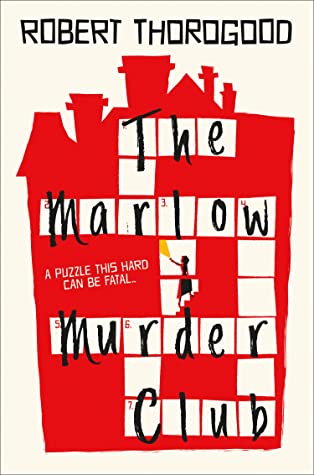
The Marlow Murder Club by Robert Thorogood

HQ| 7 January 2021|347 pages| Kindle review copy via Netgalley| 3*

I hadn’t read any of Robert Thorogood’s books, but I thought I’d enjoy The Marlow Murder Club based on the blurb. It begins well. Seventy-seven year old Judith Potts is happy with her life, living in an Arts and Crafts mansion on the River Thames, although there are hints that there is something in her past she wants to forget. It’s the height of summer, in the grip of a heatwave, and Judith decides to take all her clothes off and go for swim in the Thames. She was enjoying herself when she hears a shout from her neighbour’s house on the opposite riverbank, followed by a gunshot. Later, when she goes to investigate, she finds him, dead in the river, with a bullet hole in the centre of his forehead.

It’s set in Marlow, which is what attracted me to the book as it’s a place I know quite well. The main characters are Judith, Suzie and Becks, who together discover who killed Stefan. They’re all quirky personalities with secrets they’re keeping hidden. Detective Sergeant Tanika Malika leads the police team and eventually when more bodies turn up she agrees that the three woman can help with the official investigation.

The Marlow Club Murder is a ‘cosy’ murder mystery, easy to read and fast paced. Judith is a crossword compiler, who writes cryptic clues so I really enjoyed that aspect of the book, and the relationship between her, Suzie and Becks is well-drawn. But there is quite a lot of repetition as Judith and her friends go over the evidence that they’ve gathered several times and the solution to the murder mystery is easy to predict. The ending is very rushed and let down by convenient coincidences. Overall, I think it’s light, easy reading that is quite entertaining, and the relationship between the three women is what kept me reading to the end of the book.

My thanks to the publishers and NetGalley for my review copy.
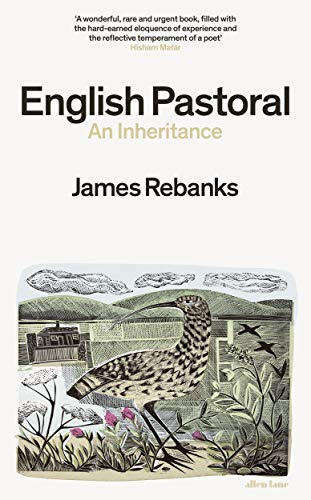
English Pastoral by James Rebanks

Penguin| 3 September 2020| 283 pages| Kindle review copy via Netgalley| 5*

English Pastoral: An Inheritance by James Rebanks is an absolutely marvellous book, the best book I’ve read this year and although it’s still February I can’t imagine that I’ll read a better book all year.

About the book:

As a boy, James Rebanks’s grandfather taught him to work the land the old way. Their family farm in the Lake District hills was part of an ancient agricultural landscape: a patchwork of crops and meadows, of pastures grazed with livestock, and hedgerows teeming with wildlife. And yet, by the time James inherited the farm, it was barely recognisable. The men and women had vanished from the fields; the old stone barns had crumbled; the skies had emptied of birds and their wind-blown song.

English Pastoral is the story of an inheritance: one that affects us all. It tells of how rural landscapes around the world were brought close to collapse, and the age-old rhythms of work, weather, community and wild things were lost. And yet this elegy from the northern fells is also a song of hope: of how, guided by the past, one farmer began to salvage a tiny corner of England that was now his, doing his best to restore the life that had vanished and to leave a legacy for the future.

This is a book about what it means to have love and pride in a place, and how, against all the odds, it may still be possible to build a new pastoral: not a utopia, but somewhere decent for us all.

It is inspirational as well as informative and it is beautifully written. I enjoyed his account of his childhood and his nostalgia at looking back at how his grandfather farmed the land. And I was enlightened about current farming practices and the effects they have on the land, depleting the soil of nutrients.

But all is not doom and gloom as Rebanks also explains what can be done to put things right, how we can achieve a balance of farmed and wild landscapes, by limiting use of some of the technological tools we’ve used over the last 50 years so that methods based on mixed farming and rotation can be re-established. By encouraging more diverse farm habitats, rotational grazing and other practices that mimic natural processes we can transform rural Britain.

I loved this book and came away with much to think about and also hope for the future.

My thanks to the publishers and NetGalley for the review copy, and as it is such an excellent book, after reading the review copy, I bought the e-book.

Exit by Belinda Bauer

Random House UK, Cornerstone| 21 January 2021| 336 pages| Kindle review copy| 4*

I wasn’t at all sure about Exit by Belinda Bauer when I first started to read it a few months ago, so put it to one side and only picked it up again a few days ago. What initially put me off was the opening chapter, which sets the scene for the work of the Exiteers, a group of people who provide support for people with a terminal illness to end their lives. Their role is ostensibly passive, just to be there to keep the dying company as they take their final breaths. But they do provide the means! And one assignment for John (real name Felix Pink) and Amanda goes wrong when they discover they have ‘helped’ the wrong man.

But I read on and what at first looks like a novel considering the ethics of assisted suicide turns into crime fiction as Felix and Amanda realise they have become murder suspects. It’s all mayhem after that as Felix, overcome with remorse, tries to put things right and to discover how and why the wrong man had died.

Far from being a ‘thriller’ it becomes a borderline ‘cosy’ murder mystery, verging on farce in places and I was amused by the wry humour and surreal scenes. It’s a comedy of errors, interspersed with poignant scenes as we learn about Felix’s grief over the deaths of his wife, Margaret and son James. His thoughts always end up with wondering what Margaret would do in the same situation.

It gets off to a slow start, the pace only gradually picking up in the later chapters, when the multiple twists kept me engaged and keen to know how it would end. There are quite a lot of characters in the book, which I found a bit confusing at first, although the main characters, Felix and Acting DC Calvin Bridges are clearly defined and distinctive characters. Some of the minor characters, such as old Greybeard and other clients in the betting shop, are clearly quirky and their actions absurd. And I particularly liked old Skipper, Albert’s father. But underneath the comedy there is a tragedy, as Felix discovers how he has been deceived all along. And the ending is bitter sweet. I began not sure I really wanted to read Exit and ended it feeling I’m glad I did. It’s unlike anything else I’ve read!

Thanks to the publishers and NetGalley for my proof copy.

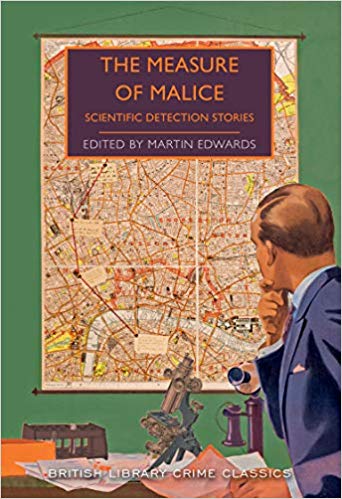
Measure of Malice: Scientific Detection Stories edited by Martin Edwards

The Measure of Malice edited by Martin Edwards is one of the more enjoyable short story collections that I’ve read. It contains 14 stories in which scientific/technological methods are used in the detection of crime. There is an excellent introduction by Martin Edwards with information about the authors, five of whom were doctors, two were engineers and one was an academic chemist.

As always with short story collections some stories are better than others. I’m highlighting a few of the better ones here:

The Boscombe Valley Mystery by A Conan Doyle was originally published in the Strand Magazine in October 1891, and is the first short story to feature Inspector Lestrade. It’s a solid story, solved by Sherlock Holmes by inspecting and analysing the footprints and signs at the scene of the crime.

The Horror of Studley Grange by L T Meade and Clifford Halifax (1894), from Stories for the Diary of a Doctor, originally published in the Strand Magazine. I enjoyed this one although it was pretty easy to predict. Ostensibly a ghost story, the solution involves the use of a laryngoscope.

After Death the Doctor by J J Connington, a Scottish professor of chemistry. This one was first published in 1934, involving a contemporary scientific gadget. The doctor in question is Doctor Shefford who together with Sergeant Longridge, investigate the murder of old Barnaby Leadburn, found dead with his throat cut.

The next two are the ones I enjoyed the most:

The Broken Toad by H C Bailey, first published in 1934, featuring the surgeon and Home Office Consultant, Reggie Fortune as he considers the death of a police constable from poisoning. I enjoyed all the detailed complications and Bailey’s literary mannered style of storytelling.

In the Teeth of the Evidence by Dorothy L Sayers, first published in 1939, about forensic dentistry, which starts as Lord Peter Wimsey is sitting in his dentist’s chair. The police had just visited the surgery, wanting to see his predecessor’s records to identify the victim of a burnt out garage. An upper right incisor crown and the filling in a molar provided the clues to his death. Gory if you actually visualise what is involved!

  • Publisher : Poisoned Pen Press (4 Feb. 2020)
  • Language: : English
  • Paperback : 336 pages
  • ISBN-10 : 1492699624
  • ISBN-13 : 978-1492699620
  • Source: The Poisoned Pen Press via NetGalley
  • My Rating: 3.5*

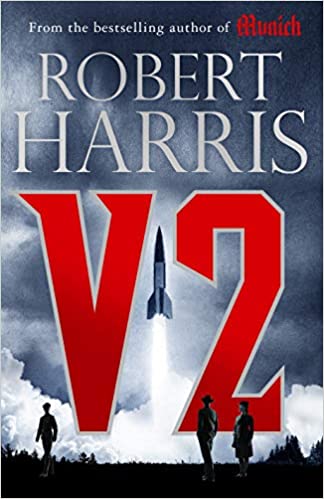
V2 by Robert Harris

Random House UK, Cornerstone| 17 September 2020| 314 pages| Kindle review copy| 5*

Description

Victory is close. Vengeance is closer.

On the brink of defeat, Hitler commissioned 10,000 V2s – ballistic rockets that carried a one-ton warhead at three times the speed of sound, which he believed would win the war.

Dr Rudi Graf who, along with his friend Werner von Braun, had once dreamt of sending a rocket to the moon, now finds himself in November 1944 in a bleak seaside town in Occupied Holland, launching V2s against London. No one understands the volatile, deadly machine better than Graf, but his disillusionment with the war leads to him being investigated for sabotage.

Kay Caton-Walsh, an officer in the WAAF, has experienced first-hand the horror of a V2 strike. When 160 Londoners, mostly women and children, are killed by a single missile, the government decides to send a team of WAAFs to newly-liberated Belgium in the hope of discovering the location of the launch sites. But not all the Germans have left and Kay finds herself in mortal danger.

As the war reaches its desperate end, their twin stories play out, interlocked and separate, until their destinies are finally forced together.

My thoughts:

V2 is historical fiction with a solid factual framework. I like to know when I’m reading historical fiction how much is history and how much is fact. So, I was pleased to find that at the end of the book Harris has included a list of the sources he consulted on the history of the V2 and how it worked, including the work of the photographic reconnaissance interpreters, before writing V2. In particular he acknowledges Eileen Younghusband’s two volumes of memoirs – Not an Ordinary Life and One Woman’s War. She had worked as a WAAF officer on the Mechelen operation, working on detecting the location of the V2 launch sites, and her memoirs had provided him with a vivid insight into her wartime life. Without them he would not have written V2.

It’s set over five days at the end of November 1944 as the Germans fired V2 missiles on London from the woods around Scheveningen on the Dutch coast. The British response was a counter-operation, including a team of WAAFs. The cast includes some historical figures such as Werner von Braun, the real-life head of the Nazi rocket programme, and SS-General Hans Kammler. It’s told in alternating chapters from two of the fictional characters’ perspectives – Dr Rudi Graf, a rocket engineer on the V2 team and Kay Caton-Walsh of the Women’s Auxiliary Air Force. Kay was part of the team based at Mechelen using radar to try to locate the V2 firing sites. Harris emphasises that his fictional character, Kay, bore no resemblance to Mrs Younghusband, apart from the fact that she worked on the Mechelen project.

I thoroughly enjoyed reading this novel, learning a lot about that period of the Second World War and about the V2. It is detailed and tense, and very readable, describing the intricate details of the launching of the V2s and Kay’s work, which became increasingly dangerous as their location became known to the Germans.

Many thanks to the publishers and NetGalley for my digital proof copy.

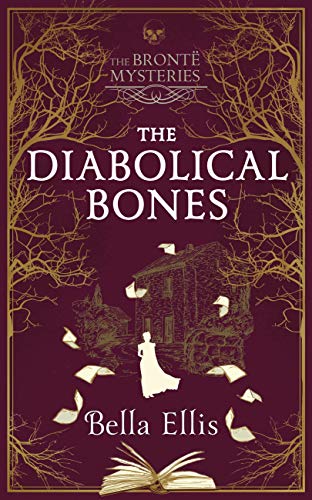
The Diabolical Bones by Bella Ellis

It’s Christmas 1845 and Haworth is in the grip of a freezing winter.

Hodder and Stoughton|5 November 2020| 309 pages| e-book| Review copy|4*

The Diabolical Bones is the second novel by Bella Ellis about the Brontë sisters. It’s historical fiction that brings the period (1845) and the setting vividly to life. It begins with Charlotte in 1852 looking back to that December of 1845 when her brother and sisters had still been alive and they had faced the hidden horror that lay within Top Withins Hall. This is a dark story, as the four Brontës discover – it involves not only murder, but also the occult and child exploitation. It highlights what life was like in the mid nineteenth century, the living conditions and the inequalities between the well-to-do and the poor.

Charlotte, Emily and Anne and their brother, Branwell became real people before my eyes, seeing them in their home in the Parsonage at Howarth. And together they make a formidable team as they set about discovering the truth about the bones of a child hidden in a chimney in the oldest part of Top Withins Hall, an ancient house high up on the moors above Howarth.

The Hall is the home of the Bradshaw family, known by Tabby, the Brontes’ housekeeper as a ‘bad lot’. She is steeped in the local superstitions and folklore and believes the land where the Bradshaws live is where the ‘hidden folk’ live. It fills her with horror as she tells the sisters about the children of Adam and Eve who live among the rocks and woodland, moors and rivers, unseen. In the past people would leave out offerings for them to keep away ill fortune. She warns them that now that there is a heavy price to be paid – and that the discovery of the bones is just the start of it.

There are links to other Brontë books in the names of some of the characters – for example, imagine finding Mrs Grace Poole, the guardian of the mad woman in the attic in Jane Eyre in charge of an orphanage. And I was delighted to find Emily in particular was inspired by Top Withins Hall and the events that took place there to write a novel, because its resemblance to Wuthering Heights struck me immediately. The more I read the more I could believe that the Brontë family were just as Bella Ellis has described them.

Bella Ellis’ is the Brontë inspired pen name for the author Rowan Coleman, who has been a Brontë devotee for most of her life – and it shows so well in this book. The setting is superb, the characters are ‘real’ and the book is well plotted. It was only towards the end that I suspected the identity of the main culprit and the danger that the four siblings had to face. I do hope there will be a third Brontë book.

My thanks to Hodder & Stoughton for an e-book review copy via NetGalley