C is for Chaffinch

There are countless numbers of chaffinches in our garden. It’s the second commonest breeding bird in the UK, so perhaps it’s not surprising that there are so many around. They eat insects and seeds, but they prefer to eat the seeds that have fallen to the ground rather than from the bird feeders.

We have put a tray of seeds on a garden table outside our kitchen patio doors and can watch them at quite close quarters as they come to eat the seeds. Whilst they crowd together on the ground they’re more cautious closer to the house and they only come one at a time to the table. David took these photos. (Click on the photos to enlarge them.)

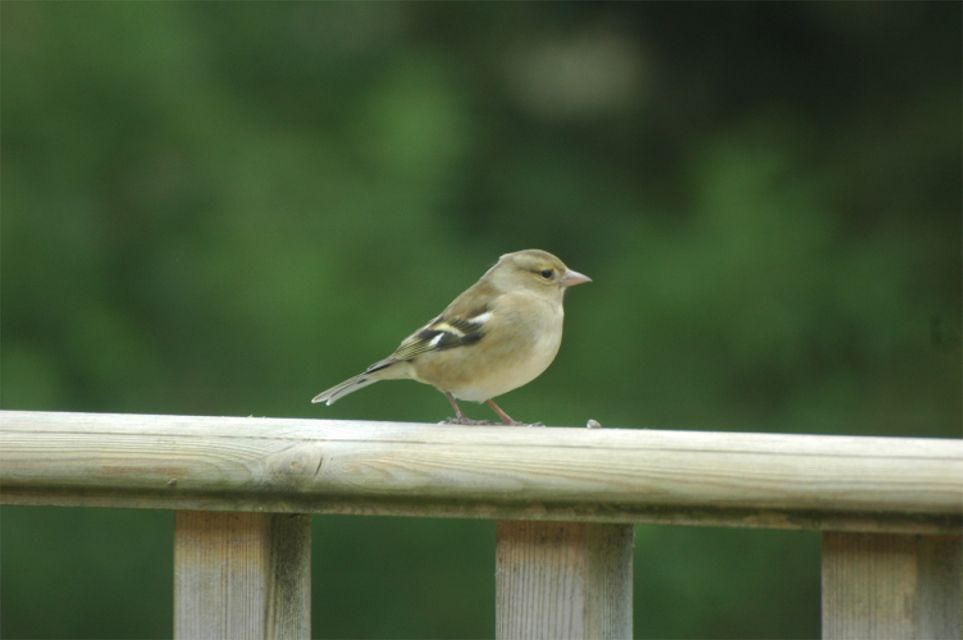
I think this one is so lovely. It’s a female chaffinch that has just landed on the rail of the decking and the wind is ruffling her feathers.

Chaffinch fluffy 01

In this next photo her feathers have settled down:

Chaffinch female 01

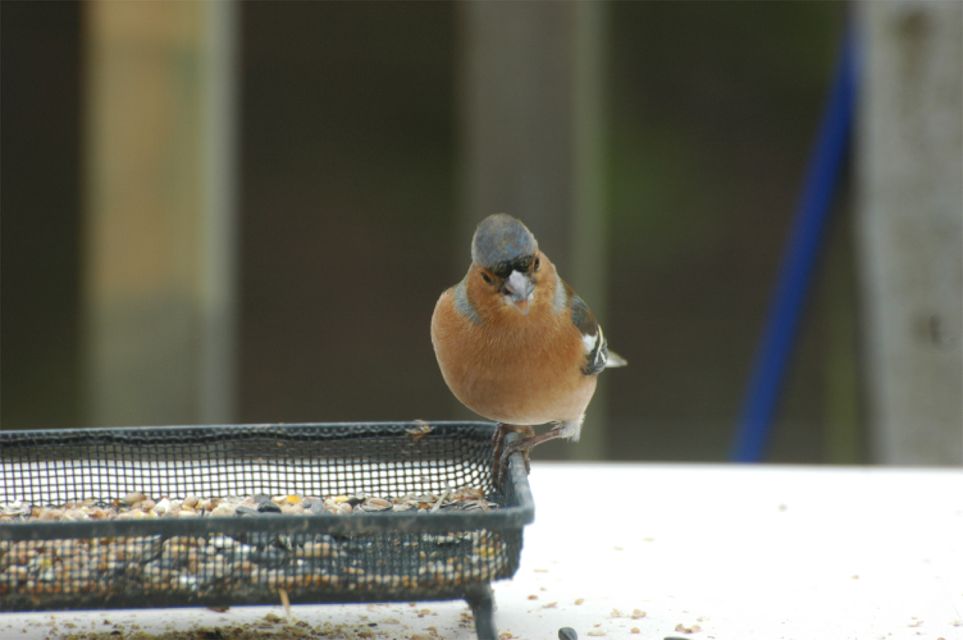
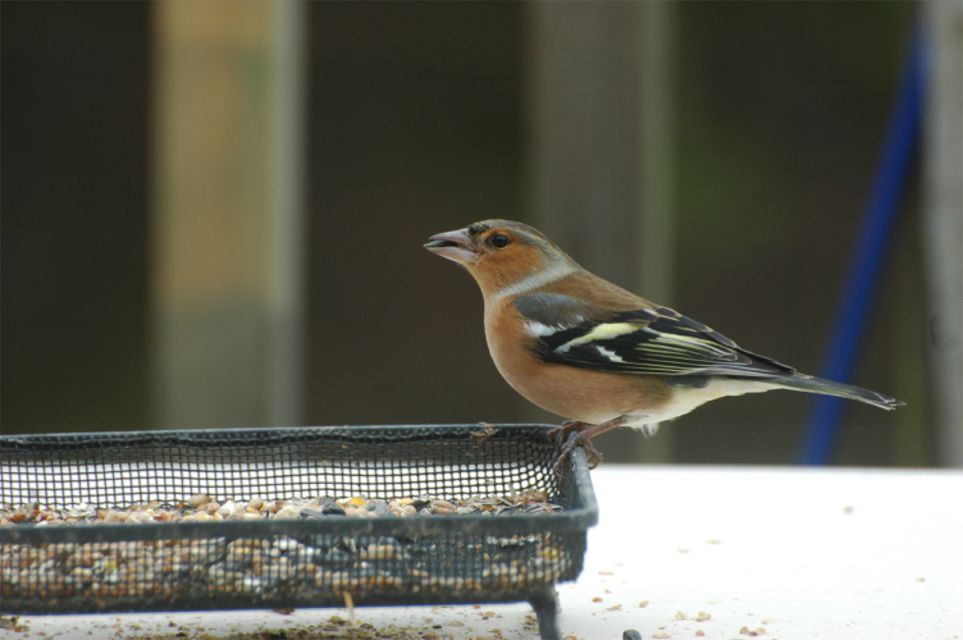
Then a male chaffinch arrived. He likes the sunflower seeds.

Chaffinch w seed 2

I love his colours.Chaffinch w seed

An ABC Wednesday post for the letter C.

Saturday Snapshot

Here’s another old photo from my family photos. This is my Great Aunty Emily, who was born in 1886 and died in 1935. On the back of this small photo, mounted on card, my Mother wrote ‘Aunty Emily Miss Taylor at Blackpool’. You can enlarge the photo by clicking on it.

I doubt she was actually sat on the beach at Blackpool when this photo was taken, that deck chair looks remarkably near the waves and the sand looks very solid. I suppose she was on holiday there, but as the photo isn’t dated I don’t know when this was.

She was my Grandmother’s younger sister and I’ve found out from the Census Returns that she was born at Lostock Junction, Bolton in Lancashire. My Great Grandfather, her father was Thomas Taylor, a domestic gardener, born in 1856 at Bulwick, Northamptonshire. He had another daughter, Florrie, born in 1901 and a son Thomas William born in 1892. All his children were born in different places, as he moved from Northamptonshire, to Lancashire and then to Cheshire.

Emily never married, but stayed at home acting as Housekeeper for her father after her mother died in 1911. I have a copy of her death certificate 1935, which records that she was aged 51 and died at 94 Victoria Road, Hale, Cheshire of a cerebral haemorrhage. Her occupation was described as ‘Housekeeper (domestic) Daughter of Thomas Taylor a Gardener (domestic) (deceased) of 6 Oak Road, Hale’. My Granny, Evelyn Owens, was present at her death. Had my Granny come to stay with her because she wasn’t well – at that time Granny lived in Pen-y-fford, in Wales?

I knew Florrie because when I was a child she lived in the next road and I used to visit her each week with my Mother. She was lovely and looked very like Emily does in the photo (only older).

I also have a vague memory of Thomas William – Uncle Tom, because when his daughter, Joyce, her husband and their daughter Jennifer (who was born just over a year later than me) emigrated to Australia there was a family party before they left. I don’t know how old I was at the time, probably about 5. I remember Uncle Tom as a very large old man, who was very upset about his daughter emigrating! As usual I’m left wishing I knew more about these people.

See more Saturday Snapshots on Alyce’s blog, At Home With Books.

Saturday Snapshot

This is the Bell Tower at the northern side of Berwick-upon-Tweed, the most northerly town in England. It was built about 1577, replacing a 14th century tower on the medieval walls of the town. There used to be a warning bell in the tower that sentries would sound at the sight of danger to the townspeople. At one time there used to be a beacon on top, which could be lit if the country was invaded.

These days it’s an odd sight on a grassy mound at the end of a residential road.

But in earlier days it was in a prime position overlooking the sea, the fields and the town. Nearby is Lord’s Mount, a fort built in  around 1540 during Henry VIII’s reign. It was orginally on two floors but all that remains are parts of the ground floor and you can see fireplaces, a flagged kitchen floor, a well and a privy.

There used to be guns mounted on the parapet and I climbed what was left of the steps to see the view. I didn’t venture on to the top; it was very windy and I don’t have a head for heights!

Photos taken September 2011.

For more Saturday Snapshots see Alyce’s blog At Home With Books.

Saturday Snapshot

I’ve been spending time doing some family history these last few days and looking at old photos. I came across this one of my father as a baby, with his brother Jack and sister Mary. He was born in 1914. How children’s clothes have changed! And none of them look too happy – click on photo to enlarge and see their expressions.

And here is a more cheerful one of Dad with his brother-in-law – I think this was taken at Mum and Dad’s wedding in 1938.

Finally, here’s a photo of Mum and Dad, which I really like. It was taken in Llandudno, probably on their honeymoon.

Saturday Snapshot is hosted by Alyce at At Home With Books.

Saturday Snapshot – Newcastle’s Castle

A few Saturdays ago I posted photos of Newcastle uponTyne’s bridges. Today here are some more photos I took on that grey, gloomy day. This time they are of Newcastle’s Castle Keep and Black Gate.

Our first sight of the castle was as it appeared behind the railway line:

The Castle was was built in stone during the reign of Henry II, between 1168 and 1178, at a cost of £1,144. There was an earlier castle on the site, a wooden motte and bailey castle built by William the Conqueror’s son, Robert Curthose. This was replaced by the stone castle – hence the name of Newcastle! It stands high above the River Tyne – Newcastle upon Tyne.

This is the Castle Keep, which is the only remaining part of the 12th century Castle:

It is a Scheduled Ancient Monument and is open to the public, but we didn’t have time that day to go inside. On our next visit to Newcastle, we will make time to have a proper look at the Castle Keep!

The Gatehouse to the Castle is still standing – the Black Gate. It was added to the Castle site in 1247 by Henry III.  The wooden footbridge was originally a drawbridge.

Saturday Snapshot is hosted by Alyce at At Home With Books.