ABC Wednesday: A is for The Artist’s House at Argenteuil

Another round of ABC Wednesday began today. Amazingly it’s been going for around 5 years and this is Round 11.

A is for The Artist’s House at Argenteuil by Claude Monet, one of my favourite Impressionist paintings. It’s oil on canvas painted in 1873, now held in the Art Institute of Chicago.

Monet moved to Argenteuil in 1871 and lived there until 1877. This was a prolific period for him – he was happy and well-off during that time. It was whilst he was living there that he developed a passion for gardening, influenced by fellow artist Gustave Caillebotte. This painting shows the first house he lived in at Argenteuil, with beds of red, white and blue flowers in front of the house, a creeper covering much of the wall and potted plants in large blue and white tubs on the gravel drive.

I especially like this painting because of the colours and also the figures adding personality – the little child with a hoop is Monet’s five-year old son, Jean, whilst his wife, Camille is seen in the doorway.

Happy Mother’s Day

Today is Mother’s Day, or Mothering Sunday. My son knows what I like and sent me this book:

OakOak by Stephen Taylor

It’s a beautiful book telling and showing how British artist Stephen Taylor has painted the same oak tree in a field in Essex, England, dozens of times over a period of three years in extremes of weather and light, at all times of the year and hours of the day.

I’m fascinated by how artists create their pictures and this book is excellent. Not only is it full of illustrations, but Stephen also describes his methods of painting, outside and in the studio and explains what he was aiming to achieve.

I hope to write more about this book when I’ve had more time to study it. One thing that struck me immediately was this fact stated in Alain de Botton’s introduction:

The oak is estimated to be 250 years old. It was therefore already home to skylarks and starlings when Jane Austen was a baby and George III the ruler of the American colonies.

I love such connections! Thank you, Paul.

P is for Pissarro

L'Hermitage a Pontoise 1867, oil on canvas

 Camille Pissarro (1830 – 1903) was one of the French Impressionist painters. In 1866 he moved to Pontoise on the banks of the River Oise, on the outskirts of Paris and lived there until 1884. He loved the area and painted 300 or so paintings in that period. L’Hermitage à Pontoise, the painting above, is one of my favourites of his, painted in a realistic rather than an impressionist style, showing an idyllic village scene and the hills behind. I like all the detail and his use of light and shade drawing attention to the figures on the road and highlighting the houses.

Red Roofs, 1877, oil on canvas

Ten years later he painted Red Roofs showing a corner of the village in winter with the traditional 18th century houses viewed through the trees. I like the blend of colours with the differing tones of the red of the roofs, fields and earth in the foreground, contrasting with the green of the grass and the blue of the sky. The twisting forms of the trees with their vertical trunks contrast sharply with the geometric shapes of the houses.

An ABC Wednesday post.

‘Young Man at the Window’ by Gustave Caillebotte

Young Man at Window by Caillebotte (1876)

File:G. Caillebotte - Jeune homme à la fenêtre.jpg

(Photo courtesy of Wikimedia Commons.)

I’m quite surprised that Gustave Caillebotte (1848 – 1894) was a member of the French Impressionists as his paintings are much more realistic than the others’ paintings. He painted more modern subjects and his paintings are almost photographic in style.

His painting of a Young Man at Window shows Caillebotte’s brother standing at the window of a new apartment looking out on the scene below. I love the clarity and crispness of this painting, the detail of the stone balustrade, the back view of the young man – a ‘flaneur’ or man about town – and the contrast between the dark interior and bright view outside the window. In the 1870s Paris was being transformed into a modern metropolis under Napoleon III, with Baron Haussmann’s new boulevards and apartements and the rise of the bourgeoisie. The urban setting of this painting shows the tree-lined boulevard and horse drawn carriages.

Is the young man looking at the woman outside? Does he know her? What is the story behind the painting?

An ABC Wednesday post.

Work by Ford Madox Brown

Work by Ford Madox Brown (1852 – 1865)

Taking 13 years to complete, Work is Ford Madox Brown’s major achievement. After he finished it he exhibited it along with a detailed catalogue describing it and explaining its significance. Wikipedia has a detailed account, but put simply this painting is of workers of all descriptions, both physical and intellectual as well as non-workers – the unemployed and the leisure classes.

Work by Ford Madox Brown

The painting is oil on canvas, held at Manchester City Art Gallery. (Click on image to enlarge.) There is so much to see in this painting, so much activity and social comment!

An ABC Wednesday W post.

ABC Wednesday: V is for Vincent

Vincent Van Gogh

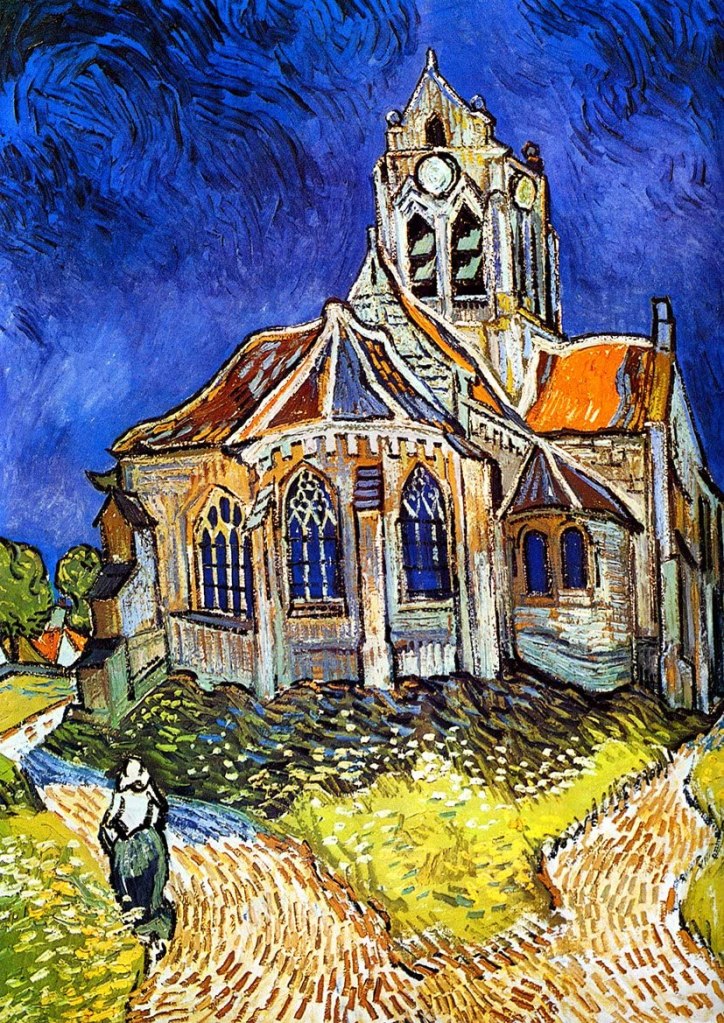
I’ve already posted one of Van Gogh’s paintings in the ABC Wednesday series – I for Irises.  Another painting of his that appeals to me is Church at Auvers-sur-Oise.

What I like about it are the colours and the contrast between the deep blue of the sky, the violet and orange roof of the church and the pastel colours of the divided path and grass in the foreground. I love the perspective, so wonky and wavy, and the details of the church.

This painting featured in the Doctor Who episode Vincent and the Doctor, in which the Doctor discovers a strange and malevolent figure in the painting peering out from one of the church window’s.  An interesting link, I thought – maybe Van Gogh’s depression had a supernatural cause!