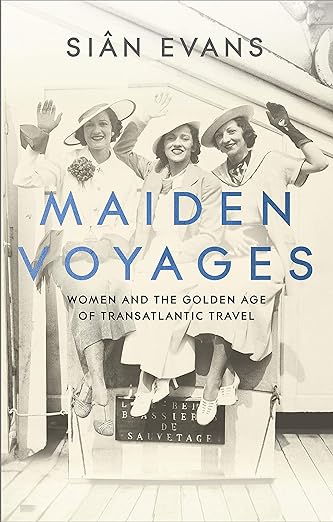
Maiden Voyages by Siân Evans

Rating: 5 out of 5.

Two Roads| 2021| 354 pages| paperback| Library book|5*

I first read about Maiden Voyages: Women and the Golden Age of Transatlantic Travel by Siân Evans on Cath’s blog Read-Warbler. I thought it sounded excellent, so I reserved a copy from the library. It covers a wide range of topics that fascinate me – not just travel, but also social history, both World Wars, the sinking of the Titanic, emigration, the impact that the ocean liners had on the economy. and on women’s working lives and independence, adventure and so much more besides.

It is a ‘collection of selected biographical tales, both cautionary and life-affirming, about dynamic women on the move, set primarily between the two World Wars, during the golden age of transatlantic travel.‘ (page 25)

It is well written, and thoroughly researched. Like all good non-fiction it has a bibliography and an index. For more detail about the contents of this book I think this description on Amazon UK summarises it very well and I need say no more:

Summary:

Migrants and millionairesses, refugees and aristocrats all looking for a way to improve their lives. After WW1 a world of opportunity was opening up for women … Before convenient air travel, transatlantic travel was the province of the great ocean liners and never more so than in the glory days of the interwar years. It was an extraordinary undertaking made by many women. Some traveled for leisure, some for work; others to find a new life, marriage, to reinvent themselves or find new opportunities. Their stories have remained largely untold – until now.

Maiden Voyages is a fascinating portrait of these women, and their lives on board magnificent ocean liners as they sailed between the old and the new worlds. The ocean liner was a microcosm of contemporary society, divided by class: from the luxury of the upper deck, playground for the rich and famous, to the cramped conditions of steerage or third class travel. These iconic liners were filled with women of all ages, classes and backgrounds: celebrities and refugees, migrants and millionairesses, aristocrats and crew members.

Full of incredible gossip, stories and intrigue, Maiden Voyages has a diverse cast of inspiring women – from A-listers like Josephine Baker, a dancer from St Louis who found fame in Paris, Marlene Dietrich and Wallis Simpson, Violet ‘the unsinkable’ Jessop, a crew member who survived the sinking of the Titanic, and entrepreneur Sibyl Colefax, a pioneering interior designer.

Whichever direction they were travelling, whatever hopes they entertained, they were all under the spell of life at sea, a spell which would only break when they went ashore. Maiden Voyages is a compelling and highly entertaining account of life on board: part dream factory, part place of work, independence and escape – always moving.

Siân Evans is a Welsh author, journalist, commentator, speaker, publicist and film consultant specialising in social history. She is the author of a plethora of popular social histories, including Mrs Ronnie: the Society Hostess Who Collected Kings; The Manor Reborn (tied in to a major four-part BBC1 TV series); Life Below Stairs in the Victorian and Edwardian Country HouseGhosts: Mysterious Tales from the National Trust; seven National Trust Guidebooks between 2008 and 2014 and Queen Bees, a book examining the role of six influential interwar society hostesses.

WWW Wednesday: 10 April 2024

WWW Wednesday is run by Taking on a World of Words.

The Three Ws are:

What are you currently reading?
What did you recently finish reading?
What do you think you’ll read next?

Currently I’m reading The Case of the Gilded Fly by Edmund Crispin, written while Crispin was an undergraduate at Oxford.I wrote about its beginning and an extract from page 56 in my Book Beginnings post here. It’s the first Gervase Fen Mystery, a locked room mystery, first published in 1944.

Edmund Crispin was the pseudonym of (Robert) Bruce Montgomery (1921-1978). His first crime novel and musical composition were both accepted for publication while he was still an undergraduate at Oxford. After a brief spell of teaching, he became a full-time writer and composer (particularly of film music. He wrote the music for six of the Carry On films. But he was also well known for his concert and church music). He also edited science fiction anthologies, and became a regular crime fiction reviewer for The Sunday Times. (from Goodreads)

The last book I read was Nero by Conn Iggulden, an Advanced Reader Copy via NetGalley; the expected publication date is 23 May 2024. It’s the first in a new trilogy, historical fiction set in Ancient Rome, telling of Nero’s birth and early years, so it’s more about his mother Agrippina than about Nero. It doesn’t shy away from the brutality of the age, particularly those of Tiberius, Caligula and Claudius, who was easily as ruthless as his predecessors. I read and watched the TV series I Claudius and Claudius the God years ago and this book is making me want to re-read those books. I find the period absolutely fascinating. I’ll be writing more about nearer to its publication.

I’m never sure what I’ll be reading next but it could be: Enemies and Neighbours: Arabs and Jews in Palestine and Israel, 1917-2017 by Ian Black because I want to understand more about the conflict between Palestine and Israel.

Synopsis from Amazon UK

A century after Britain’s Balfour Declaration promised a Jewish ‘national home’ in Palestine, veteran Guardian journalist Ian Black has produced a major new history of one of the most polarising conflicts of the modern age.

Drawing on a wide range of sources – from declassified documents to oral testimonies and his own decades of reporting – Enemies and Neighbours brings much-needed perspective and balance to the long and unresolved struggle between Arabs and Jews in the Holy Land.

Beginning in the final years of Ottoman rule and the British Mandate period, when Zionist immigration transformed Palestine in the face of mounting Arab opposition, the book re-examines the origins of what was a doomed relationship from the start. It sheds fresh light on critical events such as the Arab rebellion of the 1930s; Israel’s independence and the Palestinian catastrophe (Nakba in Arabic) of 1948; the watershed of the 1967 war; two Intifadas; the Oslo Accords and Israel’s shift to the right. It traces how – after five decades of occupation, ever-expanding Jewish settlements and the construction of the West Bank ‘separation wall’ – hopes for a two-state solution have all but disappeared, and explores what the future might hold.

Yet Black also goes beyond the most newsworthy events – wars, violence and peace initiatives – to capture thereality of everyday life on the ground in Jerusalem and Hebron, Tel Aviv,Ramallah, Haifa and Gaza, for both sides of an unequal struggle. Lucid, timelyand gripping, Enemies and Neighbours illuminates a bitter conflict that shows no sign of ending – which is why it is so essential that we understand it.

Although this is a weekly meme I’m only taking part occasionally.

Library Books – December 2023

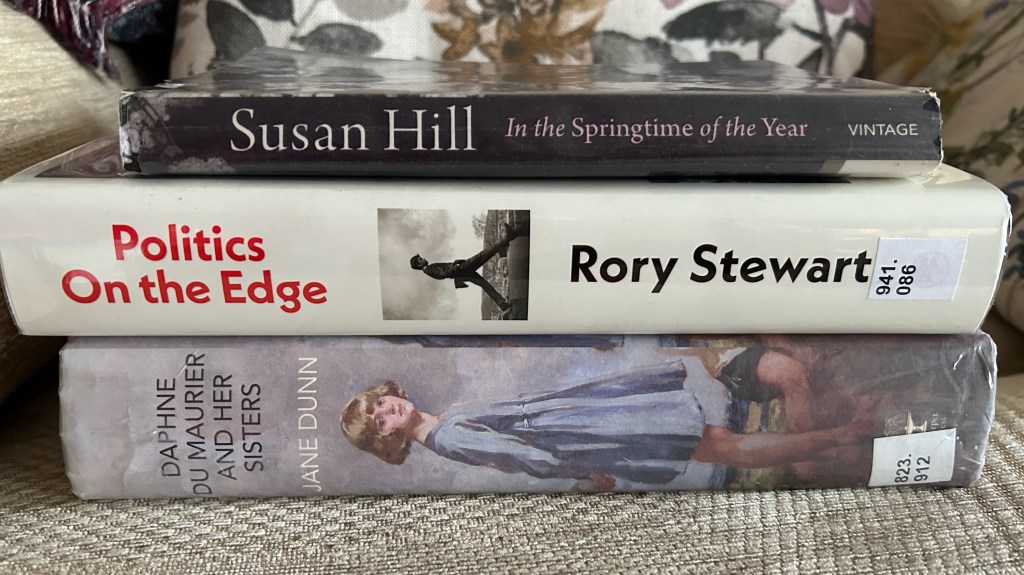
These are the books I have on loan from my local library:

Daphne Du Maurier and her sisters : the hidden lives of Piffy, Bird and Bing by Jane Dunn.The Du Mauriers – three beautiful, successful and rebellious sisters, whose lives were bound in a family drama that inspired Angela and Daphne’s best novels. Much has been written about Daphne but here the hidden lives of the sisters are revealed in a riveting group biography. The sisters are considered side by side, as they were in life, three sisters who grew up during the 20th century in the glamorous hothouse of a theatrical family dominated by a charismatic and powerful father. This family dynamic reveals the hidden lives of Piffy, Bird & Bing, full of social non-conformity, love, rivalry and compulsive make-believe, their lives as psychologically complex as a Daphne du Maurier novel.

Politics on the edge : a memoir from within by Rory Stewart. Over the course of a decade from 2010, Rory Stewart went from being a political outsider to standing for prime minister – before being sacked from a Conservative Party that he had come to barely recognise. Tackling ministerial briefs on flood response and prison violence, engaging with conflict and poverty abroad as a foreign minister, and Brexit as a Cabinet minister, Stewart learned first-hand how profoundly hollow and inadequate our democracy and government had become. Cronyism, ignorance and sheer incompetence ran rampant. Around him, individual politicians laid the foundations for the political and economic chaos of today. Stewart emerged battered but with a profound affection for his constituency of Penrith and the Border, and a deep direct insight into the era of populism and global conflict. This book invites us into the mind of one of the most interesting actors on the British political stage.

In the Springtime of the Year by Susan Hill. After just a year of close, loving marriage, Ruth has been widowed. Her beloved husband, Ben, has been killed in a tragic accident and Ruth is left suddenly and totally bereft. Unable to share her sorrow and grief with Ben’s family, who are dealing with their pain in their own way, Ruth becomes increasingly isolated, hiding herself in her cottage in the countryside as the seasons change around her. Only Ben’s young brother is able to reach out beyond his own grief to offer Ruth the compassion which might reclaim her from her own devastating unhappiness.

I’d love to know if you’ve read any of these books and if so what did you think? If you haven’t, do any of them tempt you?

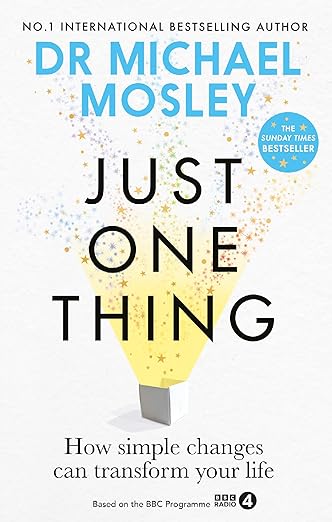
Just One Thing by Michael Mosley

Octopus Publishing Short Books| 22 October 2022|206 pages| E-book review copy| 5*

I was keen to read Just One Thing by Michael Mosley because I’ve enjoyed his TV programmes and I wasn’t disappointed. I think it’s an excellent source of information about improving your health. He picked 30 of his favourite things that you could fit into your life and explains the benefits of each one. He divides the day into periods – morning, mid morning, lunch time, afternoon and evening, giving examples of things to try throughout the day.

I’ve highlighted just a few in this post. S0me of them I already knew about, like doing exercise, doing squats and lunges, drinking water, meditation, spending time outdoors, taking a break to reduce stress, deep breathing, and so on. And I was very pleased to see that reading fiction for 30 minutes a day is a whole brain workout!

Other ideas that were new to me are things like drinking coffee, which lowers the risk of strokes, heart disease, cancer and dementia, and eccentric exercise – which involves walking downhill, down stairs and lowering weights, which have been shown to be more effective than running uphill, up stairs and lifting weights.

I knew about eating an apple a day, but not about the benefits of eating beetroot (which I love) two to three times a week. One thing that really pleased me is finding out that eating two squares of dark chocolate a day instead of eating sweet treats, lowers blood pressure and boosts your brain. In fact most of the ideas improve your mood and sleep, how your brain functions, and reduce anxiety, stress, fatigue and depression and so on. Standing on one leg, for example improves your balance, improves your core strength, and posture which reduces the likelihood of falling and breaking bones. Singing loudly for 5 minutes a day not only boosts your mood, and reduces anxiety, but can also relieve chronic pain.

It’s an inspiring book to read for making small changes, and some not so small changes, to improve your health and well-being. I’ve already started to stand on one leg whilst brushing my teeth and doing squats/lunges whilst waiting for the kettle to boil and will be trying more of the ideas too.

Many thanks to the publishers for a review copy via NetGalley.

The Bone Chests by Cat Jarman

A history of the making of England as a nation, told through six bone chests, stored for over a thousand years in Winchester Cathedral.

William Collins| 14 September 2023| 400 pages| Review copy| 4*

The front cover shows a section of the Great West Window of Winchester Cathedral, made up of mosaics created after 1660 from the glass that had been smashed during the Civil War in 1642. I think it is just beautiful.

Description:

In December 1642, during the Civil War, Parliamentarian troops stormed the magnificent cathedral, intent on destruction. Reaching the presbytery, its beating heart, the soldiers searched out ten beautifully decorated wooden chests resting high up on the stone screens.

Those chests contained some of England’s most venerated, ancient remains: the bones of eight kings, including William Rufus and Cnut the Great – the only Scandinavian king to rule England and a North Sea empire; three bishops ; and a formidable queen, Emma of Normandy. These remains belong to the very people who witnessed and orchestrated the creation of the kingdom of Wessex in the seventh century, who lived through the creation of England as a unified country in response to the Viking threat, and who were part and parcel of the Norman conquest.

On that day, the soldiers smashed several chests to the ground, using the bones as missiles to shatter the cathedral’s stained glass windows. Afterwards, the clergy scrambled to collect the scattered remains.

In 2012, the six remaining chests were reopened. Using the latest scientific methods, a team of forensic archaeologists attempted to identify the contents: they discovered an elaborate jumble of bones, including the remains of two forgotten princes. In The Bone Chests, Cat Jarman builds on this evidence to untangle the stories of the people within. It is an extraordinary and sometimes tragic tale, and one of transformation. Why these bones? Why there? Can we ever really identify them? In a palimpsest narrative that runs through more than a millennium of British history, it tells the story of both the seekers and the sought, of those who protected the bones and those who spurned them; and of the methods used to investigate.

My knowledge of the Anglo-Saxons from school history lessons is very basic – little more than Alfred the Great on the run from the Vikings and letting the cakes burn, and King Canute, sitting in his throne placed at the water’s edge and trying unsuccessfully to forbid the waves from advancing and wetting his feet.

So I was looking forward to learning more in The Bone Chests: Unlocking the Secrets of the Anglo-Saxons. In her Author’s Note Cat Jarman clarifies that her intention with this book is to tell the stories of the chests, and of the tumultuous times that they and the people interred in them, lived through. She has concentrated on the south and south-west of England to consider why Wessex and Winchester took on such significance in the history of England in the early medieval period. So, the main emphasis in this book is on the history, on the kings and politics of the period rather than on the forensic archaeology and the modern scientific techniques.

Having said that there is enough about the use of DNA and isotopic analysis of teeth to investigate the diet and origins of the owners of the bones for me as a non scientist to understand. I found it all fascinating even though in places I was left wondering what century I was in, having moved from the 11th to the 21st century (when Richard III’s remains were discovered under a Leicester car park), via various Viking raids and the 17th century. At times I had to keep reminding myself which chest was being described.

The mortuary, or bone chests, themselves, are most interesting and I would love to visit Winchester Cathedral to see them for myself. There are six chests, painted wooden caskets which are displayed high on stone screen walls on either side of the high altar area. The bones are the remains of many kings and bishops who were originally buried in the Anglo-Saxon cathedral known as Old Minster, north of the present cathedral.

Jarman describes the chests in, vaguely, chronological order and has relied on the Mortuary Chests Project, a research project led by archaeologists from Bristol University in collaboration with Winchester Cathedral that began in 2012. She is not involved in the Project but has incorporated details of the team’s partial results released in May 2019 in her book.

The book is very detailed and well researched and I learned so much, bringing the medieval period to life as I read. I had never heard of Queen Emma and the details about her life stand out for me. She was the daughter of Richard I, Duke of Normandy, wife of two Anglo- Saxon kings – Æthelred the Unready and Cnut (Canute) – and the mother of Edward the Confessor and Harthacnut of Denmark. She was given the name Ælfgifu and in 1017 she married Cnut. I was fascinated to read that the Project team has put together a set of bones that they confidently determine to be a female that could be the body of Emma. (See – details of an exhibition at Winchester Cathedral, Kings and Scribes: the birth of a nation. This includes a 3D model of the female skeleton thought to be Queen Emma).

The last section of the book is made up of Notes of the sources used, an extensive Bibliography, and an Index. There is also a List of Illustrations; the illustrations were not included in my review copy.

Many thanks to the publishers for a review copy via NetGalley.

Dr Cat Jarman is a bioarchaeologist and field archaeologist specialising in the Viking Age, Viking women, and Rapa Nui. She uses forensic techniques like isotope analysis, carbon dating, and DNA analysis on human remains to untangle the experiences of past people from broader historical narratives. Dr Jarman has contributed to numerous TV documentaries as both an on-screen expert and historical consultant, including programmes for the BBC, Channel 4, History, Discovery, and more.

Elizabeth Macarthur by Michelle Scott Tucker

In 1788 a young gentlewoman raised in the vicarage of an English village married a handsome, haughty and penniless army officer. In any Austen novel that would be the end of the story, but for the real-life woman who became an Australian farming entrepreneur, it was just the beginning.

John Macarthur took credit for establishing the Australian wool industry and would feature on the two-dollar note, but it was practical Elizabeth who managed their holdings—while dealing with the results of John’s manias: duels, quarrels, court cases, a military coup, long absences overseas, grandiose construction projects and, finally, his descent into certified insanity.

Michelle Scott Tucker shines a light on an often-overlooked aspect of Australia’s history in this fascinating story of a remarkable woman.

My thoughts

Two years ago I read A Room Made of Leaves by Kate Grenville, historical fiction telling the story of Elizabeth and John Macarthur, who settled in Australia at the end of the eighteenth century, which made me keen to find out more about them. In particular it was the epigraph ‘ Believe not too quickly‘, which is a quotation from one of Elizabeth’s letters, that highlighted for me that A Room Made of Leaves is a work of fiction. And then I came across Michelle Scott Tucker’s biography: Elizabeth Macarthur: A Life at the Edge of the World and I was delighted to see that Kate Grenville references this book as the standard biography in her Acknowledgements. So I bought a copy.

Elizabeth was born on 14 August 1766 in Devon, England and she married John Macarthur in October 1788. In June 1789 they sailed with their first child, Edward, initially on the Neptune, and then on the convict ship Scarborough to New South Wales where John joined his regiment, the New South Wales Corps, in the recently established colony of New South Wales. They went on to have four more sons, James (1793-1794), John (1794-1831), James (1798-1867) and William (1800-1882), and three daughters, Elizabeth (1792-1842), Mary (Mrs Bowman, b.1795) and Emmeline (b.1808).

For sixty years, Elizabeth ran the family farm in Parramatta, west of Sydney town – on her own during her husband’s long absences abroad, four years during her husband’s first absence, and nine years during the second, when she was responsible for the care of their valuable merino flocks, as well as the Camden Park estate and the direction of its convict labourers. By the time Macarthur came back from that second absence, he was overwhelmed by mental illness, and they spent the last few years of his life apart. He died in 1834. The house and gardens of her farm, aptly named ‘Elizabeth Farm’ is now an ‘access all areas’ museum. In 1850, she died in her daughter and son-in-law’s house at Watson’s Bay outside Sydney, overlooking the Pacific Ocean.

I was interested to see how the biography differed from Kate Grenville’s novel. Both interpret the facts, based on Elizabeth Macarthur’s letters, journals and official documents of the early years of the New South Wales colony, trying to explain what happened and why, dependent on the available evidence. However, fiction is more flexible than a biography and can fill in the gaps where the documentary evidence is lacking. And Kate Grenville has used her storytelling imagination in filling in the gaps in the records, in particular about her relationship with William Dawes, an astronomer with the Corps, who was mapping the night sky. He had an observatory near Elizabeth’s farm and it was there that she attempted to learn from him about astronomy. However, in A Room Made of Leaves, Kate Grenville embellishes the basic facts, whilst exploring what it could have been that made Elizabeth ‘blush at my error‘, as she described it in a letter to her friend, Bridget, claiming she had mistaken her abilities and she ended her astronomical studies. Michelle Scott Tucker comments that the evening visits to Dawes’ observatory were open to misinterpretation, whereas Kate Grenville’s version is much more explicit as she imagines what might have happened. Her book, whilst it is based on history is fiction, as she makes clear in her Author’s Note at the end of the book.

I have only just skimmed the surface of this book – there is so much more detail about the landscape, the indigenous population, the disputes between various sections of the colony, about farming and the establishment of the wool industry, not forgetting the details of the Macarthur family members, illnesses, and the position of the women within the community – Elizabeth wasn’t the only colonial woman who was responsible for her family farm. She was resourceful, a good farm manager and business woman, was respected within the colony, and was loved by her family. There are a number of reasons I recommend this book. There is a ‘Select Bibliography’ which looks comprehensive to me, copious notes citing sources and a family tree. It is thorough, well researched and It provides an insight into the early years of Australia’s colonial history and it is an extremely readable biography of a fascinating woman.