Weekend Cooking – Forever Summer

Although it’s not yet summer here, it’s been feeling like it this last two weeks. We’ve had some gloriously sunny days, which made me think of cooking something from Nigella Lawson’s Forever Summer. This is a book full of recipes to give you that summery feeling all year round. There are recipes from around the world and I decided to make Strawberry Meringue Layer Cake.

Nigella writes that this is an Oz-emanating recipe that she scribbled down from a friend after a gardenside Sunday’s summer lunch.

It’s a combination of Pavlova and Victoria Sponge: make the sponge mixture by creaming 100g very soft butter with 100g caster sugar, beat in 2 egg yolks, fold in 12g plain flour, 25g cornflour and 1½ teaspoons of baking powder, add 2 teaspoons of vanilla extract and stir in 2 tablespoons of milk to thin the batter. Divide this mixture between 2 x 22cm Springform tins.

Then add the pavlova mixture – whisk the 2 egg whites until soft peaks form, gradually add 200g caster sugar and spread a layer of the meringue on top of the sponge batter in each tin and sprinkle over 50g flaked almonds.

Bake for 30 – 35 minutes in a preheated oven – 200°C/gas mark 6 until the almond scattered meringues are a dark gold. Let the cakes cool in the tins until you’re ready to assemble the cake.

Whip 375ml double cream and hull and slice 250g strawberries and sandwich the cream and berries between the two cakes – meringue on the base layer and on the top.

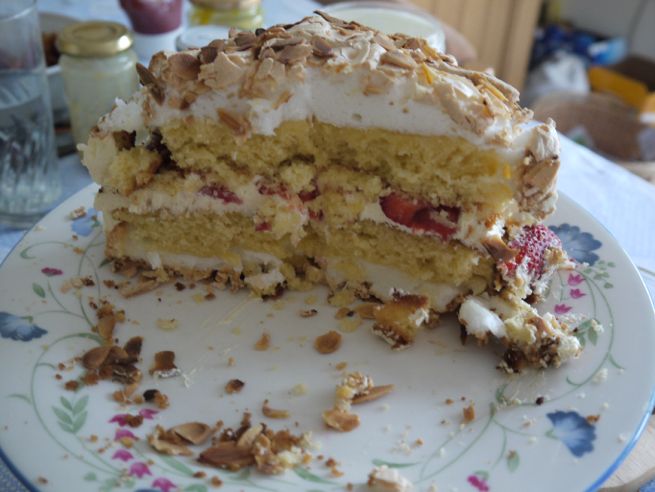
I made this last weekend when we had the family round,  As Nigella suggested I placed more strawberries in a separate dish to eat alongside the cake and it was half gone by the time I remembered to take a photo of it. It’s definitely a recipe I’ll be making again – it’s scrumptious.

Strawberry meringue layer cake

Weekend Cooking is host at Beth Fish Reads and is open to anyone who has any kind of food-related post to share: Book (novel, nonfiction) reviews, cookbook reviews, movie reviews, recipes, random thoughts, gadgets, fabulous quotations, photographs. For more information, see the welcome post.

Weekend Cooking

Two Greedy Italians

I love Italian food, so Two Greedy Italians by Antonio Carluccio and Gennaro Contaldo looks like a book that I would love to have!

This book  accompanies a new series on BBC2 which starts on Wednesday 27 April 2011 at 8 pm.

Carluccio and Contaldo are old friends. They return to Italy to reconnect with their culinary heritage, explore past and current traditions and reveal the very soul of Italian gastronomy. Containing over 100 mouthwatering recipes, this  book goes beyond the clichés to reveal real Italian food, as cooked by real Italians. It includes an intriguing combination of classic dishes and ingredients as well as others showcasing the changes in style and influences that have become a part of the Italy of today.  (Description adapted from the Product Description on Amazon.)

  • Hardcover: 192 pages
  • Publisher: Quadrille Publishing Ltd (18 April 2011)
  • Language English
  • ISBN-10: 9781844009428
  • ISBN-13: 978-1844009428

We do have one of Antonio Carluccio’s books – Passion for Pasta, which is a beautiful book, full of recipes for making your own pasta and sauces. He writes:

… I would like you to forget about bottled sauces, ready-made pasta dishes, and pre-packed Parmesan cheese. Instead indulge yourself by trying the amazing soft texture of your own hand-made pasta, the bite of fresh Italian cheeses, the flavour of cured meats such as Parma ham, and anchovies and fresh basil. (page 7)

There are also lots photos of mouth-watering food, such as this which shows Pasta Per Tutte Stagioni – Pasta For All Seasons, made with fresh shitake mushrooms, fresh oyster mushrooms, chanterelles and small dried fusilli. It includes double cream, smoked ham, lemon juice, olive oil, garlic, parsley and truffle oil, which Carluccio says is very expensive and very sophisticated – a dish for special occasions!

  • Paperback: 192 pages
  • Publisher: BBC Books; 2nd Revised edition edition (24 July 2003)
  • Language English
  • ISBN-10: 9780563487616
  • ISBN-13: 978-0563487616
  • ASIN: 0563487615
  • Product Dimensions: 25.8 x 18.2 x 1.4 cm
  • Source: I bought it

This is my contribution to this week’s Weekend Cooking hosted by Beth Fish Reads

“Weekend Cooking is open to anyone who has any kind of food-related post to share: Book (novel, nonfiction) reviews, cookbook reviews, movie reviews, recipes, random thoughts, gadgets, fabulous quotations, photographs. If your post is even vaguely foodie, feel free to grab the button and link up anytime over the weekend.”

Book Notes

I’ve recently finished reading two books:

It’s taken me several weeks to read Eden’s Outcasts and at one point I nearly abandoned it because I thought it was too much about Louisa May Alcott’s father. I’m glad I persevered because the second half of the book  concentrates much more on Louisa and I realised that the title does convey the subject matter very well as it reveals the relationship between them. Bronson Alcott was a complicated person who appeared to have mellowed as he grew older. Louisa, well known and loved for her children’s books never achieved her ambition to write serious books for mature readers, enduring debilitating illness in her later years.

I learnt a lot from this book about their lives and their relationships with other writers such as Emerson, Thoreau and Hawthorne. It’s a very detailed book and there is no way I can summarise their lives in a few words and a double biography is even more difficult to deal with. In the final  paragraph Matteson sums this up very well:

To the extent that a written page permits knowledge of a different time and departed souls, this book has tried to reveal them. However, as Bronson Alcott learned to his amusement, the life written is never the same as the life lived. Journals and letters tell much. Biographers can sift the sands as they think wisest. But the bonds that two persons share consist also of encouraging words, a reassuring hand on a tired shoulder, fleeting smiles, and soon-forgotten quarrels. These contracts, so indispensable to existence, leave no durable trace. As writers, as reformers, and as inspirations, Bronson and Louisa still exist for us. Yet this existence, on whatever terms we may experience it, is no more than a shadow when measured against the way they existed for each other. (page 428)

Turning to Climbing the Bookshelves by Shirley Williams,  I thought an autobiography would maybe include more personal recollections and descriptions of events. It starts off very well with her descriptions of her early childhood – her earliest memory from 1933 when she was three and fell on her head from a swing at the Chelsea Babies’ playground. I was very impressed by her memories of the time she spent in America as a young girl during the Second World War and her self-reliance and independence.

However, much of the book consists of her accounts of her political life, making it very much a political history of Britain, rather than a personal account of her life. There are some personal memories and I particularly liked her descriptions of her fellow politicians – Harold Wilson, Jim Callaghan, Roy Jenkins and so one – very little about Margaret Thatcher and a few pertinent comments about Tony Blair. Having said that she comes over as a very honest, genuine person who cares deeply about being a good politician. And maybe it is more personal than I originally thought because in the last chapter she writes these words:

Being an MP is like being a member of an extended family. You learn to love your family with all its knobbliness, perversity, courage and complexity. You learn respect and build up trust. …

To be a good politician in a democracy you have to care for people and be fascinated by what makes them tick. … The politician whose eyes shift constantly to his watch, or to the apparently most important person in the room, feeds the distrust felt by the electorate. It is a distrust born of being manipulated, conned, even decieved and it is fed by a relentlessly cynical national press. (page 389)

A side effect of reading this book is that I’m going to read her mother’s book, a best seller published in 1933 – Testament of Youth by Vera Brittain. Shirley describes it as

… an autobiography of her wartime experience as a nurse and her personal agony in losing all the young men she most loved … (page 13)

In the preface to Testimony of Youth she wrote:

Testimony of Youth is, I think, the only book about the First World War written by a woman, and indeed a woman whose childhood had been a very sheltered one. It is an autobiography and also an elegy for a generation. For many men and women, it described movingly how they themselves felt.

This looks like a much more personal autobiography.

Library Loot

This is a sign that I’m a hopeless bookaholic. Despite listing books I’ve had for ages and still haven’t read – not mentioning all the to-be-read books all around the house – yesterday I went to the library and came home with these books:

  • The Fanatic by James Robertson is historical crime fiction, described on the back cover as ‘an extraordinary history of Scotland: a tale of betrayals, stolen meetings, lost memories, smuggled journeys and disguised identities.‘ I’d enjoyed his second book The Testament of Gideon Mack a few years ago. And how could I resist bringing this book home when I saw it began in Bass Rock, which is just up the coast from us – see my photo here.
  • Stories of the Railway by V L Whitechurch. From the book cover I learnt that V L Whitechurch was a celebrated crime writer and an expert railway enthusiast. He wrote a large number of crime short stories set in the golden age of Britain’s railways – this selection was originally published in 1912 as ‘Thrilling Stories of the the Railway‘. I’d read about him on Martin Edward’s blog and was pleased to find a copy on the library shelves.
  • The Oxford Murders by Guillermo Martinez. I’d read about this book, a mix of murder and maths and wondered whether my elementary grasp of maths would be enough for me to follow the equations  and cryptic symbols involved in solving this mystery.
  • The London Train by Tessa Hadley. There seems to be a theme here in my choice, following on from the Stories of the Railway. In this book, the London train between Wales and London, connects two stories that are interlinked through ‘a single moment concerning two lives stretched between two cities’.

And last but by no means least two books on watercolour painting, because this is now taking up some of my reading time. On Thursdays I go to a local art group and dabble in paint. I mentioned this a while ago on my blog and people asked to see some of my paintings. Here are two I don’t feel too embarrassed to show:

The Sunday Salon

Today I’ve been reading more from Eden’s Outcasts: the story of Louisa May Alcott and Her Father. At long last, as I have been reading this book for ages, I have arrived at the time of Louisa’s life where she has written and published Little Women. Up to this point (about 60% of the book) most of it has been about Bronson Alcott, her father and it is Louisa who I find most interesting.

Louisa wrote in vortices – completely engrossed in her writing, with barely time for anything else, so intense was her concentration. Mostly she wrote in her bedroom at a desk Bronson had built for her, but sometimes she sat on the parlour sofa. Her family knew that if the bolster pillow next to her stood on its end they could speak to her, but if the pillow lay on its side they couldn’t disturb her. In two and a half months she had completed writing 402 manuscript pages and at the end of it she had briefly broken down.

Little Women was an instant success, the first printing of 2,000 copies sold out within days of the book’s release and another 4,500 copies were in print by the end of the year (1868). Three months later she had written the second part of Little Women – the book I know as Good Wives. She had

… plunged back into a creative cortex on November 1, vowing to write a chapter a day. She worked ‘like a steam engine’, taking a daily run as her only recreation and barely stopping to eat or sleep.  Falling behind the ambitious schedule she had set for herself, she spent her birthday alone’writing hard.’ (page 345)

She put her heart and soul into her writing.

Both Louisa and her father were complex characters and Matteson’s biography is detailed and in depth. It’s not a quick read, but then biographies never are in my experience.

Crime Fiction Alphabet – Letter I

Rebus’s Scotland: A Personal Journey by Ian Rankin is my choice to illustrate the letter I in Kerrie’s Crime Fiction Alphabet.

If you like the Rebus books, like me, then you’ll also like this book. It is fascinating to read, with insights into Ian Rankin’s own life and that of the character he has invented, along with his thoughts on Scotland and the Scottish character. It’s partly autobiographical, blending his own life with Rebus’s biography. It also describes many of the real life locations of the books, in particular Edinburgh, Rebus’s own territory.

I particularly enjoyed Ian Rankin’s views on writing – how writers mine their own experiences, reshaping their memories to create fiction and the similarities between novelists and detectives:

Both seek the truth, through creating a narrative from apparently chaotic or unconnected events. Both are interested in human nature and motivation. Both are voyeurs. (The Edinburgh-born Muriel Spark says that she and her fellow novelists ‘loiter with intent’ – playing on the idea of a criminal activity.) I certainly enjoy dipping into other people’s lives, giving fresh texture and tone to them, while Rebus has his own reasons for prying into everyone else’s secrets. (page 31)

He went on to quote from The Hanging Garden and then The Falls giving Rebus’s reasons – which were ‘to stop him examining his own frailties and failings.’

I’ve read all the Rebus books – links to my posts are in the Author Index (the tab at the top of the blog). Some of these are brief and last year I decided to make a page on each one to flesh them out a bit more. So far, that just remains an intention, although the parent page has a list of all the books. In preparing to write Rebus’s Scotland Ian Rankin re-read all his Rebus books. Here is his own analysis:

Authors seldom read their own work: by the time a book has been published, we’re busy with our next project. When a story is done, it’s done – reading it through would only make most authors want to tinker with it. Having said that, I enjoyed the majority of the Rebus novels. Knots & Crosses I thought wildly overwritten – definitely a young man’s book. Dead Souls possesses too many characters and story-lines: at points it confused even its author! But several books which had seemed real chores to write surprised me with their deftness – Set in Darkness and Let it Bleed especially. (I think they probably seemed chores because of the amount of political detail they had to embrace – it’s never easy to make politics seem exciting to the layman.) (page 125)

Throughout this book Ian Rankin quotes liberally from his books to illustrate the points he makes. He begins with a chapter on the place where he was born and grew up, which was in the same cul-de-sac as John Rebus – even in the same house. But really, of course, Rebus was not born there. He was created in a bed-sit in Edinburgh where Rankin was living and writing. He deals with Rebus’s ‘prodigious intake of alcohol‘, the Oxford Bar, his taste in music, the city of Edinburgh (Rebus’s territory) and Fife, where Rebus and Rankin have shared memories. I like the way he writes about Rebus as though he were a real person, sometimes admitting that he’s not sure what Rebus will do, but at the same time acknowledging that he is his creation.

An excellent book. My only criticism is that I would have loved it to have an index – maybe I’ll do one for myself

  • Paperback: 224 pages
  • Publisher: Orion; New Ed edition (1 Jun 2006)
  • Language English
  • ISBN-10: 0752877712
  • ISBN-13: 978-0752877716
  • Source: my own copy