Book Beginnings & The Friday 56: Death in the Tunnel by Miles Burton

Every Friday Book Beginnings on Friday is hosted by Gillion at Rose City Reader where you can share the first sentence (or so) of the book you are reading. You can also share from a book you want to highlight just because it caught your fancy.

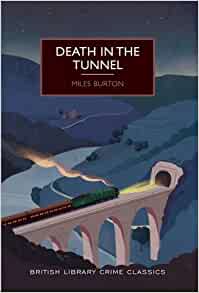
This week I’m featuring one of the books I’m currently reading – Death in the Tunnel by Miles Burton, a Golden Age murder mystery. Miles Burton is one of the pen names of Cecil John Street, who also wrote under the names John Rhode and Cecil Waye. He was a prolific author who produced four detective novels a year for thirty-seven years!
The Book Begins:

The 5.0 pm train from Cannon Street runs fast as far as Stourford, where it is due at 6.07. On Thursday, November 14th, it was, as usual, fairly full, but not uncomfortably so.

A fairly dull opening paragraph to a very complicated murder mystery that is keeping me turning the pages as fast as I can and at the same time trying to take in all the detail.

Also every Friday there is The Friday 56, hosted by Freda at Freda’s Voice. *Grab a book, any book. *Turn to Page 56 or 56% on your  ereader . If you have to improvise, that is okay. *Find a snippet, short and sweet, but no spoilers!

The alternative to suicide can only be murder. I should naturally like to know who may be said to benefit by Sir Wilfred’s death?

Summary:

On a dark November evening, Sir Wilfred Saxonby is travelling alone in the 5 o’clock train from Cannon Street, in a locked compartment. The train slows and stops inside a tunnel; and by the time it emerges again minutes later, Sir Wilfred has been shot dead, his heart pierced by a single bullet.

Suicide seems to be the answer, even though no motive can be found. Inspector Arnold of Scotland Yard thinks again when learns that a mysterious red light in the tunnel caused the train to slow down.

Finding himself stumped by the puzzle, Arnold consults his friend Desmond Merrion, a wealthy amateur expert in criminology. Merrion quickly comes up with an ‘essential brainwave’ and helps to establish how Sir Wilfred met his end, but although it seems that the dead man fell victim to a complex conspiracy, the investigators are puzzled about the conspirators’ motives as well as their identities. Can there be a connection with Sir Wilfred’s seemingly troubled family life, his highly successful business, or his high-handed and unforgiving personality? And what is the significance of the wallet found on the corpse, and the bank notes that it contained? 

~~~

What have you been reading lately?
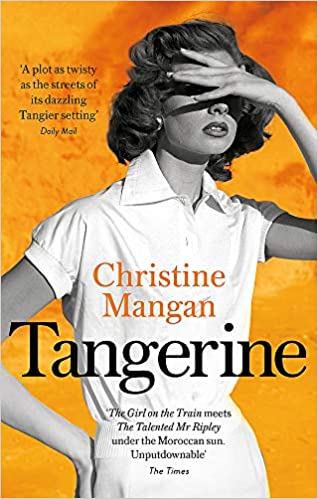
Book Beginnings & The Friday 56: Tangerine by Christine Mangan

Every Friday Book Beginnings on Friday is hosted by Gillion at Rose City Reader where you can share the first sentence (or so) of the book you are reading. You can also share from a book you want to highlight just because it caught your fancy.

This week I’m featuring Tangerine by Christine Mangan. A few years ago I bought this book attracted by its cover, something I rarely do, but it was so eye-catching on the bookshop’s display table. Since then I’ve seen very mixed reviews, some severely criticising it and some heaping praise on it. I’m wondering what I’ll make of it – the blurb makes it sound a book I’d like. If you’ve read it please let me know what you thought.

The Book Begins:

Tuesdays were market days.

Not just for me, but for the entire city, the Rif women parading down from the mountains heralding the start, their baskets and carts overflowing with fruit and vegetables, their donkeys flanking them on either side.

Also every Friday there is The Friday 56, hosted by Freda at Freda’s Voice. *Grab a book, any book. *Turn to Page 56 or 56% on your  ereader . If you have to improvise, that is okay. *Find a snippet, short and sweet, but no spoilers!

These are the rules:

  1. Grab a book, any book.
  2. Turn to page 56, or 56% on your eReader. If you have to improvise, that is okay.
  3. Find any sentence (or a few, just don’t spoil it) that grabs you.
  4. Post it.
  5. Add the URL to your post in the link on Freda’s most recent Friday 56 post.

Page 56:

I noted again the strangeness in her sudden cheerfulness – such a change from the stoic calmness she had exhibited earlier that morning. It was almost frantic, as if at any moment it could all go horribly wrong.

Summary:

The perfect read for fans of Daphne du Maurier and Patricia Highsmith, set in 1950s Morocco, Tangerine is a gripping psychological literary thriller.

The last person Alice Shipley expected to see since arriving in Tangier with her new husband was Lucy Mason. After the horrific accident at Bennington, the two friends – once inseparable roommates – haven’t spoken in over a year. But Lucy is standing there, trying to make things right.

Perhaps Alice should be happy. She has not adjusted to life in Morocco, too afraid to venture out into the bustling medinas and oppressive heat. Lucy, always fearless and independent, helps Alice emerge from her flat and explore the country.

But soon a familiar feeling starts to overtake Alice – she feels controlled and stifled by Lucy at every turn. Then Alice’s husband, John, goes missing, and Alice starts to question everything around her: her relationship with her enigmatic friend, her decision to ever come to Tangier, and her very own state of mind.

Tangerine is an extraordinary debut, so tightly wound, so evocative of 1950s Tangier, and so cleverly plotted that it will leave you absolutely breathless.

~~~

What have you been reading lately?
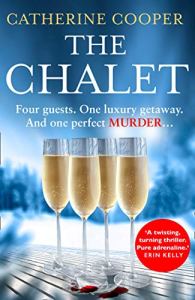
The Chalet by Catherine Cooper

3*

The Chalet, by Catherine Cooper, is a fast-paced murder mystery, set mainly in La Madière, a fictional ski resort in the French Alps. It is her first published full-length novel, though she has also written several (unpublished) thrillers for teens and a (what used to be called) chick lit novel set in TV production.

Synopsis

French Alps, 1998 -Two young men ski into a blizzard… but only one returns.

20 years later – Four people connected to the missing man find themselves in that same resort. Each has a secret. Two may have blood on their hands. One is a killer-in-waiting. Someone knows what really happened that day.

And somebody will pay.

The Chalet is Catherine Cooper’s first published full-length novel, though she has also written several (unpublished) thrillers for teens and a (what used to be called) chick lit novel set in TV production.

I read The Chalet quickly. It’s well written, easy reading, with a beautiful setting in the French Alps. It began well and I was quickly drawn into the drama of the story. The narrative moves between 1998, and 2020 and is told from several of the characters’ perspectives. None of the characters are particularly likeable and they all seem to have something to hide.

It’s a story of revenge, stemming from the events in 1998 when two brothers go skiing with their girlfriends and only one of the brothers returns. The weather conditions were bad and on a difficult off-piste route they lost contact with their guides and only one of them was found, but he couldn’t remember anything about what had happened. The body of the other brother was only found 20 years later after an avalanche hit the resort.

In 2020 a group of people, four couples mixing business with pleasure are staying at the same resort in a luxury chalet. The atmosphere is a difficult one as the couples’ relationships begin to breakdown, particularly when the weather worsens and a storm sets in, leaving them somewhat isolated. Various past events became clearer as secrets are revealed. Although there are plenty of twists and turns, it really wasn’t hard to work out what had happened and who was seeking revenge. An entertaining read, but maybe a bit too predictable by the latter half of the book. The last paragraph promises there is more to come in this story – I’ll be interested to see what happens next, if there is a sequel.

  • ASIN: ‎ B086JJ2TK1
  • Publisher: ‎ HarperCollins (31 Oct. 2020)
  • X-Ray: ‎ Enabled
  • Print length: ‎391 pages
  • My Rating: 3*

My thanks to NetGalley and Harper Collins, the publishers for a review copy.

A Line to Kill by Anthony Horowitz

Random House UK, Cornerstone Digital| 19 August 2021| 368 pages| Review copy| 4*

Synopsis:

There has never been a murder on Alderney.

It’s a tiny island, just three miles long and a mile and a half wide. The perfect location for a brand new literary festival. Private Investigator Daniel Hawthorne has been invited to talk about his new book. The writer, Anthony Horowitz, travels with him.

Very soon they discover that not all is as it should be. Alderney is in turmoil over a planned power line that will cut through it, desecrating a war cemetery and turning neighbour against neighbour.

The visiting authors – including a blind medium, a French performance poet and a celebrity chef – seem to be harbouring any number of unpleasant secrets. When the festival’s wealthy sponsor is found brutally killed, Alderney goes into lockdown and Hawthorne knows that he doesn’t have to look too far for suspects.

There’s no escape. The killer is still on the island. And there’s about to be a second death…

A Line to Kill is the third in Anthony Horowitz’s Hawthorne and Horowitz Mystery series. I have read the earlier books, The Word is Murder and The Sentence is Death and I think it really it best if you read these books in order to fully understand the main characters and their relationship. Daniel Hawthorne, an ex-policeman, is now a private investigator, who the police call in to help with their more complicated cases. Anthony Horowitz himself plays a major role as one of the main characters, recruited by Hawthorne to write a book about him and the cases he investigates and he’d agreed to a three-book contract with Hawthorne.

This third book is about the third case they investigate. I loved the setting on the island of Alderney where the literary festival is being held. I enjoyed the interplay between Hawthorne and the fictional Horowitz, a somewhat difficult relationship as Hawthorne is particularly secretive about his personal life and about the reason he left the police force. In a way he is a Sherlock Holmes type of character keeping Horowitz very much in the dark about what he thinks about the identity of the murder. He is not an easy person to like, single minded with a somewhat superior air about him, but he does get results.

Like the two earlier books this is a complicated murder mystery, with a type of ‘locked room’ puzzle to be solved. As you would expect it is full of red herrings and multiple twists and turns. I was soon totally immersed in this fascinating novel. The characters are fully formed, all with secrets they want to keep hidden and clues are all there, but so well hidden that I was once again totally bemused by it all.

The fictional Horowitz is by now, thoroughly intrigued by Hawthorne himself – just what is he keeping hidden about himself, why did he really leave the police force? Will the writer Horowitz reveal the secret is his next book – if there is to be one? I do hope so.

Thank you to Anthony Horowitz, Random House and NetGalley for an ARC of A Line to Kill.

Short Stories on Sunday

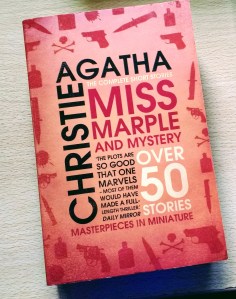
Today I’ve read one of the short stories from Agatha Christie’s collection Miss Marple and Mystery .

IMG_20180513_095855842.jpg

This collection contains 55 stories, 20 of them featuring Miss Marple. I’ve read some of these in other short story collections but there are still many I haven’t read. There is an Short Story Chronology in the Appendix with a table aiming to present all Agatha Christie’s short stories published between 1923 and 1971, listed in order of traced first publication date.

Counting how many there are in total is a difficult task – some stories that first appeared in weekly or monthly magazines were later  re-worked and became chapters in a larger work, some in Partners in Crime were sub-divided into smaller chapters, 13 were re-worked into the episodic novel, The Big Four, and some were rewritten so substantially that they appear separately in different books!

The Lonely God has also been published as an e-book. It was first published in the Royal Magazine in July 1926.

This is an unusual story from Agatha Christie. It’s a love story about two lonely people who meet in the British Museum. Frank is forty, recently returned to England after spending 30 years in Burma. He has no friends and feels he is out of touch with the times, having spent so long abroad. He wanders around aimlessly and strolls into the British Museum one day to look at the Asian curiosities. There he spots a little grey stone idol, a pathetic little figure sitting hopelessly in isolation, elbows on his knees and his head in his hands; ‘a lonely god in a strange country.’

One day he finds a young woman in front of the ‘lonely god‘. Although dressed shabbily she is obviously a poverty stricken lady, fallen on hard times. They are both fascinated by the little stone god and gradually begin a conversation. And then they have tea together in an ABC shop near the Museum. Frank is in love. But when he goes to the see the lonely god again she doesn’t come – and he has no idea where she lives, or even know her name, because she wouldn’t tell him, wanting them to be just ‘two lonely people, who’ve come together and. made friends. It makes it so much more wonderful – and different.’ Frank is heartbroken. Will he ever find her again?

I really enjoyed this little story. As I said not crime fiction, but just a touching little romance that appealed to me. Agatha Christie, however described it in her Autobiography as ‘ regrettably sentimental‘. She had written it after reading The City of Beautiful Nonsense. (Autobiography page 198 in my paperback copy). I had to look up that book. It’s by Ernest Temple Thurston, published in 1909 and described as a ‘sentimental novel’. It is a tale of two cities: mainly about the life of the shabby genteel in Edwardian London, but also in Venice.

Short Stories on Sunday

Today I’ve read one of the short stories from Agatha Christie’s collection Miss Marple and Mystery .

IMG_20180513_095855842.jpg

This collection contains 55 stories, 20 of them featuring Miss Marple. I’ve read some of these in other short story collections but there are still many I haven’t read. There is an Short Story Chronology in the Appendix with a table aiming to present all Agatha Christie’s short stories published between 1923 and 1971, listed in order of traced first publication date.

Counting how many there are in total is a difficult task – some stories that first appeared in weekly or monthly magazines were later  re-worked and became chapters in a larger work, some in Partners in Crime were sub-divided into smaller chapters, 13 were re-worked into the episodic novel, The Big Four, and some were rewritten so substantially that they appear separately in different books!

Manx Gold has also been published as an e-book. It was first published in the Manchester Daily Dispatch between 23-28 May 1930, and as a booklet distributed throughout the island, as a treasure hunt to promote tourism in the Isle of Man. She received a fee of £65 (in today’s money over £4,000!)

Cousins, who are engaged, Fenella and Juan are left an intriguing puzzle by their uncle who lived in the Isle of Man – to find four ‘ treasure chests’, not gold ingots or coins, but actually snuff boxes. In addition there are two more relatives also search for the ‘gold’.

I thought it sounded good, but I have to say that I was rather disappointed by the slightness of this short story. Their uncle has left cryptic clues leading to the ‘chests’ and a couple of sketch maps to guide them to the treasure. But I had no idea what the clues mean and could only read Fenella’s exclamations when they work it out and find the little snuff boxes. Oh, there is also a murder – one of the other relatives is bashed on the head by the other one and left to die.

It’s quite an entertaining little story, but I much prefer Agatha Christie’s full length books.