Accidents Happen by Louise Millar

Accidents Happen is one of my TBR e-books that I’ve had for a couple of years. It’s described as a ‘gripping psychological thriller where one woman’s streak of bad luck may be something far more sinister’, so I thought it would be just the right sort of book to read for this year’s R.eaders I.mbibing P.eril XI.

It begins well with a strange, scary episode about a child waking up to the sight of something slithering, full of threat, not sure what it was but terrified as it was angry with a gaping mouth revealing a tiny white spot, where the poison came from.

Episodes like this are interspersed between the chapters of the story, each one more terrifying than the rest. These are actually much more scary than the main story, which is about Kate, a widow and her young son Jack.

Blurb:

Kate Parker has had so much bad luck in her life, she’s convinced she’s cursed. But when she tries to do her best to keep herself and her son safe, people tell her she’s being anxious and obsessive.

Just when her life starts to spin completely out of control, an Oxford professor she meets offers to help. But his methods are not conventional. If she wants to live her life again, he will expect her to take risks.

When a mysterious neighbour starts to take more than a passing interest in her, Kate tries to stay rational and ignore it.

Maybe this, however, is the one time Kate should be worried.

My thoughts:

Kate’s husband had died 5 years before the book starts and Kate is obsessed with statistics, so much so that they are now ruling her life – statistics about all the things that go wrong, or could go wrong. And this is preventing her from living a normal life – the lengths she goes to are extreme and they are affecting her Jack, her son. As readers we know that some of Kate’s fears are real, but she doesn’t focus on those, although they do bother her. I began to feel something was wrong. And when she met Jago, an Oxford professor my feelings intensified – there was definitely something suspicious going on. Why was he getting her to take such risks and putting herself into such strange situations?

At first I was enjoying this book – it’s very readable, although the concentration on Kate’s fears got a bit repetitive – but increasingly as I read on I just couldn’t believe what was happening. For me the tension that had been building up just disappeared. I didn’t think it was plausible and I couldn’t suspend my disbelief.

I think I’m in the minority about this book as it has more favourable reviews on both Amazon and Goodreads.

Reading Challenges: Mount TBR Reading Challenge and R.eaders I.mbibing P.eril XI.

Recent Additions at BooksPlease

books-sept-2016

From top to bottom: the first seven in the pile are from Barter Books in Alnwick, my favourite bookshop where you can either swap or buy books. I took seven books in and came home with another seven. I love browsing at Barter Books and always find books I want to read.

  • Absent in the Spring by Mary Westmacott – I had to search round the various places fiction is shelved in Barter Books before I found this book in the Romance section. It’s by Agatha Christie, writing as Mary Westmacott. The books she wrote under this pseudonym are a complete change from her crime fiction – she was such a versatile writer. Her daughter, Rosalind, called them ‘bitter-sweet stories about love’. It was first published in 1944.
  • Arms and the Women by Reginald Hill – I’ve been collecting his books in an attempt to read them in chronological order. This is the 18th Dalziel and Pascoe mystery in which Ellie, Pascoe’s wife is in danger at a decaying seacoast mansion.
  • An April Shroud by Reginald Hill – the 4th Dalziel and Pascoe mystery, set in a solitary mansion in the Lake District where Pascoe is spending his honeymoon.
  • The House by the Churchyard by Sheridan Le Fanu – the Horror section is right next to Crime Fiction and I don’t usually look there but as I walked past this book caught my eye as it was displayed in one of the holders on the side of the bookcase, maybe because I’m taking part in the R.I.P. event at the moment. Le Fanu was described by Henry James as in the ‘first rank of ghost writers‘. Set in the 1760s in Ireland, it begins with the accidental disinterment of an old skull and an eerie late-night funeral.
  • A Game of Sorrows by Shona MacLean – the second book in the Alexander Seaton series. I’ve read the first and the third so I was pleased to find this one. It’s set in 1628 in Ulster as Seaton investigates a family curse – a family divided by secrets and bitter resentments.
  • The Collector by John Fowles – another author whose books I’ve enjoyed in the past. This could also be a choice for the R.I.P. event. It’s described as a thriller with psychological and social overtones, the story of a kidnapping.
  • A Walk Along the Wall by Hunter Davies – I was really pleased to find this book Hadrian’s Wall is the most important Roman monument in Britain. Hunter Davies grew up at one end of the wall and was inevitably drawn to walk its length. It’s part history, part guidebook and part personal experience and gives readers a taste of what life was like in this remote part of Britain 2000 years ago.

The bottom two books in the pile aren’t from Barter Books:

  • The Black Caravel by Harry Nicholson is a book the author sent to me for review. It’s his second novel, a sequel to ‘Tom Fleck‘ which I reviewed in 2011. It begins and ends at Hartlepool in 1536, the year of The Pilgrimage of Grace, as Barbary corsairs are raiding northwards.

and finally a birthday present (in August):

  • Rowan’s Well by C J Harter – a psychological thriller (another one for  R.I.P. maybe). Rowan’s Well is a remote house on the north-east coast of England, home to the charismatic Brooke family, the scene of murder and betrayal.

I want to start reading them all – now!

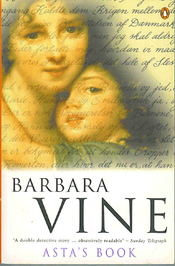
Asta’s Book by Barbara Vine

What an amazing book is Asta’s Book by Barbara Vine*. It was published as Anna’s Book in the USA. I loved A Dark Adapted Eye, A Fatal Inversion and The House of Stairs, but Asta’s Book tops all those.  I think it’s brilliant!

It’s a book that demanded all my attention and I just didn’t want to put it down. There’s a murder, a missing child, a question of identity and overarching it all are the stories of two families – the Westerbys and the Ropers and all the people connected to them. So many characters, so many red herrings, so many incidents that at first did not appear to be of any or of much importance that turned out to have great relevance.

It had me going backwards and forward and placing so many markers in the book to try and keep track of it all. How did Barbara Vine handle so much material in such a clever way? It is so intricately plotted and the portrayal of so many characters is so skilfully handled.

It begins in 1905 when Asta Westerby and her husband Rasmus have come to East London from Denmark with their two little boys and their servant Hansine. With Rasmus constantly away on business, Asta keeps loneliness and isolation at bay by writing a diary in her native tongue of Danish. The story is not told chronologically, but switches backwards and forwards between Asta’s diaries, beginning in 1905 when she was pregnant and hoping the new baby would be a daughter, and the present day after Asta’s death. The diaries had been translated and published by her daughter Swanny (Swanhilde), and along with details of the family’s life reveal clues to an unsolved murder and to the mystery of a missing child. After Swanny died Asta’s granddaughter Ann became involved in searching for the truth about these facts. Additional material is also related through a trial transcript and various accounts of events by different people.

The book kept me guessing all the way throughout the various mysteries it threw up. I was very tempted to peek at the end of the book for the answers, but managed not to and I’m glad I didn’t as it would have ruined the suspense. I was so impressed at how it all hung together, with no extraneous material – all those minor incidents and characters are completely necessary.

As in other books by Barbara Vine it is not only the characters and the mystery that are enthralling, it is also the atmosphere and the settings. Houses in her books take on characters of their own and in this one there are several, maybe the most dominant is Devon Villa where Lizzie Roper was murdered, her mother also died of a heart attack and Lizzie’s daughter, Edith was last seen as she climbed the stairs up to her mother’s bedroom. And then there is the doll’s house that Rasmus made for his daughter, Marie, replicating Padanaram, the Westerbys’ second house in Shepherd’s Hill, Highgate.

*Barbara Vine is the pseudonym of Ruth Rendell, who was a Fellow of the Royal Society of Literature and the author of many thrillers and psychological murder mysteries . She died in 2015 at the age of 85. Her mother was born in Sweden and brought up in Denmark; her father, Arthur Grasemann, was English. As a result of spending Christmas and other holidays in Scandinavia, Rendell learned Swedish and Danish.

Asta’s Book is my third book for the 20 books of Summer Challenge and the 25th for the Mount TBR Reading Challenge. Definitely a book I’d love to re-read.

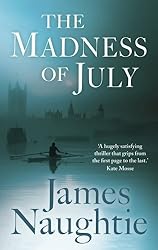
The Madness of July by James Naughtie

When I began reading The Madness of July I was immediately drawn into the story. I used many markers as I read it because it has such a complicated plot. It’s a political thriller set in London in the mid 1970s one sweltering July as Will Flemyng the foreign office minister and former spy finds himself drawn back into the world of espionage, a world of deception, manipulation and diplomacy. It’s the Cold War period and Will discovers politics can be just as dangerous as espionage.

I really wasn’t sure what was going on at first, not sure what was relevant for me to remember and understand, not even sure who was who as the narrative switched between London, New York, Washington and the Highlands of Scotland. So there were times when I had to backtrack when I came across a character or an event, that turned out to be important to the story, which I hadn’t realised earlier on. The characters know what has gone before, know each other, know what they are talking about – but we don’t.

In a different book this would be a major drawback – in this book it is necessary. It’s as though we’re peering through the fog, until gradually the fog lifts and things become clearer. Or it’s like beginning a cryptic crossword where you have all the clues and no idea about the answers. Anyway, I loved it. If the content isn’t too clear at first the writing is, Naughtie uses beautiful imagery and the characters are vividly drawn, in particular the part set in Scotland at Altnabuie, the Flemyngs Highland estate:

At Altnabuie, they woke to a trembling dawn. Flemyng had raised his bedroom window before turning in, and when he opened his eyes, very early, he could smell the highlands. There was a edge to the warmth and the damp, and the tang of tree and field lured him on. He looked towards the loch and saw swirls of mist rising up in thin pillars, like the guilty secrets of hidden smokers, leaving a thin topping of white cotton on the water that crept over the surface and was beginning to disperse here and there with the coming of a soft breeze. It would be gone within the hour. The herons were on their favourite stone, prim and still like a pair of disapproving clerks. The crows cawed in the woods beyond, and behind him, on the eastern side of the house where the sun was already giving life to the place, he could hear the cockerel at work. Everything was crisp and clean, the stifling urban fog a world away. (page 173)

The events that July take place over just 6 days. An American, Joe Manson dies, apparently of an overdose and is found in a store cupboard (it was a large one full of boxes and all sorts of spare objects) in the House of Commons – except that as the House is technically a royal palace deaths are not allowed and bodies have to be discreetly removed and ‘expire’ elsewhere. And thus begins a political crisis – who was Manson, how did he die, what did he know, what had he said – and to whom? And there is a letter on House of Commons notepaper that Will found on the photocopier – an anonymous letter that is puzzling him, a letter from someone who is desperate and who feels he/she is being driven insane.

A secondary plot, but to my mind just as interesting, maybe even more so, concerns Will and his family. He has two brothers, an older on, Mungo who lives at Altnabuie, and a younger one, Abel, who goes by the name of Grauber, their mother’s maiden name, and lives in New York. Mungo has been researching their family history and has discovered a secret about their mother that he finds disconcerting, even frightening.

And the madness? At one point Flemyng, talking about politics says that the rules of the game mean that you have to behave irrationally. A point is reached where you invited destruction, he’d said, as if it were inevitable. ‘Maybe madness isn’t an aberration, but the natural end to our game.’ Everyone aspired to it in politics, even if they didn’t recognise it for what it was. (page 110)

Madness has been haunting Flemyng: Because in these corridors – balance and rational though we believe ourselves to be – there’s madness on the loose. (page 326)

If you like a quick easy read, then The Madness of July is not the book for you. It, however, like me, you like a book that makes you think, that keeps you on your toes as you read, that both puzzles and entertains you, then you’ll probably enjoy it as much as I did.

James Naughtie (pronounced Nochtee, or ‘“ /ˈnɔːxti/ as it is given in Wikipedia, which doesn’t mean anything to me) is a British radio and news presenter for the BBC. From 1994 until 2015 he was one of the main presenters of Radio 4’s Today programme. He is now a ‘Special Correspondent’ with ‘responsibility for charting the course of the constitutional changes at the heart of the UK political debate’, as well as the BBC News’s Books Editor, contributing a book review to the Saturday morning editions of Today. The Madness of July is his first novel. He has also written books on politics and music. He was born in Aberdeenshire and lives in Edinburgh and London.

His second novel, Paris Spring, also featuring Will Flemyng, is due to be published in April this year.

…………………….

Reading Challenge: Read Scotland 2016 and What’s in  Name? 2016 – in the category of a book with a month of the year in the title.

Slade House by David Mitchell

I was in the middle of reading two books on my Kindle, Doctor Thorne by Anthony Trollope and SPQR: a History of Ancient Rome by Mary Beard, when the battery died and I know I could still have continued reading whilst it was re-charging, but I didn’t. Instead I picked up Slade House by David Mitchell, a book I’d been thinking of reading soon and once I started it I didn’t want to stop. It’s not long, just 233 pages and they just whizzed past my eyes in no time.

Apparently it began as a short story on Twitter – but I didn’t know that – and is a sort of sequel to The Bone Clocks – but I haven’t read that, and there is a character near the end who also appears in The Thousand Autumns of Jacob de Zoet – but I haven’t read that yet either!

None of that mattered. I suppose it’s the sort of book to read at Hallowe’en, but that doesn’t matter either, because I read it, devoured it I could say, yesterday and was thoroughly entertained. It’s a mixture of a ghost story, science fiction and horror. Something nasty happens every nine years at the end of October at Slade House. I read it as a fantasy, something that I couldn’t believe could ever happen (or at least, I hope not) – but that didn’t stop me enjoying it immensely.

It’s not easy to find Slade House. It’s down Slade Alley, which doesn’t normally exist and it only appears to those who have been invited, or are drawn to it. There is a door set into the right hand wall of the alley, a small black iron door with no handle or keyhole, that opens if you’re meant to enter. There you meet a stranger, are invited into the House, and find yourself in a strange and dangerous situation, and there is no way out – eventually you find yourself in a long attic at the top of the stairs – where something terrible happens to you.

The stories begin in 1979 (although in fact it begins much earlier than that) and ends in a strange and mystifying way in 2015. Each story is complete in itself; the people who enter Slade House do not seem to be connected in anyway – a young teenage boy and his mother, a recently divorced Detective Inspector, students on a Paranormal Society field trip, and then the sister of one of the students. The connection is the House and the brother and sister who occupy it – and to say what they were would be to reveal too much. Needless to say that I was hoping each time that the victims would escape their fate. I was gripped both by the individual stories and by Slade House itself, enchanting and darkly sinister. The sense of menace just grew as each victim succumbed and yet tried to warn those who followed.

Now, I’m keen to read both The Thousand Autumns of Jacob de Zoet, which I bought a few years ago and is still sitting in my TBR piles and The Bone Clocks, which I haven’t got yet. It just shows how reading one book can seriously disrupt whatever reading plans I had!

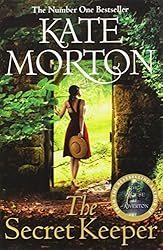
The Secret Keeper by Kate Morton

This is a book that really captured my imagination. I loved everything about it – the descriptive passages, the mystery, the secrets and the people involved. It was all real to me. It’s one of the best books, if not the best book, I’ve read this year.

The Secret Keeper by Kate Morton has been sitting unread for two years on my bookshelves, but if I’d read it earlier I wouldn’t have had the pleasure of reading it now – it was well worth the wait!

It begins on a summer’s day in 1961 in Suffolk when sixteen-year old Laurel is shocked when she sees her mother stabbing a stranger who had come to their farm. Fast forward 50 years Laurel and her three sisters and brother are coming to terms with the fact that their mother, Dorothy is moving closer to the end of her life. Laurel realises that there is so much she doesn’t know about Dorothy’s life and when they find a photograph of Dorothy and a friend, Vivien, in a book of the play Peter Pan, it arouses old and ugly memories for Laurel – images of her mother’s frightened face as she confronted the stranger. Who was Vivien and who was the stranger? Why was Dorothy so scared? Laurel is determined to find out.

It’s a story moving between time periods from 2011, back to the 1960s and also to the 1940s when Dorothy first met and fell in love with Jimmy, a war photographer, and also became friends with the wealthy and beautiful Vivien, married to a successful novelist.  Laurel, with the help of her brother, Gerry, tracks down records throwing light on Dorothy’s and Vivian’s past, back to war-time England and pre-war Australia.

It’s not a straight forward story. By that I don’t mean it’s difficult to read, because each time period is clearly headed and the characters are clearly defined. But there are so many twists and turns – I thought several times I’d got things clear and knew where the story was heading only a bit later on to realise that not all the clues had been revealed and I had to revise my thoughts. It’s so cleverly written and so well plotted that it was only near the end that I had an inkling of Dorothy’s relationship with Vivien and what had really happened to them all. It really is a book I didn’t want to put down and also a book I wanted to enjoy as long as possible. By the end, though, I couldn’t turn the pages fast enough!

Kate Morton’s next book, The Lake House is due to be published in October 2015. I’m looking forward to reading it.

Note: as well as being my 17th book for the Mount TBR Challenge 2015 this is my 3rd book for the TBR Pile Challenge 2015. And the 9th book for the Historical Fiction Reading Challenge 2015.