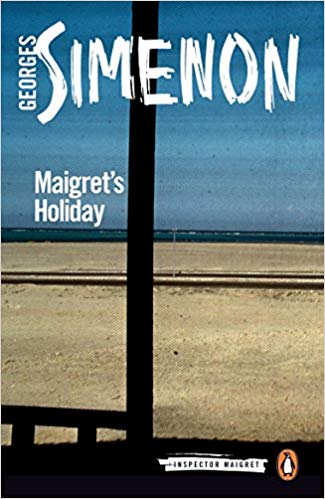
Maigret’s Holiday by Georges Simenon

I am way behind with writing about the books I’ve read, so I thought it’s best to start catching up by writing about the last book I finished, whilst it is still relatively fresh in my mind.
Rating: 5 out of 5.

Maigret’s Holiday, translated by Ros Schwartz, is one of Penguin Classics’ new translations of the entire series of Georges Simenon’s Maigret novels. This edition was published 4 February 2016. It was first published in French as Les Vacances de Maigret in 1948 (the 28th book in the series) and has previously been published in translations as No Vacation for Maigret and A Summer Holiday.

It is August; Maigret and his wife are on holiday in the seaside town of Les Sables d’Olonne. On their first evening they’d eaten a huge dish of freshly caught mussels and they’d both been ill. Maigret quickly recovered but next day on the beach Madame Maigret complained of vague pains and their second night she developed a fever. Admitted to hospital the next day, she was still there nine days later after an emergency operation for acute appendicitis. When a young woman in room 15 in another ward died, Maigret was unable to resist investigating the circumstances of her death, especially as he had received an anonymous note that had been slipped into his pocket; the words irritated him:

For pity’s sake, ask to see the patient in room 15.

The young woman had died after being flung from a moving car. Of course, it is not a straightforward death and the mystery deepened with the disappearance of her brother.

Maigret visited his wife everyday for half an hour. But he was bored with his routine as he strolled around the resort, along the promenade, Le Remblai, feeling he couldn’t go and sit alone on the vast beach among all the mothers and their children. He wandered from stall to stall in the covered market and stopped at cafes and various favourite places for a glass of white wine or of Calvados. Each afternoon he went to the Brasserie du Remblai, overlooking the beach, where a group of important men, including the local chief inspector of police, Monsieur Mansuy, met to play bridge. Maigret sat and watched them play. And it is through Mansuy that Maigret learns about the local characters, which proves essential for him in solving the mystery.

I loved the way Simenon sets the scene. His writing is direct and lucid with just the right amount of description. I could imagine myself in Les Sables d’Olonne, walking on the narrow cobblestone streets and going into the hospital with its atmosphere that reminded Maigret of his childhood when he was a choirboy – ‘the purity of silence had a quality that cannot be found anywhere other than a convent.’ A hospital where the nurses were nuns.

Maigret relieved his boredom by investigating the mystery surrounding the patient in room 15. He gradually peeled back the layers and without him, no one would have had any idea what had really happened or why. Maigret worked methodically and thoroughly, as he tried to understand the locals and their reactions to the police. In the end he painstakingly visited the shops and cafes asking questions and realised that there was at least one other person in danger. But he knew nothing about that person, not even whether it was a man or a woman and he couldn’t guess their age or profession. As he got closer to the solution he became agitated, so much so that it seemed to him that he was no longer breathing, as he tried to avert a further tragedy.

I thoroughly enjoyed reading this book. It is perfectly paced, building in intensity and complexity, over just 199 pages. A note about the author reveals that Simenon acknowledged that he and his fictional detective shared an important characteristic:

My motto, to the extent that I have one, has been noted often enough, and I’ve always conformed to it. It’s the one I’ve given to old Maigret, who resembles me in certain points … ‘understand and judge not.’

I think that is exactly what Maigret does in this book.

Fresh Water for Flowers by Valerie Perrin

I finished reading  Fresh Water for Flowers by Valérie Perrin a while ago, so this is just a brief post which really doesn’t do justice to this beautifully written book, translated from the French by Hildegarde Serle. It will be published by Europa Editions on 7 July 2020. My copy is an uncorrected proof from NetGalley.

This is a story of love and loss – and hope. Violette, the caretaker at a cemetery in a small town in Bourgogne, is a character I really warmed to; she is optimistic, brave, creative and caring. This is very much a character driven story, and full of original and quirky characters, such as the three gravediggers – Nono, Gaston and Elvis. But it is also a story with a mystery at the heart of it – as Julien Seul, the policeman is delving into his mother’s past, intrigued by her wish to have her ashes scattered far from her home and on the grave of a stranger.

It is also an emotional and moving story about Violette, her estranged husband, Phillippe, his miserable parents and their young daughter, Leonine. What happened to Leonine is especially tragic. But this a story full of warmth and happiness and life in the cemetery is full of surprises and joy. It is not what I expected to be and I am so pleased I’ve read it.

I haven’t said very much about the plot – so here is the publishers’ description:

A POIGNANT RUNAWAY BESTSELLER full of French charm and memorable characters, Fresh Water for Flowers is Valérie Perrin’s English debut.

Violette Toussaint is the caretaker at a cemetery in a small town in Bourgogne. Casual mourners, regular visitors, and sundry colleagues—gravediggers, groundskeepers, and a priest—visit her to warm themselves in her lodge, where laughter, companionship, and occasional tears mix with the coffee she offers them. Her life is lived to the rhythms of their funny, moving confidences.

Violette’s routine is disrupted one day by the arrival of Julien Sole—local police chief—who insists on scattering the ashes of his recently deceased mother on the gravesite of a complete stranger. It soon becomes clear that Julien’s inexplicable gesture is intertwined with Violette’s own difficult past.

With Fresh Water for Flowers, Valérie Perrin has given readers an intimately told story that tugs on the heartstrings about a woman who believes obstinately in happiness, despite it all. A number one bestseller in France, Fresh Water for Flowers is a heartwarming and tender story that will stay will readers for years after the final page is turned.

My thanks to the publishers and NetGalley for an uncorrected proof copy.


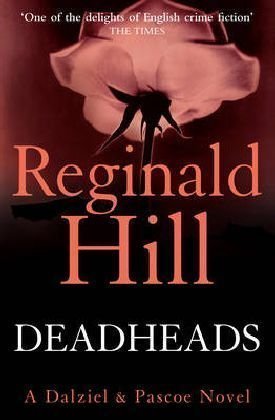
Deadheads by Reginald Hill

5 Stars

Deadheads is the 7th Dalziel and Pascoe novel first published in 1983 and by then Reginald Hill was really getting into his stride and showing his versatility as this book is not a bit like his earlier books. There are deaths, of course, but are they murders? Each one could just as easily be from natural causes or accidents. You think you know from the first chapter who the culprit could be, but I wasn’t really sure – and even by the end I was still wondering if I was right. The police investigation is run mainly by Pascoe and to a certain extent by his wife, Ellie, whilst Dalziel is occupied with other matters, only involved as the mystery draws towards its end.

Blurb

Patrick Aldermann inherits the splendid Rosemount House and gardens on the death of his aunt, and there he is able to indulge his horticultural passions without restraint.

When his boss, Dick Elgood, suggests that Aldermann is a murderer, then retracts the accusation, Peter Pascoe’s detecting instincts are aroused. How did an underachieving accountant make his way to the top of the company so quickly? And why do so many of his colleagues keep dropping dead?

Meanwhile, when not fielding politically incorrect insults from Superintendent Dalziel, Police Cadet Singh—Mid-Yorkshire’s first Asian copper—has dug up some very interesting information about Aldermann’s beautiful wife, Daphne, who’s now firm friends with one Ellie Pascoe…

It’s important to read the first chapter of Deadheads by Reginald Hill very carefully. At first I didn’t, but as I read on I began to think I’d misread it, so I went back to it – and then I understood its significance. It’s a short chapter that sets the theme for the book. Each chapter is named after a particular rose followed by a description of that rose and the first one is called Mischief, a hybrid tea, in which old Mrs Florence Aldermann instructs her great nephew, eleven year old Patrick, how to deadhead roses and explains why it is necessary.

The blurb outlines the plot and to write much more would, I think, mean I’d be giving away too many spoilers. I found the whole book fascinating, written with humour and social commentary on the issues of racism, homosexualty, feminism and marital infidelity. The plot is well executed and Hill’s descriptive writing is, as usual superb, both in terms of the setting and the development of the characters. And I especially liked the ambiguity of the plot and the circularity of the book – ending as it began with Patrick in his rose garden, pruning roses.

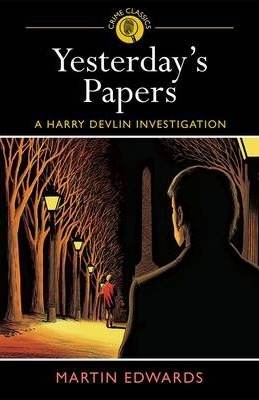
Yesterday’s Papers by Martin Edwards

Yesterday’s Papers is the 4th book in Martin Edwards’ Harry Devlin book in his Liverpool series, first published in 1991 and it’s the first one I’ve read. There are eight books in the series. My copy is a paperback edition, published in 2013 and it is one of my TBRs.

About the book

On Leap Year Day in 1964, an attractive teenager called Carole Jeffries was strangled in a Liverpool park. The killing caused a sensation: Carole came from a prominent political family and her pop musician boyfriend was a leading exponent of the Mersey Sound. When a neighbour confessed to the crime, the case was closed. Now, more than thirty years later, Ernest Miller, an amateur criminologist, seeks to persuade lawyer Harry Devlin that the true culprit escaped scot free. Although he suspects Miller’s motives, Harry has a thirst for justice and begins to delve into the past. But when another death occurs, it becomes clear that someone wants old secrets to remain buried – at any price…

My thoughts

I’ve enjoyed Martin Edwards’ Lake District mysteries, so I was expecting to enjoy his Liverpool novels, featuring solicitor Harry Devlin, and I’m glad to say that I did enjoy this one. The titles of the books are all taken from songs – Yesterday’s Papers is a song by the Rolling Stones from their 1967 album, Breaking the Buttons. In this book Harry is investigating a crime dating back thirty years to the 1960s, the period of Beatlemania, with the focus on the sixties music scene. It has a great sense of place – Martin Edwards obviously knows Liverpool very well.

Although I wanted to know more about Harry Devlin, this does work well as a standalone as there is enough information to get some idea about his character and personal life – his wife, Liz, died – murdered – ten years earlier; he has no family and lives alone. (I must read the first book, All the Lonely People to find out what happened to Liz. ) He is in partnership with Jim Crusoe. Thirty years ago when Edwin Smith was charged with murdering Carole Jeffries Tweats had been his solicitor, so when Crusoe and Devlin had taken over Tweats’ practice the case files, including that of her murder, were handed over to them. Harry is intrigued when Ernest Miller is convinced that Smith was innocent and when Smith is found dead, possibly murdered too, he decides to look into the case.

I like Harry. He is thorough and is not easily deterred, even though it’s difficult to get to the truth after the passage of thirty years, especially when Carole’s father had died and her mother is extremely reluctant to talk to Harry. Needless to say, this proves to be a complicated case and I had little idea what the outcome would be. I had my suspicions, but was wrong and only worked it out just before the end of the book. I thoroughly enjoyed Yesterday’s Papers and am keen to read more about Harry Devlin!

The Liverpool series:

  • All the Lonely People (1991)
  • Suspicious Minds (1992)
  • I Remember You (1993)
  • Yesterday’s Papers (1994)
  • Eve of Destruction (1996)
  • The Devil in Disguise (1998)
  • First Cut is the Deepest (1999)
  • Waterloo Sunset (2008)

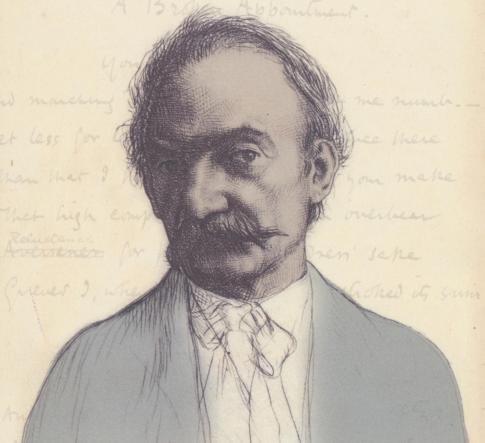
The Return of the Native by Thomas Hardy

Blurb from Amazon:

First published serially between January and December of 1878 in the sensationalistic monthly London magazine “Belgravia”, Thomas Hardy’s “The Return of the Native” is the author’s sixth published novel. Set in Egdon Heath, an area of Thomas Hardy’s fictionalized Wessex known for the thorny evergreen shrubs, called furze or gorse, which are cut there by its residents for fuel.

When the story begins, on Guy Fawkes Night, we find Diggory Venn, a merchant of the red mineral called reddle which farmers use to mark their sheep, giving aid to Thomasin Yeobright, whom he is in love with but has unsuccessfully wooed over the preceding two years. Diggory is helping Thomasin, who is in distress having left town with Damon Wildeve under the false promise of matrimony, return home to her aunt, Mrs. Yeobright. Damon has rebuffed Thomasin in favor of the beautiful young Eustacia Vye.

However when Mrs. Yeobright’s son Clym, a successful diamond merchant, returns from Paris, Eustacia loses interest in Damon, seeing a relationship with Clym as an opportunity to escape the Heath in favor of a more glamorous and exciting locale. A classically modern novel, “The Return of the Native” presents a world of people struggling between their unfulfilled desires and the expectations of society. 

My thoughts:

Thomas Hardy is one of my favourite authors and I throughly enjoyed The Return of the Nativewhich I think is one of his best books. I loved the setting on Eldon Heath, which is based on the small heath by Hardy’s childhood home, but is much larger. The ancient round barrows named Rainbarrows, and Rushy Pond, which lie immediately behind Hardy’s childhood home, form the centre of the fictional heath. Hardy’s description of it is detailed, poetically lyrical and beautiful. 

It’s a dramatic and tragic love story. It has a large cast of characters, with lovers who change their affections throughout the novel and it’s full of intrigue with striking moonlit scenes, disputes, heated quarrels and misunderstandings, along with rustic characters and traditional celebrations, for example Guy Fawkes night, May Day and a Mummers’ play at Christmas.

It was first published in 1878 in three volumes with revisions at later dates. The revision I read was published in 1912. Hardy’s Preface establishes that the events described took place between 1840 and 1850. ‘Egdon Heath’ is a combination of various heaths that were later ploughed or planted to woodland. He liked to think of it as the ‘heath of that traditionary King of Wessex – Lear’. The Return of the Native is a complex novel, shocking to its contemporary public because of its depiction of passionate and illicit sexual relationships (tame by today’s standards).

It begins with a description of Egdon Heath, a sombre isolated place, loved by some and hated by others, some regarding it as a prison. Along the ancient highway that crossed the heath the solitary figure of an old man sees a cart ahead of him in the long dry road. Both the driver, who walked beside it, and the cart, were completely red – he was a reddleman, who supplied  farmers with redding for their sheep. He plays an important part in the novel, appearing at significant times and places to great effect on the course of events. 

It’s not a book to read quickly and it transported me back to a time that ceased to exist before I was born, where time moved more slowly, ruled by the seasons and the weather, and with a clearly defined social hierarchy. And yet, I was surprised to find that youngsters were scribbling graffiti on ‘every gatepost and barn’s doors’, writing ‘some bad word or other’ so that a woman can hardly pass for shame some time.’ Learning to write and sending children to school was blamed:

’Ah, there’s too much of that sending to school these days! It only does harm. … If they’d never been taught how to write they wouldn’t have been able to scribble such villainy. Their fathers couldn’t do it, and the country was all the better for it.’ (Page 108)8

Quite simply – I loved it. It’s a love story full of depth, atmosphere and passion, but also of tragedy  and a mix of darkness and light.

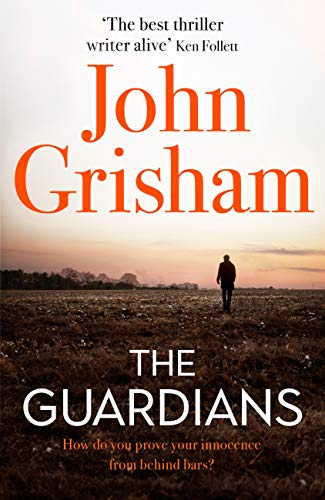
The Guardians by John Grisham

The guardians

From the inside flap:

He was framed for murder.
Now he needs a miracle.

22 years ago Quincy Miller was sentenced to life without parole. He was accused of killing Keith Russo, a lawyer in a small Florida town. But there were no reliable witnesses and little motive. Just the fact that Russo had botched Quincy’s divorce case, that Quincy was black in a largely all-white town and that a blood-splattered torch was found in the boot of Quincy’s car. A torch he swore was planted. A torch that was conveniently destroyed in a fire just before his trial.

The lack of evidence made no difference to judge or jury. In the eyes of the law Quincy was guilty and, no matter how often he protested his innocence, his punishment was life in prison.

Finally, after 22 years, comes Quincy’s one and only chance of freedom. An innocence lawyer and minister, Cullen Post, takes on his case. Post has exonerated eight men in the last ten years. He intends to make Quincy the next.

But there were powerful and ruthless people behind Russo’s murder. They prefer that an innocent man dies in jail rather than one of them. There’s one way to guarantee that. They killed one lawyer 22 years ago, and they’ll kill another without a second thought.

My thoughts:

Years ago I read as many John Grisham books that I could find – I loved them. So I was delighted to find that The Guardians, his latest book is really good too, even though it is written in the present tense. I often find that style irritating but in this case I was gripped by the story and the tense didn’t trouble me in the slightest.

The book is based on a real story and a real person, which gives it a really authentic feel. Guardian Ministries is based Centurion Ministries founded by James McCluskey, working to prove the innocence of convicted criminals, convinced of their innocence. The narrator, Cullen Post, a lawyer who is also a priest, is working on behalf of several prisoners. The book opens dramatically as Duke Russell is having his last meal before being executed. But the main part of the story is centred on Quincy Miller who maintains he was framed for the murder of lawyer Keith Russo and has been in prison for 22 years.

The only small criticism I have is that at first several minor characters are introduced which muddied the waters a little but once I got further into the book it became clear that there were major miscarriages of justice that Post was investigating, as he concentrates on Quincy’s case. It’s an easy read but packed with detail, a lot of it quite shocking. I enjoyed it immensely, especially learning about the US legal system.

  • Hardcover: 384 pages
  • Publisher: Hodder & Stoughton; 01 edition (15 Oct. 2019)
  • Language: English
  • ISBN-10: 1473684439
  • ISBN-13: 978-1473684430
  • Source: I bought the book

My rating: 4*