My Day in Books 2012: a meme

Today I was going to write a post about one of the books I’ve read recently but then I saw that Cornflower had posted this meme: ‘œMy Day in Books’. I did this last year and fancied doing it again with this year’s books. The task is to complete the sentences using the titles of books you have read this year.  Here’s what I came up with:

I began the day by The Secret River

before breakfasting on Red Bones (that’s all there was!)

and admiring The Victorian Chaise-Longue.

On my way to work I saw The Woman in White

and walked by The House of Silk

to avoid Our Mutual Friend

but I made sure to stop at The Village.

In the office, my boss said, Death Comes to Pemberley

and sent me to research The Murder on the Links.

At lunch with My Cousin Rachel

I noticed A Man Lay Dead

in A Room Full of Bones

greatly enjoying  A Quiet Life!!

Then on the journey home, I contemplated Endless Night

because I have A Weekend with Mr Darcy

and am drawn to Dancing Backwards.

Settling down for the evening in A Place of Greater Safety

I studied Dark Matter

by Blue Lightning

before saying goodnight to (the) Bad Boy.

I’ve written posts about most of them. Here are the links If anyone wants to to read what I thought about the books:

My Life According to Books, 2012 Edition

I saw this meme on Cath’s blog, Read Warbler. Like Cath I’m behind with writing book reviews but instead of doing that today I decided to do Pop Culture Nerd’s new version of the My Life as a Book meme. Every year she gives us fill-in-the-blank sentences to complete by using the titles of books we’ve read that year.

Here’s my contribution for the 2012 edition:

1. Every Monday I look like: The Help (Kathryn Stockett)

2. Last time I went to a doctor was because: (of) The Parasites (Daphne du Maurier)

3. Last Meal I ate was: Red Bones (by Ann Cleeves)

4. My savings account is: The Safe House (Nicci French)

5. When a creepy guy asks for my number I: Bring Up the Bodies (Hilary Mantel)

6. Ignorant politicians make me: (think of) The War of the Worlds (H G Wells)

7. Some people need to spend more time: (in) A Room Full of Bones (Elly Griffiths)

8. My memoir could be titled: A Quiet Life (Beryl Bainbridge)

9. If I could have, I would’ve told my teenage self: (to beware of the) Dark Matter (Michelle Paver)

10. In five years I hope I am: (in) A Place of Greater Safety (Hilary Mantel)

Crime Fiction Alphabet: Q

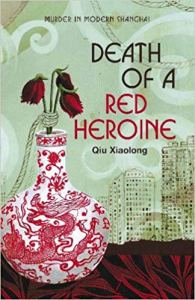
For the letter Q in Kerrie’s Crime Fiction Alphabet I’ve chosen Death of a Red Heroine by Qiu Xiaolong.

Death of a red heroineQX

I  ‘discovered’ Qiu Xiaolong in 2010 during a previous series of the Crime Fiction Alphabet when I wrote about his second book, A Loyal Character Dancer. Death of Red Heroine is his first book featuring Chief Inspector Chen. It won the Anthony Award for Best First Crime Novel in 2001.

Synopsis from the back cover

Shanghai in 1990. An ancient city in a Communist country: looking to the future for its survival. Chief Inspector Chen, a poet with a sound instinct for self-preservation, knows the city like few others. 

When the body of a prominent Communist Party member is found, Chen is told to keep the party authorities informed about every lead. And he must keep the young woman’s murder out of the papers at all costs. When his investigation leads him to the decadent offspring of high-ranking officials, he finds himself instantly removed from the case and reassigned to another area.

Chen has a choice: bend to the party’s wishes and sacrifice his morals, or continue his investigation and risk dismissal from his job and from the party. Or worse . . .

My thoughts:

I think this is as much historical fiction as it is crime fiction. There is so much in it about China, its culture and its history before 1990 – the Communist regime and then the Cultural Revolution in the 1960s – as well as the changes brought about in the 1990s after the massacre of Tiananmen Square. This does interfere with the progress of the murder investigation as Chen has to cope with the political ramifications and consequently there are several digressions and the pace is slow and lacking tension. As Chen is a poet as well as a policeman there are also references to Chinese literature which although interesting, don’t move the murder mystery forward. A fair amount of concentration is needed both to understand the background and work out the plot.

Chen is a reluctant policeman, he has a degree in  English literature and is a published poet and translator. However, he is a good detective and helped by Detective Yu begins to unravel the mystery. Having found a suspect it is really the motive that provides a stumbling block, that and the constant need to keep in mind the ‘interests of the Party’ that prevents a quick resolution.

I like the characterisation, Chen and Yu in particular are clearly drawn, distinctive characters, and the setting is superb. I also like the many descriptions of food (as there are in A Loyal Character Dancer), such as this dinner menu Chen lays on for a party in his new apartment:

For the main dishes, there were chunks of pork stomach on a bed of green napa, thin slices of smoked carp spread on fragile leaves of jicai, and steamed peeled shrimp with tomato sauce. There was also a plate of eels with scallions and ginger, which he had ordered from a restaurant. He had opened a can of Meiling steamed pork and added some green vegetables to make it another dish. On the side, he placed a small dish of sliced tomatoes, and another of cucumbers. When the guests arrived, a soup would be made from the juice of the canned pork and canned pickle. (page 12)

It’s a fascinating book on several levels and one I enjoyed reading. I’m a bit late catching up with reading Qiu Xiaolong’s books as there are now seven Inspector Chen books:

1. Death of a Red Heroine (2000)
2. A Loyal Character Dancer (2002)
3. When Red Is Black (2004)
4. A Case of Two Cities (2006)
5. Red Mandarin Dress (2007)
6. The Mao Case (2009)
7. Don’t Cry, Tai Lake (2012)

ABC Wednesday: D is for Degas

Edgar Degas (1834 – 1917) was a French artist and is perhaps most well known for his paintings of dancers; ballerinas were his favourite subject:

This is The Dance Class, oil on canvas, 1874 (the Metropolitan Museum of Modern Art). Here the dancers are in various poses at the end of a rehearsal. You can see the exhaustion on their faces and in their figures – see the girl at the front scratching her back, the girls at the back sunk to the floor, and the girl on the right, her arms folded, shoulders rounded and her head drooping down. I love the contrast between them and the rigid figure of the ballet master.Their flimsy tutus stand out so well against the hard diagonal floorboards.

I also like painting L’Absinthe, also called The Absinthe Drinker, A Sketch of a French Café,  or Figures at Café. It’s oil on canvas, 1876 (Musée D’Orsay). It’s a melancholy painting of a forlorn couple in the Café de la Nouvelle-Athènes in Paris.

They are drowning their sorrows. She is drinking absinthe, ‘the Green Fairy’, a lethal drink that was later banned. She is seen staring into space, sad, and desolate, lost in her own world. He is also in his own world, detached, his head turned away from her, as though they aren’t together. Degas’s models for the painting were Ellen Andre, an actress and Marcellin Desboutin, an engraver and artist. They were both annoyed by the painting, which depicted them as alcoholics and Degas had to state publicly that they were not.

I like it just because it tells a tale. It is so expressive and the detail is so fine, the slump of her shoulders, her air of exhaustion and his desire not to be there come over to me so powerfully. It gives the impression that Degas painted this from real life, but actually he painted it in his studio, with the pair carefully posed.

An ABC Wednesday post.

Crime Fiction Alphabet: L is for …

Lord Edgware Dies by Agatha Christie. This was first published in the UK in 1933 and later the same year in the USA as Thirteen for Dinner. It’s the eighth book featuring Hercule Poirot, narrated by Captain Hastings. Agatha Christie had written it in the autumn of 1931 at her house in Ninevah, whilst with her husband, Max Malloran on his expedition in the Middle East sponsored by the British Museum.

Lord Edgware Dies is set far from Ninevah, in London’s West End. Poirot is having supper at the Savoy with Hastings after they had been to the theatre to see the celebrated American impressionist, Carlotta Adams. At the next table is Jane Wilkinson, Lady Edgware, also a celebrated actress, who Carlotta had impersonated during her show. Jane implores Poirot to help her to ‘get rid of her husband’ – to convince him to agree to a divorce. Poirot agrees to go and see Lord Edgware. Much to Poirot’s surprise, Lord Edgware readily agrees to a divorce, but as Poirot and Hastings leave the house, Hastings is surprised to see an astonishing change in Lord Edgware’s face:

That suave smiling face was transformed. The lips were drawn back from the teeth in a snarl, the eyes were alive with fury and an almost insane rage. (page 33 0f my copy)

The next morning Lord Edgware was found dead, stabbed in the back of the neck. Jane was seen at the house the night before, but there are witnesses who can testify that she was at a dinner party with twelve other guests.  Could Jane have been in two places at once and killed him? She had boasted to her friends that if Poirot couldn’t help her that she would

‘have to call a taxi to go round and bump him off myself. (page 17)

Or was it Carlotta Adams impersonating Jane?

It’s not a simple mystery and there is a second murder which complicates matters. Poirot is at his best, relying on his knowledge of psychology, the ‘employment of the little grey cells‘, which gives him such mental pleasure. There are small personal touches such as this where Poirot compares his moustache to that of Hastings in this conversation between the two of them:

‘You have made a hit, Poirot. The fair Lady Edgware can hardly take her eyes off you.’

‘Doubtless she had been informed of my identity’, said Poirot, trying to look modest and failing.

‘I think it is the famous moustaches’, I said. ‘She is carried away by their beauty.’

Poirot caressed them surreptitiously.

‘It is true that they are unique,’ he admitted. ‘Oh, my friend, the ‘tooth-brush’ as you call it, that you wear – it is a horror – an atrocity – a wilful stunting of the bounties of nature. Abandon it, my friend, I pray of you.’ (pages 12-13)

Yet again, another baffling case solved by Hercule Poirot – a very entertaining book.

The Crime Fiction Alphabet 2012 is a meme hosted by Kerrie at Mysteries in Paradise.

Six Months Summary

I saw that Jo at The Book Jotter has created a new meme, and I thought I’d join in. The idea is to celebrate the first six months of the reading year by putting six books into each of six categories. I’ve altered her categories a bit and not listed any books that disappointed me because I don’t want to draw attention to them. I’ve listed some books in more than one category and have linked the titles to my posts on the books.

I’ve already listed 10 of the best crime fiction books I’ve read this year, but I’ve also included some of them in these categories:

Six authors new to me (and the books I read):

  1. Kathryn Stockett – The Help
  2. Adrienne Dines – The Jigsaw Maker
  3. Terri Armstrong – Standing Water
  4. Vera Brittain – Testament of Youth
  5. Anne Bronte – Agnes Grey
  6. Kate Grenville – The Secret River

Six authors I have read before (and the books I read):

  1. Agatha Christie – several
  2. Jane Austen – Pride and Prejudice
  3. Daphne Du Maurier – My Cousin Rachel
  4. Rosy Thornton – Ninepins
  5. Hilary Mantel – A Place of Greater Safety and Bring Up the Bodies
  6. Charles Dickens – A Tale of Two Cities

Six books I have enjoyed the most:

  1. The Help by Kathryn Stockett
  2. Little Boy Lost by Marghanita Laski
  3. The Redeemed by M R Hall
  4. The Secret River by Kate Grenville
  5. A Quiet Life by Beryl Bainbridge
  6. A Tale of Two Cities by Charles Dickens

Six historical fiction tiles I’ve enjoyed:

  1. The Help by Kathryn Stockett
  2. The Arrow Chest by Robert Parry
  3. The Village by Marghanita Laski
  4. A Place of Greater Safety by Hilary Mantel
  5. Bring Up the Bodies by Hilary Mantel

Six authors I am looking forward to reading more of:

  1. Phil Rickman
  2. M R Hall
  3. Ann Cleeves
  4. Wilkie Collins
  5. Anne Zouroudi
  6. Beryl Bainbridge

Six series of books read or started:

  1. Dandy Gilver by Catriona McPherson – read some
  2. Hermes Diaktoros by Anne Zouroudi – read some
  3. Rose McQuinn by Alanna Knight – read the first
  4. Wycliffe by W C Burley – read some
  5. Shetland Quartet – by Ann Cleeves – read all, but another Jimmy Perez book is on the way
  6. Inspector Alleyn by Ngaio Marsh – read the first