Sunshine on Scotland Street by Alexander McCall Smith

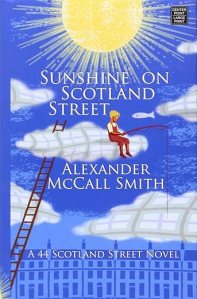
I’ve read a few of Alexander McCall Smith’s Isabel Dalhousie books, which I enjoyed – but not any of his 44 Scotland Street novels. So when I saw Sunshine on Scotland Street in the library, going off the blurb on the back cover, I thought it would be a change from the crime fiction and historical novels I’ve been reading recently.

From the back cover:

Scotland Street witnesses the wedding of the century of Angus Lordie to Domenica Macdonald, but as the newlyweds depart on honeymoon Edinburgh is in disarray. Recovering from the trauma of being best man, Matthew is taken up by a Dane called Bo, while Cyril eludes his dog-sitter and embarks on an odyssey involving fox-holes and the official residence of a cardinal. Narcissist Bruce meets his match in the form of a sinister doppelganger; Bertie, set up by his mother for fresh embarrassment at school, yearns for freedom; and Big Lou goes viral. But the residents of Scotland Street rally, and order – and Cyril – is restored by the combined effects of understanding, kindness, and, most of all, friendship.

My thoughts:

Even though I haven’t read the seven books before this one I had no difficulty in following the storylines, although it is obvious that the characters all have backstories and previous relationships that are hinted at in this book. In a way it’s very like the Isabel Dalhousie books as the action is interspersed with McCall Smith’s philosophical and ethical musings, his thoughts about human nature and relationships, which in general I liked more than the story.

It begins with an amusing account of the preparations for Angus and Domenica’s wedding, which Angus seems to think will just happen without much preparation by him – a hole in his kilt, his lack of a ring, and he has given no thought at all about where to go for thier honeymoon. But his bestman, Matthew helps him sort out the kilt and ring problem and Domenica has arranged both the reception and the honeymoon.

After that Angus and Domenica disappear from the book until the last chapter, leaving Cyril, Angus’s dog in the care of the Pollock family, the insufferable Irene, her long-suffering husband, Stuart, 6 year-old son Bertie and baby Ulysses. Cyril and Bertie are my favourite characters in the book and their ‘adventures’ caused me much concern, as Irene does not like Cyril and stifles both Bertie and Stuart. In fact I wasn’t too bothered about any of the other characters, apart from Bertie’s spindly-legged friend from cub scouts, Ranald Braveheart Macpherson and his mother who has no difficulty in putting Irene firmly in her place.

This is an easy read, meandering from one character to the next. It has a light, humorous tone that I enjoyed, along with thoughts about friendship, religion, spirituality and happiness. At the end as Angus looks round the group of people gathered for their homecoming party it strikes him that they are an ‘infinitely precious band of souls’:

And this realisation that he had was not specifically religious – although it could easily and appropriately be that. It was, rather, a spiritual notion – the idea that each of us, even the least of us, has a rich hinterland of value behind us: the lives we have led, the thoughts we have had, the love we have given and received – the little things of our lives that may not mean much to others unless and until they are granted the insight that brings love into the heart, sudden, exalting love. To see another as a soul was to acknowledge the magnifcent, epic course that life is for each of us, and to experience sympathy for the other in his or her negotiation of that course. It was quite different from seeing others simply as people. (pages 294 – 295)

Reading challenges: Read Scotland and What’s In a Name, in the category of a book with a country in the title.

  • Paperback: 304 pages
  • Publisher: Abacus (18 July 2013)
  • Language: English
  • ISBN-10: 0349139164
  • ISBN-13: 978-0349139166
  • Source: Library book

The Woman Who Walked into the Sea by Mark Douglas-Home

Earlier this year I read and loved The Sea Detective, the first Cal McGill book. Cal is an oceanographer using his skills in tracking human bodies and sea-borne objects. So I was really looking forward to reading the second book, The Woman Who Walked into the Sea. Maybe my expectations were too high because I was a bit disappointed – that’s not to say I didn’t like it because I did, but it lacked the pace and complexity of the first book and just didn’t grip my imagination in the same way. Cal is really a secondary character and there is very little sea detection in the story.

Set in an imaginary coastal village of Poltown in the north of Scotland, the story revolves around the main character,Violet who had been abandoned as a new-born baby. An anonymous letter to a social worker reveals that her mother, Megan Bates, had last been seen walking into the sea. Her body had never been found and it had been assumed after her bag and hat had drifted ashore that she had drowned herself. Cal helps Violet with details of the tides and currents which convinces Megan had not committed suicide. She is determined to discover what had happened.

I liked the mystery surrounding Megan and the local people, most of whom have problems/secrets and then there is the ‘local’ mafia and a controversial wind farm proposal. But the appeal of The Sea Detective for me was not just the detective elements but Cal himself and his expertise in the marine environment, the mystery of how the ocean currents and wind speeds affect where things get washed ashore and tracking back to find where they originated.  And I thought this second book was unevenly paced, the action slowed down by long descriptive passages so that the suspense that had been built up drained away and my attention drifted.

So, even though I liked this book, I don’t think it quite lived up to The Sea Detective. There is a third book, The Malice of Waves and I hope that the focus is more on Cal and his sea detective work.

Reading Challenges: Read Scotland 2016 ‘“ by a Scottish author and set in Scotland.

The Spy Who Came in from the Cold by John le Carré

I’ve recently read John le Carré’s biography by Adam Sisman and inevitably it made me want to read le Carré’s books. I decided to start with his third novel, The Spy Who Came in from the Cold, first published in 1963.

Blurb:

a gripping story of love and betrayal at the height of the Cold War. This Penguin Modern Classics edition includes an afterword by the author and an introduction by William Boyd, author of Any Human Heart.

Alex Leamas is tired. It’s the 1960s, he’s been out in the cold for years, spying in the shadow of the Berlin Wall for his British masters. He has seen too many good agents murdered for their troubles. Now Control wants to bring him in at last – but only after one final assignment. He must travel deep into the heart of Communist Germany and betray his country, a job that he will do with his usual cynical professionalism. But when George Smiley tries to help a young woman Leamas has befriended, Leamas’s mission may prove to be the worst thing he could ever have done. In le Carré’s breakthrough work of 1963, the spy story is reborn as a gritty and terrible tale of men who are caught up in politics beyond their imagining.

My view:

This is a dark, tense book and quite short, just 252 pages. It’s complicated and although the language le Carré uses is clear and straight forward at times I wasn’t sure just what was going on, what lay behind the scenes – just what was Leamas up to, amidst the various deceptions and subterfuges? George Smiley does appear briefly in the book, but is there throughout in that he is masterminding Leamas’ mission.

Back from Berlin where he had seen his last agent killed whilst trying to cross the Berlin Wall, Leamas is apparently no longer useful. He goes to seed whilst working out his contact in the Banking Section, transforming into a drunken wreck no longer of use to the Secret Services, left without any money or a job until he finds work as a helper in a library for Psychical Research. Here he meets Liz Gold, who then unwittingly gets drawn into Smiley’s plan.

The atmosphere throughout is of secrecy, manipulation, of human frailty and its duplicitous nature. As the German, Fiedler says for a secret agent:

… deception is first a matter of self-defence. He must protect himself not only from without, but also from within, and against the most natural of impulses; though he earns a fortune, his role may forbid him the use of a razor, though he  be erudite, it can befall him to mumble nothing but banalities; though he be an affectionate husband and father, he must under all circumstances withhold himself from those in whom he should naturally confide. (page 143)

By the end of the book Leamas is in despair as his mission seems to have failed. Liz can’t work out which side he is on and he says:

What do you think spies are: priests, saints, martyrs? They’re a squalid procession of vain fools, traitors too, yes; pansies, sadists and drunkards, people who play cowboys and Indians to brighten their rotten lives. (page 243)

I hate it; I hate it all; I’m tired. But it’s the world, it’s mankind that’s gone mad. We’re a tiny price to pay … but everywhere’s the same, people cheated and misled, whole lives thrown away, people shot and in prison, whole groups and classes of men, written off for nothing. (pages 244-5)

But then again did his mission fail? This is one of those books that I find so hard to write about without giving away too much of the plot – the introduction by William Boyd begins with this statement, ‘New readers are advised that this Introduction makes details of the plot explicit.‘ And indeed it does. I was glad I read it after reading the book, though, as it also gives an interpretation that I found helpful – in particular just what Boyd thought was meant by ‘coming in from the cold‘.

This fulfils the “Broken Object” category on the Silver Vintage Scavenger Hunt card.

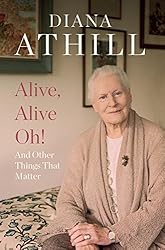
Alive, Alive Oh! And Other Things That Matter by Diana Athill

Alive, Alive Oh! And Other Things That Matter by Diana Athill (published in 2015) contains memories, thoughts and reflections on her life as she approaches her 100th year (she was born in 1917). I quoted the opening paragraph of this book and a teaser paragraph in an earlier post, First Chapter, First Paragraph.

It’s only a short book (168 pages), but it covers a wide range of Diana Athill’s memories, many images of beautiful places, and the friends and lovers she has known. The chapters follow on chronologically but are unconnected except for the fact that they demonstrate her love of life.

She writes about her Great Grandfather’s garden at Ditchingham Hall in Norfolk, which she used to love visiting in the 1920s and 1930s, when her grandparents lived there. Her writing is so clear and precise, describing in detail its exact layout and expressing her delight in her memories of it.

In other chapters she describes post-war life and her visits to Florence, and in particular the Club Mediterranee in Corfu in the 1950s; her experiences in Trinidad and Tobago, where she was struck by the disparity between the local people and the tourists/incomers; and the miscarriage when she was in her early 40s, when she nearly died. It was heart breaking to read this remarkably candid account both about what happened and how she felt, her detachment, her resentment that she had lost the baby, even her relief, and finally her gratitude that she was still alive, and her love of life:

‘I AM ALIVE.’ 

It was enough.

It was everything. It was filling me to the brim with pure and absolute joy, a feeling more intense than any I had known before. (page 87)

It is this love of life that is evident in her writing that makes it such a remarkable book. She writes about her decision to move into a home, persuaded by a friend who lived there and about how much she enjoys living there. And her main luxury now is her wheelchair, which she finds has unexpected benefits, such as when she was at an art exhibition – the crowds fell away from her in her wheelchair and she was able to lounge in perfect comfort in front of Matisse’s red Dance.

Of course, she writes about death and dying, as ‘death is no longer something in the distance, but might well be encountered any time now.’ She doesn’t find this alarming, and remembers when she was close to death after her miscarriage that her feelings were of acceptance: ‘Oh well, if I die, I die‘. Death is not something she fears, although she has some degree of anxiety at the process of dying and recognises that whereas it’s ‘unwise to expect an easy death, it is not unreasonable to hope for one.

This book has given me much to think about, including this paragraph:

Looking at things is never time wasted. If your children want to stand and stare, let them. When I was marvelling at the beauty of a painting or enjoying a great view it did not occur to me that the experience, however intense, would be of value many years later. But there it has remained, tucked away in hidden bits of my mind, and now it comes out, shouldering aside even the most passionate love affairs and the most satisfying achievements, to make a very old woman’s idle days pleasant instead of boring. (pages 5 – 6)

I loved it.

Slade House by David Mitchell

I was in the middle of reading two books on my Kindle, Doctor Thorne by Anthony Trollope and SPQR: a History of Ancient Rome by Mary Beard, when the battery died and I know I could still have continued reading whilst it was re-charging, but I didn’t. Instead I picked up Slade House by David Mitchell, a book I’d been thinking of reading soon and once I started it I didn’t want to stop. It’s not long, just 233 pages and they just whizzed past my eyes in no time.

Apparently it began as a short story on Twitter – but I didn’t know that – and is a sort of sequel to The Bone Clocks – but I haven’t read that, and there is a character near the end who also appears in The Thousand Autumns of Jacob de Zoet – but I haven’t read that yet either!

None of that mattered. I suppose it’s the sort of book to read at Hallowe’en, but that doesn’t matter either, because I read it, devoured it I could say, yesterday and was thoroughly entertained. It’s a mixture of a ghost story, science fiction and horror. Something nasty happens every nine years at the end of October at Slade House. I read it as a fantasy, something that I couldn’t believe could ever happen (or at least, I hope not) – but that didn’t stop me enjoying it immensely.

It’s not easy to find Slade House. It’s down Slade Alley, which doesn’t normally exist and it only appears to those who have been invited, or are drawn to it. There is a door set into the right hand wall of the alley, a small black iron door with no handle or keyhole, that opens if you’re meant to enter. There you meet a stranger, are invited into the House, and find yourself in a strange and dangerous situation, and there is no way out – eventually you find yourself in a long attic at the top of the stairs – where something terrible happens to you.

The stories begin in 1979 (although in fact it begins much earlier than that) and ends in a strange and mystifying way in 2015. Each story is complete in itself; the people who enter Slade House do not seem to be connected in anyway – a young teenage boy and his mother, a recently divorced Detective Inspector, students on a Paranormal Society field trip, and then the sister of one of the students. The connection is the House and the brother and sister who occupy it – and to say what they were would be to reveal too much. Needless to say that I was hoping each time that the victims would escape their fate. I was gripped both by the individual stories and by Slade House itself, enchanting and darkly sinister. The sense of menace just grew as each victim succumbed and yet tried to warn those who followed.

Now, I’m keen to read both The Thousand Autumns of Jacob de Zoet, which I bought a few years ago and is still sitting in my TBR piles and The Bone Clocks, which I haven’t got yet. It just shows how reading one book can seriously disrupt whatever reading plans I had!

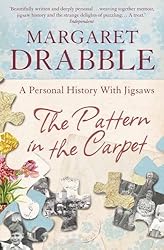
The Pattern in the Carpet by Margaret Drabble

I began reading The Pattern in the Carpet: A Personal History With Jigsaws in December and finished it this morning. It took me a long time not because it’s difficult reading (it isn’t) but because I only read short sections each day – I often read non-fiction like that.

FOREWORD

This book is not a memoir, although parts of it may look like a memoir. Nor is it a history of the jigsaw puzzle, although that it was what it was once meant to be. It is a hybrid. … This book started off as small history of the jigsaw, but it has spiralled off in other directions and now I am not sure what it is.

It is not the book she meant to write and it is not the book I expected to read. I enjoyed parts of immensely – those parts about her childhood, and life at Bryn, her grandparents’ house in Long Bennington and about her beloved Aunt Phyl (Phyllis Boor) and of course those parts about jigsaws, both personal and historical, about mosaics (looking at them as a form of jigsaw), the history of children’s games and puzzles and amusements. She does ‘spiral off in other directions’ which meant in parts it lacks a clear structure in a sort of ‘stream of conciousness’ style, particularly in her reminiscences and nostalgia about life (reproduced in some jigsaws) in a rural community that no longer exists.

I noted down a few points she made about jigsaws:

  • jigsaws renew the brain cells – that’s good! (page 66)
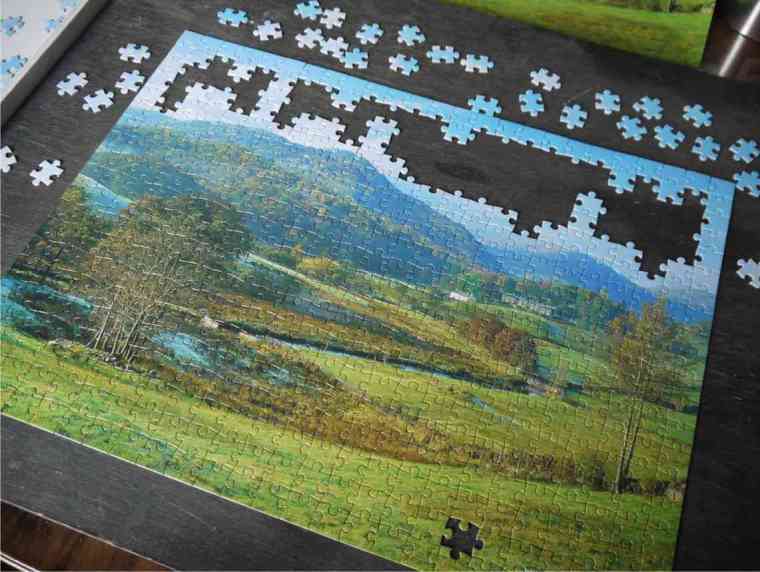
  • putting away a finished jigsaw can be a sad moment – I agree and usually leave mine for a while before dismantling them. These days I take a photo. (page 94)
  • because they have no verbal content they exercise a different part of the brain, bringing different neurons and dendrites into play. (that’s good too) (page 122)
  • some people disapprove of jigsaws, some of knitting, of card games and other activities and artistic traits. (page 187)
  • jigsaws maybe connected with depression and used as time-killers, filling empty days and evenings (page 242)
  • people can be addicted to jigsaws (page 244)
  • doing a jigsaw is like creating order out of chaos (page 245)
  • jigsaws reproducing works of art helps you learn about art (pages 250-1)
  • jigsaws as metaphors  and simile are everywhere eg wikipedia etc (page 267)

I don’t think I’m a jigsaw addict, in the same way as I am a book addict, after all I do just a few jigsaws now and then, whereas reading is a constant and I feel lost if I don’t have a book on the go. And you may have noticed (from the side bar) that I am not currently reading a book! Time to find the next one to read …